Strategy Counters MSCI's Plan to Exclude MSTR from Global Indices

cryptonews.ruPublicado em 2026-08-15Última atualização em 2026-08-15

Resumo

Strategy Inc. (MSTR) has publicly challenged MSCI's proposal to exclude the largest corporate Bitcoin holder from its global equity indexes. The index provider's consultation introduces a two-step filter to identify "non-operating companies," where firms failing a primary operational assets test face further financial ratio screenings. MSTR, classified as such due to its Bitcoin treasury model, risks removal alongside firms like Yellow Cake and Metaplanet. MSCI estimates potential exclusion of three companies from its ACWI IMI index as of May, with MSTR being the only large-cap firm, facing an estimated $2.8 billion in passive fund outflows. The company argues that digital assets are legitimate and index providers should not dictate what assets companies hold. This new proposal replaces a previous, more crypto-specific rule that MSCI abandoned after criticism. With MSTR's stock trading close to the value of its Bitcoin reserves, its premium is minimal, and the availability of spot Bitcoin ETFs offers direct exposure without corporate risks. Feedback on the proposal closes September 30, with results announced by October 16 and any changes taking effect in November 2026.

On August 14, Strategy Inc. (Nasdaq: MSTR) issued a public rebuttal to MSCI's statement after the index provider this month initiated consultations on excluding the largest corporate Bitcoin holder from its global equity indices. Funds that track these indices adjust their portfolios accordingly, turning the selection rule into automatic portfolio changes.

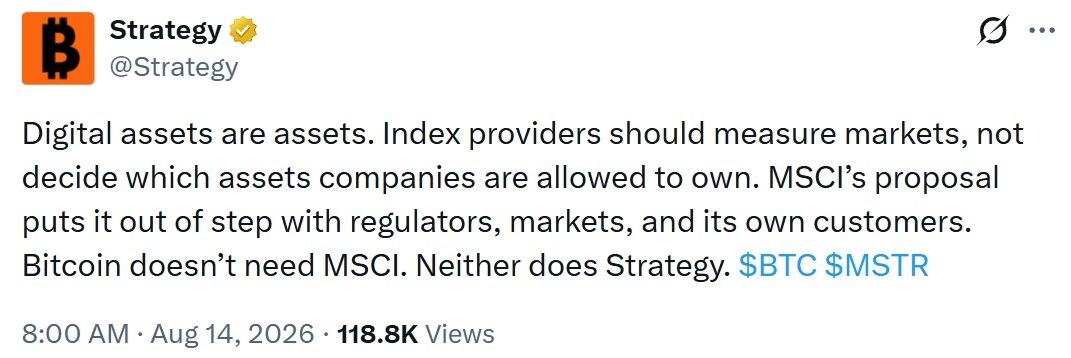
"Digital assets are assets," the company wrote on X, arguing that index providers should measure markets, not define what assets companies can own. Strategy stated that MSCI's proposal does not align with the stance of regulators, markets, and clients, adding that neither Bitcoin nor the company itself is dependent on the index provider.
As part of the consultation, MSCI proposes a two-stage filter for so-called "non-operating companies"—firms whose value appreciates due to assets on their balance sheet rather than business income. An issuer passes the first stage if operating assets constitute more than half of total assets.

How MSCI's New Filter Identifies 'Bitcoin Treasuries'

Issuers failing this primary test are then screened against five financial ratios covering operating asset intensity, expense intensity, operating cash flow, fair value intensity, and capital dependency. Four "red flags" out of these five deem a company unsuitable for inclusion in Global Investable Market Indices.

The proposal applies more lenient thresholds to current index constituents than to external candidates: starting with an operating asset share of less than 10% of the balance sheet and operating expense share of less than 5% of assets. Negative operating cash flow, excessive non-operating fair value fluctuations affecting both assets and revenue, and financing cash flow exceeding 30% of assets, along with reporting confirming external financing was raised to purchase assets, complete this set of criteria.

Index constituents must fail the criteria for two consecutive years before being removed, while new entrants lose eligibility after just one reporting period. MSCI follows a cautious policy to limit turnover, so a single instance of non-compliance does not lead to loss of index membership.

Which Companies Are Slated for Exclusion

MSCI's simulation using the MSCI All Country World Investable Market Index (ACWI IMI) identified three companies for exclusion as of May. Strategy was the only large-cap company among them, with a free-float adjusted market value of $23.93 billion.

Following it is London-listed uranium mining company Yellow Cake with a market value of $1.81 billion, and Tokyo-listed Metaplanet—$654 million; both companies fall into the small-cap category. Additionally, as of the end of the second quarter, Metaplanet held approximately 43,000 $BTC and uses these reserves as collateral for loans.
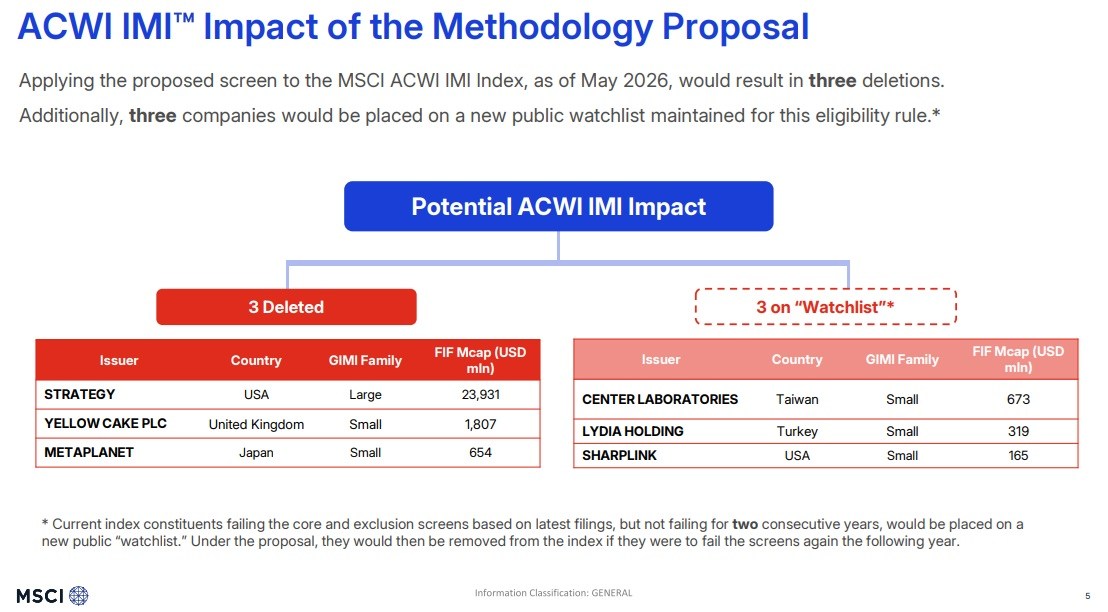
As a result of MSCI's simulation conducted in May 2026, Strategy was identified as the only large-cap company among three facing potential exclusion from the ACWI IMI index under the proposed selection criteria. Source: MSCI

Three more companies enter a new public watchlist: Taiwan's Center Laboratories with a market cap of $673 million, Turkey's Lydia Holding at $319 million, and SharpLink, managing ether reserves, at $165 million. Yellow Cake holds physical uranium, not tokens, indicating the selection criteria extend beyond digital assets.

A Rule MSCI Already Abandoned Once

In its previous attempt, MSCI singled out digital asset holding companies, defining them as issuers where half or more of total assets are cryptocurrency, and named 39 candidates. Executive Chairman Michael Saylor and CEO Phong Le signed a letter in December calling this threshold discriminatory, arbitrary, and unworkable.

That proposal was shelved on January 6, and MSCI promised a broader review of non-operating issuers. The new proposal contains no cryptocurrency threshold; however, it impacts Strategy through its treasury model mechanism, which raises equity and debt to accumulate Bitcoin.

According to the latest reporting, Strategy owns 840,447 $BTC, having bought roughly 175,000 coins this year and sold about 7,000. Le made it clear the company will resume purchases at the end of this year.

The Cost to Shareholders from an Index Exclusion

Passive investment funds follow index composition, so excluding a company from an index would force index funds to sell Strategy's shares or otherwise rebalance their position in the stock. JPMorgan analysts estimated outflows of around $2.8 billion if Strategy were removed from MSCI indices; this estimate was based on the withdrawn 2025 proposal, not the current one.

Strategy's shares trade close to the value of its Bitcoin portfolio: according to the company's dashboard, the mNAV ratio was about 1x on August 14. This ratio evaluates the company's market value relative to its own reserves. Such a small premium leaves shareholders with limited downside protection should index-tracking funds be forced to sell shares. It also indicates investors assign little additional value to Strategy's ability to raise debt, its capital-raising strategy, and corporate structure beyond its underlying Bitcoin assets.

Furthermore, spot Bitcoin ETFs provide exposure at near-par value without an intervening corporate balance sheet, weakening the argument for a stock premium. Investors can gain Bitcoin exposure without taking on Strategy-specific risks related to debt, convertible obligations, equity dilution, management decisions, or index eligibility. This alternative may cap the premium investors will pay for Strategy, especially when a potential benchmark exclusion creates an additional source of selling pressure.

The feedback period ends September 30, results will be announced by October 16, and any adopted changes will take effect during the index review in November 2026. MSCI notes consultations may or may not lead to changes, and watchlisted companies remain in the index until a second consecutive exclusion, meaning Center Laboratories, Lydia Holding, and SharpLink will face the same filter again next year.


Perguntas relacionadas

QWhy is MSCI proposing to exclude companies like Strategy Inc. from its global indexes, and what is the core argument made by Strategy against this proposal?

AMSCI is proposing a two-step filter to identify and potentially exclude 'non-operational companies,' defined as firms whose value is driven by assets on their balance sheet rather than business earnings. Strategy Inc. argues that index providers should measure markets, not dictate what assets companies can own, stating that digital assets are legitimate assets and that MSCI's proposal is inconsistent with regulators, markets, and clients.

QWhat are the specific financial ratio criteria in MSCI's proposed filter that could lead to a company's exclusion, and how many 'red flags' trigger ineligibility?

AThe proposed filter uses five financial ratios: operating asset intensity, expense intensity, operating cash flow, fair value intensity, and capital dependency. A company becomes ineligible for inclusion in MSCI's Global Investable Market Indexes if it raises four 'red flags' out of these five criteria.

QAccording to the article, which companies were identified for potential exclusion from the MSCI ACWI IMI index as of May, and what was their market capitalization?

AAs of May, the simulation identified three companies for potential exclusion: Strategy Inc. (large-cap, $23.93B market cap), Yellow Cake (small-cap, $1.81B), and Metaplanet (small-cap, $654M). Three more companies were placed on a watchlist: Center Laboratories ($673M), Lydia Holding ($319M), and SharpLink ($165M).

QWhat was the estimated financial impact on Strategy Inc.'s shareholders if the company were to be excluded from MSCI indexes, according to analysts mentioned in the article?

AAnalysts at JPMorgan estimated that exclusion from MSCI indexes could result in outflows of approximately $2.8 billion. This estimate was based on a withdrawn 2025 proposal, not the current one.

QWhat is the deadline for feedback on MSCI's consultation, and when would any adopted changes take effect?

AThe deadline for feedback on MSCI's consultation is September 30. Results will be announced by October 16, and any adopted changes would take effect at the index review in November 2026.

Leituras Relacionadas

Michael Saylor Compares Bitcoin and Gold!

Michael Saylor, founder of MicroStrategy, argues that Bitcoin fundamentally changes how wealth is stored and transferred by transforming digital scarcity into economic value. He describes Bitcoin as the first digital monetary network, combining computers, digital networks, and cryptography. It digitizes monetary assets, allowing their supply to be controlled by public protocols rather than institutions, thus converting economic value into information transmissible over global networks. Comparing Bitcoin to gold, Saylor states that while increasing Bitcoin's supply is harder, its integration with software and transfer is easier. He highlights Bitcoin's proof-of-work mechanism, which ties it to the physical world by consuming real energy to secure the ledger, making past transactions immutable. This creates a shared security system involving miners, energy companies, and investors. Saylor suggests "digital monetary energy" is a more accurate term than "digital gold." He emphasizes that the Bitcoin network is an adaptive ecosystem of miners, nodes, developers, and users. Its core design is intentionally simple, focused on maintaining a secure ledger for scarce digital assets, with complex functionalities built in higher-layer applications. This architecture allows Bitcoin to serve as a foundation for transmitting value and fostering innovation in payments and financial services. Saylor notes Bitcoin's deeper impact lies in creating digital sovereignty, where private keys give individuals permissionless control over their economic power, with ownership verified mathematically, not by institutions. He concludes that while gold's physical scarcity makes it money, Bitcoin's digital scarcity does the same, characterizing Bitcoin as the monetary energy of the digital age.

cryptonews.ruHá 30m

Michael Saylor Compares Bitcoin and Gold!

cryptonews.ruHá 30m

Media: Anthropic Aims for Revenue Up to $200 Billion by 2028 Ahead of IPO

Anthropic, the AI company behind Claude, is reportedly projecting its revenue could reach between $190 billion and $200 billion by 2028, according to sources cited by Reuters. This forecast, significantly higher than its reported $47 billion annual run-rate in May 2026, is being used by investors and bankers to value the company ahead of a potential IPO. Anthropic has confidentially filed with the SEC, with listing details dependent on market conditions and regulatory approval. The valuation reportedly applies a revenue multiple (EV/Revenue) to these future 2028 figures, an approach common for high-growth tech firms but unusual for a forecast two years ahead of an IPO. This reflects confidence in Anthropic's rapid scaling; its annual run-rate grew tenfold yearly for three years leading into 2026, jumping from ~$9B in late 2025 to over $47B by May 2026. Investors are betting the company's massive spending on GPUs, model training, and infrastructure will eventually outpace costs, leading to expanding margins. Public companies like Palantir, Cloudflare, and SpaceX, valued at high multiples of their forward revenue, serve as benchmarks. While this forward-looking method has precedents, some analysts question the sustainability of such valuations and the actual productivity gains from AI. Despite these concerns, earlier reports suggested Anthropic could be valued at over $1 trillion for its IPO.

cryptonews.ruHá 53m

Media: Anthropic Aims for Revenue Up to $200 Billion by 2028 Ahead of IPO

cryptonews.ruHá 53m

Trading

Spot
活动图片