Strategy Bets on Trump to Help Cultivate New Class of Investors

cryptonews.ruPublicado em 2026-08-05Última atualização em 2026-08-05

Resumo

Strategy, a Virginia-based company formerly known as MicroStrategy and the world's largest corporate holder of bitcoin, announced a new employee benefit tied to the federal "Trump Accounts" program. The company will make an annual $250 contribution to a Trump Account for every eligible U.S. employee's child under 18. For children born on or after January 1, 2025, Strategy will also provide a one-time $1,000 match to the initial federal government deposit. The Trump Accounts, formally established under tax code Section 530A, are tax-deferred individual retirement accounts for children. U.S.-born children from 2025-2028 are eligible for a one-time $1,000 Treasury deposit. Contributions from families, friends, and employers are capped at $5,000 annually, with employer contributions (up to $2,500) generally not counted as taxable income for the employee. Funds must be invested in qualifying, low-cost funds tracking broad U.S. market indices, and early withdrawals are heavily restricted until the child turns 18. Strategy's CEO, Phong Le, stated the initiative aligns with the company's values and optimism for the future, promoting financial education and long-term savings. Strategy joins other major companies like Bank of America, BlackRock, and JPMorgan Chase in supporting the Invest America Business Pledge. The company's benefit will take effect after the Treasury Department finalizes the employer contribution system and publishes operational guidance.

A company from Tysons Corner, Virginia, announced on Wednesday that it will contribute $250 annually to the account of each child under 18 who meets eligibility criteria, regardless of their birthdate. For children born on or after January 1, 2025, Strategy will also pay a one-time lump sum of $1,000, matching the initial federal government contribution.

Strategy Expands Its Family Benefits

This benefit applies to children of eligible U.S. employees of Strategy and will go into effect after the Treasury Department finalizes the system for employer contributions and publishes final operating instructions, once the mechanism is fully ready for operation.
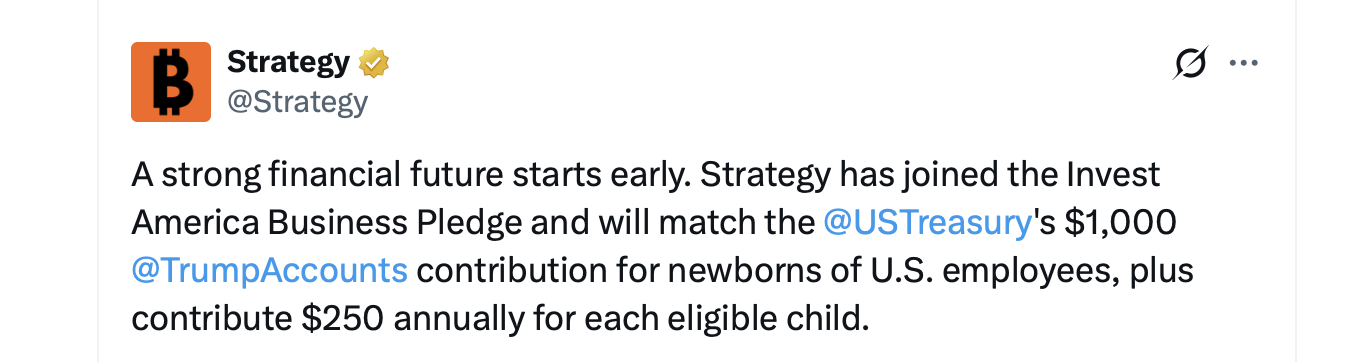
Image Source: X

Strategy, formerly known as Microstrategy, is best known as the world's largest corporate holder of Bitcoin. The company also develops corporate analytics software and is listed on the stock exchange through its common stock MSTR and a series of preferred securities. Last week, Strategy sold 1,638 $BTC, but still holds 842,138 $BTC. The company is the largest publicly traded corporate holder of Bitcoin.

This decision includes the company, which has become synonymous with Bitcoin, in a federal program built around traditional investments in the U.S. stock market. Funds held in "Trump Accounts" are generally required to be invested in eligible funds that track broad indexes composed predominantly of American companies.

"'Trump Accounts' and the 'Invest America' initiative can help build a more secure financial future for American children," noted Strategy President and CEO Phong Le.

The executive added:

"Strategy will match the government's initial $1,000 contribution and will make additional annual contributions for children of eligible employees. We are also impressed with the thoughtful technological solutions that make these accounts simple and accessible for families. These accounts can promote financial education, foster long-term thinking, and cultivate a culture of saving and investing from an early age. These goals are closely aligned with Strategy's values and our optimism about the future."

"Trump Accounts" Attract Children to Markets

The recently launched "Trump Accounts," officially established under Section 530A of the federal tax code, are individual retirement accounts with tax deferral designed for children. Tax deferral means that investment earnings are generally not taxed as long as the money remains in the account.

A child must have a Social Security number and be under 18 by the end of the year in which the account is opened. A parent, guardian, or other authorized adult manages the account while the child remains a minor.

Children who are U.S. citizens and born between January 1, 2025, and December 31, 2028, can receive a one-time Treasury deposit of $1,000 after properly opening an account. Contributions began on July 4, 2026.

Families, friends, and employers can contribute to "Trump Accounts" within federally established limits. The total amount of non-excluded contributions is generally capped at $5,000 per year, with employers able to contribute up to $2,500 annually to an employee's or employee dependent's account. Employer contributions count toward the overall $5,000 limit but are generally not included in the employee's taxable income.

Investment Rules Restrict Early Access

During the fund accumulation period in the account, the funds must be held in qualifying low-cost mutual funds or exchange-traded funds. These products pool investor money and allocate it among numerous American companies, limiting dependence on the performance of any single stock.

Children generally cannot withdraw funds until January 1 of the year they turn 18, except for a narrow set of circumstances. After the restrictive period ends, the account generally functions like a traditional Individual Retirement Account (IRA), with withdrawals subject to taxes and potential penalties according to standard IRA rules.

This structure allows contributions to earn compound interest over many years. Compound interest occurs when investment earnings begin to generate additional returns, although account balances can still decline sharply when stock markets fall.

Employers Actively Support Federal Government Initiative

Strategy joins the Invest America Business Pledge initiative alongside dozens of banks, technology companies, and financial firms supporting "Trump Accounts" through employee benefits, account servicing, or charitable funding. The Treasury Department previously named participating companies, including technology and financial giants such as Bank of America, Blackrock, Block, Coinbase, JPMorgan Chase, Nvidia, Robinhood, and Visa.

Strategy clarified that it announced its participation internally during a quarterly meeting. The company plans to publish registration instructions before the program takes effect. Employees and their families will be able to follow the final employer rules published by the Treasury Department, Strategy's registration schedule, and details on how the company's annual payments will combine with contributions made by parents or other relatives.

end-content

Perguntas relacionadas

QWhat new employee benefit did the company Strategy announce?

AStrategy announced it will contribute $250 annually to a 'Trump Account' for each eligible employee's child under 18. For children born on or after January 1, 2025, the company will also make a one-time $1,000 contribution, matching the initial federal government deposit.

QWhat is Strategy (formerly Microstrategy) best known for in the financial world?

AStrategy is best known as the world's largest corporate holder of Bitcoin. The company also develops corporate analytics software and is publicly traded under the stock ticker MSTR.

QWhat are the key features and eligibility rules for a 'Trump Account' as described in the article?

AA 'Trump Account' is a tax-deferred retirement account for children. The child must have a Social Security Number and be under 18. U.S. citizen children born between Jan 1, 2025, and Dec 31, 2028, are eligible for a one-time $1,000 Treasury deposit. Annual contributions are generally capped at $5,000. Funds must be invested in qualified, low-cost funds, and withdrawals before age 18 are severely restricted.

QHow are employer contributions to a 'Trump Account' treated for tax purposes?

AEmployer contributions (up to $2,500 per year) count toward the overall $5,000 annual contribution limit but are generally not included in the employee's taxable income.

QBesides Strategy, which other major companies are mentioned as supporting the 'Trump Accounts' initiative through the Invest America Business Pledge?

AThe article mentions several major companies supporting the initiative, including Bank of America, Blackrock, Block, Coinbase, JPMorgan Chase, Nvidia, Robinhood, and Visa.

Leituras Relacionadas

Besu Patches Vulnerabilities in 5 Components: What Node Operators Need to Know

The Ethereum client Besu, developed by the Hyperledger community, has patched five security vulnerabilities discovered by blockchain security firm CertiK. These vulnerabilities, detailed in four security advisories on August 14, were all addressed in version 26.7.1, an urgent security update initially released on July 27. The intentional delay between the patch release and the public disclosure of details gave node operators a crucial window to update. JiaLiang Chang, CertiK's Director of Security Engineering, explained this "patch first, details later" model provides defenders a time advantage, allowing them to identify affected systems, test the update, and coordinate deployments—particularly important for institutional or permissioned blockchain networks requiring formal change management. The vulnerabilities, found through CertiK's "Chain Scan" attack methodology, involved issues in block announcement handling, consensus proposal buffering, WebSocket subscription limits, and JSON-RPC filter creation. If exploited, they could have allowed an attacker to exhaust a node's memory or thread resources, compromising its availability and the consensus process. Chang highlighted that while the open-source ecosystem is moving toward more formalized security testing (like differential fuzzing and bug bounty programs), coverage remains uneven. Testing often focuses more on protocol compliance than on continuous resource exhaustion, race conditions, or deployment-specific failures. He emphasized that third-party research remains vital for uncovering attack vectors beyond routine development, advocating for a mature, cumulative security model combining continuous integration, multi-node attack testing, independent audits, and regression testing for each confirmed vulnerability.

cryptonews.ruHá 21m

Besu Patches Vulnerabilities in 5 Components: What Node Operators Need to Know

cryptonews.ruHá 21m

Hack of Term Finance: Attacker Withdraws $8.5 Million Through Governance System Vulnerability

Decentralized lending protocol Term Finance lost $8.5 million due to an exploit of its governance mechanism, not a smart contract hack. The attacker manipulated the low voter turnout in the Meta Vaults system. By depositing just 0.5 ETH, they received a token (tmvETH) representing a share in the vault. Most users did not convert this token into a separate voting token (gtmvETH). The attacker did, gaining control of 90.66% of the issued voting power despite owning only 0.017% of the vault's capital. The attacker created a legitimate governance proposal to disable the 7-day withdrawal timelock and add their own contract to receive user funds. The proposal, publicly viewable for about 145 hours, passed due to a quorum requirement of only 5% and simple majority rule. After voting ended on August 23, 2026, the proposal was executed, allowing the immediate theft of 2,841 WETH and 1.68 million USDC (later swapped for DAI) from several vaults. The incident highlights systemic risks in decentralized governance when voting rights are separated from economic stake and low participation thresholds exist. Security mechanisms like timelocks were ineffective as the attacker could disable them from within the proposal itself. In response, Term Labs irrevocably closed all Meta Vaults and revoked DAO roles. The core lending protocol remained unaffected. The attack underscores the need for governance designs where security parameters are protected from modification through ordinary proposals.

cryptonews.ruHá 21m

Hack of Term Finance: Attacker Withdraws $8.5 Million Through Governance System Vulnerability

cryptonews.ruHá 21m

Trading

Spot
活动图片