Strait Of Hormuz Crisis Deepens After Trump Deadline – Crypto Markets Brace For Volatility

bitcoinistPublicado em 2026-03-23Última atualização em 2026-03-23

Resumo

The Strait of Hormuz crisis has escalated dramatically following a 48-hour ultimatum from former US President Donald Trump, threatening to destroy Iranian power plants if free passage is not restored. Iranian forces have blockaded the strait since March 4, attacking ships and reducing tanker transits by over 90%, which has sent Brent crude soaring past $100 per barrel. The disruption is causing severe global energy shock, with potential shortages in key commodities and rising prices. Despite the oil market volatility and shifting interest rate expectations, Bitcoin has shown relative stability, consolidating between $67,000 and $71,000 as speculative leverage cools.

One ship paid $2 million just to pass through the Strait of Hormuz. That single data point tells you everything about the state of the world’s most critical oil corridor right now.

Ships Sit Idle As Clock Runs Out

US President Donald Trump issued a 48-hour ultimatum Saturday, threatening to destroy Iranian power plants if free passage through the Strait of Hormuz is not restored by Monday night.

The warning — posted on Truth Social — came as maritime data showed tanker transits through the strait have collapsed by more than 90%. Hundreds of vessels sit idle on both sides of the waterway, pushing Brent crude above $100 per barrel for the first time since 2022.

Iran declared the Strait of Hormuz closed on March 4, three days after the US and Israel launched joint air strikes on Iranian military targets on February 28.

Since then, Iranian forces have attacked at least 10 ships attempting to transit the corridor, killing five crew members aboard two vessels.

Tehran has made clear it is not backing down. Iranian officials warn they will target regional energy facilities if their own oil infrastructure comes under direct attack.
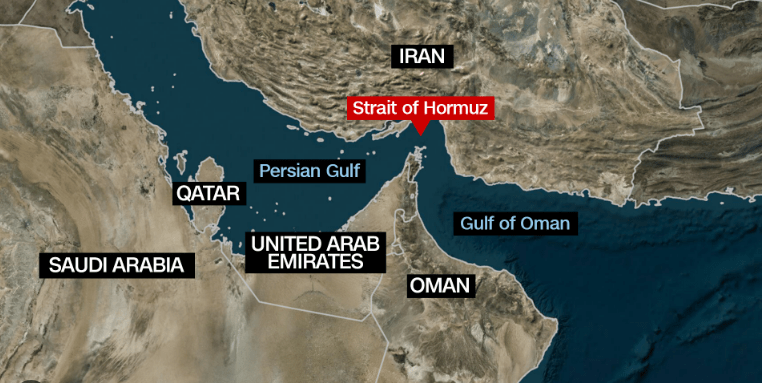
The Strait of Hormuz. Image: CNN

The US military has tried to punch holes in Iran’s ability to threaten shipping. Admiral Brad Cooper, head of US Central Command, said American fighter jets bombed an underground Iranian coastal facility storing anti-ship cruise missiles earlier this week, claiming it had “degraded” Iran’s attack capacity. Iran’s response to Trump’s latest ultimatum: threats of broader retaliation.

Energy Shock Ripples Across Global Markets

The scale of this disruption has no modern equivalent. The International Energy Agency called it “the greatest global energy and food security challenge in history.”

Brent crude hit $126 per barrel at its peak — the closure has been described as the largest energy supply disruption since the 1970s oil crisis.

BTCUSD now trading at $68,687. Chart: TradingView

The economic pain extends well beyond the pump. Moody’s supply chain lead Andrei Quinn-Barabanov warned that for many commodities moving through the strait, inventories typically cover only a few weeks, meaning shortages could surface quickly if disruptions drag on.

Roughly 85% of Middle East polyethylene exports move through the Strait of Hormuz, meaning packaging, auto parts, and consumer goods are all facing higher costs. Aluminum, fertilizer, and helium prices have also climbed.

Bitcoin Holds Ground As Crypto Watches Oil

Digital asset markets are not sitting this one out. US strikes on Iran and the blockade of the Strait of Hormuz have hit the global oil market, pushing volatility to its highest levels since 2020 and forcing markets to revise expectations on the timing of interest rate cuts — a shift that directly affects crypto valuations.

Yet Bitcoin has shown a degree of staying power that surprised some traders. Even as oil prices swung violently and Goldman Sachs warned of potential $150 per barrel prices, Bitcoin consolidated between $67,000 and $71,000, with falling open interest suggesting a cooling of speculative leverage.

Featured image from Navy Lookout, chart from TradingView

Criptomoedas em alta

Perguntas relacionadas

QWhat was the specific ultimatum issued by former US President Donald Trump regarding the Strait of Hormuz?

AUS President Donald Trump issued a 48-hour ultimatum on Saturday, threatening to destroy Iranian power plants if free passage through the Strait of Hormuz was not restored by Monday night.

QHow has the closure of the Strait of Hormuz impacted global oil prices and tanker transits?

AThe closure caused tanker transits through the strait to collapse by more than 90%, pushing Brent crude above $100 per barrel for the first time since 2022, with a peak of $126 per barrel.

QBeyond oil, what other global commodities and industries are being affected by the Strait of Hormuz crisis?

ARoughly 85% of Middle East polyethylene exports move through the strait, impacting packaging, auto parts, and consumer goods. Prices for aluminum, fertilizer, and helium have also climbed due to the disruption.

QHow has the Bitcoin market reacted to the increased volatility and energy shock caused by the crisis?

ABitcoin showed a degree of stability, consolidating between $67,000 and $71,000 despite the oil price swings. Falling open interest suggested a cooling of speculative leverage in the market.

QWhat military action did the US take in response to Iran's threat to shipping, and what was Iran's stated retaliation?

AThe US military bombed an underground Iranian coastal facility storing anti-ship cruise missiles, claiming it degraded Iran's attack ability. Iran responded to Trump's ultimatum with threats of broader retaliation.

Leituras Relacionadas

CPU Makes a Comeback to the Table, A $170 Billion "Power Seizure" Drama Begins

A new era is dawning for the server CPU (Central Processing Unit), driven by the shift from AI model training to large-scale reasoning and the rise of Agentic AI. This article explores how the CPU is reclaiming a central role in the AI data center. For years, the focus has been on the GPU (Graphics Processing Unit) for AI training. However, as AI moves to the inference and Agent phase—where tasks involve complex, multi-step reasoning, tool calls, and data management—the workload balance is flipping. Studies show CPUs now handle over 70% of the workload in Agentic AI, up from 10-30% in training. This is because Agent tasks generate massive intermediate data (KV Cache) that exceeds GPU memory, forcing it to be offloaded to the CPU's larger, more scalable memory pools. This increased importance is translating into market changes. Major players are taking note: NVIDIA launched its first standalone CPU line, Vera, based on ARM architecture and optimized for Agent performance. AMD doubled its server CPU market forecast to over $1200 billion by 2030. Analyst reports project the total server CPU market could reach $1700 billion by 2030, with AI-driven demand being a primary driver. Furthermore, the classic ratio of CPUs to GPUs in AI servers is rapidly changing, converging from 1:8 toward 1:1 for Agent deployments. This surge in demand has led to a rare industry-wide price increase of 10-15% for server CPUs from Intel and AMD, breaking a decade-long trend of "more performance for the same price." Demand is bifurcating into high-core-count CPUs for in-rack GPU support and moderate-core CPUs for standalone Agent task orchestration. In China, this global trend presents an opportunity for domestic CPU manufacturers like Hygon (海光信息) and Huawei Kunpeng, who are bolstered by both growing AI infrastructure needs and national policies promoting technological self-reliance ("xin chuang"). The maturity of their software ecosystems is also accelerating, evidenced by faster adaptation to new AI models. In conclusion, the narrative is shifting from a GPU-centric view to one where CPU-GPU synergy is critical. The CPU is no longer a peripheral component but a performance-defining bottleneck and a key growth driver in the AI hardware stack, opening a massive new market estimated in the hundreds of billions of dollars.

marsbitHá 1h

CPU Makes a Comeback to the Table, A $170 Billion "Power Seizure" Drama Begins

marsbitHá 1h

TechFlow Intelligence: AMD AI Director Publicly Criticizes Claude Code for "Becoming Dumber and Lazier", Trump Claims Full Ceasefire in Hormuz But Strait Still Has 80 Unexploded Mines

TechFlow Intelligence Report: This daily digest covers key developments in AI, crypto, hardware, and geopolitics. In AI, SK Telecom faces US export control scrutiny over its partnership with Anthropic, while a Gemini user reports being misled in a scam scenario, sparking safety debates. China's Z.AI launches the GLM-5.2 model, rivaling Claude Opus without NVIDIA chips. In crypto, Bithumb lists ReProtocol, and Upbit delists KernelDAO. On the hardware front, MIT researchers build a custom OS to study chips, ASML denies US claims its advanced lithography machines are in China, and Amazon considers selling its in-house AI chips. Apple's future A21 Pro chip may use TSMC's latest N2P process. Major tech issues include 10,000 GitHub repositories distributing malware and Apple patching a critical eavesdropping flaw in Beats earbuds. US stocks rise, led by semiconductors, with Intel surging 10.6%, while SpaceX falls 3.5%. Geopolitically, despite a US-Iran deal, the Strait of Hormuz remains risky with ~80 uncleared mines, stalling 80M barrels of oil on standby tankers. Iran postpones Switzerland talks, and Trump calls the agreement an "unconditional surrender." The report highlights a contrast: temporary geopolitical calm versus the ongoing, fundamental restructuring of tech supply chains and chip independence.

marsbitHá 1h

TechFlow Intelligence: AMD AI Director Publicly Criticizes Claude Code for "Becoming Dumber and Lazier", Trump Claims Full Ceasefire in Hormuz But Strait Still Has 80 Unexploded Mines

marsbitHá 1h

Trading

Spot
Futuros

Artigos em Destaque

Como comprar ONE

Bem-vindo à HTX.com!Tornámos a compra de Harmony (ONE) simples e conveniente.Segue o nosso guia passo a passo para iniciar a tua jornada no mundo das criptos.Passo 1: cria a tua conta HTXUtiliza o teu e-mail ou número de telefone para te inscreveres numa conta gratuita na HTX.Desfruta de um processo de inscrição sem complicações e desbloqueia todas as funcionalidades.Obter a minha contaPasso 2: vai para Comprar Cripto e escolhe o teu método de pagamentoCartão de crédito/débito: usa o teu visa ou mastercard para comprar Harmony (ONE) instantaneamente.Saldo: usa os fundos da tua conta HTX para transacionar sem problemas.Terceiros: adicionamos métodos de pagamento populares, como Google Pay e Apple Pay, para aumentar a conveniência.P2P: transaciona diretamente com outros utilizadores na HTX.Mercado de balcão (OTC): oferecemos serviços personalizados e taxas de câmbio competitivas para os traders.Passo 3: armazena teu Harmony (ONE)Depois de comprar o teu Harmony (ONE), armazena-o na tua conta HTX.Alternativamente, podes enviá-lo para outro lugar através de transferência blockchain ou usá-lo para transacionar outras criptomoedas.Passo 4: transaciona Harmony (ONE)Transaciona facilmente Harmony (ONE) no mercado à vista da HTX.Acede simplesmente à tua conta, seleciona o teu par de trading, executa as tuas transações e monitoriza em tempo real.Oferecemos uma experiência de fácil utilização tanto para principiantes como para traders experientes.

315 Visualizações TotaisPublicado em {updateTime}Atualizado em 2026.06.02

Como comprar ONE

Discussões

Bem-vindo à Comunidade HTX. Aqui, pode manter-se informado sobre os mais recentes desenvolvimentos da plataforma e obter acesso a análises profissionais de mercado. As opiniões dos utilizadores sobre o preço de ONE (ONE) são apresentadas abaixo.

活动图片