Story Co-Founder Defends Token Unlock Delays; Why Long-Term Scaling Matters For $MAXI

bitcoinistPublicado em 2026-02-09Última atualização em 2026-02-09

Resumo

Story Protocol co-founder S.Y. Lee defends delayed token unlocks, arguing that extended vesting periods prevent premature sell pressure and support long-term protocol development. This approach prioritizes sustainable growth over short-term liquidity. Similarly, meme coin project Maxi Doge ($MAXI) emphasizes high-conviction holding through staking rewards, a 'Leverage King' culture, and planned utility features. Having raised over $4.5M in presale, it aims to build a resilient, engaged community by incentivizing long-term participation and reducing launch-day sell pressure.

In a market sector often defined by impatience and ‘up-only’ demands, Story Protocol co-founder S.Y. Lee has taken a contrarian stance: slower is better. Addressing the recent controversy surrounding delayed token unlocks, Lee defended the decision to extend vesting cliffs.

His argument? Premature liquidity often strangles protocol development before it achieves escape velocity. In a recent interview with CoinDesk, Lee pointed to Worldcoin’s extended lockups as a successful precedent, suggesting that longer runways prevent the rampant sell pressure that historically capsizes early-stage infrastructure projects.

That signals a fundamental shift in how crypto capital creates value. The era of ‘fair launch’ farming, where liquidity is mercenary and fleeting, is giving way to high-conviction retention models. Lee’s defense highlights a crucial friction point: retail traders want immediate access, but sustainable ecosystems require entrenched capital. By prioritizing long-term alignment over short-term liquidity events, Story is betting that patience pays a higher yield than speed.

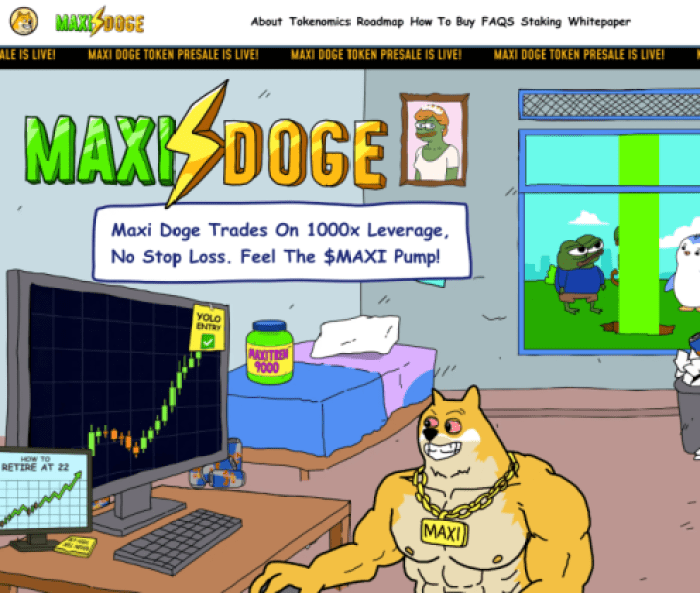
This pivot toward strength accumulation rather than quick exits isn’t isolated to infrastructure layers. It’s beginning to permeate the high-octane world of meme coins, where community conviction is the only true fundamental. While Story locks up tokens to build IP rails, a new contender, Maxi Doge, is locking in value through a culture of ‘1000x leverage’ mentality and heavy staking incentives.

Just as Story demands patience for protocol health, Maxi Doge ($MAXI) demands grit for portfolio health, positioning itself as the counter-narrative to low-effort, low-reward trading.

Maxi Doge Brings ‘Never Skip Leg Day’ Mentality to Meme Sector

While Story Protocol focuses on intellectual property, Maxi Doge effectively tokenizes market resilience. The project operates under a distinct philosophy: ‘Never skip leg day, never skip a pump.’

In a sector cluttered with derivative dog coins that collapse at the first sign of volatility, $MAXI is engineered to mirror the psychology of high-conviction traders. It addresses a specific retail pain point, the lack of whale-sized conviction, by gamifying the holding process through a culture of strength and heavy leverage.

The project differentiates itself through its planned utility that reinforces holding behavior. Future features like holder-only trading competitions and a ‘Maxi Fund’ treasury are designed to deepen liquidity rather than drain it.

The ‘Leverage King’ culture isn’t just marketing fluff; it’s a mechanism to filter out weak hands. It creates a community base that mirrors the long-term alignment S.Y. Lee advocates for at the protocol level. By integrating viral gym-bro humor with actual financial incentives, the project creates a feedback loop where community engagement directly correlates with token stability.
Plus, the ecosystem includes planned partner events with futures platform integrations, allowing top ROI hunters to compete for leaderboard rewards. That turns passive holding into active participation. The risk here for casual observers? Dismissing the aesthetic as pure satire.

Beneath the ‘beefcake’ branding lies a structured economy designed to outperform the original $DOGE by rewarding those who grind through the bear and bull cycles alike.

EXPLORE THE HEAVYWEIGHT DIVISION AT MAXI DOGE

Whale Activity and Staking Rewards Signal High Conviction

The market’s appetite for this high-conviction model is visible in the on-chain data. Maxi Doge has raised over $4.5M. That significant figure suggests retail and institutional interest is coalescing around the project before it hits open markets. With tokens currently priced at $0.0002803, early entrants are positioning themselves ahead of the public listing, betting on the project’s ability to capture the ‘gym-bro’ meme niche. If you want to know more check out our ‘What is Maxi Doge?‘ guide.

Smart money seems to be validating this thesis. On-chain data from Etherscan shows 2 whale wallets each accumulated $314K. Although not a sign of success, this level of capital injection during a presale phase is rare for standard meme coins and implies that sophisticated actors see value beyond the hype.

To lock in this capital, Maxi Doge uses a dynamic staking APY, with daily planned automatic smart contract distributions derived from a 5% staking allocation pool. This setup mirrors the delayed gratification model defended by Story Protocol’s founders, rewarding users who commit their assets to the network for up to one year. By incentivizing a lock-up of supply, the project aims to reduce sell pressure on launch day, creating a firmer floor price than competitors relying solely on viral momentum.

CHECK OUT THE $MAXI PRESALE

This article is for informational purposes only and does not constitute financial advice. Cryptocurrencies are high-risk assets; invest only what you can afford to lose.


Perguntas relacionadas

QWhat is the main argument made by Story Protocol co-founder S.Y. Lee regarding token unlock delays?

AS.Y. Lee argues that slower token unlocks and extended vesting cliffs are beneficial because premature liquidity often strangles protocol development before it achieves escape velocity. He believes longer runways prevent rampant sell pressure that can capsize early-stage projects, prioritizing long-term alignment over short-term liquidity events.

QHow does Maxi Doge ($MAXI) differentiate itself from other meme coins in the market?

AMaxi Doge differentiates itself by tokenizing market resilience and promoting a high-conviction 'Never skip leg day' mentality. It gamifies the holding process through features like holder-only trading competitions, a 'Maxi Fund' treasury, and staking incentives, aiming to create a community with long-term alignment and reduce sell pressure.

QWhat on-chain data indicates significant interest in Maxi Doge before its public listing?

AOn-chain data shows that Maxi Doge has raised over $4.5M in its presale, with two whale wallets each accumulating $314K worth of tokens. This level of capital injection during the presale phase is rare for standard meme coins and suggests both retail and institutional interest.

QHow does Maxi Doge's staking mechanism work to incentivize long-term holding?

AMaxi Doge uses a dynamic staking APY with daily automatic smart contract distributions derived from a 5% staking allocation pool. This rewards users who commit their assets to the network for up to one year, reducing sell pressure on launch day and creating a firmer floor price.

QWhat is the core philosophy behind Maxi Doge's approach to the meme coin sector?

AMaxi Doge's core philosophy is 'Never skip leg day, never skip a pump,' which emphasizes market resilience and high-conviction trading. It aims to counter low-effort, low-reward trading by fostering a culture of strength, leverage, and active community participation through financial incentives and gamified holding.

Leituras Relacionadas

Huawei Cloud Rejects Token Price War, Zhou Yuefeng Seeks a New Winning Formula for AI Cloud

At the 2026 Huawei Cloud INSPIRE Creator Conference, CEO Zhou Yuefeng outlined Huawei Cloud's distinct strategy in the competitive AI cloud market. Instead of engaging in price wars based on token volume or Maas revenue—a common focus for rivals like Alibaba Cloud and ByteDance's Volcano Engine—Huawei Cloud is shifting the competition towards real-world productivity gains. Zhou highlighted three core differentiators: a fully domestic computing stack (Ascend, Kunpeng), a focus on government and enterprise clients rather than consumer internet, and a deep commitment to open-source ecosystems. To this end, Huawei Cloud launched a suite of new products under the "Agentic Infra" paradigm, including the AICS Lingqu computing cluster, AMS memory storage, and the ModelArts Next platform. These aim to solve enterprise challenges in deploying AI agents, such as latency, memory, scheduling, and security. The strategy further involves creating specialized industry zones ("AI Dream Factories") for sectors like healthcare and embodied intelligence. For example, a smart medical zone developed with Shanghai Ruijin Hospital aims to democratize expert-level diagnostic capabilities. In essence, Huawei Cloud is positioning itself not as a commodity token provider, but as the foundational infrastructure for industrial AI, leveraging its domestic supply chain and hybrid cloud solutions to serve sectors where productivity, not just scale, is the ultimate measure of value.

marsbitHá 10m

Huawei Cloud Rejects Token Price War, Zhou Yuefeng Seeks a New Winning Formula for AI Cloud

marsbitHá 10m

70% of the Public Opposes AI, Americans Hope the U.S. Loses the AI War

70% of Americans believe AI development is moving too fast, with growing public resistance evolving from online criticism to real-world protests and violence. This widespread anti-AI sentiment stems from fears of job losses, rising utility costs, environmental damage, threats to democracy, and financial instability. Key incidents illustrate the backlash: Google's former CEO Eric Schmidt was loudly booed at a graduation for promoting AI; AI company ads are vandalized; protests and even violent attacks target AI firms and data centers. Polls show deep public pessimism and strong local opposition to data center construction, often surpassing resistance to nuclear power plants. The core grievances are economic and practical: AI is seen as automating jobs, concentrating wealth, and increasing household electricity and water bills due to massive data center resource demands. Environmentalists also oppose AI's high energy use and carbon emissions. This opposition has turned AI into a major political issue in the US. While the Trump administration prioritizes AI innovation for global competition, bipartisan pushback is growing. Democrats and factions within the MAGA movement are forming temporary alliances to support stricter regulations and local bans on new data centers, pressuring the administration to choose between its tech industry backers and its voter base. The situation highlights a profound national divide over AI's future.

marsbitHá 43m

70% of the Public Opposes AI, Americans Hope the U.S. Loses the AI War

marsbitHá 43m

Agents Take Over Traffic Distribution Power: What Are Tencent, ByteDance, and Alibaba Competing For?

In the race to dominate the AI era's entry point, China's tech giants—Tencent, ByteDance, and Alibaba—are aggressively deploying AI Agents to control the future of traffic distribution. Alibaba is pursuing a dual-track "closed loop + openness" strategy. Its Qianwen app is evolving into a super-Agent integrated across its ecosystem (Taobao, Alipay, etc.) to handle complex tasks like travel planning. Concurrently, it is opening its platform to external brands (Luckin Coffee, KFC) and has launched a B2B Agent platform, "Wukong," targeting enterprise automation. Its other flagship, Quark, aims to be an "AI super search box" for information and tasks. ByteDance is executing an omnipresent "sprawl strategy." Its Doubao app boasts over 300 million monthly active users and is evolving into a default AI entry point for daily life, with plans for paid versions and e-commerce integration. Its core weapon is the Kouzi platform, a visual "AI assembly factory" for developers to build custom Agents. ByteDance is also pushing hardware integration, collaborating on AI phones and developing smart glasses to embed Doubao everywhere. Tencent is playing its long-held "ultimate card" by quietly embedding an AI Agent directly into WeChat. This Agent, accessible via a swipe, can understand user commands and automatically execute tasks by calling upon WeChat's millions of mini-programs (e.g., finding and ordering coffee). This leverages WeChat's unparalleled 1.4-billion-user ecosystem to position the app as an AI-powered "service operating system," a move that could dramatically reshape the competitive landscape. The core battleground is shifting from competing for "user screen time" to competing to be the "default execution layer" for user intent. The business model is evolving from an "attention economy" to an "intent economy," where the Agent that can most efficiently fulfill a user's need gains control over service access and token flow. This represents a fundamental change in how users connect with digital services, making the fight for the Agent入口 (entry point) a pivotal moment for redefining industry leadership in the AI age.

marsbitHá 2h

Agents Take Over Traffic Distribution Power: What Are Tencent, ByteDance, and Alibaba Competing For?

marsbitHá 2h

Trading

Spot
Futuros
活动图片