Stock Price Halved in 45 Days, Is Circle Actually the "DeFi Barometer"?

marsbitPublicado em 2026-06-29Última atualização em 2026-06-29

Resumo

Over a 45-day period, Circle's stock price plummeted by approximately 50% to around $63, coinciding with a significant $70 billion decline in the circulation of its USDC stablecoin from its peak. In contrast, Tether's USDT saw a much smaller reduction. Analyst Ed Engel posits that Circle acts as a barometer for DeFi activity, as a high correlation exists between USDC supply and ETH price movements. The vast majority of USDC is concentrated within crypto exchanges and DeFi protocols for yield generation, rather than for widespread daily use in payments or commerce, unlike USDT which has stronger real-world adoption in various regions. The recent contraction in DeFi Total Value Locked (TVL), following security incidents like the Kelp DAO attack, appears to mirror Circle's declining stock performance. While Circle is actively promoting USDC's use as a settlement asset on platforms like Hyperliquid and in institutional payment corridors—where its organic transfer volume surpasses USDT's—these efforts have not sufficiently driven growth in USDC's overall supply. The company's revenue remains heavily tied to DeFi's expansion. For Circle's investment narrative to change, it must either significantly reduce its reliance on the volatile DeFi sector or demonstrably prove that real-world adoption can substantially and sustainably increase USDC circulation. In the near term, market confidence hinges on DeFi addressing its inherent risk-reward imbalances.

Original author: Eric, Foresight News

In June 2026, what seemed like a good show of bottoming out and rebounding for Circle just began and then came to an abrupt halt. As of June 25 US local time, the circulating supply of USDC has dropped to 73.6 billion, down about 7 billion from its peak, while Circle's stock price has also been nearly halved to around $63.
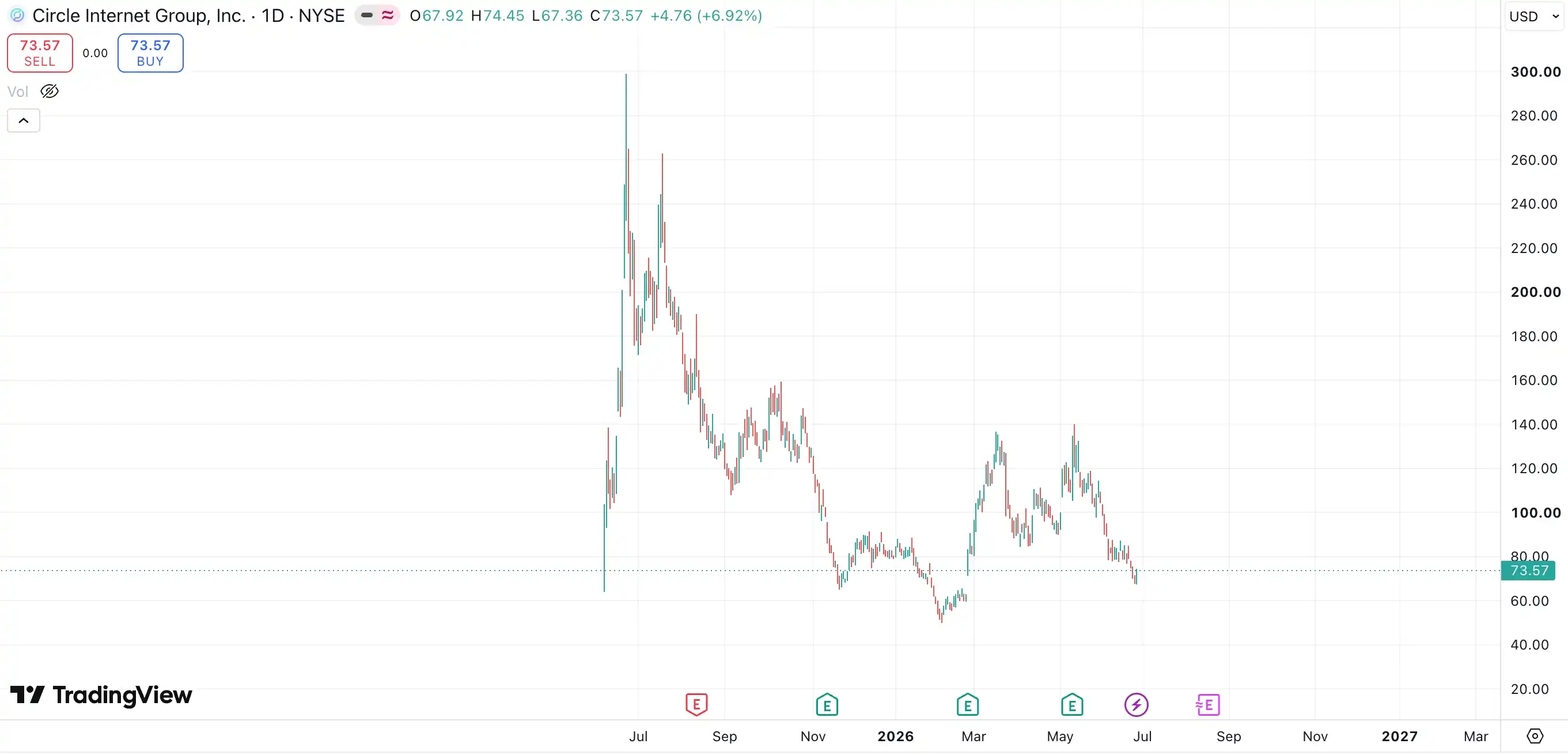
On the surface, 7 billion is less than 10% of 800 billion. For comparison, the circulating supply of USDT next door once reached a peak of around 191 billion, and now remains around 186.3 billion, having decreased by only 4.7 billion, a reduction proportion of less than 3%.

While there is no evidence directly linking the decline in USDC's circulating supply to the drop in Circle's stock price, their synchronized movement, along with the coincidental timing of security incidents in the DeFi space and Circle's stock price decline, inadvertently supports the view expressed by Compass Point analyst Ed Engel as early as January this year:

Circle is a barometer for DeFi activity.

Engel believed at the time that Circle trades similarly to cyclical stocks. From October 2025 to January 2026, the correlation coefficient between the USDC circulating supply curve and ETH's price trend reached 0.66. The core reason is this: 75% of USDC circulates in scenarios like cryptocurrency exchanges and DeFi protocols, while the amount of USDC actually used for daily consumption and cross-border payments is far lower than imagined.
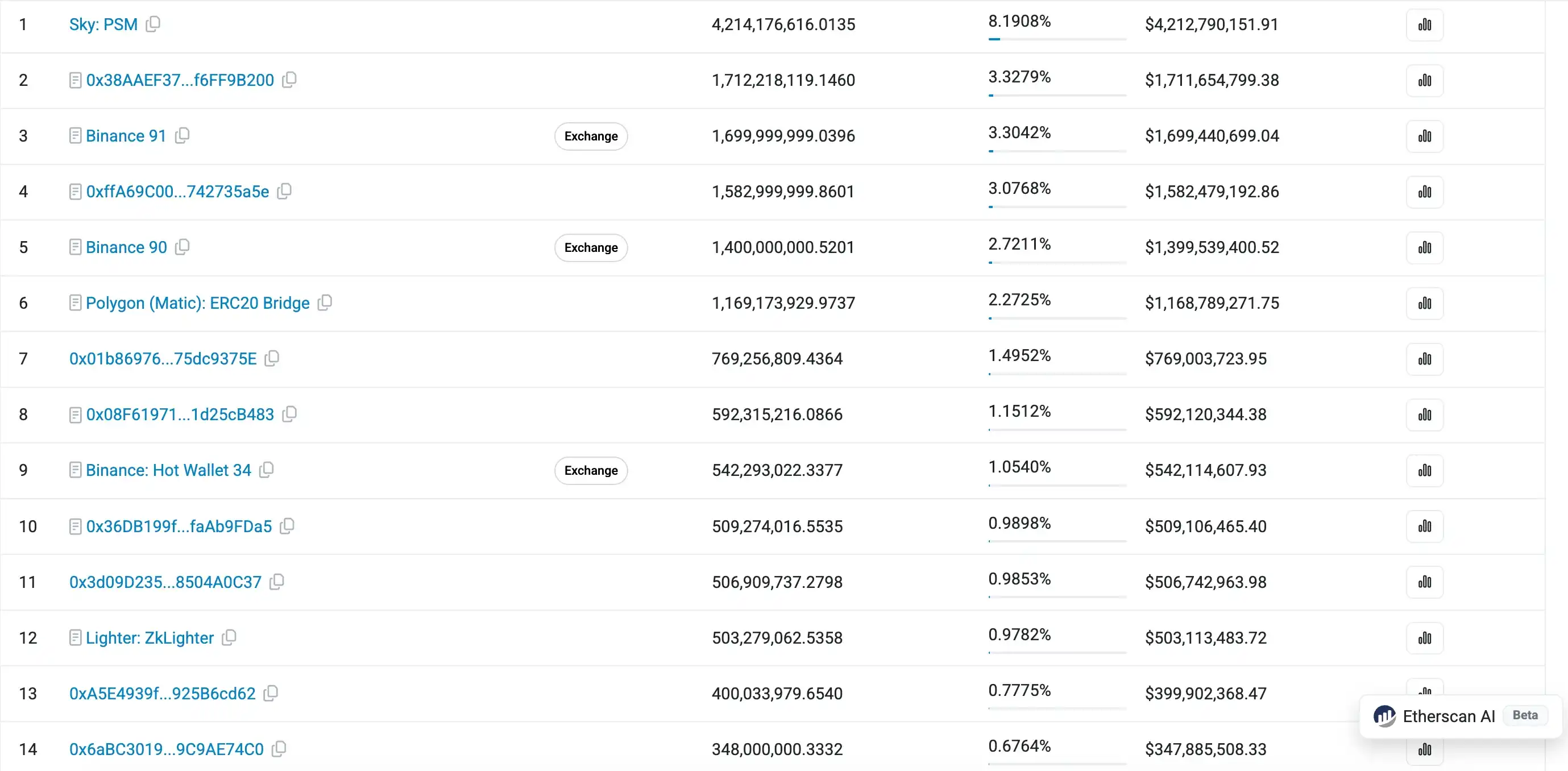
Looking at the Etherscan USDC holding address rankings, a large number of contract addresses appear on the first page. These USDC reside in protocols or addresses such as DeFi, exchange multi-signature wallets, and cross-chain bridges. Furthermore, the top 100 USDC holding addresses on Ethereum account for over 50% of the USDC supply, with just 0.32% of the addresses holding 93.55% of the total supply. A vast amount of USDC is placed in protocols to earn yields higher than bank deposits.

This level of concentration is not what a "digital dollar" intended for daily circulation should have. You might counter by pointing to USDT's even higher concentration on Ethereum, but it's very common for the Web3 industry to use USDT for salary payments, the foreign trade sector to use USDT for settlements, gray/black markets to use USDT to evade regulation, and third-world countries to use USDT to protect savings. These are practical use cases.

Although perhaps not as "glorious" as USDC, these scenarios also form the foundation of USDT. This has simultaneously led to USDT, which should theoretically be the most used stablecoin for crypto trading pairs, outperforming the more compliant USDC in terms of shrinkage during such a weak market. The news today that the local price of USDT in India is already at an 8% premium to its normal price also corroborates this view.
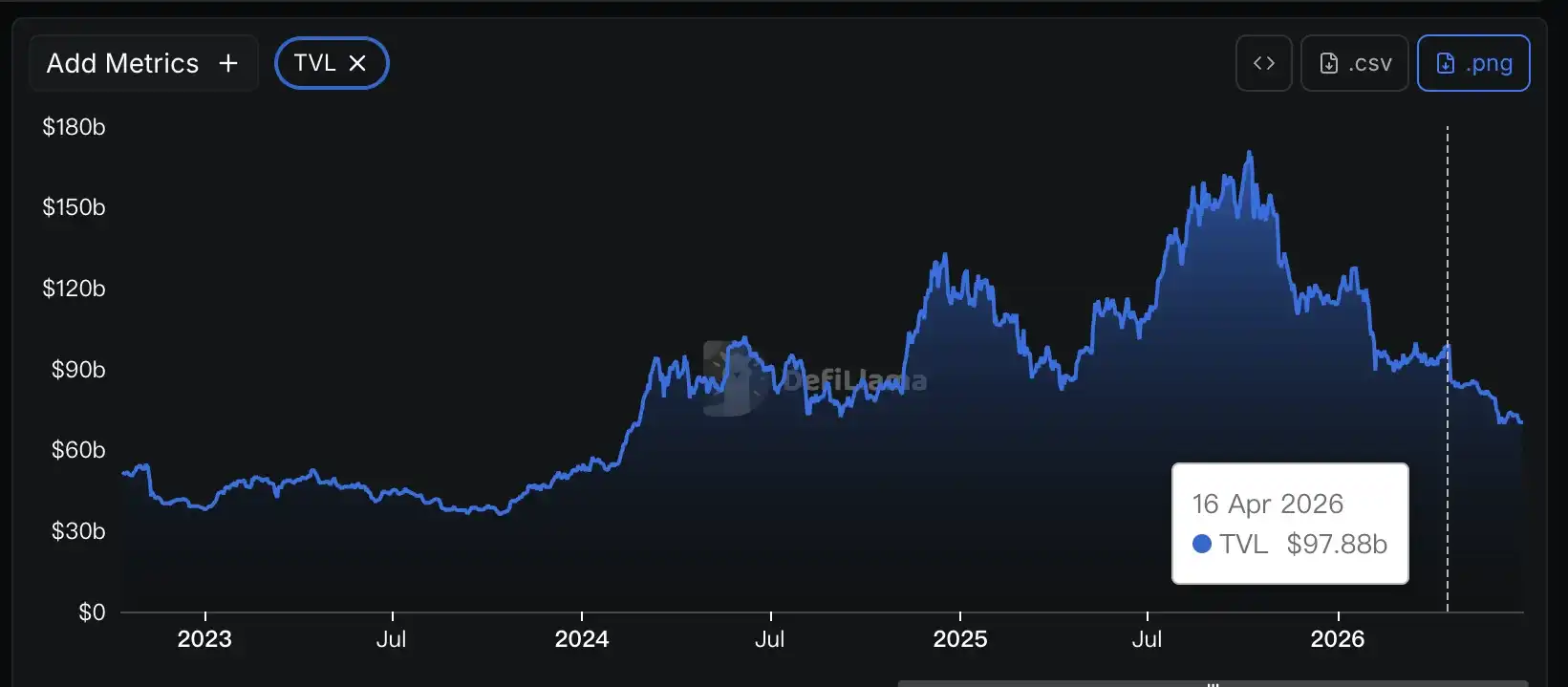
The overall TVL of DeFi started declining from mid-April, coinciding with the beginning of the Kelp DAO hack incident. Circle's stock price began its decline from mid-May. Although the starting times were spaced apart, the subsequent trends are largely similar.

Just last month, Circle and Coinbase jointly pushed USDC to become the settlement stablecoin on Hyperliquid. The cost was not only having to stake 500,000 HYPE tokens each but also ceding 90% of the income generated from the reserve assets backing USDC on Hyperliquid. Behind this seemingly "win-win-win" situation on the surface lies Circle's helplessness: the DeFi space, its main battleground, has begun to shrink rapidly. The Kelp DAO incident severely damaged DeFi's credibility. Waiting for DeFi to naturally increase the volume of USDC has hit a bottleneck, forcing Circle to "fend for itself."

If you observe closely, you'll find that USDC is not only the settlement asset for Hyperliquid but also for platforms like Lighter. Outside the cryptocurrency field, Circle is also sparing no effort to promote USDC "to be used as dollars." According to Artemis data, the "organic transfer volume" of USDC (excluding wash trading, high-frequency trading, exchange wallet consolidation, etc.) in 2025 was $18.3 trillion, while USDT's was $13.2 trillion.

It's an undeniable fact that USDC is widely used in institutional and compliant payment scenarios. However, the amount of USDC needed for these scenarios is not as high as one might imagine. The flow of funds may not always be in the form of USDC; instead, USDC might serve as an "intermediate state," reducing the time and capital costs of transfers between banks or financial institutions.

In other words, to increase the supply of USDC by 10 billion might require trillions of dollars in actual capital flow in the real world, but on-chain, it could just be a few large DeFi protocols, Memecoin trading platforms, or prediction markets. No matter how fast USDC circulates or how high its usage rate is in reality, if the issuance volume of USDC doesn't increase, neither will revenue nor profits.

Of course, none of this is enough to "pronounce a death sentence" on Circle. If in the future Circle can break free from its reliance on DeFi, or demonstrate that real-world usage significantly drives the growth of USDC issuance, then the investment logic for Circle might be rewritten. But in the short term, attention likely still needs to focus on whether DeFi can break the shackles of "asymmetric returns and risks" and give the market more confidence.


Perguntas relacionadas

QAccording to the article, what is the main reason why Circle's stock price is considered a barometer of DeFi activity?

AThe main reason is that approximately 75% of USDC's circulation is concentrated within cryptocurrency exchanges and DeFi protocols, meaning its demand and supply are heavily dependent on DeFi market activity, making Circle's performance cyclical and correlated with DeFi trends.

QHow does the usage pattern of USDC differ from that of USDT based on the article's analysis?

AUSDC is heavily concentrated in DeFi protocols and exchange wallets for yield generation, while USDT has a stronger 'real-world' basic demand from uses like cross-border payments, remittances, salary payments in some regions, and use in the shadow economy, making its circulation more resilient.

QWhat event does the article suggest triggered the decline in overall DeFi TVL, which subsequently impacted Circle?

AThe article suggests the decline in overall DeFi TVL began with the Kelp DAO hack/exploit in mid-April, which damaged public trust in DeFi.

QWhat recent move did Circle make on the Hyperliquid platform to promote USDC usage, and what does the article imply was the motivation behind it?

ACircle, in partnership with Coinbase, made USDC the settlement stable币 on Hyperliquid. The article implies the motivation was Circle's 'helplessness' as growth from its main DeFi战场 was stagnating, forcing it to proactively secure new on-chain use cases even by offering significant incentives (staking HYPE, sharing 90% of reserve收益).

QWhat key challenge must DeFi overcome to regain market confidence and positively impact Circle, according to the article's conclusion?

AAccording to the article's conclusion, DeFi must overcome the constraint of '收益与风险不对等' (收益与风险不对等), meaning it needs to solve the issue where the risks (like hacks) do not appropriately match the potential rewards, in order to restore market信心.

Leituras Relacionadas

Strategy Launches 'Digital Credit Capital Framework': Authorizes Sale of $12 Billion in Bitcoin, Ending the 'Never Sell' Script

Strategic, the world’s largest corporate holder of Bitcoin (formerly MicroStrategy), has dramatically shifted its long-standing “never sell Bitcoin” strategy by announcing a new “Digital Credit Capital Framework” on June 29. This plan authorizes the sale of up to $1.25 billion worth of Bitcoin to raise cash, establishes a $2.55 billion USD reserve, increases the dividend rate on its STRG preferred shares to 12%, and authorizes up to $1 billion each for repurchases of its own digital credit securities and Class A common stock. This pivot comes amid severe financial pressure. The company’s STRG preferred shares are trading at a ~24% discount to their $100 face value, making new issuances difficult and stalling its buy-Bitcoin funding flywheel. Its annualized dividend obligation has surged to ~$1.2 billion. Meanwhile, its MSTR stock has plummeted 36% in eight days, erasing its traditional premium over its Bitcoin holdings per share. In recent weeks, Strategic has already shifted focus from accumulating Bitcoin to bolstering cash reserves by selling its own MSTR shares. The new framework formalizes this defensive turn, aiming to ensure liquidity, cover dividends, and support its securities prices through buybacks. However, the move risks triggering a “death spiral” if Bitcoin sales pressure the market, further devaluing the company’s core asset. The company also faces a potential securities investigation and carries significant debt, with Bitcoin’s current price below its average acquisition cost.

marsbitHá 4m

Strategy Launches 'Digital Credit Capital Framework': Authorizes Sale of $12 Billion in Bitcoin, Ending the 'Never Sell' Script

marsbitHá 4m

Deforming the Transformer, LLMs Become Smarter

A new research paper proposes "Tapered Language Models (TLMs)," a method that improves large language model performance without adding any parameters. It challenges the standard Transformer design where each layer has the same number of parameters ("feed-forward network" width). Building on evidence that layers are not equally important—earlier layers handle foundational information like grammar, while later layers often reinforce existing judgments—the researchers suggest reallocating model capacity from later to earlier layers. The core idea is to make the layer width taper off monotonically from start to end, keeping total parameters and compute constant. Experiments compared linear, cosine, and sigmoid tapering curves on a 440M parameter model. The cosine curve (e.g., starting width 1.5x baseline, ending 0.5x) achieved the best result, reducing perplexity by 1.84 points compared to the uniform baseline—a significant gain at zero cost. This finding proved robust across four different model architectures (including gated attention and memory-augmented models) and at larger scales (760M and 1.3B parameters), consistently improving performance on commonsense reasoning and language modeling tasks without harming long-context retrieval ability. The work highlights a long-overlooked design dimension: optimal parameter allocation across depth. It offers a "free lever" for efficiency, potentially applicable beyond language models to vision Transformers and diffusion models. The study was conducted by researchers from Mila, Cornell University, and the University of Montreal.

marsbitHá 14m

Deforming the Transformer, LLMs Become Smarter

marsbitHá 14m

From SpaceX to Galaxy Digital: A Detailed Look at 37 New AI Companies and 7 Crypto Dark Horses Added to the Russell Indexes

On June 26th, following its annual reconstitution, the Russell US Indexes finalized their new components, with changes taking effect for market trading on June 29th. The Russell 3000 Index, representing approximately 98% of the investable US equity market, saw significant turnover. A record $334 billion was traded during Nasdaq's closing cross on reconstitution day, highlighting the massive passive fund flows tied to these benchmarks. Companies newly added to the index are set to benefit from mandatory buying by these funds. The reconstitution raised the market cap threshold between the large-cap Russell 1000 and small-cap Russell 2000 by 24% to $5.7 billion. Overall, 224 new companies entered the Russell 3000. Of these, 19 joined the Russell 1000, and 205 joined the Russell 2000, while 118 firms were removed. Notably, among the newcomers, approximately 37 are companies operating in the AI and semiconductor ecosystem, accounting for roughly 17% of new additions. The most prominent is SpaceX, which, following its recent IPO and soaring valuation, was fast-tracked directly into the Russell 1000 and Top 200 indexes. Additionally, about 7 cryptocurrency-related companies were newly included, representing about 3% of new entrants. These include Galaxy Digital, Bitmine, and Tron, among others. The inclusion of several Decentralized Autonomous Trust (DAT) entities signals the model's sustained market presence. For these smaller AI and crypto firms, index inclusion boosts visibility, potentially attracting further institutional investment and supporting their stock performance.

Odaily星球日报Há 18m

From SpaceX to Galaxy Digital: A Detailed Look at 37 New AI Companies and 7 Crypto Dark Horses Added to the Russell Indexes

Odaily星球日报Há 18m

Token Uneconomical

"Token Inefficiency" explores the rising economic burden of AI model token usage in enterprises, where escalating costs often fail to match tangible productivity gains. Major companies like Microsoft, Uber, and Meta are facing "token inefficiency"—characterized by budget overruns for tools like Claude Code with unclear returns. This inefficiency stems from supply-side factors like strategic model price hikes by leaders (e.g., Anthropic) and price increases in budget-friendly models, alongside technical waste in Agent systems through context traps, tokenizer inflation, redundant skill calls, and multi-Agent coordination overhead. A deeper demand-side challenge limits token value: their primary utility remains confined to highly digitalized domains like programming, which benefits from automatic, low-cost feedback loops. Extending tokens to physical world tasks or less digitalized industries faces the "Sim-to-Real Gap," where real-world validation is costly and slow, unlike in code compilation. The article warns that this inefficiency concentrates financial risk in mid-tier model developers, potentially fueling circular financing schemes and shadow credit bubbles. It also highlights societal externalities, as data center expansion strains local power grids and inflates utility costs for residents. To achieve a positive net token economy, the path forward requires dual efforts: technical optimizations (context compression, skill reduction, model routing, budget constraints) and business-side discipline (governance, cost attribution, ROI focus). The ultimate goal is shifting from showcasing AI capabilities to maximizing value per token, finding scalable commercial applications that justify the investment and bridge the digital-physical divide.

marsbitHá 36m

Token Uneconomical

marsbitHá 36m

Trading

Spot
活动图片