Stellar [XLM] hits a critical $0.261 wall – Breakout or rejection ahead?

ambcryptoPublicado em 2026-01-07Última atualização em 2026-01-07

Resumo

Stellar (XLM) is showing early signs of renewed momentum after months of consolidation, with a 7% price increase testing the critical $0.261 resistance level. This supply zone has historically triggered rejections, but a breakout could signal a trend shift and end the consolidation phase. Derivative data supports a bullish outlook, with long positions significantly outweighing shorts, reflecting strong buyer dominance. Liquidity clusters above the current price level further support potential upward movement. A decisive break above $0.261 may lead to a sustained bullish run, while failure could result in increased volatility.

Stellar’s price action is starting to show early signals of renewed momentum after spending months locked inside a tight flag consolidation.

At the time of writing, the token was up 7%, moving price action closer to the upper boundary of the long-standing flag channel and restarting bullish expectations among investors.

While the broader structure remains intact for now, the recent bullish move hints at the growing buyers’ activity and dominance at current levels.

Key supply zone at $0.261 comes into sight

At the heart of XLM’s near-term structure lies a familiar obstacle. The token is now testing the $0.261 supply zone, a level that has repeatedly capped upside attempts in recent months.

Historically, this price level triggered several rejection moves, and the chances of the situation repeating can be excluded.

However, a breakout above $0.261 would not only nullify the short-term supply threat but may also foretell a short-term trend shift, making it possible to break out of the phase of consolidation.
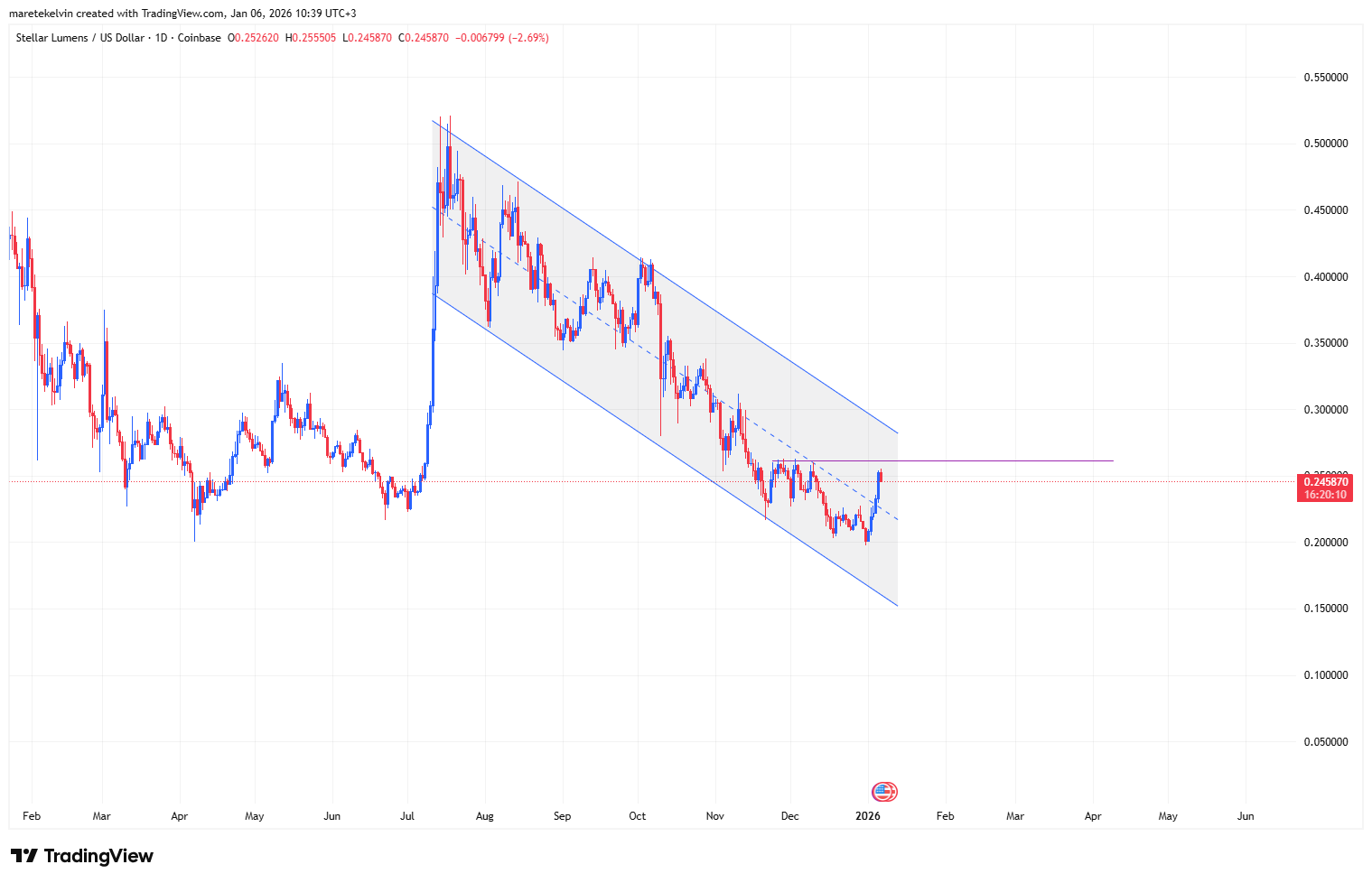
Source: TradingView

Market bias shifts

Stellar derivative data adds weight to the bullish narrative. At current prices, long positions are nearly tripling short positions.

In fact, at press time, the Long/Short Ratio stood at 2.769,  indicating a significant buyers’ dominance as position distribution tilts to the bulls’ favor.

Most XLM investors and traders are betting on further price surges. The resultant growing confidence from the imbalance could prolong the current momentum, more so if resistance gives way.

However, such positioning also raises the stakes. If price stalls at resistance, the market could see heightened volatility as leveraged traders adjust.
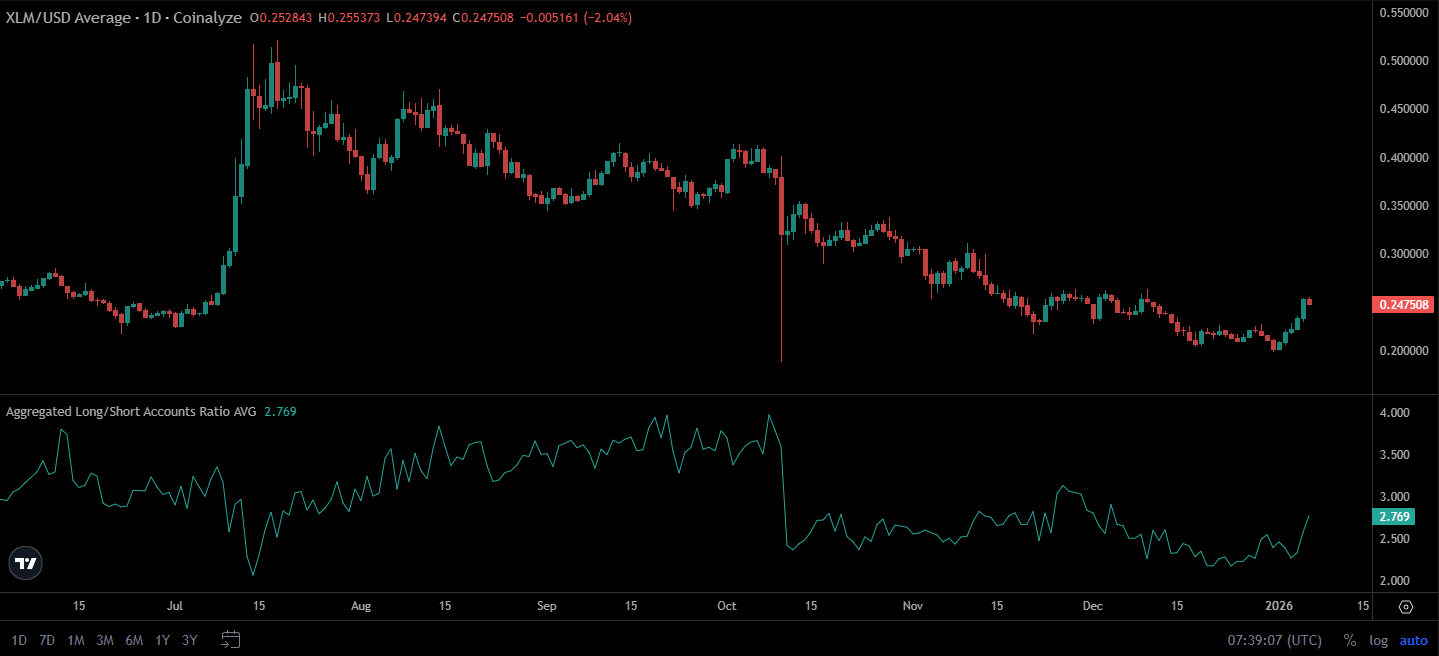
Source: Coinalyze

Potential momentum continuation?

Further supporting the breakout scenario, CoinGlass’s liquidity data revealed notable clusters sitting above the current trading range.

The 304.15K liquidity cluster at around 0.2683 affirmed the bullish bias, as traders logically aim at areas with higher stop and order concentration.
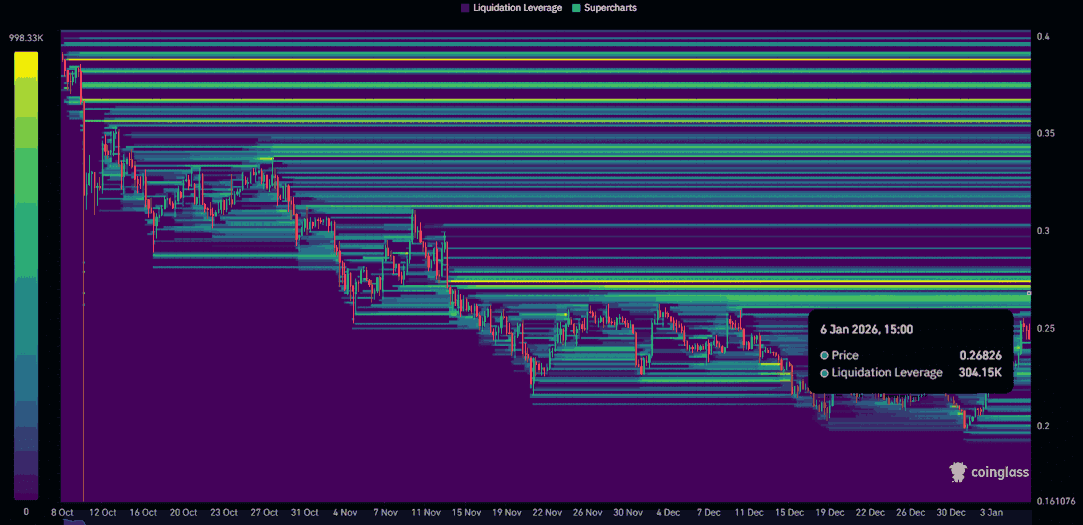
Source: CoinGlass

Cumulatively, the rising bullish positioning paired with proximity to key resistance and overhead liquidity suggests that XLM could be in for a more bullish run.

A decisive move past $0.261 resistance will be key in determining whether the token prices will surge further to mitigate the liquidity clusters above.


Final Thoughts

  • XLM is testing a critical $0.261 supply zone after a 7% daily surge.
  • Liquidity clusters above current price levels suggest that a breakout could trigger a further bullish run if resistance fails to hold.
Next: Bitmine’s $14B Ethereum empire – Is one company quietly taking over ETH?
Share
  • Share
  • Tweet

Criptomoedas em alta

Perguntas relacionadas

QWhat is the critical resistance level that Stellar (XLM) is currently testing?

AThe critical resistance level that Stellar (XLM) is testing is $0.261.

QWhat does the Long/Short Ratio of 2.769 indicate about market sentiment?

AA Long/Short Ratio of 2.769 indicates significant buyer dominance, meaning long positions are nearly tripling short positions and showing that most traders are betting on further price increases.

QAccording to the article, what could a breakout above $0.261 potentially signal?

AA breakout above $0.261 could nullify the short-term supply threat and potentially signal a short-term trend shift, allowing the price to break out of its consolidation phase.

QWhat does the liquidity cluster at around $0.2683 suggest for price movement?

AThe liquidity cluster at around $0.2683 suggests a bullish bias, as traders often aim for areas with higher concentrations of stop orders and liquidity, which could attract further buying pressure.

QWhat are the two key factors mentioned in the 'Final Thoughts' that support a potential bullish run?

AThe two key factors are: 1) XLM is testing the critical $0.261 supply zone after a 7% daily surge, and 2) Liquidity clusters above current price levels suggest a breakout could trigger further bullish momentum if resistance is broken.

Leituras Relacionadas

STRC Hits Historic Low, Saylor's Perpetual Motion Machine Grinds to a Halt

STRC, the perpetual preferred stock issued by MicroStrategy to fund its Bitcoin purchases, hit a historic low of $85.32, a 17% discount to its $100 par value. Designed as a "digital credit engine" to trade stably near par and enable continuous share issuance for buying Bitcoin, its plunge signals a breakdown in this model. Three key factors drove the decline: 1. Bitcoin's price fell over 50% from its peak, trading around $63,000 amid hawkish Fed signals. 2. MicroStrategy's cash reserves were depleted after a $1.5 billion convertible note repayment, slashing the dividend coverage for STRC's 11.5% yield to ~7 months. The company then sold 32 BTC to cover dividends—Michael Saylor's first Bitcoin sale since 2022—damaging the "never sell" narrative. 3. A competing Bitcoin-backed preferred stock, Strive's SATA, offers a higher yield (~13%) and daily dividends, drawing investors away from STRC. The drop triggers a negative cycle: STRC below par halts ATM share issuances, cutting off a key funding source for Bitcoin buys and potentially forcing more BTC sales for dividends, further eroding confidence. While Saylor argues the model is mathematically sound—needing only 2.3% annual Bitcoin growth to sustain itself—the market is testing the resilience of the leveraged Bitcoin treasury strategy in a bear market. The STRC price now reflects rising skepticism about this financial machinery's durability during downturns.

marsbitHá 14m

STRC Hits Historic Low, Saylor's Perpetual Motion Machine Grinds to a Halt

marsbitHá 14m

A Guide to Grayscale’s ‘Bottom Fishing’: Using Cash Flow to Assess Cryptocurrency Value

**Title:** Grayscale's Guide to Bottom-Fishing: Valuing Cryptoassets Using Cash Flows **Summary:** This report by Grayscale Research presents a fundamental valuation framework for cryptocurrency assets, moving beyond pure speculation to analyze those with underlying cash flows. It distinguishes between "commodity-like" assets (e.g., Bitcoin) and "cash-flow" assets, primarily within DeFi. Using the leading decentralized lending protocol Aave as a case study, the analysis applies traditional financial methodologies like Discounted Cash Flow (DCF) and Price-to-Earnings (P/E) multiples. Key findings indicate that AAVE tokens are currently undervalued. Despite recent challenges, the protocol's strong revenue growth, ~50% net profit margin, and diversified treasury support a fundamental valuation range of $80-$100 per token (compared to a ~$75 market price at the time of writing). In a base-case scenario driven by stablecoin adoption and regulatory clarity, the fair value could rise to around $175 within a year. The report emphasizes that protocol success does not automatically translate to token value. It critically examines the "value capture" mechanisms—such as buybacks, burns, and staking rewards—that channel protocol profits to token holders. Furthermore, it addresses the legal and governance complexities of Decentralized Autonomous Organizations (DAOs), noting their difference from traditional corporate equity but highlighting how robust, transparent governance can align protocol economics with holder interests. The conclusion is that the crypto market is maturing, with capital increasingly flowing towards projects with demonstrable fundamentals, real adoption, and disciplined capital allocation, creating opportunities for value-based investors.

marsbitHá 1h

A Guide to Grayscale’s ‘Bottom Fishing’: Using Cash Flow to Assess Cryptocurrency Value

marsbitHá 1h

After semiconductors lead the gains, are funds buying into AI orders or a macroeconomic rebound?

After US-Iran talks led to a temporary ceasefire and framework for reopening the strategic Strait of Hormuz, U.S. stocks rose on June 18, with the Nasdaq gaining 1.9%. The semiconductor and AI hardware sectors outperformed. This rally stemmed primarily from reduced geopolitical risk, which lowered oil prices and inflation expectations, easing discount rate pressure on high-valuation growth stocks like tech. The key question is not whether tech rebounded, but the nature of the rebound. The market appears to be selectively repricing AI infrastructure plays rather than broadly chasing AI narratives. Gains were concentrated in chips, optical interconnects, memory, and domestic manufacturing—segments tied to tangible data center build-outs and capital expenditure. Intel's ~10% surge, fueled by a Trump statement about potential Apple collaboration, exemplifies this mixed dynamic. It reflects policy catalysts and domestic manufacturing sentiment more than confirmed fundamentals. Meanwhile, strong earnings from companies like Astera Labs (revenue up 93% YoY) provided concrete evidence of AI-driven demand in hardware. In essence, the rally represents a risk-premium recalibration. Lower Middle East tensions opened a valuation repair window, and capital flowed first into AI infrastructure segments with visible near-term revenue streams. The sustainability of this move hinges on upcoming Q2 earnings, specifically continued strength in cloud provider capex, AI server orders, and hardware company guidance. Policy hopes alone are insufficient; the cycle needs validation from orders and financials.

marsbitHá 1h

After semiconductors lead the gains, are funds buying into AI orders or a macroeconomic rebound?

marsbitHá 1h

Trading

Spot
Futuros

Artigos em Destaque

Como comprar XLM

Bem-vindo à HTX.com!Tornámos a compra de Stellar (XLM) simples e conveniente.Segue o nosso guia passo a passo para iniciar a tua jornada no mundo das criptos.Passo 1: cria a tua conta HTXUtiliza o teu e-mail ou número de telefone para te inscreveres numa conta gratuita na HTX.Desfruta de um processo de inscrição sem complicações e desbloqueia todas as funcionalidades.Obter a minha contaPasso 2: vai para Comprar Cripto e escolhe o teu método de pagamentoCartão de crédito/débito: usa o teu visa ou mastercard para comprar Stellar (XLM) instantaneamente.Saldo: usa os fundos da tua conta HTX para transacionar sem problemas.Terceiros: adicionamos métodos de pagamento populares, como Google Pay e Apple Pay, para aumentar a conveniência.P2P: transaciona diretamente com outros utilizadores na HTX.Mercado de balcão (OTC): oferecemos serviços personalizados e taxas de câmbio competitivas para os traders.Passo 3: armazena teu Stellar (XLM)Depois de comprar o teu Stellar (XLM), armazena-o na tua conta HTX.Alternativamente, podes enviá-lo para outro lugar através de transferência blockchain ou usá-lo para transacionar outras criptomoedas.Passo 4: transaciona Stellar (XLM)Transaciona facilmente Stellar (XLM) no mercado à vista da HTX.Acede simplesmente à tua conta, seleciona o teu par de trading, executa as tuas transações e monitoriza em tempo real.Oferecemos uma experiência de fácil utilização tanto para principiantes como para traders experientes.

339 Visualizações TotaisPublicado em {updateTime}Atualizado em 2026.06.02

Como comprar XLM

Discussões

Bem-vindo à Comunidade HTX. Aqui, pode manter-se informado sobre os mais recentes desenvolvimentos da plataforma e obter acesso a análises profissionais de mercado. As opiniões dos utilizadores sobre o preço de XLM (XLM) são apresentadas abaixo.

活动图片