Stablecoins See Largest Conversion Spreads In Africa, Research Shows

bitcoinistPublicado em 2026-02-12Última atualização em 2026-02-12

Resumo

Research from Borderless.xyz reveals that Africa has the highest median conversion spreads for stablecoin-to-fiat transactions globally, reaching nearly 300 basis points (3%) in January. This is significantly higher than Latin America's 1.3% and Asia's 0.07%. Within Africa, costs vary widely; South Africa has a low rate of 1.5% due to competition, while Botswana and Congo saw spreads exceeding 19% and 13%, respectively. The high costs are attributed to local market structure and lack of liquidity rather than blockchain technology. While stablecoins offer potential for cheaper remittances, the final conversion cost depends heavily on local competition and infrastructure, limiting savings in many African corridors.

Africa’s promise of cheaper remittances via stablecoins is clashing with reality in many places. According to data from Borderless.xyz, January’s median spread for stablecoin-to-fiat conversions across Africa reached nearly 300 basis points — about 3% — far higher than Latin America’s roughly 1.3% and Asia’s tiny 0.07%. That gap matters. It hits wallets where people send money home.

Conversion Costs Vary By Market

Reports note huge differences inside the continent. South Africa showed one of the lowest conversion costs at about 1.5%, where several providers compete and markets have deeper liquidity.

At the other extreme, Botswana’s median spread climbed to almost 19.4% in January, although pricing eased later that month. Congo also saw conversion levels above 13%. The dataset covered 66 currency corridors and nearly 94,000 rate observations, so these are not isolated blips.
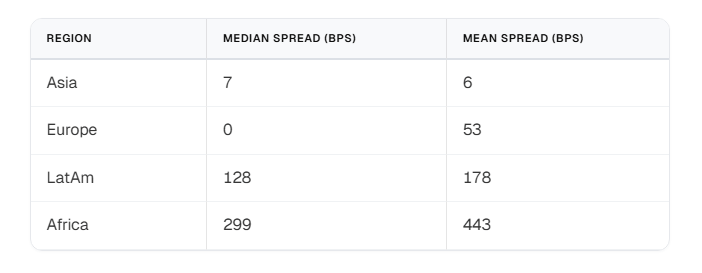
Average regional spreads for stablecoin transactions. Source: Borderless.xyz

Competition And Liquidity Shape Rates

The numbers point to a simple takeaway: who sits between the stablecoin and the local cash matters. Where multiple payment providers operate, conversion costs generally sit between about 1.5% and 4%.

Where a single outfit dominates, spreads can top 13%. The “spread” here is the gap between what a provider will buy and sell a stablecoin for — like a bid-ask gap in traditional markets — and it is the execution cost a sender ultimately pays.

Based on reports, it appears these frictions come from local market structure and liquidity more than from the underlying blockchain tech.
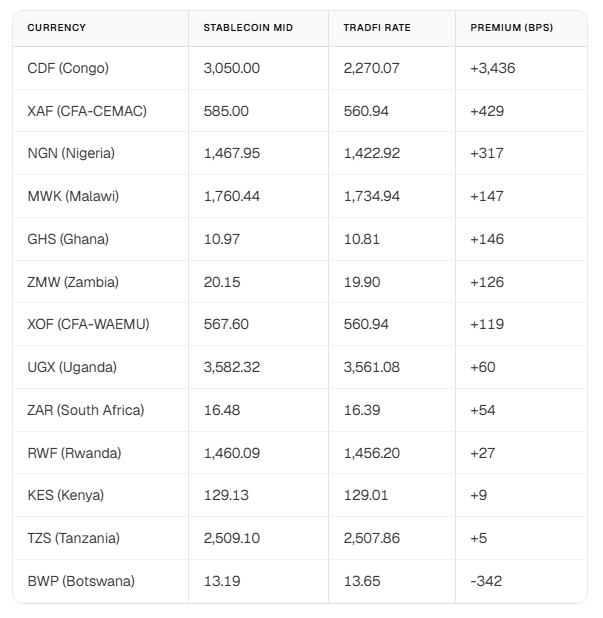
Table shows mid-market stablecoin rates, local Tradfi rates, and the resulting BPS premium per currency. Source: Borderless.xyz

Stablecoins Compared With Traditional FX

Borderless.xyz also measured how stablecoin mid-rates stack up against interbank FX mid-market rates, a metric the company calls the TradFi premium.

Across 33 currencies globally, the median difference was about five basis points, or 0.05%, meaning stablecoins and traditional mid-market rates were largely aligned in many places.

In Africa, however, the median gap widened to close to 120 basis points, or about 1.2%. That larger premium helps explain why stablecoins do not automatically translate into big savings for every corridor.

BTCUSD trading at $67,018 on the 24-hour chart: TradingView

What This Means For Senders And Markets

Economists say stablecoins are cutting remittance costs in Africa, noting that legacy services often charge around $6 for every $100 sent.

The recent data adds nuance: faster settlement and lower fees are possible, but only when local on-ramps and off-ramps work well. For consumers, that means potential savings in some corridors and frustratingly high costs in others.

For regulators and market entrants, the signal is clear — boosting competition and liquidity at the local level is as important as improving cross-border rails.

Stablecoins have opened a route that can be cheaper and quicker. Yet in practice, the last mile — turning crypto into local money — still depends on local players, pricing models, and market depth.

Featured image from andBeyond, chart from TradingView

Perguntas relacionadas

QWhich continent has the highest median spread for stablecoin-to-fiat conversions according to the research?

AAfrica has the highest median spread for stablecoin-to-fiat conversions at nearly 300 basis points (about 3%), which is far higher than Latin America's 1.3% and Asia's 0.07%.

QWhat factors are identified as the primary drivers of high conversion costs for stablecoins in certain African countries?

AThe primary drivers are local market structure and liquidity. High conversion costs occur where a single payment provider dominates, leading to spreads that can top 13%, whereas areas with multiple competing providers see lower costs between 1.5% and 4%.

QHow does the median TradFi premium for stablecoins in Africa compare to the global median?

AThe median TradFi premium in Africa is about 120 basis points (1.2%), which is significantly wider than the global median of approximately 5 basis points (0.05%).

QWhat was the median spread for stablecoin conversions in Botswana in January, according to the report?

ABotswana's median spread for stablecoin conversions climbed to almost 19.4% in January, although the pricing eased later that month.

QWhy don't stablecoins automatically translate into big savings for every remittance corridor despite their potential?

AStablecoins do not automatically translate into big savings because the final cost depends on the efficiency of local on-ramps and off-ramps. High spreads charged by local providers, due to lack of competition and liquidity, can erase the potential benefits of faster settlement and lower base fees.

Leituras Relacionadas

In Jinjiang, Fujian, a Storage Super Unicorn Lies Quiet

In Fujian's Jinjiang, a city known for sportswear, lies a quiet semiconductor giant: Fujian Jinhua Integrated Circuit Co. (JHICC). Once a promising domestic DRAM manufacturer alongside Yangtze Memory and ChangXin Memory Technologies (CXMT), its journey was derailed in 2018 when the U.S. placed it on an Entity List and filed criminal charges for alleged trade secret theft. This halted production for years. A turning point came in February 2024 when a U.S. federal court found JHICC not guilty. However, it had lost crucial time. While CXMT soared to become a top-valued A-share company in 2024, JHICC, with an estimated valuation of 80 billion RMB, was just restarting. Its current output is primarily customized DDR4 chips, not the advanced DDR5/HBM demanded for AI, but it still benefits from the broader memory chip upcycle. JHICC's story is tied to Chen Zhengkun, a veteran engineer who left Micron to lead the venture. Founded in 2016 with state-backed funding, JHICC partnered with Taiwan's UMC to develop DRAM technology. Rapid progress was cut short by the U.S. actions, which Micron initiated, partly due to its heavy reliance on the Chinese market. Post-sanctions, Chen's team worked to rebuild the production line with reduced reliance on U.S. technology. According to its records, JHICC achieved small-scale production and revenue growth under immense pressure. It now focuses on the stable "niche" DRAM market (e.g., TVs, routers) with a monthly capacity of ~40,000 wafers, aiming for 60,000 by 2026. It holds over 1,000 patents but remains on the Entity List. For Jinjiang, investing in JHICC was a bold industrial leap. The local government provided unwavering financial and logistical support during the crisis, helping the company survive. JHICC has become the anchor for a growing local semiconductor cluster. Though its scale lags behind domestic peers, JHICC's persistence symbolizes a hard-won foothold in a global market long dominated by Samsung, SK Hynix, and Micron. Having missed one boom, it seeks a place in the new AI-driven memory supercycle.

marsbitHá 36m

In Jinjiang, Fujian, a Storage Super Unicorn Lies Quiet

marsbitHá 36m

Must-Watch Events Next Week|CLARITY Act Could Face Senate Vote; SpaceX, Circle to Report Earnings (8.3-8.9)

**Summary: Key Events and Developments to Watch (August 3-9)** The upcoming week is marked by significant financial disclosures, key legislative deadlines, and notable product updates. **Major Financial Events:** Several companies are scheduled to release their Q2 2026 earnings. American Bitcoin (ABTC) will report on August 3, followed by SpaceX and Hut 8 Mining Corp. on August 4, and Circle on August 5. Notably, a significant portion of SpaceX shares (up to 12% of total shares) will be unlocked on August 6 following their earnings release. **Key Legislative Deadline:** The U.S. Senate faces an August 7 deadline to secure 60 votes for the CLARITY Act, a bipartisan bill aiming to establish a federal regulatory framework for cryptocurrencies. The Senate may hold a full vote on the bill during the week. **Economic Data:** The U.S. July Non-Farm Payrolls report will be released on August 7, providing crucial labor market data. **Technology & Product Updates:** * **Shutdowns:** DeFi portfolio tracker Zapper and wallet app Ctrl Wallet will cease operations on August 3. * **Upgrades:** LayerZero will deprecate its v1 relayers on August 3. XRP Ledger's new version 3.3.0, featuring five new functions, is expected next week. * **AI:** Elon Musk announced that the advanced Grok 4.6 AI model is set for release around August 7. * **Bitcoin:** The BIP-110 forced signaling for a potential Bitcoin network change is scheduled to begin around August 8. **Other Notable Events:** Chinese robotics firm Unitree Tech has set its preliminary price inquiry for its IPO for August 5. South Korean exchange Upbit will delist AQT and AERGO tokens on August 3.

marsbitHá 2h

Must-Watch Events Next Week|CLARITY Act Could Face Senate Vote; SpaceX, Circle to Report Earnings (8.3-8.9)

marsbitHá 2h

Trading

Spot
活动图片





