Stablecoins Don’t Meet Core Requirements Of Money, BIS Says

bitcoinistPublicado em 2026-04-21Última atualização em 2026-04-21

Resumo

The Bank for International Settlements (BIS) General Manager, Pablo Hernández de Cos, stated that existing stablecoins fail to meet the core requirements of money, specifically "singleness" and "interoperability." Singleness refers to the need for different forms of money to be interchangeable at par value, which is ensured by central banks in traditional finance but not in decentralized stablecoins. Interoperability means seamless cross-platform transactions, which stablecoins currently lack due to fragmentation across multiple blockchains. These shortcomings limit stablecoins' network effects and widespread acceptance, keeping them a "niche" payment instrument. However, de Cos acknowledged their potential to improve cross-border payments, though he also warned of risks to financial stability and monetary policy. Despite a bearish crypto market, the stablecoin market cap has reached a new all-time high of over $320 billion.

The BIS General Manager has said that existing stablecoins fall short of the requirements for a widely accepted and used payment instrument.

Stablecoins Remain A “Niche” Payment Instrument

Pablo Hernández de Cos, General Manager at the Bank for International Settlements (BIS), spoke on the topic of stablecoins at a Bank of Japan seminar in Tokyo on Monday. The BIS is an international financial institution that serves as a bank for central banks. It’s owned by constituent central banks, of which there are 63 in total at the moment. The institution has been vocal about its concerns regarding stablecoins in the past.

Stablecoins are cryptocurrencies that have their price tied to a fiat currency. In recent years, these tokens have gained popularity, inviting regulation from major economic hubs.

Since stables run on blockchain technology, they naturally offer relatively cheap 24/7 transactions. This has made their main use, besides being a store of value, as a mode of payments.

Stablecoins try to mimic fiat currencies, but do they count as “money”? de Cos has discussed the two features that decide the “moneyness” of an instrument: singleness and interoperability.

First, singleness is the idea that different forms of money should be perfectly substitutable at par across financial intermediaries and platforms. In fiat economics, this is facilitated by central banks. For the decentralized stablecoins, there is no such central settlement so deviations can emerge.

Though, these differences tend to be relatively modest. “Yet confidence shocks can widen discounts abruptly and, when they do, users may refuse to accept certain stablecoins, as seen on several occasions in the past,” said de Cos.

The other property, interoperability, means that users can send and receive funds seamlessly across platforms and networks. Today, stablecoins are distributed across a wide range of blockchains, so even versions of the same token that run on different blockchains aren’t interoperable by default.

The BIS General Manager explained:

Together, these features undermine the network effects that are key to money – the use of money begets its acceptance, and acceptance begets wider use. It is therefore conceivable that under current designs stablecoins remain a “niche” instrument.

While current stablecoin systems may fall short of the requirements of a widely accepted payment instrument, de Cos noted that they have the potential to significantly enhance cross-border payments. But the opportunities provided by fiat-tied cryptocurrencies don’t come without challenges; the BIS head cautioned that these assets can affect credit supply, financial stability, and monetary and fiscal policy.

The wider digital asset sector has faced bearish winds since Q4 2025, but the stablecoin market has managed to hold up relatively well as its market cap has seen a slight uptrend in this period, according to data from DefiLlama.
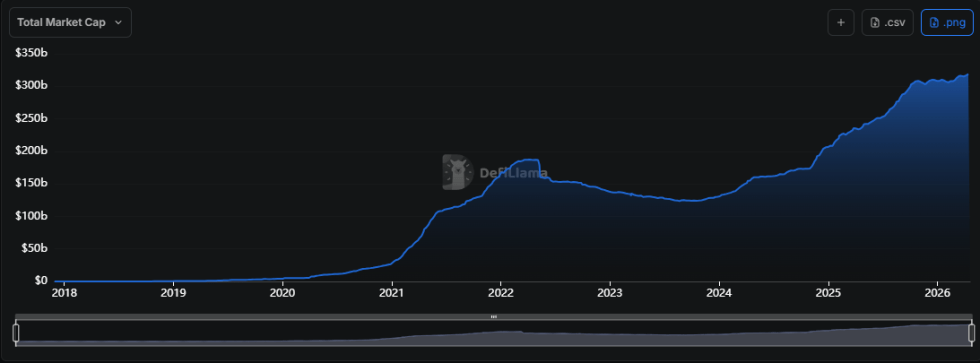
The trend in the stablecoin market cap over the last few years | Source: DefiLlama

Currently, the fiat-pegged coins have a combined valuation of over $320 billion, which is a new all-time high.

Bitcoin Price

At the time of writing, Bitcoin is trading around $75,000, up more than 6% over the past week.

The price of the coin seems to have retraced from its Friday high | Source: BTCUSDT on TradingView


Perguntas relacionadas

QAccording to the BIS General Manager, what are the two key features that determine the 'moneyness' of an instrument like a stablecoin?

AThe two key features are singleness and interoperability.

QWhat is the main reason the BIS believes stablecoins currently remain a 'niche' payment instrument?

ABecause they lack the network effects that are key to money, as their design undermines singleness and interoperability, which prevents wider acceptance and use.

QDespite their shortcomings, what potential benefit of stablecoins did the BIS General Manager acknowledge?

AHe noted that stablecoins have the potential to significantly enhance cross-border payments.

QWhat is the current total market capitalization of all stablecoins as mentioned in the article?

AThe combined valuation is over $320 billion, which is a new all-time high.

QWhat are the two specific risks that the BIS head cautioned stablecoins could pose?

AThey can affect credit supply, financial stability, and monetary and fiscal policy.

Leituras Relacionadas

SpaceX, OpenAI, Anthropic: The Three AI Giants Racing for IPO, Which One Is Worth Betting On?

SpaceX, OpenAI, and Anthropic are poised for historic IPOs within weeks, potentially raising a combined $180 billion—a sum exceeding the entire internet bubble's fundraising. The hosts of the Limitless Podcast argue this isn't just individual company financing but an unprecedented capital concentration for AI infrastructure, driven by an insatiable need for compute, data centers, power, and chips. SpaceX's IPO is notable for reportedly changing market index rules to allow faster inclusion, potentially funneling trillions in passive retirement funds into its stock, despite its unproven space-based data center business model. In contrast, Anthropic demonstrates explosive growth, with ARR reportedly hitting $45 billion and approaching profitability, fueled by strong enterprise adoption of products like Claude Code. Google's separate $80 billion raise highlights the immense capital pressure, even for giants. The discussion acknowledges bubble risks but leans optimistic. The hosts contend the massive spending is building essential physical infrastructure for the next technological era. A key bottleneck isn't capital but the real-world limits of chip manufacturing and construction speed. As long as demand for AI compute outstrips supply, this investment cycle represents a foundational build-out rather than a purely financial bubble. All three companies are seen as foundational bets on the future, with Anthropic often cited as the most immediately compelling due to its proven revenue trajectory.

marsbitHá 1h

SpaceX, OpenAI, Anthropic: The Three AI Giants Racing for IPO, Which One Is Worth Betting On?

marsbitHá 1h

From 'Old Guys' to 'New Favorites': How AI Is Revaluing Old Infrastructure from Dell to Nokia?

From "Vintage Tech" to "New AI Darlings": How AI Revalues Old Infrastructure One year ago, tech giants like Dell, Nokia, Cisco, and Western Data were seen as slow-growth, low-valuation stories, far from the AI spotlight dominated by players like Nvidia. Now, these legacy tech stocks are gaining market attention, sparking debate on whether this is genuine industry revaluation or a temporary narrative. As AI moves from model parameters to real-world data centers, the market is recognizing companies with proven delivery and infrastructure capabilities. This shift marks a change in the AI investment thesis: from pure model and GPU focus to the complex systems engineering required for deployment. Companies like Dell, HPE, and Corning are being revalued not for being "sexy" AI innovators, but for their decades of accumulated expertise in supply chains, enterprise delivery, and infrastructure—assets that have become critical in the AI buildout phase. The revaluation is unfolding across three key infrastructure lines: 1. **Servers & System Integration:** Dell and HPE are emerging as crucial system integrators or "general contractors" for AI data centers, translating GPU orders into complete, deployable server racks integrated with power, cooling, and networking. 2. **Networking & Connectivity:** AI's scale demands robust high-speed connections. Corning (fiber optics), Nokia (AI-RAN, 6G), and Cisco (data center switches) are gaining importance for enabling efficient data transfer within and between AI clusters. 3. **Storage:** Beyond high-speed memory (HBM/DRAM), the AI data explosion is driving demand for high-capacity hard drives (HDDs) from companies like Western Digital and Seagate to handle training data, logs, and cold storage cost-effectively. For this revaluation to be substantive and not just a narrative, three criteria are key: 1) Concrete AI-related order and revenue growth (e.g., Dell's AI server sales), 2) Upward revisions to company financial guidance, and 3) Sustainable improvements in profit quality, not just top-line revenue spikes. In essence, AI's transition to a real construction phase is re-pricing "old assets" against "new demand." The opportunity, however, is selective. Only those legacy firms that are demonstrably integrated into the capital expenditure chains of data center and enterprise AI deployment are likely to experience a true "logic re-rating" rather than just a temporary valuation bounce.

marsbitHá 1h

From 'Old Guys' to 'New Favorites': How AI Is Revaluing Old Infrastructure from Dell to Nokia?

marsbitHá 1h

The Merger of Codex and ChatGPT Marks the Beginning of a Major Reshuffle in Programming Tools

OpenAI is shifting its strategic focus from ChatGPT to Codex, merging them along with the browser tool Atlas into a unified desktop super-app. This move signals an internal belief that Codex, originally a programming tool, represents the next evolution of AI more than conversational models like ChatGPT. Over the past year, Codex's weekly active users have surged past 5 million. The key distinction is that while ChatGPT answers questions, Codex executes tasks. Enterprises increasingly value this ability to get work done over simply receiving advice. Consequently, Codex is attracting professionals beyond developers, including analysts, bankers, marketers, and product managers. OpenAI's reorganization and increased investment in Codex stem from recognizing that the future of AI competition lies in execution capabilities, not just conversation. The company is launching role-specific plugins (e.g., for data analysis, sales, design) to transform Codex into a broad knowledge work platform that automates and redefines white-collar workflows. Beyond being a tool, Codex reflects OpenAI's ambition to redefine software. New features like "Sites"—which generates interactive websites from documents—and collaborative "Annotations" aim to create a paradigm where the AI understands the goal and handles the tools and steps, functioning more like a digital colleague than traditional software. The ultimate goal is a unified experience where the user cares only about the completed task.

marsbitHá 2h

The Merger of Codex and ChatGPT Marks the Beginning of a Major Reshuffle in Programming Tools

marsbitHá 2h

Trading

Spot
Futuros

Artigos em Destaque

Como comprar CORE

Bem-vindo à HTX.com!Tornámos a compra de CORE (CORE) simples e conveniente.Segue o nosso guia passo a passo para iniciar a tua jornada no mundo das criptos.Passo 1: cria a tua conta HTXUtiliza o teu e-mail ou número de telefone para te inscreveres numa conta gratuita na HTX.Desfruta de um processo de inscrição sem complicações e desbloqueia todas as funcionalidades.Obter a minha contaPasso 2: vai para Comprar Cripto e escolhe o teu método de pagamentoCartão de crédito/débito: usa o teu visa ou mastercard para comprar CORE (CORE) instantaneamente.Saldo: usa os fundos da tua conta HTX para transacionar sem problemas.Terceiros: adicionamos métodos de pagamento populares, como Google Pay e Apple Pay, para aumentar a conveniência.P2P: transaciona diretamente com outros utilizadores na HTX.Mercado de balcão (OTC): oferecemos serviços personalizados e taxas de câmbio competitivas para os traders.Passo 3: armazena teu CORE (CORE)Depois de comprar o teu CORE (CORE), armazena-o na tua conta HTX.Alternativamente, podes enviá-lo para outro lugar através de transferência blockchain ou usá-lo para transacionar outras criptomoedas.Passo 4: transaciona CORE (CORE)Transaciona facilmente CORE (CORE) no mercado à vista da HTX.Acede simplesmente à tua conta, seleciona o teu par de trading, executa as tuas transações e monitoriza em tempo real.Oferecemos uma experiência de fácil utilização tanto para principiantes como para traders experientes.

304 Visualizações TotaisPublicado em {updateTime}Atualizado em 2026.06.02

Como comprar CORE

Discussões

Bem-vindo à Comunidade HTX. Aqui, pode manter-se informado sobre os mais recentes desenvolvimentos da plataforma e obter acesso a análises profissionais de mercado. As opiniões dos utilizadores sobre o preço de CORE (CORE) são apresentadas abaixo.

活动图片












