Stablecoins clear $1.79T record settlement – Is market bottom in sight?

ambcryptoPublicado em 2026-07-07Última atualização em 2026-07-07

Resumo

Stablecoins achieved a record $1.79 trillion in adjusted transaction volume in June, a 63% monthly and 125% yearly increase, signaling a major shift from being a crypto liquidity mechanism toward real-world utility in cross-border payments and settlement. This growth in usage, however, contrasts sharply with falling liquidity, as the combined market capitalization of USDT and USDC declined by nearly $11 billion over two months, representing a significant capital outflow. This divergence occurs amid a strengthening US dollar, which supports demand for dollar-pegged stablecoins but also pressures global currencies. While the rising utility underscores the strategic importance of Layer 1 blockchains, the concurrent liquidity contraction amid a broader crypto market downturn creates a potential risk factor heading into the second half of the year.

The stablecoin narrative is shifting from a liquidity engine toward a utility framework.

The logic is simple: As adoption matures, stablecoins are increasingly being integrated into cross-border payments, institutional transfers, DeFi applications, and 24/7 global settlement networks.

In essence, the focus is shifting from on-chain liquidity provision toward real-world financial utility.

June’s data provides a clear confirmation of this shift.

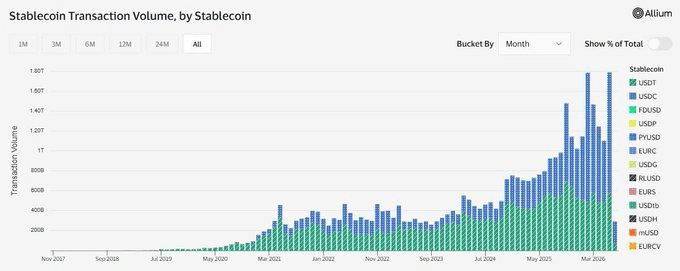
As shown in the chart below, adjusted stablecoin transaction volume reached a record $1.79 trillion during the month, representing a 63% increase from May and a 125% year-over-year surge. This acceleration highlights the growing demand for stablecoins as a settlement layer rather than merely a liquidity mechanism within crypto markets.
Source: Allium

This transition directly increases the strategic importance of Layer 1 networks.

As stablecoin activity grows, on-chain liquidity expands, making these networks more attractive for institutions.

Toncoin [TON], for example, is seeing strong momentum among major blockchain networks, with its native stablecoin supply increasing 8% over the past week to more than $810 million. This highlights the growing competition among Layer 1 networks to capture stablecoin-driven adoption.

However, at the broader market level, the rise in stablecoin transaction volume during June occurred alongside a risk-off mood.

The market ended the month down 18%+, marking the largest monthly capital outflow since February’s 20% decline. This creates a notable divergence within the stablecoin sector, highlighting a critical trend to monitor as the market navigates shifting liquidity conditions heading into H2.

Stablecoin adoption expands as USDC and USDT face new pressure

The stablecoin market is entering a new phase, where utility is diverging from liquidity.

Over the past two months, the combined market cap of USDT and USDC has declined by nearly $11 billion, signaling a contraction in stablecoin liquidity. This trend contrasts with June’s record $1.79 trillion in stablecoin transaction volume, highlighting a growing gap between usage and capital flows.

To put this into perspective, despite higher transaction activity, the total stablecoin market cap fell 2%+ during the month, marking the largest monthly outflow since January and resulting in nearly $8 billion in stablecoin outflows. In essence, stablecoin usage is increasing, but liquidity is moving in the opposite direction.
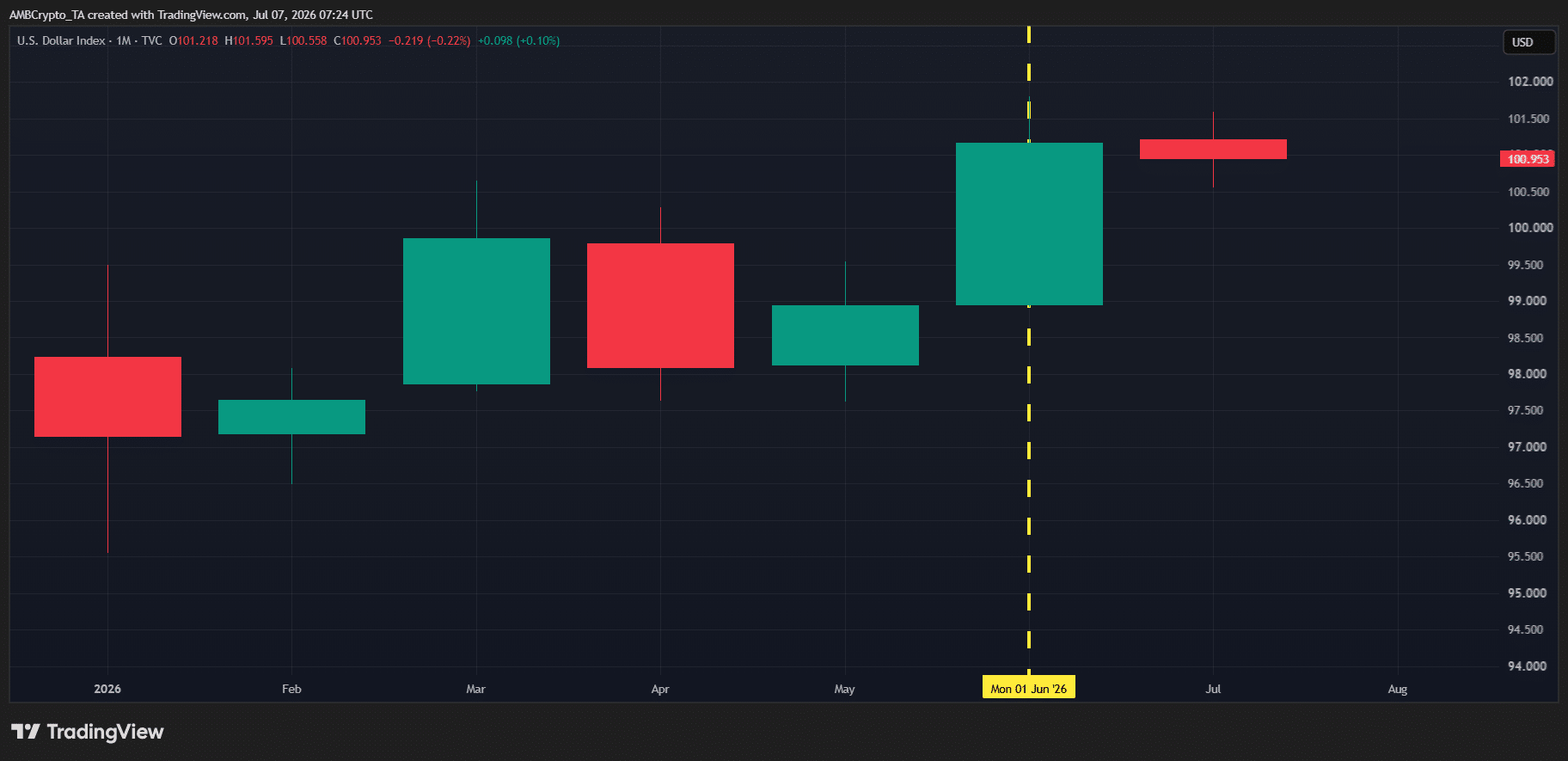
Source: TradingView (DXY)

This divergence becomes more important when viewed from a macro perspective.

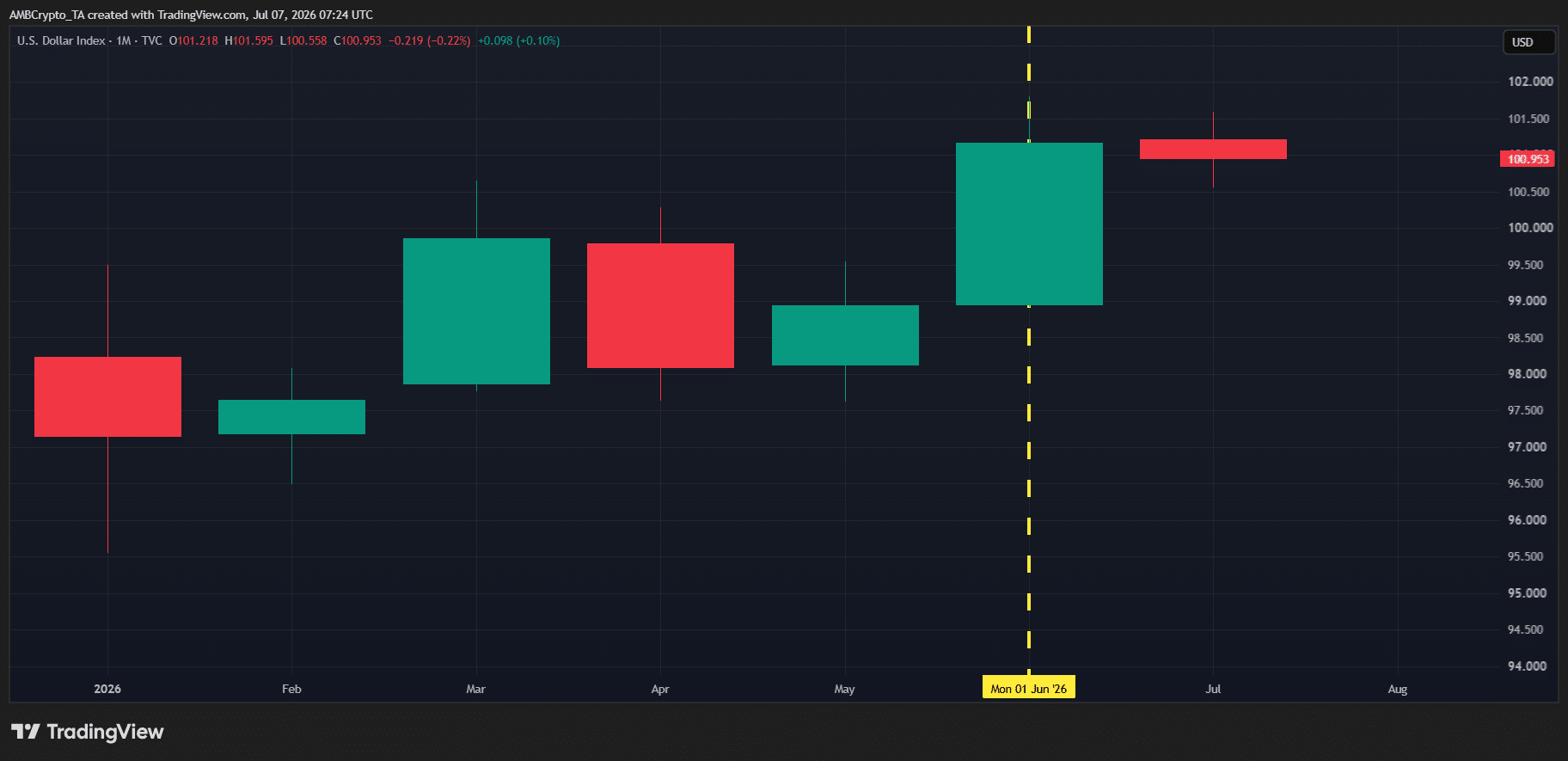
As the chart above shows, the U.S. Dollar Index (DXY) has strengthened, posting back-to-back monthly gains, with June alone rising more than 2.25%.

The stronger dollar has pressured global currencies, including the Japanese yen, which has weakened to multi-decade lows.

Against this macro backdrop, stablecoin utility could continue to strengthen as demand for dollar-based assets remains elevated.

However, the decline in USDT and USDC market cap highlights a growing gap between stablecoin usage and liquidity. If this divergence continues, it could become a key bearish factor for the crypto market heading into H2.


Final Summary

  • Stablecoin activity is rising, but falling USDT and USDC market caps point to weaker liquidity.
  • A stronger dollar is supporting stable demand, but lower liquidity could create risks for crypto markets.


Perguntas relacionadas

QAccording to the article, what record was set by stablecoin transaction volume in June, and by what percentage did it increase compared to May?

AAdjusted stablecoin transaction volume reached a record $1.79 trillion in June, representing a 63% increase from May.

QThe article describes a shift in the stablecoin narrative. What is the main focus shifting from and towards?

AThe stablecoin narrative is shifting from being primarily an on-chain liquidity engine toward a real-world financial utility framework.

QWhat contrasting trend is highlighted regarding the market caps of USDT and USDC versus their transaction volume?

AWhile stablecoin transaction volume hit a record high in June, the combined market cap of USDT and USDC declined by nearly $11 billion over the past two months, showing a divergence between increasing usage and decreasing liquidity.

QWhat macro-economic factor is mentioned as potentially strengthening stablecoin utility, despite the liquidity contraction?

AThe strengthening U.S. Dollar Index (DXY), which rose more than 2.25% in June, is cited as a factor that could continue to support demand for dollar-based assets like stablecoins.

QWhat potential risk for the crypto market in the second half of the year (H2) is identified if the current divergence in stablecoin trends continues?

AIf the divergence between rising stablecoin usage and falling stablecoin liquidity continues, it could become a key bearish factor for the crypto market heading into the second half of the year.

Leituras Relacionadas

Goldman Sachs Research Report Analysis: 135% Profit Growth in Q2, APAC Valuations Fall to a Decade Low

Goldman Sachs Asia Pacific Market Report Summary (Aug 21, 2026) Earnings soared 135% YoY in Q2 for the MXAPJ index, with 46% of companies beating expectations, led by the Information Technology sector (+390% YoY). Despite this robust profit growth, the index's forward P/E of 11x sits 2 standard deviations below its 10-year average, indicating deep valuation discount. Market sentiment remains cautious, as seen in hedge fund leverage for Asian long/short funds dropping to a one-year low. While China saw net buying in August, its allocation remains near five-year lows, and foreign investors withdrew $1.5bn from EM Asia ex-China markets. The valuation gap is attributed to market pessimism on future growth, not aligning with consensus EPS growth forecasts of 71% for 2026 and 24% for 2027. The upcoming MSCI index rebalancing is expected to trigger approximately $42bn in total two-way passive fund flows. Leveraged ETF flows in Korea and Taiwan show signs of cooling, suggesting a reduction in crowded long positions. Goldman Sachs' core trades include long positions in stocks with strong earnings revisions and AI infrastructure/semiconductors. Key downside risks are rising long-term US bond yields, heightened geopolitical tensions, and a slower-than-expected Chinese economic recovery. The firm maintains a 12-month target of 1080 for MXAPJ, implying 21% upside.

marsbitHá 4m

Goldman Sachs Research Report Analysis: 135% Profit Growth in Q2, APAC Valuations Fall to a Decade Low

marsbitHá 4m

Phantom Discontinues Support for Sui as Network Struggles to Recover

On September 24, Phantom wallet will discontinue support for the Sui blockchain, giving users a few weeks to migrate their assets. This marks the end of a partnership that began with much fanfare in January 2025, when Sui became the fourth Layer 1 network supported by the then-15-million-user wallet. Phantom is also dropping support for Monad in August, indicating a broader streamlining of its multi-chain offerings rather than a move specific to Sui. The announcement coincides with a significant downturn for the Sui network. Its Total Value Locked (TVL) in DeFi has plummeted from approximately $2 billion in early 2026 to under $1 billion by July. The price of SUI has also fallen sharply from its all-time high of $5.36 in January 2025 to around $0.83 at the time of reporting. Phantom provided users with two main migration paths: converting SUI to a wrapped version on Solana directly within the wallet (with no proprietary Phantom fee until the cutoff date), or exporting their seed phrase to another Sui-compatible wallet like Sui Foundation's preferred wallet, Sui Wallet. The company emphasized that assets remain on the blockchain, not in the wallet, and warned users against potential migration scams. While both parties describe the split as mutual and leave open the possibility of future collaboration, the loss of a major wallet's support highlights the ongoing fragmentation in the blockchain industry. This poses a challenge for Sui's retail accessibility, even as the network maintains other infrastructure support, such as from Circle for its stablecoins. The future will reveal whether other wallets follow Phantom's lead or seek to attract the displaced Sui user base.

cryptonews.ruHá 18m

Phantom Discontinues Support for Sui as Network Struggles to Recover

cryptonews.ruHá 18m

Trading

Spot
活动图片