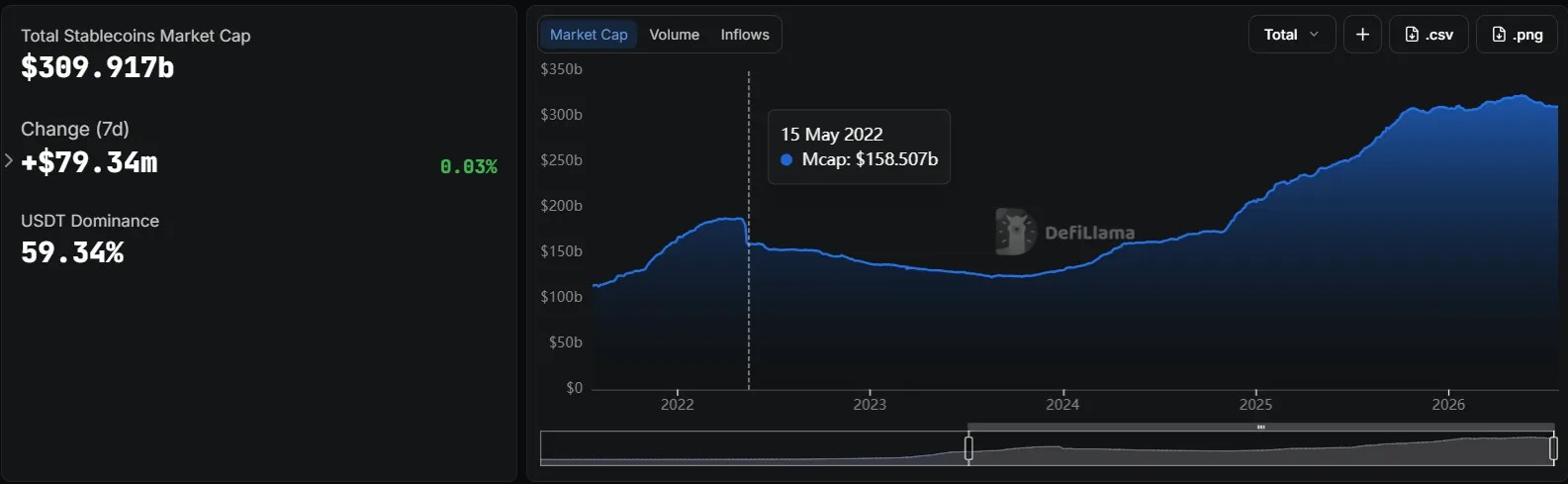
On July 28, according to data from DeFiLlama, the total market capitalization of stablecoins fell by more than $10 billion from its May peak, reaching approximately $310 billion. This outflow marked the largest monthly decline since the Terra collapse in May 2022.
Against this backdrop, the adjusted transaction volume for June 2026 hit a historical high, reaching $1.79 trillion, an increase of about 63% over the month.
Where Are Capital and Yields Going?
A key factor in the divergence between falling market cap and growing volumes is the $GENIUS Act, passed in July 2025. It prohibits issuers from paying interest on payment stablecoins.
Professor of Finance David Krause from Marquette University explained this dynamic:
"The complication is that the ban didn't destroy the underlying demand for yield—it merely shifted it. Investors who want a digital dollar with a yield close to the U.S. Treasury bill rate simply found other products with the legal right to offer it."
According to him, tokenized treasury funds, DeFi lending protocols, and offshore stablecoin issuers are ready to absorb the demand. Treasuries place idle dollars in a tokenized fund paying 4% and hold stablecoins only for the time needed to execute the actual payment. Capital is leaving the asset, while operational balances remain and turn over faster, reflected in the declining supply against record-high volumes.
"The rule [$GENIUS Act], intended to protect banks and preserve monetary control, has instead pushed capital into instruments that regulators understand less and control less strictly."
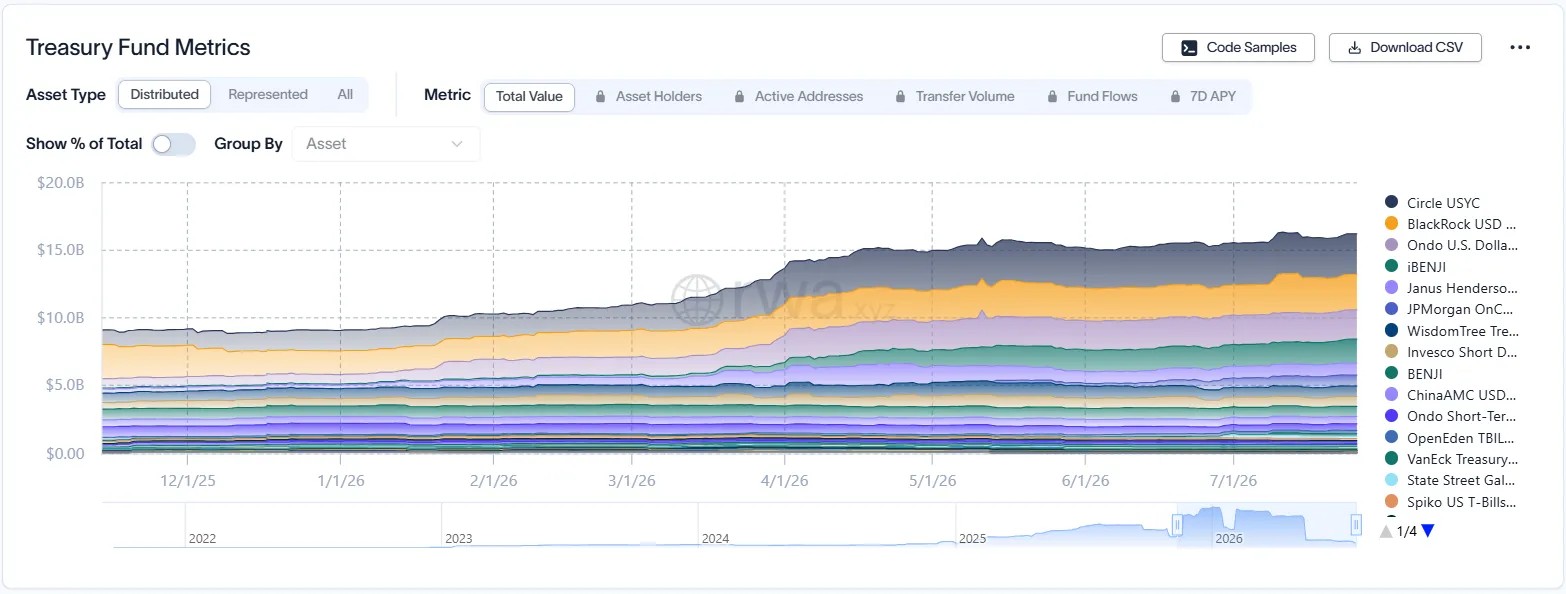
Thus, large players have moved funds into the RWA sector—tokenized U.S. Treasury bond funds, whose total volume grew from $11 billion to $16 billion over five months. This, according to data from aggregator RWA.xyz, is reflected in the leadership shift within the segment: Circle's USYC fund surpassed BlackRock's BUIDL, and a similar product from JPMorgan grew by 87% in just one month.
How Euro-Stablecoins Lost the Battle Before It Began
$USDC Seizes Initiative and Changes the Industry's Business Model
The growth in transactional activity has reshuffled the balance of power. According to Visa, the velocity of stablecoin circulation in Q4 2025 reached 13.56, outpacing the dollar M1 aggregate's rate of 1.65 by almost eight times.
In this race, $USDC has become the primary tool for institutions. According to data from Visa's Allium-based analytics dashboard, $USDC accounted for about 70% of transactions in the first half of 2026.
For June, the adjusted transfer volume in $USDC amounted to $1.21 trillion (approximately 67.6%), while USDT's figure was at $576 billion (about 32%). Despite trailing in volume, Tether maintains absolute leadership in market capitalization, retaining its status as a "savings account" in developing countries.
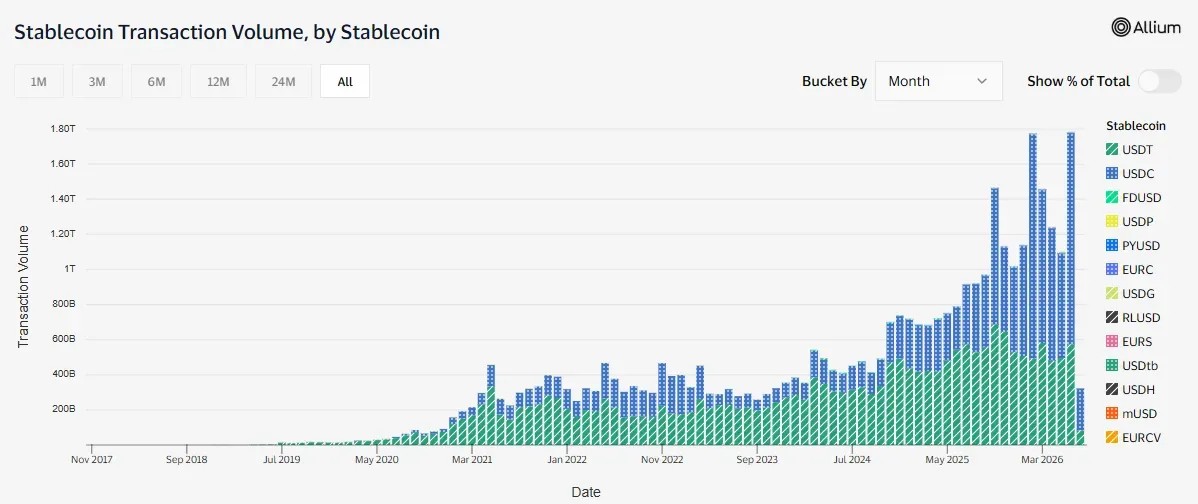
The growth in velocity amidst stagnant supply is changing the fundamental economics of the crypto sector:
- A blow to the old issuer model. Relying solely on interest from reserve assets, which was the core business model in 2021, is ceasing to be the primary financial driver.
- The triumph of infrastructure. The main revenue stream is shifting to payment networks, processing services, and blockchains that charge transaction fees. Traditional giants like Visa no longer assess the market by asset capitalization, focusing solely on clearing volumes.
- Dominance of the corporate sector. According to a joint study by McKinsey and Artemis, only about 1% of the movement in 2025 came from identifiable real-world payments—roughly $390 billion, of which $226 billion was in the B2B sector. The share is small, but it is thirty times larger than two years ago.
In June, experts explained the ban on CBDC issuance for the U.S. Federal Reserve.
Fiat Against Crypto: Why Corporations Need Their Own Stablecoins