SpaceX IPO Creates Trillion-Dollar Billionaire: Musk's Wealth Equals Half of Crypto Market

Foresight NewsPublicado em 2026-06-15Última atualização em 2026-06-15

Resumo

SpaceX's record-breaking IPO has propelled Elon Musk to become the first modern billionaire with a personal net worth exceeding $1 trillion, reaching $1.11 trillion according to Bloomberg. This staggering wealth surpasses the total market capitalization of all cryptocurrencies excluding Bitcoin and equals roughly half of the entire crypto market's value. The milestone highlights extreme wealth concentration and the significant devaluation of the altcoin market, whose total cap has nearly halved since late 2025 as capital flows into large tech stocks. SpaceX's Nasdaq debut saw its valuation hit $2.2 trillion, with shares soaring from a $135 offer price to close at $161. Its first-day trading volume of $85 billion set a new global IPO record. Musk owns 42% of the company. Despite his wealth dwarfing the altcoin sector, Musk maintains deep ties to digital assets. He personally holds Bitcoin, Ethereum, and Dogecoin, while his companies, SpaceX and Tesla, collectively hold over 30,000 Bitcoin, ranking among the top corporate BTC holders globally. His acquisition and integration of financial data tools into X (formerly Twitter) further connect his ecosystem to the markets. Ultimately, Musk's trillion-dollar status underscores the immense wealth controlled by tech founders, though this fortune remains largely tied to volatile stock prices rather than liquid assets.


Author: Oluwapelumi Adejumo

Compiled by: Saoirse, Foresight News


Key Takeaways


  • After SpaceX's public listing, Elon Musk becomes the first person in modern history with a personal net worth exceeding $1 trillion.
  • His total wealth of $1.11 trillion already surpasses the total market capitalization of all cryptocurrencies excluding Bitcoin, highlighting extreme wealth concentration and the ongoing valuation contraction of altcoins.
  • This wealth milestone remains highly dependent on stock price volatility; meanwhile, several of Musk's companies hold Bitcoin, and he himself remains an active, public figure in the digital asset space.


Elon Musk has become the first person in modern history with a personal net worth exceeding the $1 trillion mark. Last week's record-breaking public listing of SpaceX propelled him past this historic wealth threshold.


According to the Bloomberg Billionaires Index, the total wealth of this tech entrepreneur now stands at $1.11 trillion.


To put the unprecedented scale of this capital into perspective: Musk's personal net worth is already higher than the total market capitalization of the global cryptocurrency market excluding Bitcoin. If the world's largest digital asset, Bitcoin, is included in the statistics, his wealth is exactly equal to half the total market capitalization of the entire crypto industry.
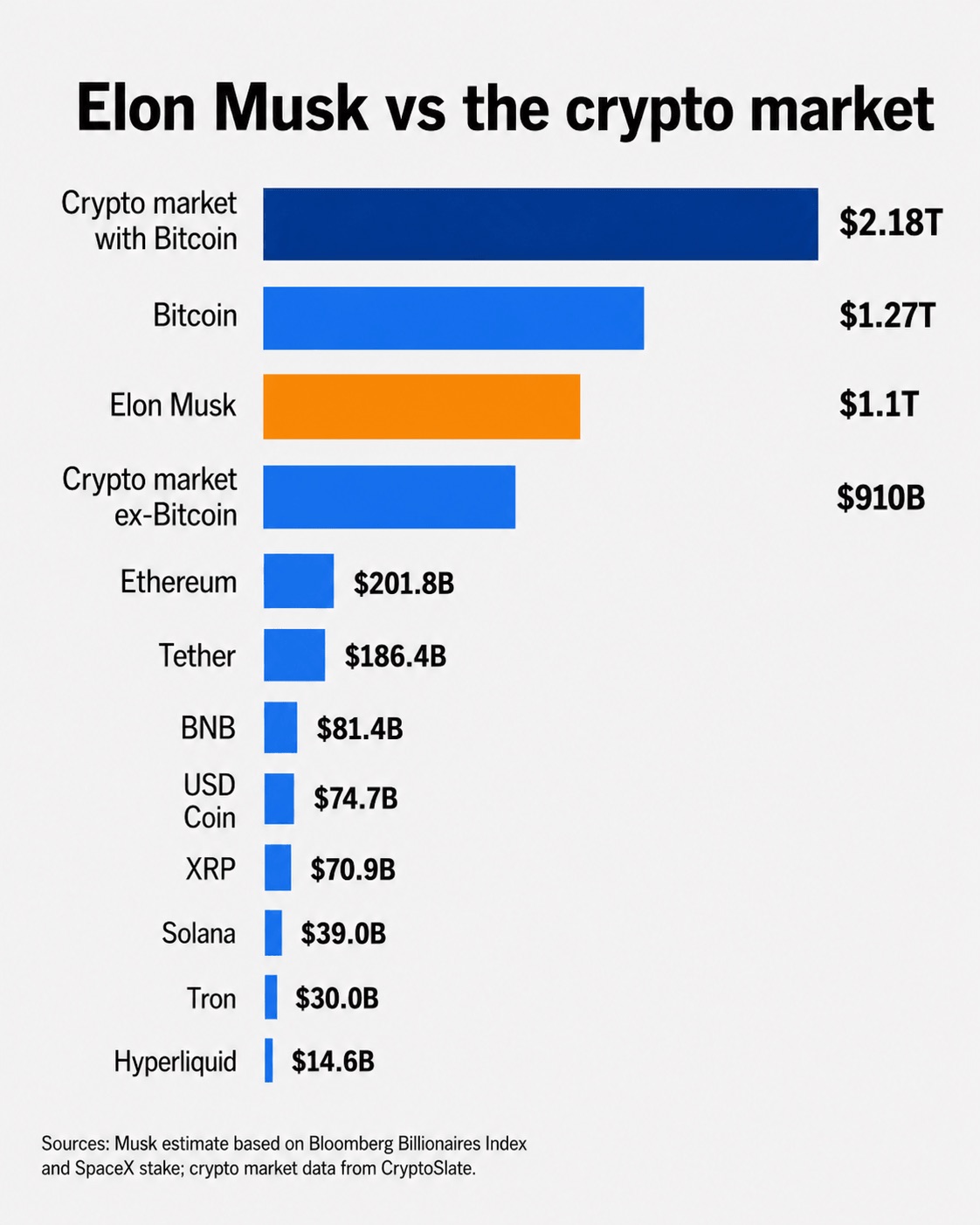


This wealth milestone quickly sparked global discussions about wealth concentration, with the scale of Musk's controlled wealth even exceeding the gross domestic product of several developed nations.


SpaceX IPO Shatters Multiple Records


The direct catalyst for Musk's wealth surge was the highly anticipated Nasdaq listing of SpaceX.


The company, which focuses on rocket development, communication services, and artificial intelligence, reached a staggering valuation of $2.2 trillion post-listing.


Underwriters initially set the offering price at $135 per share, successfully raising $75 billion before trading began.


However, market enthusiasm for the commercial space sector and Musk-related companies was unprecedented. The stock opened at $150, surged to a session high of $176.50 during the day, and ultimately closed at $161 last Friday.


Market observers noted that the stock listing brought unprecedented market liquidity.


Bloomberg ETF analyst Eric Balchunas pointed out that the stock's trading volume on its first day reached $85 billion. This figure set a new global record for single-day IPO trading volume and ranked among the top ten historical single-day trading volumes for any individual stock, surpassing Apple's highest daily trading volume over the past 40 years.
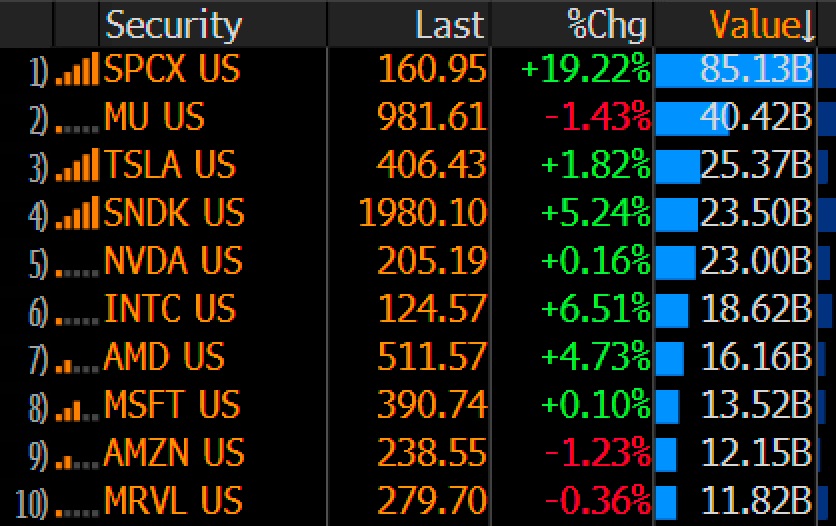

SpaceX Initial Public Offering Trading Volume (Source: Eric Balchunas)


Musk holds a 42% stake in the Hawthorne, California-based company, granting him near-unilateral voting control over its operations and strategic decisions.


Musk's Connection to Cryptocurrency


Comparing Musk's wealth scale to the digital asset market clearly reveals the significant shift in global capital allocation over the past year.


Data from the TradingView TOTAL2 index shows that the total market capitalization of all altcoins (excluding stablecoins) is approximately $880 billion. Musk's $1.11 trillion paper wealth easily surpasses this figure.


Even using the broader statistical scope of data platform CoinGecko—which puts the total global crypto market cap at about $2.27 trillion, with Bitcoin's market cap at $1.28 trillion—the combined value of all remaining altcoins after excluding Bitcoin still falls short of the personal net worth of the SpaceX CEO.


This market cap gap intuitively reflects the significant valuation contraction of mainstream altcoins compared to previous cycles. Data from Tradingview shows that in October 2025, the total market cap of crypto assets excluding Bitcoin once exceeded $1.7 trillion.
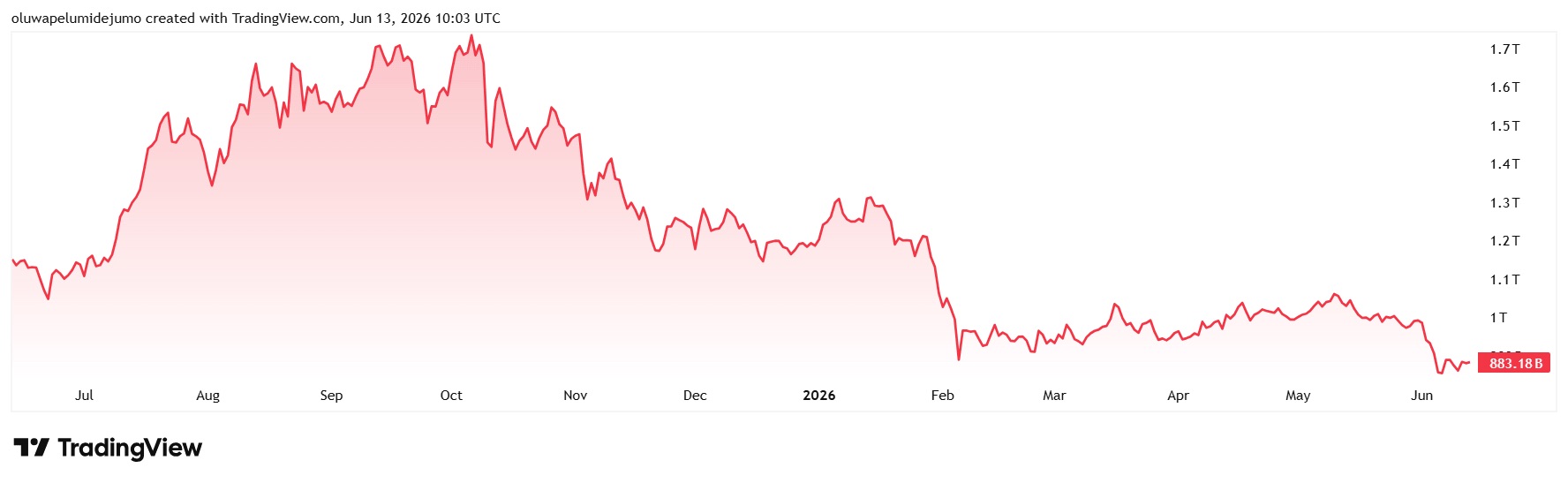

Total Cryptocurrency Market Cap Excluding Bitcoin (Source: Tradingview)


Today, that value has nearly halved. Behind this is the continued liquidity drain in the digital asset market, with institutional capital broadly exiting the crypto sector and flowing into large-cap tech stocks and artificial intelligence-related equities.


Despite his personal wealth now dwarfing the entire altcoin market, Musk remains deeply intertwined with the digital asset ecosystem, both in terms of personal holdings and corporate balance sheets.


Musk has publicly confirmed that he holds Bitcoin, Ethereum, and Dogecoin. Apart from mentioning a gift of 0.25 Bitcoin in 2018, he has never disclosed his full personal portfolio. However, several of his companies hold institutional-scale positions in the crypto market.


Post-listing regulatory filings show that SpaceX's corporate treasury holds 18,712 Bitcoin, with a market value exceeding $1.3 billion. His electric vehicle company Tesla follows a similar strategy, maintaining a long-term holding of 11,509 Bitcoin as part of its corporate liquid reserves.


If the holdings of both companies were combined, the total Bitcoin held would rank fifth globally among listed companies.
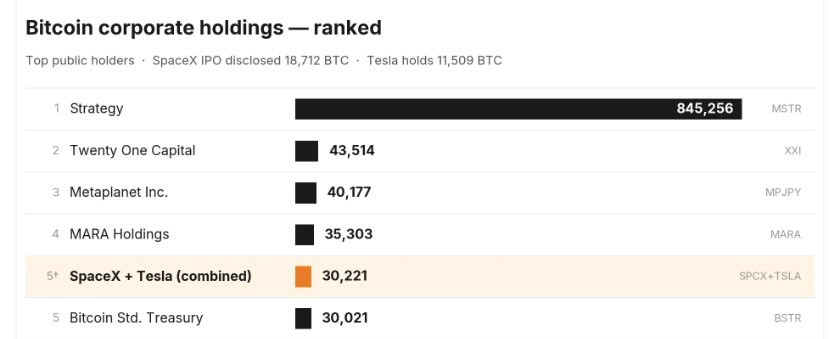

Bitcoin Holdings of SpaceX and Tesla (Source: Bitcoin Treasuries)


Furthermore, Musk's $44 billion acquisition of the social platform X (formerly Twitter) and the embedding of financial data tools within the platform have integrated financial markets directly into the public information stream. The platform's built-in cash tag function displays real-time prices for traditional stocks and various digital assets.


X's official statement clarifies that the platform serves solely as a market data tool and does not directly act as a securities broker or cryptocurrency exchange. Nonetheless, this feature further intertwines Musk's media and commercial ecosystem with the daily operations of financial markets.


Ultimately, Musk's staggering wealth scale reveals the severe concentration of private wealth within founder-controlled tech giants; it is also important to note that this trillion-dollar fortune is essentially tied to stock market prices and is not freely accessible cash assets.


Perguntas relacionadas

QWhat event made Elon Musk the first person in modern history to surpass a $1 trillion net worth?

ASpaceX's record-breaking public listing (IPO) propelled Elon Musk's net worth to over $1 trillion.

QHow does Elon Musk's current wealth compare to the total market capitalization of the cryptocurrency market excluding Bitcoin?

AElon Musk's net worth of $1.11 trillion is greater than the total market capitalization of all cryptocurrencies excluding Bitcoin, which is approximately $880 billion.

QWhich of Elon Musk's companies hold Bitcoin on their balance sheets, and what are their approximate holdings?

ABoth SpaceX and Tesla hold Bitcoin. SpaceX holds 18,712 BTC and Tesla holds 11,509 BTC, giving them a combined holding of over 30,000 BTC.

QWhat was the remarkable trading volume statistic for SpaceX's stock on its first day of public trading?

AOn its first day of public trading, SpaceX's stock reached a trading volume of $85 billion, setting a new record for IPO trading volume.

QWhat broader societal and market trend is highlighted by the comparison between Musk's wealth and the altcoin market's value?

AIt highlights both the extreme concentration of private wealth in founder-led tech giants and the significant valuation decline/contraction (nearly halved) in the altcoin market as capital has flowed towards large-cap tech and AI stocks.

Leituras Relacionadas

Long-Divided Must Unite, Long-United Must Divide: When L1 Becomes Its Own Rollup, What Is Ethereum's Endgame?

"The Inevitable Cycle: When L1 Becomes Its Own Rollup – What is Ethereum's Endgame?" For years, the Ethereum community grappled with concerns that L2s were fragmenting the ecosystem and eroding L1's value. While L2s provided cheaper execution, they also splintered liquidity and the unified user experience of a single chain. This has prompted a fundamental reassessment of the relationship between L1 and L2. Ethereum's roadmap is evolving. The "Scale" initiative merges L1 and L2 expansion into a holistic framework. L1 itself is advancing with higher gas limits, statelessness, and zkEVM verification, no longer content to be just a low-throughput settlement layer. Consequently, the primary value proposition of L2s is shifting from merely providing cheap blockspace to offering L1 cannot easily provide: application-specific optimizations, privacy features, and flexible governance models. L2s are becoming a spectrum of execution environments with varying degrees of security inheritance from Ethereum. A critical challenge in this multi-chain future is interoperability. The vision is to make Ethereum "feel like one chain again." This relies on advancements in native account abstraction (like EIP-7702) and intent-based architectures (Open Intents Framework), where users declare desired outcomes, and solvers handle the complex cross-chain execution. Furthermore, shortening Ethereum's finality time from minutes to seconds is crucial, as it underpins trust between chains for bridges, stablecoins, and cross-chain applications. Perhaps the most provocative idea is that Ethereum L1 itself could become a form of "its own Rollup." As zkEVM and proof systems mature, high-performance nodes could execute transactions and generate validity proofs. Regular validators would then verify these proofs instead of re-executing all transactions. This blurs the traditional L1/L2 hierarchy, making "Rollup" more of a general execution-verification architecture. Native Rollup aims to integrate L2 validation more directly into the Ethereum protocol, allowing L2s to inherit L1's security more fully and move away from reliance on security councils. In the end, L2s are not destined to replace L1 or be made obsolete by it. The likely future is a unified system where diverse execution environments—each optimized for specific use cases like DeFi, gaming, or privacy—coexist. They will share a common foundation of security, liquidity, and verifiable state, seamlessly connected to restore a cohesive user experience. The next phase for Ethereum is not just about scaling through separation, but about intelligently reintegrating what was separated back into a coherent whole.

链捕手Há 2m

Long-Divided Must Unite, Long-United Must Divide: When L1 Becomes Its Own Rollup, What Is Ethereum's Endgame?

链捕手Há 2m

Agent Race Ends, Super Workbench Takes Over

The era of fragmented AI agents is ending. Over the past month, China's tech giants—Tencent, Alibaba, and ByteDance—have simultaneously shifted strategy: instead of launching new, standalone AI agents, they are consolidating their various agent projects into unified "super workbenches." Tencent integrated its QClaw teams into WorkBuddy, a strategic product hailed as a potential third flagship after QQ and WeChat. Alibaba is merging its QoderWork, Wukong, and MuleRun agents into a new "Qianwen Office" platform under DingTalk's leadership. ByteDance rebranded its TRAE SOLO coding agent to TRAE Work, signaling a broader focus on workflow collaboration. This convergence marks a pivotal industry consensus. The initial exploration phase, where companies rapidly built numerous overlapping agents for different scenarios, proved costly and inefficient. With open-source tools eroding technical barriers, competition has shifted from agent creation to resource consolidation and cost control. Historically, platform wars are won not by creating more products, but by simplifying them—as seen with browsers unifying web access and super-apps consolidating services. Now, the "super workbench" aims to become the unified AI entry point for work. This reflects a deeper market realization: the primary audience for AI is no longer just programmers (a market in the tens of millions) but all knowledge workers (a market of billions). The real opportunity lies in augmenting everyday tasks—managing emails, documents, data, and meetings—across the entire workday. The core battleground is becoming control over the primary AI entry point that employees use daily. Tencent's WorkBuddy leverages WeChat and Tencent Docs; Alibaba's Qianwen Office taps into DingTalk's organizational data; ByteDance's TRAE Work integrates with Feishu's workflows. Whoever owns this "super workbench" gains strategic control over orchestrating enterprise data and APIs. This shift is redefining enterprise software. Traditional SaaS applications, valued for their user interfaces, will recede into the background. Their core functionalities will be exposed as standardized "Skills" or APIs for the super workbench's agents to invoke. Software value will shift from selling user seats to charging based on API calls and outcomes delivered. The evolution of agents is moving through clear stages: first as novel standalone products, then as consolidated primary work entry points, and finally as pervasive, invisible capabilities embedded into the digital fabric. The recent moves by major tech firms signal the transition from the first stage into the second, accelerating toward the third. In the end, the most successful agent technology may become invisible—like electricity or the HTTP protocol—a fundamental, unnamed infrastructure powering work itself.

marsbitHá 30m

Agent Race Ends, Super Workbench Takes Over

marsbitHá 30m

Michael Saylor: 110 Reasons to Oppose BIP-110

Michael Saylor presents 110 arguments against Bitcoin Improvement Proposal (BIP) 110, a soft fork aimed at restricting certain non-monetary data storage uses (like inscriptions) on the Bitcoin blockchain. He acknowledges the proponents' valid concerns—such as node costs, fee pressure, and preserving Bitcoin's monetary focus—but fundamentally disagrees with the proposed solution. Saylor argues that BIP 110 represents a dangerous precedent of using consensus rules to enforce value judgments on transaction validity, moving away from Bitcoin's core principles of neutrality and permissionless innovation. His key objections are organized into eleven categories: 1) It violates neutrality and hard consensus by banning currently valid transactions. 2) It fails to meet the high burden of proof required for a consensus change, lacking concrete data on the alleged crisis. 3) Its seven bundled technical restrictions are overly broad, targeting generic script functionalities and blocking future upgrade paths. 4) It sacrifices compatibility and future optionality by closing off designed upgrade hooks. 5) Its temporary rules add significant complexity (grandfathering, expiry states) without sufficient justification. 6) The economic and security impacts, particularly on miner revenue and fee markets, are uncertain and unmodeled. 7) Superior, market-based tools (fee markets, relay/mining policies) already exist to manage blockchain load. 8) It stifles innovation by creating a chilling effect for developers. 9) Its modified activation mechanism (55% threshold, forced signaling) is aggressive and risks network splits. 10) The precedent it sets—using consensus to suppress disliked but legal uses—is more dangerous than the problem it aims to solve. 11) A better path exists: improving measurements, refining resource-based policies, and allowing market forces to work. Saylor concludes that Bitcoin's strength lies in its neutral rules, open markets, and hard consensus. Changing these foundational elements to target specific use cases is an unnecessary and risky "iatrogenic" intervention. He advocates for guarding Bitcoin's neutrality rather than acting as its redeemer.

marsbitHá 45m

Michael Saylor: 110 Reasons to Oppose BIP-110

marsbitHá 45m

Trading

Spot
活动图片


