Space Review|Farewell to Narrative Frenzy, Web3 Enters a New Structured Phase of Pragmatic Foundation Building

marsbitPublicado em 2026-01-01Última atualização em 2026-01-01

Resumo

Reflecting on the final days of 2025, a cross-ecosystem Space hosted by key projects within the TRON network—SunPump, JUST, AINFT, BitTorrent, and WINkLink—brought together industry participants to review the past year and look ahead. The discussion centered on a shift in crypto markets: a move away from narrative-driven speculation toward a more pragmatic, utility-focused phase. Key takeaways from 2025 included a heightened awareness of systemic risk, exemplified by events like the “10.11” flash crash, which underscored the dangers of over-leverage and low liquidity. Capital increasingly flowed toward established assets like Bitcoin and Ethereum, reflecting a preference for proven value and security. Within this context, the TRON ecosystem demonstrated resilience and growth through concrete developments: - JUST reinforced its role as a DeFi cornerstone, with JustLend DAO nearing $10B in TVL and introducing a token burn mechanism to enhance JST value. Its GasFree feature also improved accessibility. - AINFT evolved into an AI + Web3 infrastructure platform, with its token listed on Binance Alpha. - SunPump drove meme token creation and trading innovation, supported by tools like SunGenX and SunX perpetual contracts. - WINkLink expanded as a decentralized oracle, while BitTorrent Chain (BTTC) upgraded to v2.0, strengthening cross-chain and data storage capabilities. Looking to 2026, participants anticipated a more structured market with heightened institutional involvement...

As the clock struck midnight on the last night of 2025, a unique gathering of minds unfolded within the TRON ecosystem. A New Year's Eve Space, jointly initiated by the five projects SunPump, JUST, AINFT, BitTorrent, and WINkLink, blended festive cheer with profound industry insights, creating a distinctive annual "thought salon" through relaxed interaction.

The event, structured around the core narrative of "Review × Sentiment × Choice × Outlook," aimed to systematically recap the key turning points in the crypto market over the past year and, on this basis, build consensus on the direction of future value. The discussions not only delved into the structural changes affecting the market but also collectively explored the innovative signals and value foundations truly worth attention as the industry transitions toward a phase of pragmatic development.

This article aims to systematically organize the essence of the dialogue and industry insights from this Space. It presents not only the reflections of market participants on extreme volatility and observations of capital flows but also deeply decodes how the TRON ecosystem, through synergistic practices in areas such as decentralized finance (DeFi), cross-chain infrastructure, and AI integration innovation, is building a value ecosystem with resilience, vitality, and long-term development potential amidst complex cycles. This gathering was not just an annual summary but can also be seen as a collective reflection and前瞻 on the future evolution path of the Web3 world.

Looking Back at 2025: The Collaborative Evolution and Value Accumulation of the TRON Ecosystem
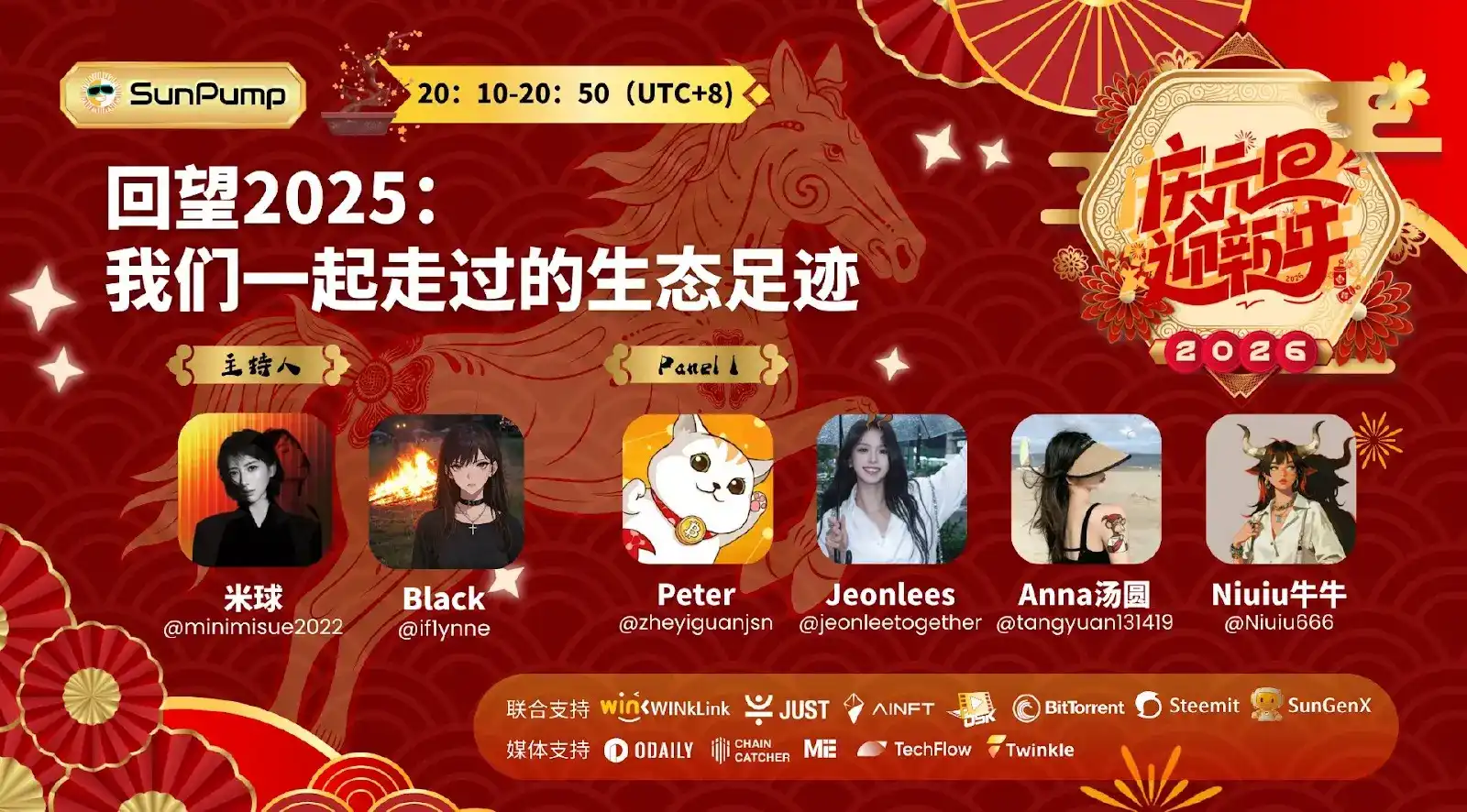
The year 2025 was one of profound "realist" calibration for the crypto market. The guests, having experienced the market firsthand, reached a consensus: the industry is moving away from narrative-driven frenzy and entering a calmer, more pragmatic stage. As guest Anna Tangyuan summarized, this year was "a year of gradually calming down after being educated by reality." The simple logic of "narrative driving price" repeatedly failed, and market sentiment shifted from optimistic expectations at the beginning of the year to caution and pragmatism by year's end.

One of the triggers for this shift was the "10.11" market flash crash, which left a deep impression on several guests. Anna Tangyuan, who experienced it firsthand, pointed out that with a "40% leveraged position still being liquidated," market risk lies not only in misjudging direction but also in severely underestimating extreme market conditions and instantaneous liquidity drying up. In the face of systemic risk, any leverage strategy seems insignificant, and "survival" becomes the primary rule for navigating cycles.

Furthermore, the market's冷静 is also reflected in its choice of capital. Guest web3 Monkey used "the strong get stronger" to point out the structural flow of capital: after numerous emerging projects were validated (or disproven) by the market, capital反而 accelerated its回流 to core assets like Bitcoin and Ethereum, indicating that the market is seeking more solid value anchors.

Despite the challenges, innovation did not stop; it simply became more考验 of meticulous cultivation. It is precisely under this new industry基调 of pursuing real utility and emphasizing risk management that the annual performance of the TRON ecosystem provides an excellent example of "how to navigate cycles."

Throughout 2025, the five core projects of the TRON ecosystem—SunPump, JUST, AINFT, BitTorrent, and WINkLink—wrote a vivid footnote for "pragmatic construction" and "ecological deepening" through their practical actions. They not only achieved breakthrough progress in their respective tracks but also, through close collaboration, jointly built a more resilient and vibrant decentralized ecosystem.

First, at the DeFi application level, JUST, with its solid protocol performance, established its position as the value anchor of the TRON ecosystem. The Total Value Locked (TVL) of its core protocol, JustLend DAO, approached the $10 billion mark mid-year and consistently ranked among the industry leaders, demonstrating the market's high recognition of its security and innovative model. Meanwhile, the robustness of the ecosystem is also reflected in the broad participation in core businesses: as of December 31, 2025, the on-chain staking volume of TRX exceeded 9.25 billion, the number of addresses participating in staking surpassed 13,417, and the staking annualized yield stabilized at 6.65%, forming a solid收益 foundation within the ecosystem.

Beyond the solid performance and market recognition of the protocol, the token buyback and burn mechanism driven by community consensus also became a key decision boosting the long-term confidence of JST holders. This mechanism, in an on-chain transparent manner, directly links protocol revenue to token value. The first burn utilized the existing revenue of JustLend DAO, totaling 59,087,137 USDT, of which 30% (17,726,141 USDT) was used for the initial buyback and burn of 559,890,753 JST, approximately 5.66% of the total supply. This substantial deflationary action laid a credible foundation for JST's long-term value model.

While JUST is committed to creating value through buyback and burn, it also致力于 lowering the participation barrier through its GasFree function, ensuring users can deeply engage with the ecosystem. Currently, the number of GasFree partners has expanded to 9, with total transactions in November reaching 423,173, averaging 14,105 per day, and the total transaction amount exceeding $7.5 billion. This innovation significantly benefits small and medium users and promotes the sustained and healthy growth of the ecosystem scale.

Second, at the frontier of innovative applications and asset paradigm exploration, AINFT and SunPump played the role of ecosystem pioneers. In 2025, AINFT successfully completed its brand strategy upgrade from a digital art platform to an "AI+Web3" infrastructure, aiming to bring empowerment ranging from intelligent interactive tools to decentralized AI models to the TRON ecosystem. Its platform token, NFT, was successfully listed on Binance Alpha in September 2025, gaining liquidity support and market exposure from a top global exchange.

SunPump, by building a vibrant Meme trading ecosystem, became the core hub connecting cultural creation and asset flow within the TRON network. Its launched AI one-click token issuance tool, SunGenX, significantly lowered the threshold for creation and issuance, seamlessly transforming cultural creativity into tradable assets. Driven by this innovative tool, the cumulative number of Meme tokens created on the platform has exceeded 100,000. Meanwhile, the SUN.io ecosystem deeply collaborated with SunPump through a series of combined efforts, including forming a CEX alliance, upgrading the AI assistant SunAgent, and launching the decentralized perpetual contract platform SunX, building a complete ecological closed loop from issuance and trading to derivative services.

Finally, the expansion of oracle and cross-chain infrastructure opened channels for the ecosystem to connect with the real world and diverse blockchain networks. The decentralized oracle WINkLink, with its reliable data services, penetrated key areas such as payments, trading, wallets, and even privacy computing, becoming the security foundation driving innovative applications like DeFi and RWA. Over the past year, WINkLink established strategic partnerships with 17 new projects, bringing the total number of ecosystem partners to 36.

At the same time, BitTorrent Chain (BTTC) completed a leapfrog upgrade to version 2.0, with the total cross-chain volume exceeding $1.63 billion. More notably, its BitTorrent File System (BTFS) boasts over 2 million global nodes and an annual storage capacity exceeding 800 PB. The synergy between WINkLink and BitTorrent共同构建了 the underlying network for data and asset circulation within the TRON ecosystem, providing solid guarantee for the ecosystem's interoperability and value expansion.

As the market scrutinizes the intrinsic value of projects amidst macro volatility, the TRON ecosystem, through its solid accumulation in technical infrastructure, economic models, and community operations over the past year, has proven that it can not only weather storms but also possesses the potential to continuously lead innovation waves.

Outlook for 2026: Pragmatic Development and Value Signals in the Web3 Market
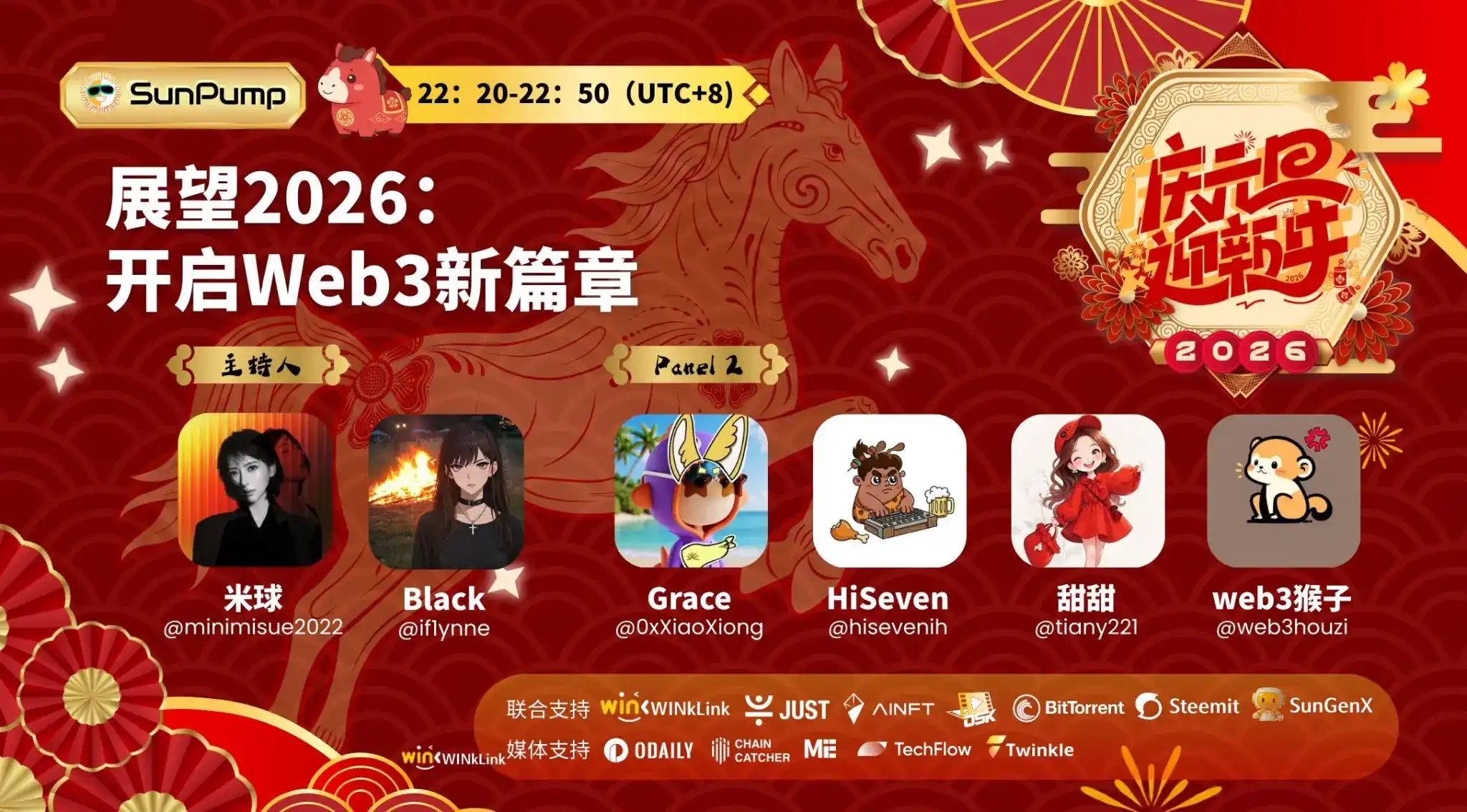
In the second half of this New Year's roundtable, the focus of discussion shifted from reviewing the past to looking toward the future. Based on their profound experiences in 2025, the guests shared their expectations for 2026 and the market signals they are most bullish on. Their discussions共同描绘出一幅 industry consensus picture: the market is moving away from expectations of a broad bull run and entering a new, more structured stage with higher demands, where opportunities and challenges are more nuanced, and individual success will depend more on the construction of systemic capabilities and the grasp of core trends.

Regarding the overall market in 2026,币圈Peter, based on macro perspectives such as continued institutional accumulation and the influx of traditional capital, remains "optimistic" about the underpinning力量 of mainstream assets. However, he敏锐地 pointed out that capital will be more discerning, and the Matthew effect of "the strong get stronger" will intensify the行情分化 between mainstream coins and altcoins.

This judgment coincides with the current trend of value flow in the market, namely that capital is shifting from assets solely reliant on narratives to those with real utility, stable cash flow, and massive ecosystem support. For example, the TRON ecosystem,凭借 its absolute dominance in the stablecoin settlement领域 (carrying over half of the global on-chain circulation of USDT) and the powerful DeFi ecosystem derived from it, has built a "digital financial infrastructure" with endogenous循环 capabilities, not reliant on short-term subsidies. This ecosystem, driven by real payment and lending demands, demonstrates precisely the resilience and sustainability the market seeks.

Regarding "which market signals are most worth carrying into 2026," the guests' analysis focused on a triangular framework of liquidity, innovation, and compliance. First, innovative application scenarios with real utility, such as AI, prediction markets, and RWA, are highly anticipated, reflecting the market's demand for native high-level on-chain applications. These are not just "narratives" but pragmatic explorations attempting to create new demands and business models.

Second, the profound changes in capital structure are a fundamental signal of the market's maturation. This is reflected in two irreversible trends: firstly, the sustained, large-scale inflow of institutional capital through transparent, compliant channels like ETFs. This is not just incremental capital but also brings higher requirements for risk management, custody services, and fundamental analysis, raising the professional threshold and stability of the market. Secondly, the structural growth and multi-scenario penetration of stablecoins on-chain have elevated them beyond mere mediums of exchange to become the foundational assets of on-chain finance. Their scale and reliability directly determine the ability of DeFi and even the crypto ecosystem to承接 incremental capital.

Finally, the weight of compliance and fundamentals will continue to increase. With the rapid evolution of global regulatory frameworks and institutional investors becoming major market participants, "regulation-friendly" and "audit-worthy" will change from plus points to entry tickets. This means that a project's compliance progress (e.g., license acquisition, operational transparency), actual utility (user activity, revenue generation capability), and token economic fundamentals (value capture mechanism, inflation/deflation model) will彻底取代 vague visions and marketing narratives, becoming the core basis for capital decisions. As the guests insightfully noted, those capable of navigating future cycles will必定 be projects that have built transparent, robust economic systems with real value capture capabilities. Their growth will rely more on endogenous value creation within the ecosystem rather than external liquidity speculation.

In converting compliance potential into capital momentum, the practices of the TRON ecosystem in 2025 serve as a标志性范例. Tron Inc. not only went public on Nasdaq but also initiated the "TRX MicroStrategy" plan, listing TRX as a reserve asset on the balance sheet of a listed company, opening a core channel for the entire ecosystem towards mainstream compliant capital. The strong confidence and transparency红利 released by this move directly drove the simultaneous rise in the Total Value Locked (TVL) of its DeFi ecosystem and network revenue, powerfully proving the systemic value that compliance building can bring.

Overall, the crypto market in 2026 will reward those ecosystems and projects that can establish advantages within the "triangular framework": capable of opening new局面 in innovation, attracting and accommodating institutional-grade liquidity, while also building solid fundamentals within a compliant framework. This预示着 that the Web3 market is transitioning from a speculative market chasing hotspots to a mature ecological system based on value discovery and sustainable construction. The advances of the TRON ecosystem in 2025 are precisely the先行答卷 delivered towards this future.


Perguntas relacionadas

QWhat was the main theme of the New Year's Space event hosted by the TRON ecosystem, and what was its purpose?

AThe main theme was 'Review × Emotion × Choice × Outlook', and its purpose was to systematically review the key turning points in the crypto market over the past year and build consensus on future value trends.

QAccording to the discussion, what major shift is the Web3 industry undergoing as it moved through 2025?

AThe industry is shifting away from a狂热 (frenzy) driven by narratives and entering a more冷静 (calm) and务实 (pragmatic) phase that emphasizes real utility and risk management.

QWhich TRON ecosystem project is highlighted as the 'cornerstone of value' for its performance in DeFi, and what evidence supports this claim?

AJUST is highlighted as the 'cornerstone of value'. Evidence includes its JustLend DAO protocol's TVL nearing $10 billion, over 13,417 addresses staking 9.25 billion TRX, and its substantial token buyback and burn mechanism.

QWhat are the three key areas of focus (the 'triangular framework') that guests identified as most important for the Web3 market in 2026?

AThe three key areas are: 1) Innovative application scenarios with real utility (like AI, prediction markets, RWA), 2) Profound changes in capital structure (institutional inflows, stablecoin growth), and 3) Increased weight of compliance and fundamentals.

QHow did the TRON ecosystem demonstrate the conversion of 'compliance momentum into capital kinetic energy' in 2025?

ATron Inc. listed on Nasdaq and initiated the 'TRX MicroStrategy' plan, which involved adding TRX to the company's balance sheet as a reserve asset. This opened a core channel for mainstream compliant capital, boosting DeFi TVL and network revenue.

Leituras Relacionadas

The Essence of AI Layoffs: Why More AI Adoption Leads to More Corporate Anxiety?

The author, awaiting potential inclusion on an 8000-person layoff list, analyzes the true nature of recent "AI-driven" layoffs. They argue that while AI use, particularly tools like Claude for code generation, has skyrocketed and boosted developer output (e.g., 2-5x more code commits), this has not translated into proportional business growth or revenue. The core issue is a misalignment between increased "Input" (code) and tangible "Outcomes" (user value, revenue). AI acts as a costly B2B SaaS, inflating operational expenses without guaranteed returns. Two key problems emerge: 1) The friction that once filtered out bad ideas is gone, as AI allows cheap pursuit of even weak concepts. 2) Organizational "alignment tax"—the difficulty of coordinating across teams—becomes crippling when development velocity outpaces consensus-building. Thus, layoffs serve two immediate purposes: 1) To offset ballooning AI costs (Token consumption) and maintain cash flow, as rising input costs without outcome growth destroys unit economics. 2) To reduce organizational bloat and alignment friction by simply removing teams, thereby speeding up execution in the short term. Therefore, these layoffs are fundamentally caused by AI, even if AI doesn't directly replace roles. They represent a painful correction until companies learn to convert AI-driven productivity into real business outcomes and streamline organizational coordination to match the new pace of work. The cycle will continue until this learning curve is mastered.

marsbitHá 4m

The Essence of AI Layoffs: Why More AI Adoption Leads to More Corporate Anxiety?

marsbitHá 4m

Can the Solana Foundation and Google's Collaboration on Pay.sh Bridge the Payment Link Between Web2 and Web3 in the Agent Economy?

Solana Foundation, in collaboration with Google Cloud, has launched Pay.sh, a payment gateway designed to bridge the gap between AI agents and enterprise-grade service infrastructure. The initiative aims to solve a key bottleneck in the "agent economy": existing payment systems are ill-suited for autonomous AI agents. Traditional methods like credit cards require human verification, while newer on-chain protocols like x402 and MPP create a separate, Web3-native system that raises barriers for service providers. Pay.sh functions as a universal payment layer. It allows users to fund a Solana wallet via credit card or stablecoin, which then acts as an identity and payment proxy for AI agents. When an agent needs to access a paid API service (e.g., Google Cloud, Alibaba Cloud), Pay.sh handles the transaction seamlessly. It leverages the HTTP 402 status code ("Payment Required") to initiate payments, intelligently choosing between one-time transfers (x402-style) or session-based authorizations (MPC-style) based on the service's billing model. This spares agents from manual account registration and API key management. A key feature for service providers is low integration effort. They can adopt Pay.sh by providing a declarative configuration file, enabling features like tiered pricing, free tiers, and automatic revenue splitting to multiple addresses (e.g., for royalties, cloud costs). Providers can also list their APIs in a central Pay Skill Registry for agent discovery. The collaboration with Google Cloud provides crucial infrastructure for API proxying, traffic routing, and compliance logging, aiming to keep agent activities within regulated boundaries. By connecting Web2 services with Web3 payment rails, Pay.sh positions the Solana wallet as a foundational identity and payment tool for AI agents, potentially driving more transaction volume to the Solana ecosystem. However, the report notes challenges. The service registry currently lacks robust vetting, risking exposure to unauthorized or malicious third-party APIs. Pay.sh also inherits security and compatibility risks from its underlying payment protocols (x402, MPC). Furthermore, adoption may be hindered by varying regional data privacy and payment compliance regulations among API providers. Despite these hurdles, Pay.sh represents a significant step towards integrating Web2 and Web3 for autonomous agent commerce.

marsbitHá 11m

Can the Solana Foundation and Google's Collaboration on Pay.sh Bridge the Payment Link Between Web2 and Web3 in the Agent Economy?

marsbitHá 11m

Bitcoin's Bull-Bear Cycle Indicator Turns Positive for the First Time in 7 Months: End of Bear Market or False Breakout?

Bitcoin's "Bull-Bear Market Cycle Indicator" from CryptoQuant has turned positive for the first time since October 2025. This gauge, based on the P&L Index relative to its 365-day moving average, suggests a potential shift from a bear market phase. Concurrently, the Bull Score Index rose to a neutral reading of 50 in late April. The indicator's move into positive territory follows a roughly 35% price rebound from a low near $60,000 in February to above $81,000. The recovery over approximately three months was faster than the 12-month period observed during the 2022 bear market. However, analysts caution against premature optimism, citing a historical precedent from March 2022. Back then, the Bull Score Index briefly hit 50, but it proved to be a false signal as Bitcoin's price subsequently plunged further. Structural differences exist in the current cycle, including consistent inflows into spot Bitcoin ETFs and an increase in large holder addresses. Yet, some models, referencing the four-year halving cycle, suggest a potential deeper bottom near $50,000 might still be possible around late 2026. In summary, while on-chain data shows marked improvement and the worst panic may be over, market participants remain cautious. A convincing trend reversal confirmation likely requires Bitcoin to sustainably break above key resistance, such as the 200-day moving average near $82,000.

marsbitHá 18m

Bitcoin's Bull-Bear Cycle Indicator Turns Positive for the First Time in 7 Months: End of Bear Market or False Breakout?

marsbitHá 18m

How to Automate Any Workflow with Claude Skills (Complete Tutorial)

This is a comprehensive guide to mastering Claude Skills, a feature for creating permanent, reusable instruction sets that automate specific workflows. Unlike simple saved prompts, Skills function like trained employees, delivering consistent, high-quality outputs by defining the entire task process, standards, error handling, and output format. The guide is structured in four phases: **Phase 1: Installation (5 minutes).** Skills are folders containing a `SKILL.md` file. The user is instructed to find a relevant Skill online, install it, test it on a real task, and compare its performance to one-off prompts. **Phase 2: Building Your First Custom Skill.** Start by rigorously defining the Skill's purpose, trigger phrases, and providing a concrete example of perfect output. The `SKILL.md` file has two parts: a YAML frontmatter with a specific name/description/triggers, and a detailed, step-by-step workflow written in natural language with examples and quality standards. **Phase 3: Testing & Optimization for Production.** Test the Skill in three scenarios: 1) a standard, common task; 2) edge cases with missing or conflicting data; and 3) a pressure test with maximum complexity. Any failure indicates a needed instruction. Implement a weekly optimization cycle to continuously refine the Skill based on real usage. **Phase 4: Building a Complete Skill Library.** The goal is to create a team of Skills for all repetitive tasks. Examples are given for industries like real estate, marketing, finance, consulting, and e-commerce. The user should list their tasks, prioritize them, and build one new Skill per week, maintaining a master document to track their library. The conclusion emphasizes the compounding time savings: ten Skills saving 30 minutes each per week reclaims over 260 hours (6.5 work weeks) per year, fundamentally transforming one's work system.

marsbitHá 42m

How to Automate Any Workflow with Claude Skills (Complete Tutorial)

marsbitHá 42m

Trading

Spot
Futuros

Artigos em Destaque

Como comprar CC

Bem-vindo à HTX.com!Tornámos a compra de CC(Canton) (CC) simples e conveniente.Segue o nosso guia passo a passo para iniciar a tua jornada no mundo das criptos.Passo 1: cria a tua conta HTXUtiliza o teu e-mail ou número de telefone para te inscreveres numa conta gratuita na HTX.Desfruta de um processo de inscrição sem complicações e desbloqueia todas as funcionalidades.Obter a minha contaPasso 2: vai para Comprar Cripto e escolhe o teu método de pagamentoCartão de crédito/débito: usa o teu visa ou mastercard para comprar CC(Canton) (CC) instantaneamente.Saldo: usa os fundos da tua conta HTX para transacionar sem problemas.Terceiros: adicionamos métodos de pagamento populares, como Google Pay e Apple Pay, para aumentar a conveniência.P2P: transaciona diretamente com outros utilizadores na HTX.Mercado de balcão (OTC): oferecemos serviços personalizados e taxas de câmbio competitivas para os traders.Passo 3: armazena teu CC(Canton) (CC)Depois de comprar o teu CC(Canton) (CC), armazena-o na tua conta HTX.Alternativamente, podes enviá-lo para outro lugar através de transferência blockchain ou usá-lo para transacionar outras criptomoedas.Passo 4: transaciona CC(Canton) (CC)Transaciona facilmente CC(Canton) (CC) no mercado à vista da HTX.Acede simplesmente à tua conta, seleciona o teu par de trading, executa as tuas transações e monitoriza em tempo real.Oferecemos uma experiência de fácil utilização tanto para principiantes como para traders experientes.

242 Visualizações TotaisPublicado em {updateTime}Atualizado em 2026.04.21

Como comprar CC

Como comprar BLEND

Bem-vindo à HTX.com!Tornámos a compra de Fluent (BLEND) simples e conveniente.Segue o nosso guia passo a passo para iniciar a tua jornada no mundo das criptos.Passo 1: cria a tua conta HTXUtiliza o teu e-mail ou número de telefone para te inscreveres numa conta gratuita na HTX.Desfruta de um processo de inscrição sem complicações e desbloqueia todas as funcionalidades.Obter a minha contaPasso 2: vai para Comprar Cripto e escolhe o teu método de pagamentoCartão de crédito/débito: usa o teu visa ou mastercard para comprar Fluent (BLEND) instantaneamente.Saldo: usa os fundos da tua conta HTX para transacionar sem problemas.Terceiros: adicionamos métodos de pagamento populares, como Google Pay e Apple Pay, para aumentar a conveniência.P2P: transaciona diretamente com outros utilizadores na HTX.Mercado de balcão (OTC): oferecemos serviços personalizados e taxas de câmbio competitivas para os traders.Passo 3: armazena teu Fluent (BLEND)Depois de comprar o teu Fluent (BLEND), armazena-o na tua conta HTX.Alternativamente, podes enviá-lo para outro lugar através de transferência blockchain ou usá-lo para transacionar outras criptomoedas.Passo 4: transaciona Fluent (BLEND)Transaciona facilmente Fluent (BLEND) no mercado à vista da HTX.Acede simplesmente à tua conta, seleciona o teu par de trading, executa as tuas transações e monitoriza em tempo real.Oferecemos uma experiência de fácil utilização tanto para principiantes como para traders experientes.

132 Visualizações TotaisPublicado em {updateTime}Atualizado em 2026.04.24

Como comprar BLEND

Como comprar ACN

Bem-vindo à HTX.com!Tornámos a compra de AITECH CLOUD NETWORK (ACN) simples e conveniente.Segue o nosso guia passo a passo para iniciar a tua jornada no mundo das criptos.Passo 1: cria a tua conta HTXUtiliza o teu e-mail ou número de telefone para te inscreveres numa conta gratuita na HTX.Desfruta de um processo de inscrição sem complicações e desbloqueia todas as funcionalidades.Obter a minha contaPasso 2: vai para Comprar Cripto e escolhe o teu método de pagamentoCartão de crédito/débito: usa o teu visa ou mastercard para comprar AITECH CLOUD NETWORK (ACN) instantaneamente.Saldo: usa os fundos da tua conta HTX para transacionar sem problemas.Terceiros: adicionamos métodos de pagamento populares, como Google Pay e Apple Pay, para aumentar a conveniência.P2P: transaciona diretamente com outros utilizadores na HTX.Mercado de balcão (OTC): oferecemos serviços personalizados e taxas de câmbio competitivas para os traders.Passo 3: armazena teu AITECH CLOUD NETWORK (ACN)Depois de comprar o teu AITECH CLOUD NETWORK (ACN), armazena-o na tua conta HTX.Alternativamente, podes enviá-lo para outro lugar através de transferência blockchain ou usá-lo para transacionar outras criptomoedas.Passo 4: transaciona AITECH CLOUD NETWORK (ACN)Transaciona facilmente AITECH CLOUD NETWORK (ACN) no mercado à vista da HTX.Acede simplesmente à tua conta, seleciona o teu par de trading, executa as tuas transações e monitoriza em tempo real.Oferecemos uma experiência de fácil utilização tanto para principiantes como para traders experientes.

81 Visualizações TotaisPublicado em {updateTime}Atualizado em 2026.04.28

Como comprar ACN

Discussões

Bem-vindo à Comunidade HTX. Aqui, pode manter-se informado sobre os mais recentes desenvolvimentos da plataforma e obter acesso a análises profissionais de mercado. As opiniões dos utilizadores sobre o preço de A (A) são apresentadas abaixo.

活动图片













