South Korean Giant BC Card Concludes Stablecoin Payments Pilot Ahead Of 2026 Framework

bitcoinistPublicado em 2025-12-24Última atualização em 2025-12-24

Resumo

South Korean payments giant BC Card has completed a two-month pilot project enabling foreigners to use stablecoins for payments at domestic merchants. The pilot, conducted with partners including Wavebridge and Aaron Group, tested the stability and convenience of converting foreign-held stablecoins into digital prepaid cards for QR code transactions, eliminating the need for physical cards or currency exchange. BC Card integrated the system into its existing payment infrastructure, allowing transactions to function like conventional card payments. The initiative is part of preparations for future regulatory changes, as South Korea anticipates a framework for won-pegged stablecoins by 2026. The project aims to establish a compliant "Korean-style stablecoin payment infrastructure" aligned with upcoming legislation.

South Korean payments giant BC Card has completed its pilot project to verify the stability and convenience of card-integrated stablecoins in collaboration with domestic and international digital asset companies.

BC Card Completes Stablecoin Payment Pilot Project For Foreigners

On Tuesday, South Korea’s largest payment processing company, BC Card, announced it had concluded its two-month pilot project enabling foreigners to use stablecoins as a payment method at domestic merchants.

The project was conducted alongside blockchain financial firm Wavebridge, overseas digital wallet company Aaron Group, and remittance fintech company Global Money Express.

According to BC Card, the pilot focused on “verifying whether foreign currency-based stablecoins held by foreigners could be practically used within the domestic payment environment, while also assessing payment convenience and stability.”

For the project, foreign users converted their stablecoins held in oversea wallets parented with BC Card into digital prepaid cards that could be used at domestic affiliated merchants using a QR code, without requiring a physical card or currency exchange procedures.

The company integrated stablecoin payments into the existing card authorization and settlement structure using a digital prepaid card as an intermediary, the announcement explained, noting that “this design enables both paying customers and merchants to transact in the same manner as with conventional card payments.”

BC Card’s President, Choi Won-seok, stated, “Stablecoins, due to their technical characteristics, are particularly useful for cross-border payments and hold significant potential to improve the domestic payment experience for foreign consumers.”

South Korean Companies Prepares For 2026 Framework

The payments giant affirmed that the pilot was not a “short-term technical verification” but a “process to prepare a stablecoin payment structure responsive to future domestic legal and regulatory changes.”

Notably, the South Korean government recently failed to submit the highly anticipated bill for the Second Phase of the Virtual Asset User Protection Act, which will address the issuance and distribution of won-pegged stablecoins.

As reported by Bitcoinist, the Financial Services Commission (FSC) did not meet the ruling party’s December 10 deadline to submit the government’s legislation to the National Policy Committee.

According to local media, the government bill was delayed after the FSC and the Bank of Korea (BOK) failed to resolve their differences over the issuance of won-denominated stablecoins.

The financial authorities reportedly agree that financial institutions must be involved in the issuance of the tokens but disagree on the extent of banks’ role. While the central bank has been pushing for a consortium of banks owning at least 51% of any stablecoin issuer seeking approval in the country, the FSC has expressed concerns that giving a majority stake to banks could reduce participation from tech firms and limit the market’s innovation.

Recent reports affirmed that the government’s proposal is expected to be announced by early next month at the latest, as the integrated bill must be submitted in January 2026. “To protect the public’s right to know, there will be a separate opportunity to explain the government’s proposed bill to the public while submitting it to the National Assembly,” an FSC official stated last week.

Ultimately, BC Card pledged to strengthen its cooperation with relevant agencies while considering the flow of virtual asset legislation, aiming to “lead the establishment of a ‘Korean-style stablecoin payment infrastructure’ by progressively advancing a payment model compliant with domestic regulations.”

“BC Card will leverage its card payment infrastructure to progressively prepare a stable stablecoin payment model that aligns with Korea’s legal and regulatory environment,” the company’s president concluded.
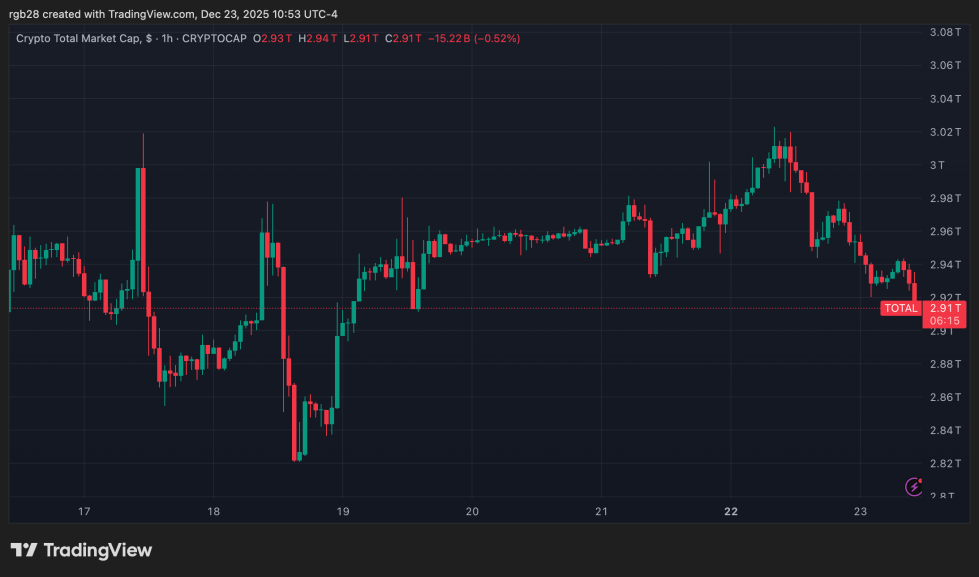
The total crypto market capitalization is at $2.91 trillion in the one-week chart. Source: TOTAL on TradingView


Perguntas relacionadas

QWhat was the main goal of BC Card's pilot project regarding stablecoins?

AThe main goal was to verify the stability and convenience of using card-integrated stablecoins for payments by foreigners at domestic merchants, assessing their practical use within the domestic payment environment.

QWhich companies collaborated with BC Card on the stablecoin payment pilot?

ABC Card collaborated with blockchain financial firm Wavebridge, overseas digital wallet company Aaron Group, and remittance fintech company Global Money Express.

QHow did foreign users utilize their stablecoins for payments in the pilot project?

AForeign users converted their stablecoins held in overseas wallets into digital prepaid cards that could be used at domestic merchants via QR code, without needing a physical card or currency exchange.

QWhy was the South Korean government's bill for the Second Phase of the Virtual Asset User Protection Act delayed?

AThe bill was delayed because the Financial Services Commission (FSC) and the Bank of Korea (BOK) failed to resolve their differences over the issuance of won-denominated stablecoins, particularly regarding the extent of banks' role in the issuance process.

QWhat is BC Card's future plan regarding stablecoin payments in South Korea?

ABC Card aims to lead the establishment of a 'Korean-style stablecoin payment infrastructure' by progressively advancing a payment model compliant with domestic regulations, leveraging its card payment infrastructure and strengthening cooperation with relevant agencies.

Leituras Relacionadas

Huang Renxun Dramatically 'Saves' South Korean Stock Market

In early June, South Korea's stock market experienced a sharp decline, with the KOSPI index dropping over 5% and triggering a trading halt. Amid this volatility, NVIDIA CEO Jensen Huang's visit to Seoul provided a dramatic boost to market sentiment. During his trip, Huang held a dinner meeting with SK Group Chairman Chey Tae-won and SK Hynix CEO Kwak Noh-Jung. He announced that NVIDIA's new Vera CPU would utilize SK Hynix DRAM and confirmed a multi-year technical collaboration between the two companies. This partnership aims to co-develop next-generation memory for NVIDIA's AI infrastructure roadmap, covering products from data center supercomputers to personal AI devices. Huang also publicly commented that AI company stocks were attractively priced. A key announcement was that NVIDIA's upcoming Vera Rubin AI supercomputer systems will use HBM4 memory, with supply qualifications granted to all three major suppliers: SK Hynix, Samsung Electronics, and Micron Technology. Despite this multi-sourcing strategy, Huang warned that the industry-wide chip shortage, affecting everything from wafers to packaging, is expected to persist for several years due to relentless demand from global AI factory construction. The collaboration extends beyond memory supply. SK Hynix will employ NVIDIA's AI platforms and Omniverse digital twin technology to enhance its own semiconductor design, simulation, and manufacturing processes, aiming for more autonomous factory operations. This visit builds upon a prior October 2025 agreement for SK Group to build a large-scale AI data center using over 50,000 NVIDIA GPUs. Huang's itinerary also included meetings with other Korean giants like Hyundai, LG, and Samsung, indicating NVIDIA's broader strategy to deepen ties with South Korea's tech industry.

链捕手Há 58m

Huang Renxun Dramatically 'Saves' South Korean Stock Market

链捕手Há 58m

When Inference Becomes a Scarce Resource, Who Captures the Value?

When Inference Becomes the Scarce Resource, Who Captures the Value? The core AI bottleneck has shifted from model training to inference (runtime execution). While concerns persisted about an "AI compute gap"—initially a $200B, now a $600B problem—the market is now recognizing that the solution and value lie in the inference layer. Nvidia's financial restructuring around "serving tokens" and Cerebras's successful IPO highlight this shift. Inference is a recurring, usage-based cost, estimated to be 10-50x larger than the one-time training market, especially with the rise of agentic AI. The inference stack spans six layers: silicon (e.g., Nvidia), bare metal (e.g., CoreWeave), GPU rental/aggregation, deployment/optimization, model APIs, and end applications. Most companies operate in one layer. However, Hyperbolic uniquely spans three layers (GPU rental, deployment, and model APIs) without owning any hardware. It aggregates fragmented GPU supply from multiple cloud providers into a standardized pool, offering developers the cheapest available compute through intelligent routing. Its multi-cloud aggregation creates a data moat and a flywheel: more supply leads to better pricing data and liquidity, attracting more developers and providers. In contrast, applications like Venice operate at the top of the stack, reselling privacy-wrapped inference but remaining dependent on and constrained by the underlying compute costs they purchase. As inference demand explodes, value accrues not just to consumer applications but increasingly to the aggregation and routing layer that captures their cost of revenue. The coming potential GPU oversupply reinforces this dynamic. While hardware owners may suffer from depreciation, asset-light aggregators like Hyperbolic benefit from price arbitrage, routing workloads to the cheapest available capacity. The ultimate winner in the inference economy may not be the entity with the most GPUs, but the one that can most efficiently discover, aggregate, and route the world's fragmented compute.

链捕手Há 1h

When Inference Becomes a Scarce Resource, Who Captures the Value?

链捕手Há 1h

Trading

Spot
Futuros
活动图片




