South Korea Joins Global Bitcoin Spot ETF Push, Targets 2026 Rollout

bitcoinistPublicado em 2026-01-10Última atualização em 2026-01-10

Resumo

South Korea has announced plans to introduce Bitcoin spot exchange-traded funds (ETFs) by 2026 as part of its broader digital asset reforms. The government is using the established spot crypto ETF markets in the US and Hong Kong as key references for its framework. These ETFs allow investors to gain exposure to cryptocurrencies like Bitcoin without directly owning the assets. In addition to ETFs, South Korea's Financial Services Commission is accelerating legislation to establish a regulatory framework for stablecoins. The announcement comes as US Bitcoin spot ETFs have recently experienced significant outflows, with the latest weekly netflow reported at a negative $431 million. Concurrently, Bitcoin's price has retraced to approximately $90,500.

South Korea has announced plans to introduce Bitcoin spot exchange-traded funds (ETFs) in 2026 as part of broader digital asset reforms.

South Korea Using US & Hong Kong Crypto Spot ETFs As A Reference

South Korea revealed in its 2026 Economic Growth Strategy plans to allow spot digital asset ETFs this year, according to Wu Blockchain, citing local media outlet News1.

Spot ETFs are investment vehicles that allow traders to gain exposure to an underlying asset without having to directly own it. Such vehicles trade in the traditional markets, so investors of a spot ETF tied to a cryptocurrency never have to interact with blockchain components like wallets and exchanges.

Instead, the funds buy and custody the assets on behalf of investors. In recent years, spot ETFs tied to cryptocurrencies like Bitcoin have gained adoption in different regions of the world as DeFi and TradFi intersect.

The US Securities and Exchange Commission (SEC) approved spot ETFs for Bitcoin in January 2024 and Ethereum in July 2024, while the Hong Kong Securities and Futures Commission (SFC) allowed both in April 2024. Approvals related to altcoins like Solana followed in 2025.

Now, it would appear that South Korea is also looking to join the fray. Per the report, the country’s government has explicitly cited the digital asset spot ETF markets active in the US and Hong Kong as key reference points. Plans related to spot ETFs aren’t all that South Korea has announced. The Financial Services Commission (FSC) of the country is also accelerating the next phase of its digital asset legislation, which will establish a framework for stablecoins.

In the East Asian bloc, other governments have already made progress on stablecoins. Hong Kong enacted its stablecoin legislation in August, while Japan saw the launch of its first yen-backed token in October. While South Korea has set a timeframe of 2026, it’s unknown when exactly spot ETFs could be introduced. As such, it only remains to be seen what plans the government will reveal next and which assets besides Bitcoin will be covered.

Speaking of spot Bitcoin ETFs, these funds have been facing outflows in the US recently, as data from SoSoValue shows.
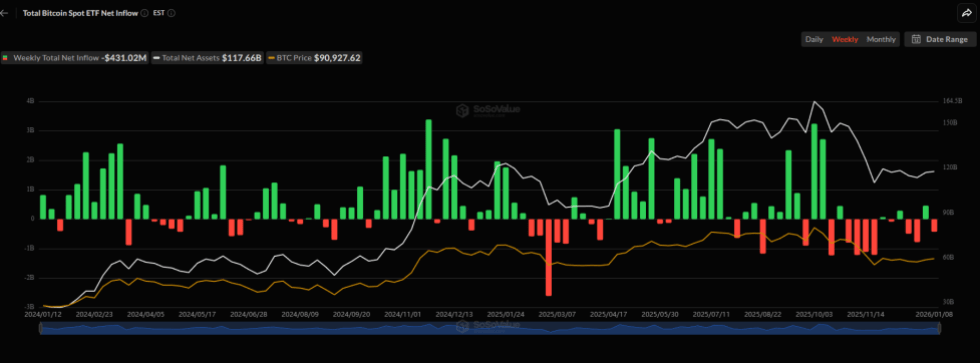
How the spot BTC ETF netflow has changed over the last couple of years | Source: SoSoValue

From the chart, it’s visible that the Bitcoin spot ETF weekly netflow has mostly been negative since the cryptocurrency’s decline started in October. There were a few weeks that saw a positive value, but the scale of net inflows remained limited.

The netflow for the latest week has stood at a negative $431 million, meaning that the US funds are continuing to bleed.

BTC Price

Bitcoin has erased some of its recent gains as its price has retraced back to $90,500.

Looks like the price of the coin has gone down recently | Source: BTCUSDT on TradingView


Perguntas relacionadas

QWhat is the timeline for South Korea's introduction of Bitcoin spot ETFs?

ASouth Korea plans to introduce Bitcoin spot exchange-traded funds (ETFs) in 2026 as part of its broader digital asset reforms.

QWhich two markets did South Korea cite as key reference points for its digital asset spot ETF plans?

ASouth Korea's government cited the digital asset spot ETF markets active in the United States and Hong Kong as key reference points.

QBesides spot ETFs, what other major digital asset legislation is South Korea's Financial Services Commission (FSC) accelerating?

AThe Financial Services Commission (FSC) of South Korea is also accelerating the next phase of its digital asset legislation to establish a framework for stablecoins.

QWhat was the netflow for the latest week for US Bitcoin spot ETFs, according to data from SoSoValue?

AThe netflow for the latest week for US Bitcoin spot ETFs was a negative $431 million, indicating continued outflows.

QWhat was the price of Bitcoin mentioned at the end of the article?

AAt the end of the article, the price of Bitcoin had retraced back to $90,500.

Leituras Relacionadas

OpenAI's 'Blueprint for the Future': Making AI Beneficial for Every Person on the Planet

A new transformative technology emerges every few generations. OpenAI draws a parallel with the advent of electricity in the 1920s, which initially brought convenience but ultimately enabled unprecedented progress in medicine, engineering, and living standards by empowering people to create new possibilities. AI is poised to recreate this phenomenon. Its true significance lies not in the technology itself, but in what people can achieve with it—from understanding a medical bill or starting a business to aiding scientific discovery. OpenAI believes AI should be universally accessible, allowing everyone to use it according to their own needs. This future, however, is not guaranteed. While transformative tech can centralize power, OpenAI's philosophy is that AI must serve humanity, augmenting human capabilities and broadly distributing its benefits. The company's first commitment is to build AI for human service, aiming to empower the many rather than concentrate power in a few. Safety, alignment with human intent, and oversight are paramount. OpenAI is optimistic about AI's potential to expand human welfare but remains clear-eyed about risks. The goal is to help people achieve more, not to replace them. Full automation is not the desired future; human judgment, values, and direction will become even more critical. OpenAI outlines three core goals: 1. Build automated AI researchers to accelerate and increasingly automate the research process itself, maintaining close human collaboration. The internal projection is that by March 2028, a significant portion of their research will be conducted by AI systems working alongside human researchers. 2. Accelerate economic development by advancing science, boosting productivity, and fostering growth, while ensuring the fruits are widely shared. 3. Provide a personal AGI for everyone on Earth, allowing individuals to benefit from this transformative technology in their own way. The company is entering its third phase, moving from foundational AGI research (Phase 1) to product deployment and learning from real-world use (Phase 2). The current challenge is making advanced AI abundant, affordable, safe, practical, and usable for all individuals and organizations. OpenAI concludes that a widely distributed power structure leads to a more resilient, adaptable, and free society. A positive AI future should not be controlled by a handful of entities but built, benefited from, and owned by many. If realized correctly, AI can become a cornerstone for enhancing global productivity, creativity, scientific advancement, and economic opportunity, fulfilling the mission to ensure AGI benefits all of humanity.

marsbitHá 20m

OpenAI's 'Blueprint for the Future': Making AI Beneficial for Every Person on the Planet

marsbitHá 20m

Arthur Hayes' New Article: AI Bubble Nears Bursting, Crypto Market Faces Short-Term Pressure

In a new essay, Arthur Hayes argues that the AI market bubble is approaching a rupture, which will place significant short-term pressure on crypto assets. He identifies rising oil prices, a trio of massive tech IPOs (SpaceX, Anthropic, OpenAI), and potential anti-AI political rhetoric from Trump as the three key catalysts for a correction. Hayes posits that the prolonged blockage of the Strait of Hormuz will drive energy prices higher, increasing operational costs for data centers and squeezing AI company profits. Simultaneously, the market may struggle to absorb the upcoming wave of multi-trillion dollar tech IPOs. Furthermore, with high inflation hurting his election chances, Trump could pivot to attacking the AI sector with proposals for heavy taxation and regulation to win over voters, spooking the market. Hayes notes that nearly all new dollar liquidity since 2022 has flowed into the AI sector, leaving little for Bitcoin, explaining its recent underperformance. He believes an AI stock crash would trigger a broad risk-off sentiment and credit contraction, dragging down crypto in the near term. Consequently, his fund, Maelstrom, has sold all AI-related stocks and non-core cryptocurrencies, retaining only Bitcoin and Ethereum while building positions in traditional energy stocks. He anticipates Bitcoin will bottom and resume its bull run only after the AI bubble pops and a new monetary easing cycle begins.

marsbitHá 23m

Arthur Hayes' New Article: AI Bubble Nears Bursting, Crypto Market Faces Short-Term Pressure

marsbitHá 23m

Trading

Spot
Futuros

Artigos em Destaque

Como comprar PUSH

Bem-vindo à HTX.com!Tornámos a compra de Push Protocol (PUSH) simples e conveniente.Segue o nosso guia passo a passo para iniciar a tua jornada no mundo das criptos.Passo 1: cria a tua conta HTXUtiliza o teu e-mail ou número de telefone para te inscreveres numa conta gratuita na HTX.Desfruta de um processo de inscrição sem complicações e desbloqueia todas as funcionalidades.Obter a minha contaPasso 2: vai para Comprar Cripto e escolhe o teu método de pagamentoCartão de crédito/débito: usa o teu visa ou mastercard para comprar Push Protocol (PUSH) instantaneamente.Saldo: usa os fundos da tua conta HTX para transacionar sem problemas.Terceiros: adicionamos métodos de pagamento populares, como Google Pay e Apple Pay, para aumentar a conveniência.P2P: transaciona diretamente com outros utilizadores na HTX.Mercado de balcão (OTC): oferecemos serviços personalizados e taxas de câmbio competitivas para os traders.Passo 3: armazena teu Push Protocol (PUSH)Depois de comprar o teu Push Protocol (PUSH), armazena-o na tua conta HTX.Alternativamente, podes enviá-lo para outro lugar através de transferência blockchain ou usá-lo para transacionar outras criptomoedas.Passo 4: transaciona Push Protocol (PUSH)Transaciona facilmente Push Protocol (PUSH) no mercado à vista da HTX.Acede simplesmente à tua conta, seleciona o teu par de trading, executa as tuas transações e monitoriza em tempo real.Oferecemos uma experiência de fácil utilização tanto para principiantes como para traders experientes.

518 Visualizações TotaisPublicado em {updateTime}Atualizado em 2026.06.02

Como comprar PUSH

Discussões

Bem-vindo à Comunidade HTX. Aqui, pode manter-se informado sobre os mais recentes desenvolvimentos da plataforma e obter acesso a análises profissionais de mercado. As opiniões dos utilizadores sobre o preço de PUSH (PUSH) são apresentadas abaixo.

活动图片












