Soothsayer Predicted Hantavirus 4 Years Ago, Are 'Prophets' in the Market Hidden Among the People?

Odaily星球日报Publicado em 2026-05-08Última atualização em 2026-05-08

Resumo

A purported "soothsayer" account on X, @soothsayer, posted a cryptic tweet in June 2022 predicting the end of COVID-19 in 2023 and the later emergence of the Hantavirus. This old post resurfaced and went viral following recent Hantavirus cases linked to a cruise ship, the "Hondius," which has resulted in 3 deaths and 8 infections. While the WHO has clarified there is no large-scale outbreak and the specific Andeans virus strain has limited human-to-human transmission, the incident has fueled public anxiety and online speculation. The crypto market quickly absorbed this narrative. A Meme token named HANTA, created a year prior, saw its market cap rise to around $12 million. Prediction markets on Polymarket and Predict.fun also launched betting pools on whether the Hantavirus would be declared a pandemic by the end of 2026, with millions of dollars in wagers reflecting public sentiment. The event highlights how cryptocurrency markets rapidly convert public attention, fear, and speculation into tradable assets. The mysterious @soothsayer account, which posted only 5 times, has since gone inactive, adding an aura of urban legend to the episode and underscoring the internet's power to blend coincidence, emotion, and narrative.

Original|Odaily Planet Daily (@OdailyChina)

Author|Wenser(@wenser 2010 )
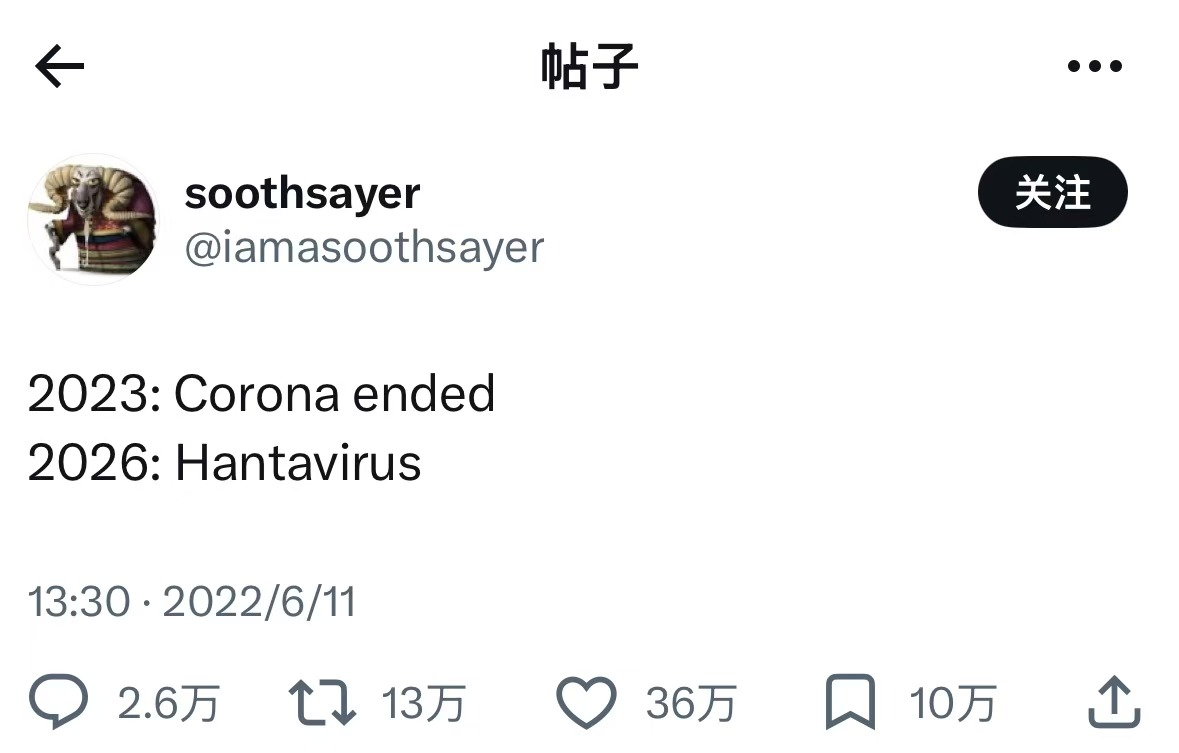
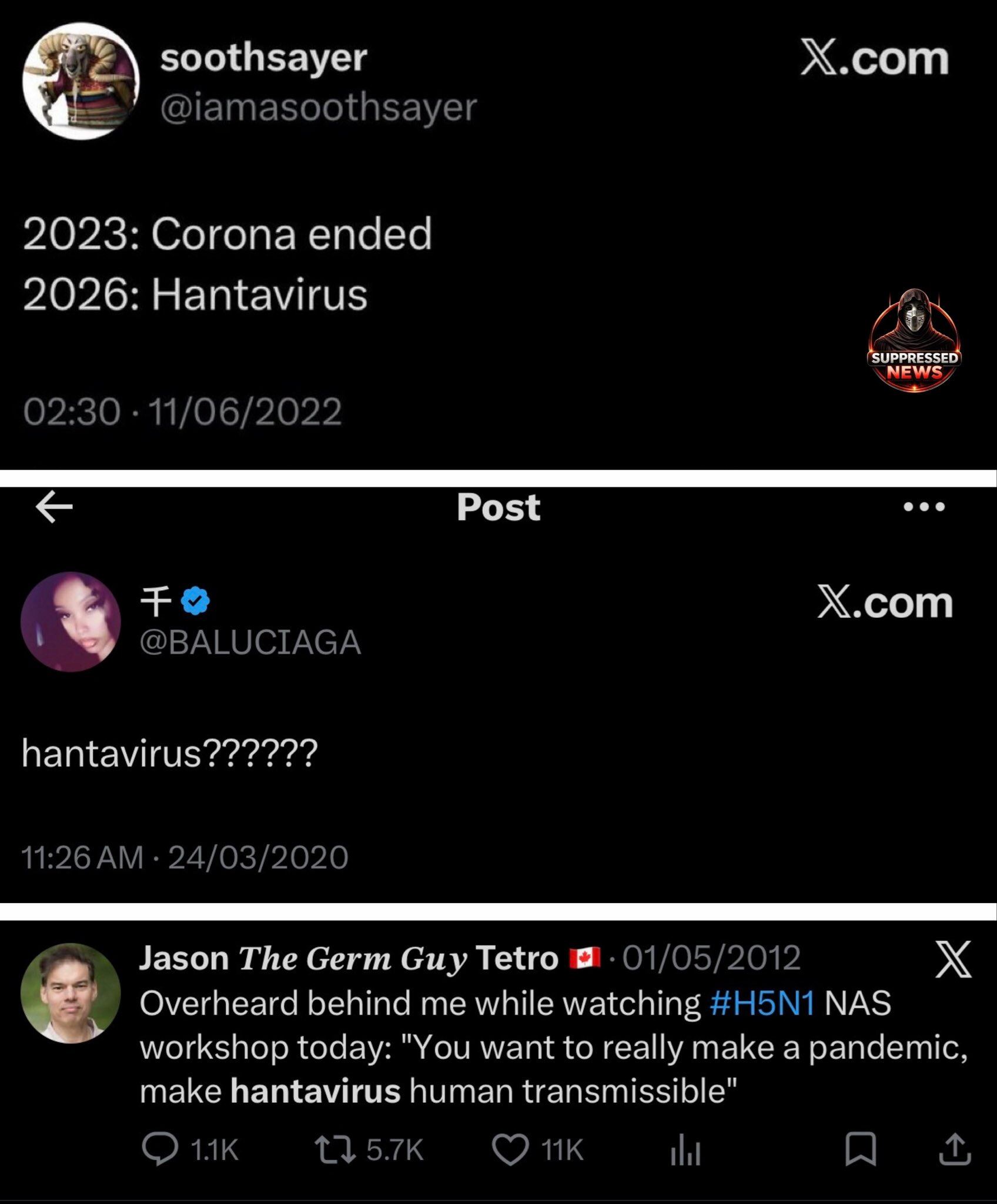
Last night, an old tweet from June 11, 2022, detonated the public opinion field on platform X like a nuclear bomb. This tweet came from a fortune-teller claiming to be able to "read the future," not only predicting the end of the COVID-19 pandemic in 2023 but also, prophetically, accurately mentioning the recent emergence of the Hantavirus.

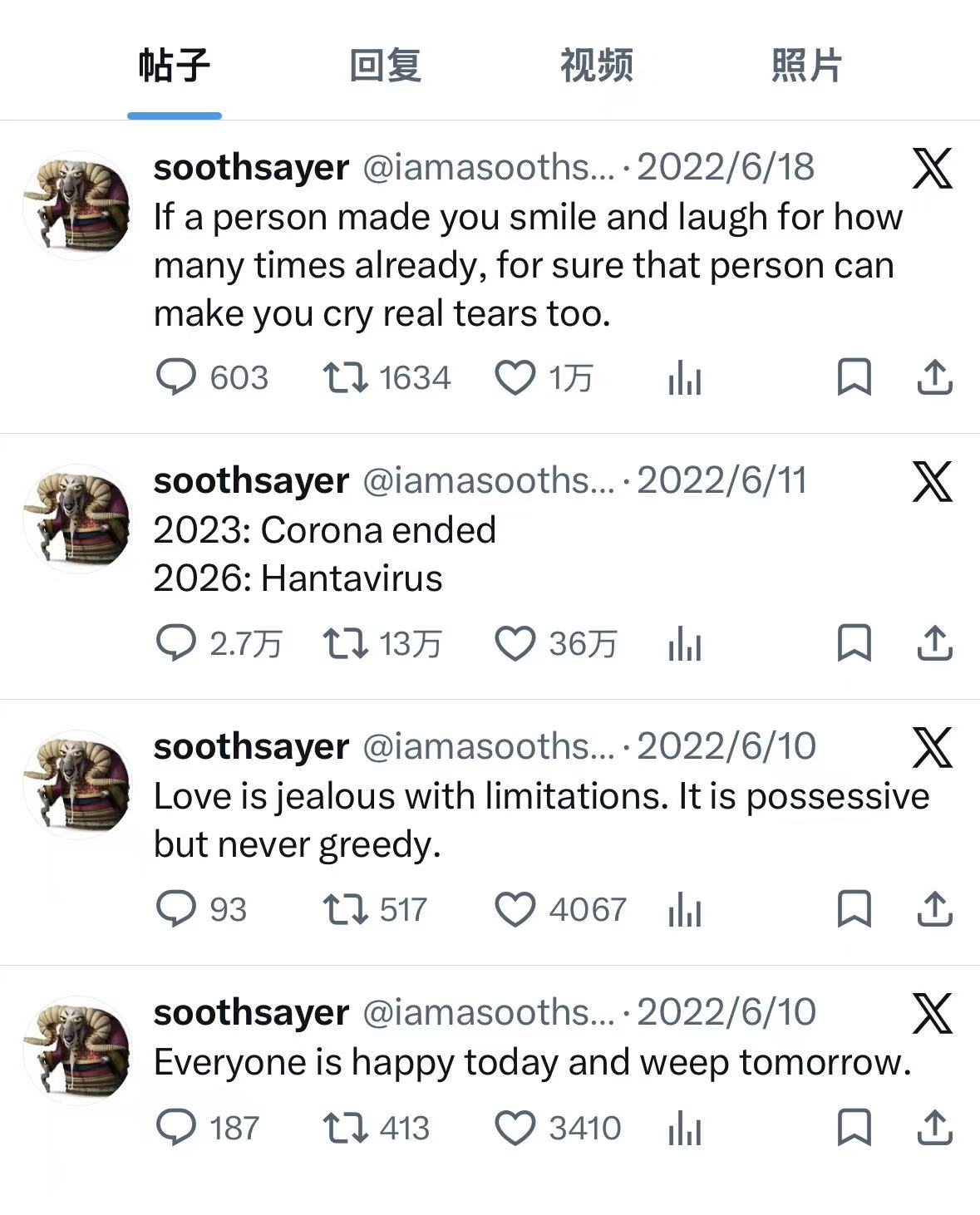
For a moment, countless people flocked to it, leaving various comments, but the account disappeared after only 5 tweets, gone without a trace, adding a mysterious touch reminiscent of an urban legend.

In the wake of the uncertainty left by the post-pandemic era, discussions related to Hantavirus quickly spilled over from public health topics, evolving into emotional amplifiers on social media. They were also rapidly absorbed by the crypto market as a new trading narrative, from Meme coins to prediction markets—speculative funds always find the points of emotional intensity first.

Amidst the indistinguishable flow of information and the resonance of group emotions, the crypto market once again showcased its instinct: rapidly converting attention, anxiety, and expectations into tradable products and prices.

A Mysterious Tweet from 4 Years Ago Linked to the Recent Cruise Ship Virus That Killed 3

The story begins with an account named @soothsayer.

This account, which only posted 5 tweets, had received little attention before. If you ignored that "Hantavirus prophecy" tweet, you might think this account was no different from the ordinary ones on X that post "inspirational quotes" and "motivational sayings" daily.

But as Hantavirus topics kept heating up these past few days, this old tweet took on a flavor of "cyber mysticism."
In April this year, a cruise ship named "Hondius" departed from Argentina in South America, originally planning to cross the entire Atlantic to the Canary Islands in Spain. However, during the voyage, a Dutch man suddenly died on board, later confirmed to be due to Hantavirus. As of May 6, the death toll had risen to 3, with infections increasing to 8, including tourists from the Netherlands, the UK, Germany, and other places. Currently, the cruise ship is temporarily denied docking due to Hantavirus, and the WHO is closely monitoring the situation. Notably, around 30 passengers disembarked from the ship two weeks prior without tracking procedures and have dispersed to 12 countries.

Therefore, although the WHO clarified that the virus had not previously shown large-scale transmission, it inevitably caused public panic, with many exclaiming, "It reminds me of the fear of being controlled by COVID."
It is worth noting that, according to test results from the South African National Institute for Communicable Diseases and the University Hospitals of Geneva, Switzerland, the virus type in this outbreak has been confirmed as the Andes Hantavirus.

The vast majority of Hantaviruses are not transmissible from human to human, but the Andes virus is the only exception; this transmission usually occurs among close contacts like family members or healthcare workers. Additionally, Hantaviruses mostly infect humans through "rodent-borne" routes, primarily via three transmission methods: respiratory infection, i.e., inhaling aerosols contaminated by rodent excreta; contact infection, i.e., broken skin or mucous membranes directly contacting excreta from infected rodents; and digestive tract infection, i.e., consuming food contaminated by rodent excreta.

As for the concern many have about whether the virus will spread to China, reliable sources indicate that in China, diseases caused by Hantavirus are known as "epidemic hemorrhagic fever." China has achieved significant success in the prevention and treatment of this virus and its associated illnesses, and there is currently no risk of a large-scale outbreak; the Chinese Embassy in Cape Verde previously issued a notice confirming that there were no Chinese citizens on the ship.

Looking back at the "fortune-teller's" tweet, it not only directly mentioned Hantavirus but was also posted four years ago, making it indeed highly topical.

Hantavirus in Crypto: Meme Coins and Prediction Markets

Following the emergence of Hantavirus, the crypto market also experienced tremors, with Meme coins and prediction markets quickly putting on their own performances.

Community members dug up a Meme coin created a year ago, officially launched on external markets on May 4th: HANTA (Hantavirus) Meme coin (2tXpgu2DLTsPUf9zFmuZmA4xrYxXKBTpVq9wAM7hzs9y). Its current market cap is temporarily reported at $12 million, making it a veritable "OG launch."

Furthermore, in terms of prediction markets, both Polymarket and Predict.fun have listed betting events related to Hantavirus.

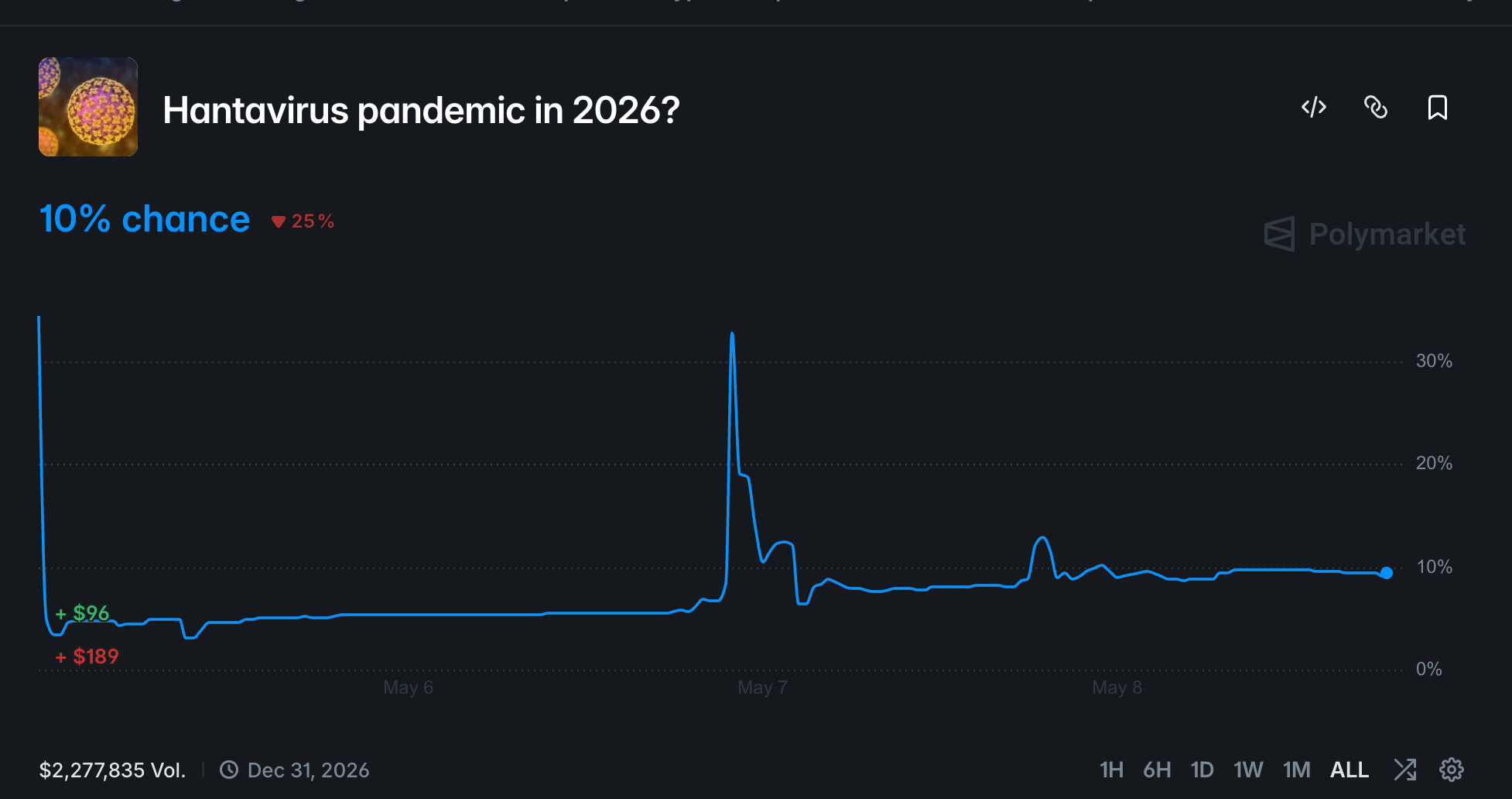
On Polymarket, the probability of the "2026 Hantavirus Pandemic" event occurring is temporarily reported at 10%, having previously surged to nearly 35%; the betting amount is currently around $2.27 million. Its settlement rule is: "If the World Health Organization, in official public communications from market creation until 11:59 PM EST on December 31, 2026, explicitly characterizes an outbreak of Hantavirus, Hantavirus Pulmonary Syndrome (HPS), Hemorrhagic Fever with Renal Syndrome (HFRS), or a Hantavirus-related outbreak as a 'pandemic,' this market will settle to 'Yes'; otherwise, this market will settle to 'No.' Explicit characterization includes official WHO statements, reports, press conferences, or publications that clearly describe the outbreak as a 'pandemic.' Declaring it a Public Health Emergency of International Concern (PHEIC) alone does not qualify unless it is also described as a pandemic. The primary settlement source for this market will be official WHO communications. Consensus from credible reporting may also serve as a source."
The probability for the similarly named betting event on the Predict.fun platform is temporarily reported at 11%, slightly higher than Polymarket's data; the betting volume is smaller, only around $4,400. Its settlement rules are similar to Polymarket's, also relying on the WHO's public statements.
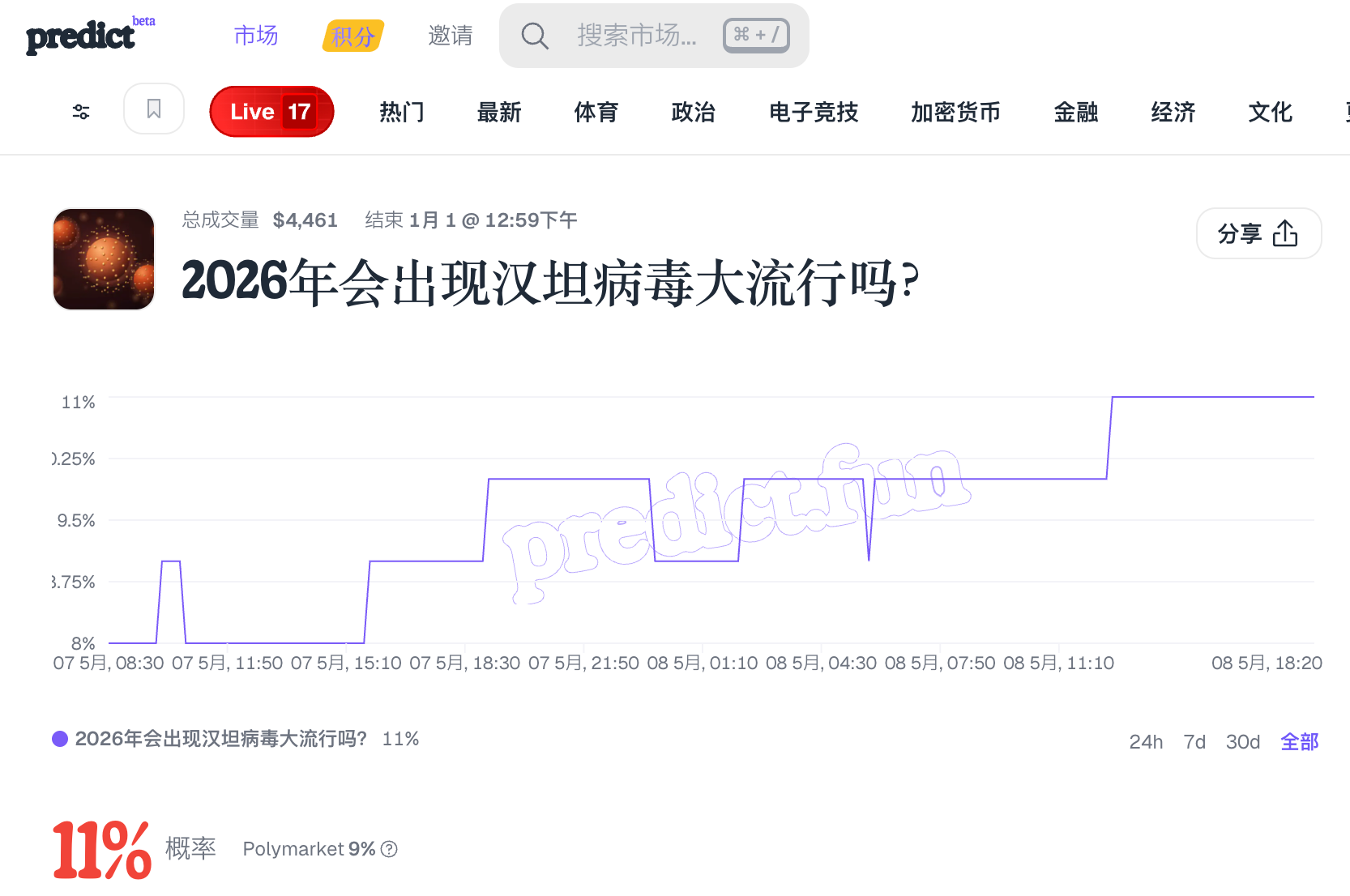
For many people, betting real money on the future is inherently addictive. The reason prediction markets are getting hotter is essentially because they turn humanity's anxiety, curiosity, and desire for the unknown directly into tradable commodities.

Finally, let's turn our attention back to platform X. There, numerous old posts about "Hantavirus" are still scattered, some posted in 2020, some even dating back to 2012. Some people fish out fragments as "divine prophecies," some piece together blurry screenshots into complete stories, and others firmly believe everything was already pre-written.

Truth or falsehood isn't important; what's truly fascinating is how the internet always manages to mix coincidence, fear, emotion, and imagination into something between reality and urban legend, making you unable to resist clicking to take a look.

Just like the words left by that fortune-teller @soothsayer: "Today's laughter, tomorrow's tears."

Perguntas relacionadas

QWhat event did a 2022 tweet from an account called @soothsayer supposedly predict, according to the article?

AAccording to the article, the 2022 tweet from the account @soothsayer predicted the Hantavirus. It also reportedly predicted that Covid-19 would end in 2023.

QWhat triggered the recent public discussion and market activity related to Hantavirus?

AThe recent public discussion was triggered by an outbreak of Hantavirus on the cruise ship 'Grendius,' which resulted in three deaths and eight infections among passengers from various European countries.

QAccording to the article, how has the cryptocurrency market reacted to the news about Hantavirus?

AThe cryptocurrency market has reacted by creating tradable assets and predictions related to the virus. This includes the emergence of a Hantavirus-themed meme coin (HANTA) and prediction markets on platforms like Polymarket and Predict.fun, where users can bet on whether the virus will be declared a pandemic by 2026.

QWhat is the Andean virus, and why is it specifically mentioned in relation to this Hantavirus outbreak?

AThe Andean virus is a specific type of Hantavirus. It is mentioned because it was the strain confirmed in the recent cruise ship outbreak. This strain is notable because it is the only known Hantavirus that can be transmitted from person to person, typically through close contact.

QHow do the prediction markets Polymarket and Predict.fun determine the outcome of their 'Hantavirus pandemic' bets?

AThese markets base their settlement on official statements from the World Health Organization (WHO). For a 'Yes' outcome, the WHO must explicitly characterize a Hantavirus-related outbreak as a 'pandemic' in an official public communication between the market's creation date and December 31, 2026. Merely declaring it a Public Health Emergency of International Concern (PHEIC) is not sufficient unless it is also described as a pandemic.

Leituras Relacionadas

Apple Also Has to Pay Rent Now

Apple Pays Rent Too: The Two-Way Flow of "Traffic Tax" and "AI Capability Rent" Between Tech Giants For over two decades, Google has paid Apple an estimated $20 billion annually to remain the default search engine on Safari, a "traffic tax" for a critical user entry point. However, in 2026, the direction of this cash flow partially reversed. Apple agreed to pay Google roughly $1 billion per year to license its Gemini AI models, as Apple's own models reportedly struggled with complex tasks. This creates a unique dynamic: Apple acts as the "landlord" in the established search ecosystem, collecting rent from Google for access. Simultaneously, in the emerging AI arena, Apple becomes the "tenant," paying Google for access to cutting-edge AI capabilities it cannot currently match internally. While Apple claims its new models are "distilled" from Gemini outputs and contain "not a drop" of Google's original code, core dependencies remain. Its knowledge base is refined using Gemini's outputs, and its most powerful cloud model runs on Google's infrastructure. Apple has structured the deal as non-exclusive, allowing it to theoretically switch AI suppliers—a hedge against over-reliance. The future hinges on whether advanced AI models become a commodity (cheap and abundant) or remain a concentrated, scarce resource (expensive and controlled by few). Apple is betting on the former, leveraging its massive device ecosystem to be a powerful, choosy customer. If the latter proves true, its bargaining power could erode. This power dynamic is extending to developers. Apple, Google, and WeChat are all pushing for apps to expose their core functions as standardized "actions" or "intents" that their respective AI assistants (Siri, Gemini, WeChat AI) can directly call. The new scarce resource is no longer just app store visibility, but "being selected by the AI." The currency of "rent" has changed from a 30% revenue share to ceding control over how users interact with an app's functions.

marsbitHá 1h

Apple Also Has to Pay Rent Now

marsbitHá 1h

Missed the SpaceX IPO? WEEX's "First Trade Protection" Lets You Experience US Stock Trading Risk-Free.

With the excitement around SpaceX's recent public listing reigniting interest in the US stock market, Chinese investors face significant challenges accessing compliant and convenient trading channels following regulatory actions against major online brokers. This article explores the available options, highlighting their risks and limitations. Traditional paths for US stock investments remain problematic. Qualified Domestic Institutional Investor (QDII) and Listed Open-Ended Fund (LOF) products, while compliant, suffer from high fees, significant purchase premiums, and a very limited selection of assets. Small, unregulated offshore brokers pose substantial risks, including potential insolvency. While secure, VIP accounts at banks in Hong Kong or Singapore require high minimum deposits (often 1-2 million RMB) and in-person visits, placing them out of reach for most retail investors. The article positions cryptocurrency exchanges, specifically their TradFi (traditional finance on-chain) offerings, as a compelling alternative. Platforms like WEEX are noted for providing access to a wide range of US stocks and ETFs, including SpaceX (SPCXON), through tokenized assets. This method offers advantages such as a single account for both crypto and traditional assets, USDT-based settlement avoiding fiat complexities, flexible leverage, and robust risk management. To attract users, WEEX is promoting a "First Trade Guarantee" campaign. Running from June 15 to July 8 (UTC+8), it features a $30,000 prize pool. Users who trade $500 worth of US stock contracts can qualify for a guarantee on their first eligible trade: 100% loss coverage up to $30 or a 20% bonus on profits up to $30. The campaign is presented as a low-risk opportunity for both crypto natives and traditional investors to experience US stock trading.

marsbitHá 1h

Missed the SpaceX IPO? WEEX's "First Trade Protection" Lets You Experience US Stock Trading Risk-Free.

marsbitHá 1h

How Difficult is Chip Making? A Division Error Costs 475 Million Dollars

How Hard Is It to Make a Chip? A Division Error Cost $475 Million Chip expert Shi Kan, a researcher at the Chinese Academy of Sciences and a popular tech creator, explains the immense challenges of chip development. Chips are foundational to modern technology, but their creation is extraordinarily difficult. The journey from sand to a functional chip involves complex design and manufacturing, but a critical bottleneck is verification—ensuring the design works flawlessly before costly production. A single, undetected bug can have catastrophic consequences, as illustrated by the infamous 1994 Intel Pentium FDIV bug. A flaw in the floating-point division unit forced a recall costing $475 million. Unlike software, chips cannot be easily patched after manufacture, making "first-time success" paramount. However, industry surveys show only 24% of chip projects achieve this; over three-quarters require at least one costly re-spin due to design flaws. Verification has thus become the dominant phase, consuming up to 70% of the design cycle. The core challenge is a "verification impossible triangle" between high performance, good debuggability, and low cost. Exhaustively verifying a modern CPU core could take 15,000 years with software simulation, or 30 years with advanced hardware emulation—timeframes utterly impractical for development. Despite being essential, verification is often seen as unglamorous "dirty work," receiving less academic attention than fields like AI. Shi and his team are tackling this by developing an agile verification research framework called ENCORE, based on FPGA technology, to improve verification efficiency and debug capability. Beyond research, Shi engages in public science communication through long-form video content, aiming to demystify chip technology, AI, and computer science. He argues for the value of pursuing "hard and long-term" endeavors, whether in the meticulous world of chip verification or in creating substantive educational content, believing such sustained effort is likely the right path forward.

marsbitHá 1h

How Difficult is Chip Making? A Division Error Costs 475 Million Dollars

marsbitHá 1h

Trading

Spot
Futuros

Artigos em Destaque

Como comprar 4

Bem-vindo à HTX.com!Tornámos a compra de 4 (4) simples e conveniente.Segue o nosso guia passo a passo para iniciar a tua jornada no mundo das criptos.Passo 1: cria a tua conta HTXUtiliza o teu e-mail ou número de telefone para te inscreveres numa conta gratuita na HTX.Desfruta de um processo de inscrição sem complicações e desbloqueia todas as funcionalidades.Obter a minha contaPasso 2: vai para Comprar Cripto e escolhe o teu método de pagamentoCartão de crédito/débito: usa o teu visa ou mastercard para comprar 4 (4) instantaneamente.Saldo: usa os fundos da tua conta HTX para transacionar sem problemas.Terceiros: adicionamos métodos de pagamento populares, como Google Pay e Apple Pay, para aumentar a conveniência.P2P: transaciona diretamente com outros utilizadores na HTX.Mercado de balcão (OTC): oferecemos serviços personalizados e taxas de câmbio competitivas para os traders.Passo 3: armazena teu 4 (4)Depois de comprar o teu 4 (4), armazena-o na tua conta HTX.Alternativamente, podes enviá-lo para outro lugar através de transferência blockchain ou usá-lo para transacionar outras criptomoedas.Passo 4: transaciona 4 (4)Transaciona facilmente 4 (4) no mercado à vista da HTX.Acede simplesmente à tua conta, seleciona o teu par de trading, executa as tuas transações e monitoriza em tempo real.Oferecemos uma experiência de fácil utilização tanto para principiantes como para traders experientes.

622 Visualizações TotaisPublicado em {updateTime}Atualizado em 2026.06.02

Como comprar 4

Discussões

Bem-vindo à Comunidade HTX. Aqui, pode manter-se informado sobre os mais recentes desenvolvimentos da plataforma e obter acesso a análises profissionais de mercado. As opiniões dos utilizadores sobre o preço de 4 (4) são apresentadas abaixo.

活动图片