Solana RWA holders jump 440% YoY – Can it bridge gap to Ethereum’s XAUT?

ambcryptoPublicado em 2026-04-06Última atualização em 2026-04-06

Resumo

Solana's RWA ecosystem is experiencing explosive growth, with a 440% year-over-year surge in holders, totaling 218,000. This positions Solana as a major hub for tokenized real-world assets, which now have a total on-chain market cap of $24 billion. While Tether Gold (XAUT) on Ethereum leads the RWA market at $3.3 billion, Solana is gaining momentum through its strong focus on tokenized U.S. Treasuries. These assets, which make up over 50% of the RWA market, could generate revenue to strengthen Solana's digital asset treasuries (DATs) and support long-term network growth. The IMF has warned that the rapid growth of on-chain RWAs could disrupt traditional finance. Solana's expansion in this sector suggests it could become a viable alternative to Ethereum for institutional capital seeking tokenized assets.

When the International Monetary Fund (IMF) sounds the alarm, it signals that the threat is real.

Recently, the IMF has been pointing out how fast the Real World Asset (RWA) market is growing on-chain, warning that TradFi players could fall behind if this keeps up.

The logic is simple: More real-world capital is moving onto blockchain, which could change how central banks manage money and financial stability.

Notably, the numbers back it up.

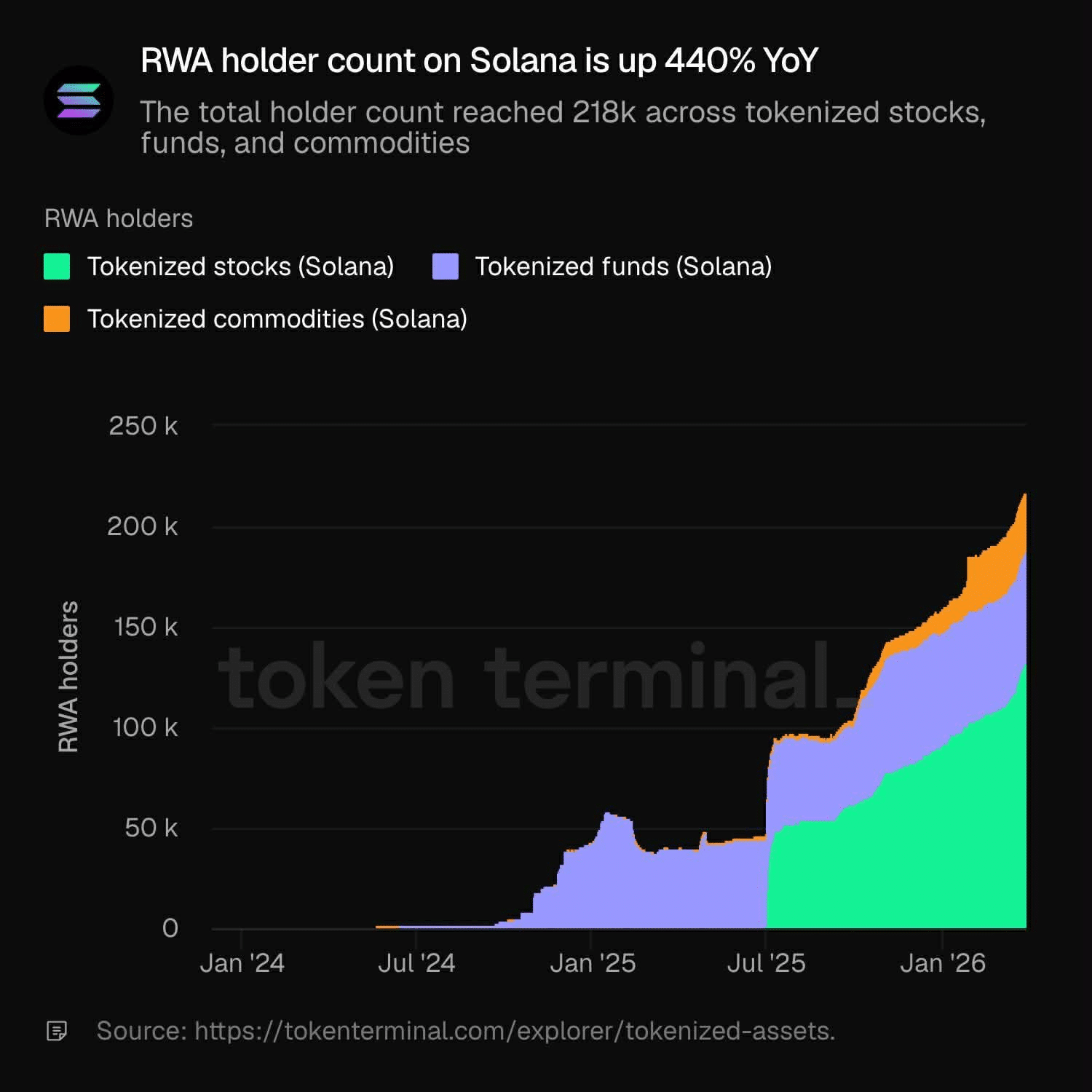
The on-chain market cap of total RWAs has just hit a new all-time high of $24 billion, with Tether Gold [XAUT] leading the pack at $3.3 billion. What’s really interesting is how the market reacted immediately, with much of the momentum flowing toward Solana [SOL] as more investors look to take advantage of its growing RWA ecosystem.
Source: Token Terminal

The real story? Solana’s RWA holder count.

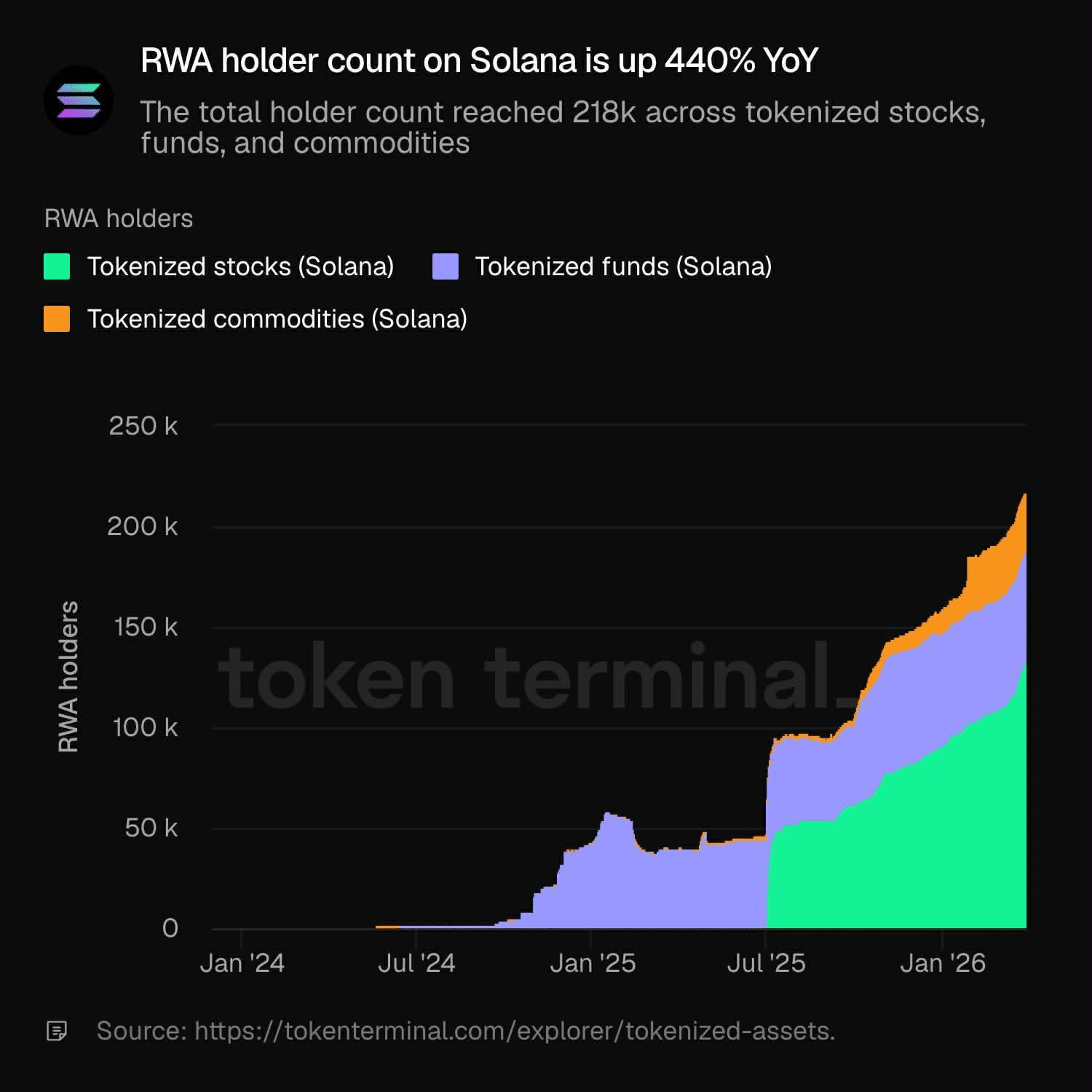
As the chart showed, the number of RWA holders on Solana was up 440% year-over-year, totaling 218,000 across tokenized stocks, funds, and commodities.

This surge signals more than hype.

Instead, it’s a clear sign that Solana is becoming a go-to network for tokenized real-world assets.

Against this backdrop, the IMF’s raising alarms starts to make sense.

XAUT’s lead in the RWA space is particularly noteworthy. Its growth comes at a time of heightened geopolitical tensions, which usually push capital into traditional safe havens.

But instead of sticking to the old playbook, investors are flowing into a tokenized version of gold, showing how RWAs are changing the way capital moves.

That said, this also complicates the narrative around Solana as the go-to network for RWAs.

XAUT currently trades only on Ethereum [ETH], raising the question: Can Solana capture this momentum indirectly, or does it need its own tokenized gold options to really cement its position in the RWA space?

Solana’s long road to dominating tokenized real-world assets

At the aggregate level, the RWA market is over 50% made up of U.S. Treasury assets.

Solana is clearly positioning itself to capture a slice of this momentum.

According to RWA.xyz, after stablecoins, Solana’s most concentrated RWAs are U.S. Treasuries, essentially tokenized versions of government debt that allow investors to hold U.S. debt on-chain and earn routine interest.

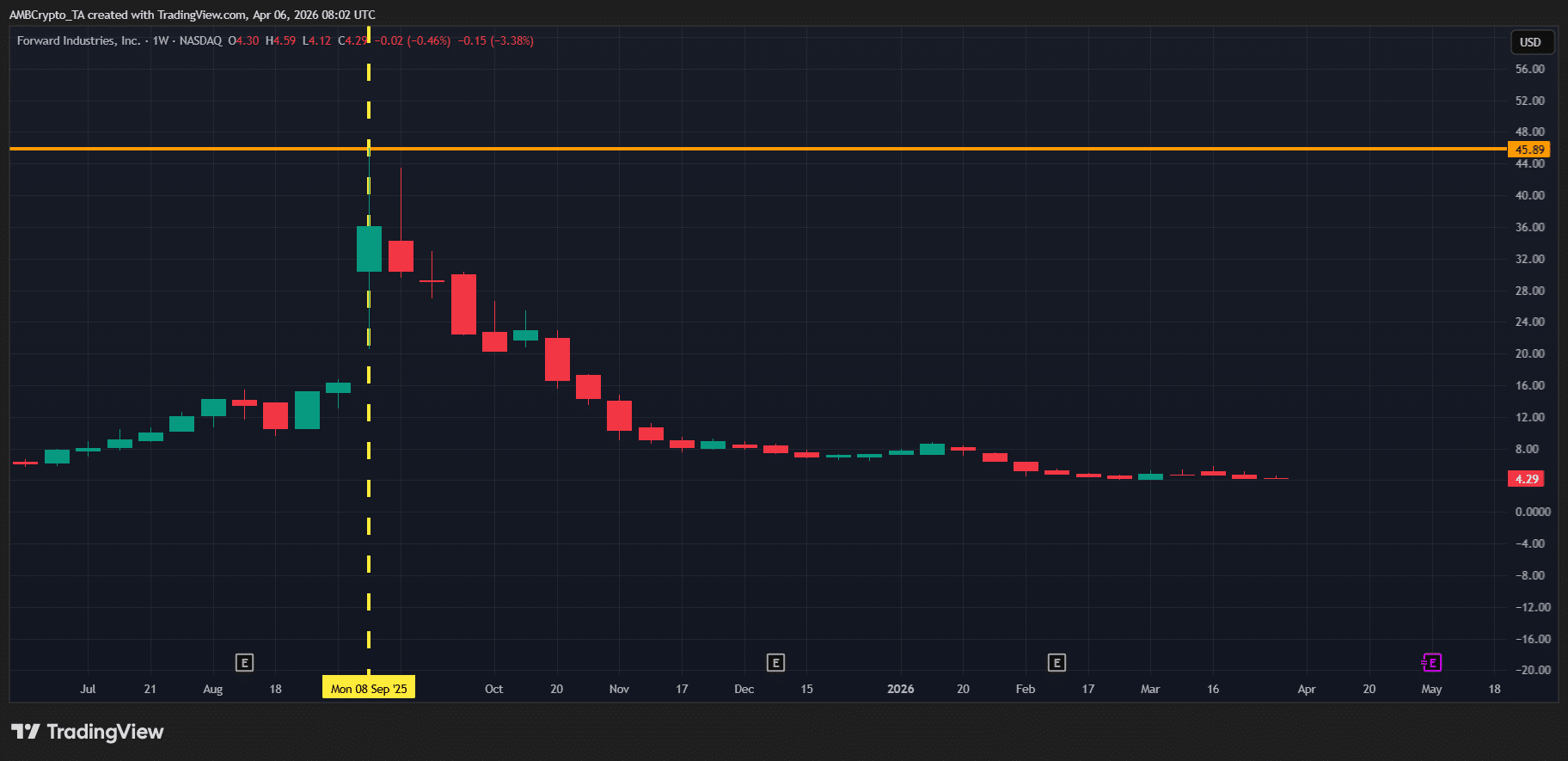
This is significant for a few reasons. Solana treasury companies are showing weak price action. Every small pump gets retraced, signaling that market confidence in treasuries hasn’t caught up with on-chain growth yet.

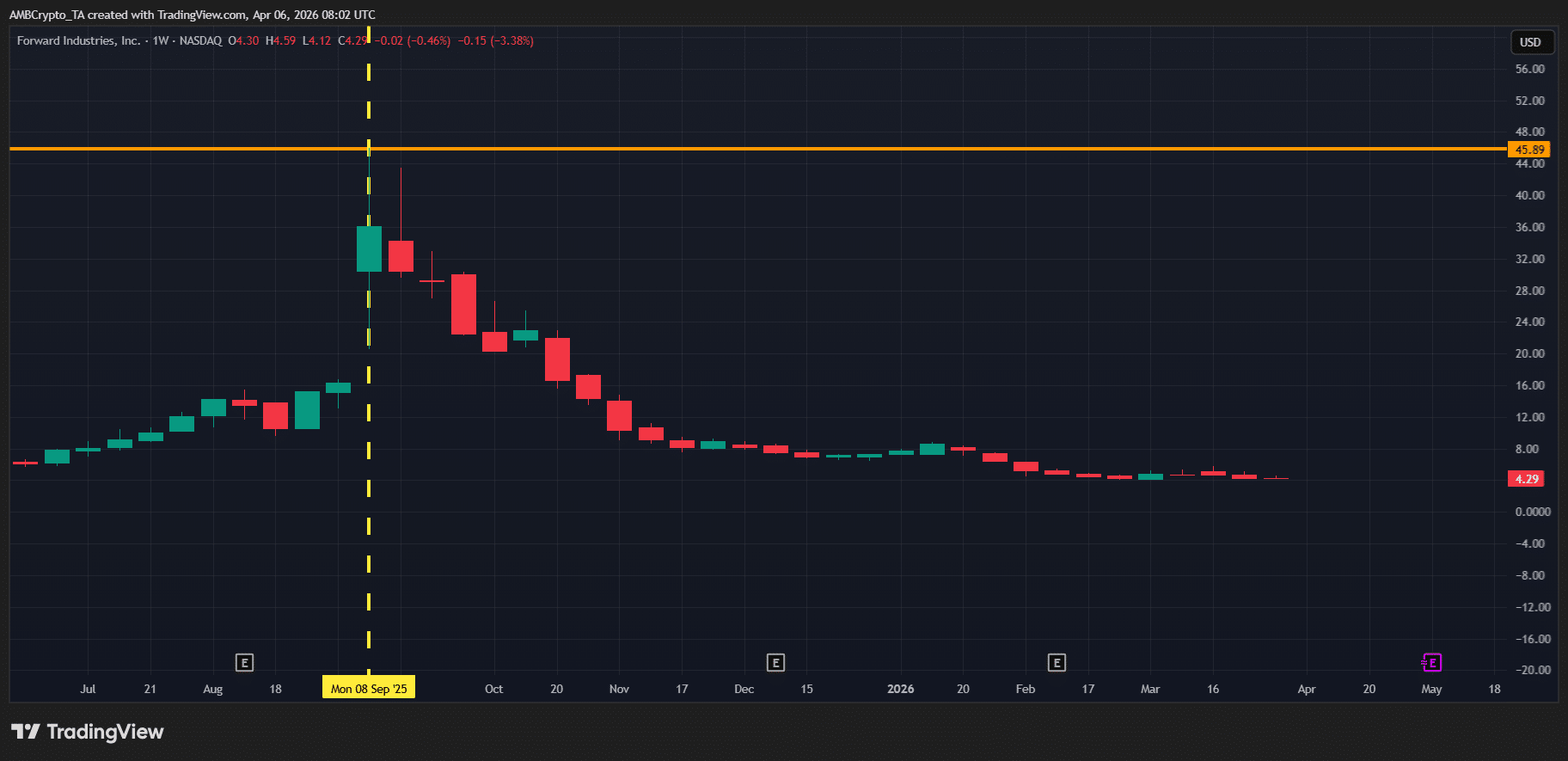
Take the largest SOL DAT, Forward Industries (NASDAQ: FWDI), for instance. It’s still over 80% below its pre-October crash levels.
Source: TradingView (FWDI/USD)

Against this backdrop, Solana’s RWA flows act as a key catalyst.

On a macro level, tokenized U.S. Treasuries could generate revenue for Digital Asset Treasuries (DATs), which can then be used to stockpile more SOL.

With Solana already holding a strong position in tokenized bonds, this is a tangible strategy that can strengthen treasuries and support long-term network growth.

Looking at the bigger picture (RWA market growth, Solana’s rising RWA holder count, and strong capital flows into U.S. Treasuries), Solana could emerge as a viable alternative to Ethereum’s XAUT play.

If the network continues to expand its RWA ecosystem, it has the potential to establish itself as a leading hub for tokenized assets, attracting substantial institutional capital in the process.


Final Summary

  • Solana is emerging as a major hub for on-chain RWAs, with a 440% YoY increase in holders.
  • Strong flows into tokenized U.S. Treasuries could make Solana a viable alternative to Ethereum’s XAUT, offering a pathway to strengthen DATs.


Perguntas relacionadas

QWhat is the year-over-year growth in the number of RWA holders on the Solana network, and what does this surge signify?

AThe number of RWA holders on Solana grew by 440% year-over-year, totaling 218,000. This surge is more than just hype; it's a clear sign that Solana is becoming a go-to network for tokenized real-world assets.

QWhich token is the on-chain RWA market cap leader, and on which blockchain does it currently trade?

ATether Gold (XAUT) is the on-chain RWA market cap leader with $3.3 billion. It currently trades only on the Ethereum blockchain.

QAccording to the article, what is the primary component (over 50%) of the aggregate RWA market?

AU.S. Treasury assets make up over 50% of the aggregate RWA market.

QWhat potential strategy is mentioned for Solana's Digital Asset Treasuries (DATs) to strengthen themselves and support long-term network growth?

ATokenized U.S. Treasuries could generate revenue for Digital Asset Treasuries (DATs), which can then be used to stockpile more SOL, thereby strengthening the treasuries and supporting long-term network growth.

QWhat key concern does the International Monetary Fund (IMF) raise regarding the article's subject matter?

AThe IMF warns that the fast-growing Real World Asset (RWA) market on-chain could cause traditional finance (TradFi) players to fall behind, potentially changing how central banks manage money and financial stability.

Leituras Relacionadas

The Value Distribution of Stablecoins

**Summary: The Value Distribution of Stablecoins** The article argues that stablecoins are evolving from mere trading tools into broader channels for dollar access. It divides the stablecoin ecosystem into four layers to analyze how value is distributed: 1. **Issuance Layer:** Mints stablecoins, holds reserve assets, and captures the spread between reserve yield and user costs (e.g., Tether, Circle). This layer currently earns the largest profit margin. 2. **Infrastructure Layer:** Connects stablecoins to the traditional financial system, handling fiat on/off-ramps, banking integration, compliance (KYC/AML), and asset management (e.g., Bridge, BVNK). This is the "unglamorous" but critical work, building the essential bridges between crypto and real-world finance. 3. **Acquiring/Distribution Layer:** Integrates stablecoins into merchant systems, manages payment flows, and provides enterprise financial software (e.g., Stripe, Coinbase). They act as the access point for businesses. 4. **Application Layer:** The end-users and businesses that ultimately use stablecoins for payments, settlements, or as a store of value. They benefit from convenience but have little pricing power. The core thesis is that while the issuance layer currently dominates profits, the often-overlooked **infrastructure layer holds significant long-term potential**. The real challenge and barrier to mass adoption is not the on-chain transfer of stablecoins (which is simple), but the complex "last mile" integration into existing business workflows, banking systems, and regulatory frameworks across different countries. Companies in this layer are currently in a "land grab" phase, investing heavily to build networks, secure bank partnerships, and establish compliance pathways. While their position is currently pressured by the profitable issuers above and distribution platforms below, the article suggests that if stablecoins become a default financial rail for businesses, the infrastructure providers who have done the hard work of integration will ultimately gain strong pricing power and become entrenched, essential players.

marsbitHá 6h

The Value Distribution of Stablecoins

marsbitHá 6h

The Value Distribution of Stablecoins

The Value Distribution of Stablecoins The article argues that stablecoins are evolving from a mere trading tool into a broad "dollar channel." It analyzes the industry's value chain through four layers: 1. **Issuance Layer (e.g., Tether, Circle):** The top layer that mints stablecoins, holds reserve assets, and captures the thickest interest rate spread. 2. **Infrastructure Layer (e.g., Bridge, BVNK):** Connects stablecoins to the traditional financial system, handling critical but complex "dirty work" like fiat on/off-ramps, banking integration, compliance (KYC/AML), and cross-border settlement. 3. **Acquiring/Distribution Layer (e.g., Stripe, Coinbase):** Embeds stablecoins into merchant systems, manages payment flows, and integrates with enterprise software. 4. **Application Layer:** End-users and businesses that ultimately use stablecoins for payments, settlement, or storing value. The author posits that while the issuance layer currently captures the most profit, the most overlooked and potentially critical layer is infrastructure. The core challenge for stablecoin adoption isn't the on-chain transfer (which is simple), but bridging the gap between blockchain and the real-world financial system. This involves solving practical problems for businesses: fiat conversion, reconciliation, tax handling, and user onboarding. Infrastructure companies are currently in a difficult "land-grab" phase—building networks, securing banking relationships, and achieving compliance country-by-country. They face pressure from both the profitable issuance layer above and distribution platforms below. However, the author suggests this layer is building a crucial moat. Once stablecoins become a default business rail, the infrastructure players who have done the hard work of integration may gain significant, durable value and pricing power.

链捕手Há 6h

The Value Distribution of Stablecoins

链捕手Há 6h

Trading

Spot
Futuros

Artigos em Destaque

Como comprar XAUT

Bem-vindo à HTX.com!Tornámos a compra de Tether Gold (XAUT) simples e conveniente.Segue o nosso guia passo a passo para iniciar a tua jornada no mundo das criptos.Passo 1: cria a tua conta HTXUtiliza o teu e-mail ou número de telefone para te inscreveres numa conta gratuita na HTX.Desfruta de um processo de inscrição sem complicações e desbloqueia todas as funcionalidades.Obter a minha contaPasso 2: vai para Comprar Cripto e escolhe o teu método de pagamentoCartão de crédito/débito: usa o teu visa ou mastercard para comprar Tether Gold (XAUT) instantaneamente.Saldo: usa os fundos da tua conta HTX para transacionar sem problemas.Terceiros: adicionamos métodos de pagamento populares, como Google Pay e Apple Pay, para aumentar a conveniência.P2P: transaciona diretamente com outros utilizadores na HTX.Mercado de balcão (OTC): oferecemos serviços personalizados e taxas de câmbio competitivas para os traders.Passo 3: armazena teu Tether Gold (XAUT)Depois de comprar o teu Tether Gold (XAUT), armazena-o na tua conta HTX.Alternativamente, podes enviá-lo para outro lugar através de transferência blockchain ou usá-lo para transacionar outras criptomoedas.Passo 4: transaciona Tether Gold (XAUT)Transaciona facilmente Tether Gold (XAUT) no mercado à vista da HTX.Acede simplesmente à tua conta, seleciona o teu par de trading, executa as tuas transações e monitoriza em tempo real.Oferecemos uma experiência de fácil utilização tanto para principiantes como para traders experientes.

930 Visualizações TotaisPublicado em {updateTime}Atualizado em 2026.06.02

Como comprar XAUT

Discussões

Bem-vindo à Comunidade HTX. Aqui, pode manter-se informado sobre os mais recentes desenvolvimentos da plataforma e obter acesso a análises profissionais de mercado. As opiniões dos utilizadores sobre o preço de XAUT (XAUT) são apresentadas abaixo.

活动图片












