SNZ–NTU CCTF Releases "Top 10 Blockchain Industry Trends for 2026"

marsbitPublicado em 2026-02-16Última atualização em 2026-02-16

Resumo

SNZ Holding and Nanyang Technological University's Computational Finance Centre (NTU-CCTF) have jointly released the "Top 10 Blockchain Industry Trends for 2026." The report highlights the ongoing transformation of Web3 from speculative experimentation into verifiable financial infrastructure. Key trends include the maturation of Real-World Assets (RWA) into composable DeFi instruments, the growing role of stablecoins in global payments, and the adoption of smart accounts and intent-based execution to improve user experience. Zero-knowledge proofs are evolving from privacy tools to foundational infrastructure for verifiable computation, while shared security and restaking are redefining security as a tradable economic resource. Other significant developments include progress in privacy-compliance engineering, DePIN networks shifting from incentive-driven models to verifiable systems, decentralized AI moving from hype to practical implementation, and token governance focusing on institutional accountability rather than mere voting procedures. The report aims to serve as a practical and forward-looking guide for industry builders, researchers, and decision-makers.

On New Year's Eve, as we bid farewell to the old and welcome the new, we are delighted to share the "Top 10 Blockchain Industry Trends for 2026," jointly produced by the SNZ Holding research team and the Nanyang Technological University Centre for Computational Finance (NTU-CCTF) in Singapore. The report is now officially released! (Read the full report)
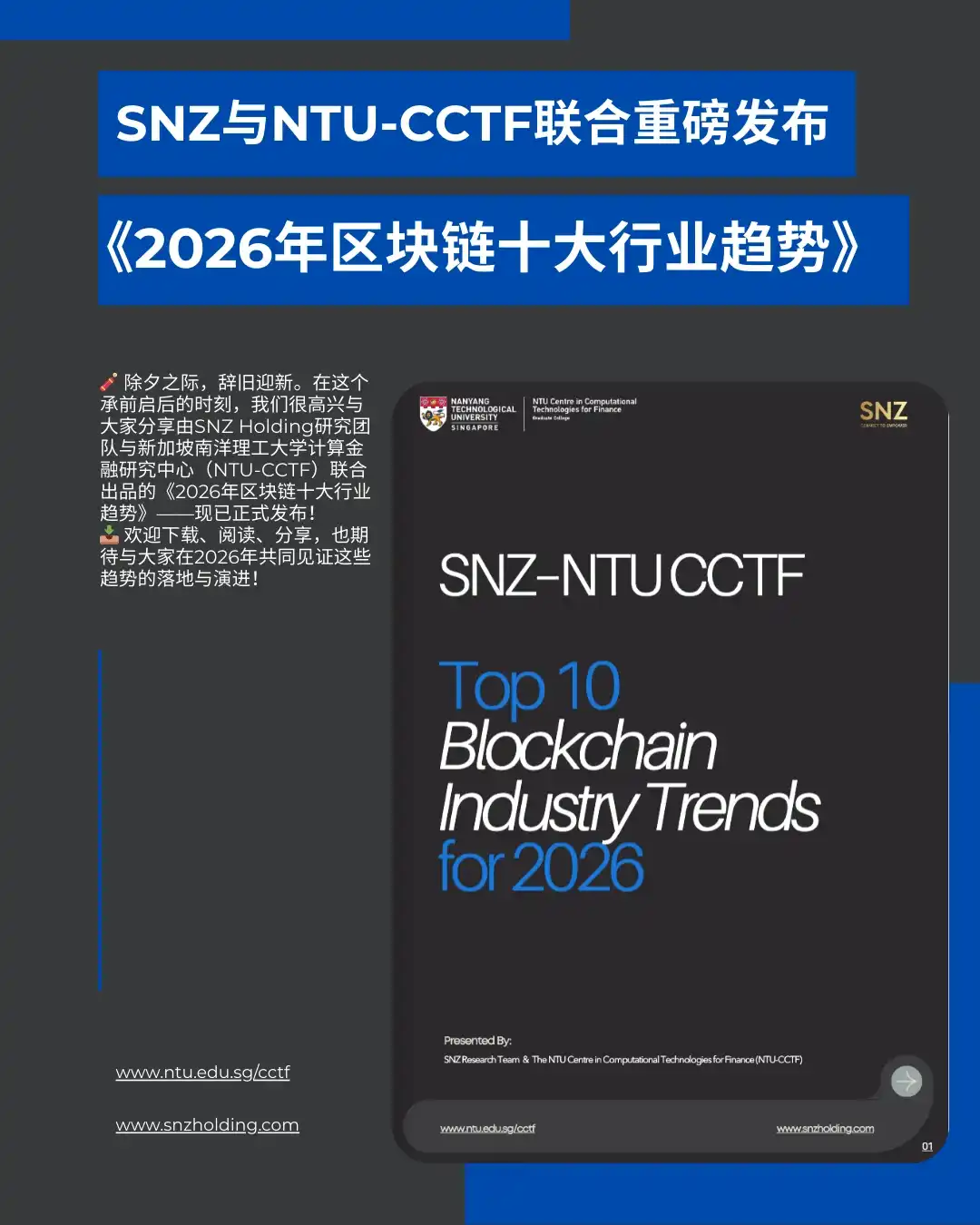
Looking back from the beginning of 2026, Web3 is undergoing a profound transformation: evolving from early speculative experiments to verifiable financial infrastructure. Stablecoins are no longer just units of account in the crypto market but are widely discussed as a settlement layer for global payments; RWA assets have moved beyond the pilot stage to become composable financial instruments in DeFi; technologies such as smart accounts, intent-based execution, and zero-knowledge proofs are bringing on-chain interactions into the mainstream user experience as expected.

Based on a systematic review of technological advancements, market dynamics, and cutting-edge academic research, we have distilled the top ten trends most worth watching in 2026:

1. On-chain Treasury Bonds and Cash Management: RWA Transitions from Concept to Product;

2. Stablecoins: The New Focus of Global Payments in 2026;

3. The Era of Smart Accounts: Returning On-Chain Interactions to Everyday User Experience;

4. From "Manual Transaction Construction" to "Goal-Based Execution + Backend Bidding";

5. Zero-Knowledge Proofs: From Privacy Features to Verifiable Computing Infrastructure;

6. Privacy and Compliance: From Trade-offs to Verifiable Engineering Balance;

7. Shared Security and Restaking: Redefining Security Budgets as Tradable Economic Resources;

8. DePIN Networks: From Incentive-Driven Narratives to Verifiable Engineering;

9. Decentralized AI: From Narrative Hype to Engineering Practice;

10. Token Governance: Returning from Voting Procedures to Institutionalized Design of Rights and Responsibilities.

This report combines SNZ Holding's industry insights in the Web3 space with NTU-CCTF's academic research, aiming to provide a forward-looking and practical reference guide for industry builders, researchers, and decision-makers.

We welcome you to download, read, and share the report, and we look forward to witnessing the implementation and evolution of these trends together in 2026! Happy New Year's Eve, and may the Year of the Bingwu bring new joy!


Perguntas relacionadas

QWhat is the main focus of the 'Top 10 Blockchain Industry Trends for 2026' report published by SNZ Holding and NTU-CCTF?

AThe report focuses on the transformation of Web3 from early speculative experiments to verifiable financial infrastructure, highlighting key trends such as stablecoins, RWA, smart accounts, zero-knowledge proofs, and decentralized AI.

QWhich trend in the report discusses the evolution of Real World Assets (RWA) in the blockchain space?

AThe trend 'On-chain Treasury and Cash Management: RWA from Concept to Product' discusses RWA moving out of the pilot phase and becoming composable financial tools in DeFi.

QHow does the report describe the role of stablecoins in 2026?

AThe report describes stablecoins as no longer just a unit of account in crypto markets but as a widely discussed settlement layer for global payments.

QWhat technological advancements are mentioned as improving the mainstream user experience in blockchain interactions?

ASmart accounts, intent-based execution, and zero-knowledge proofs are mentioned as technologies bringing on-chain interactions into the mainstream user experience.

QWhich trend emphasizes a shift from voting procedures to institutionalized design of responsibilities in token governance?

AThe trend 'Token Governance: From Voting Procedures to Institutionalized Design of Responsibilities' emphasizes this shift.

Leituras Relacionadas

In Jinjiang, Fujian, a Storage Super Unicorn Lies Quiet

In Fujian's Jinjiang, a city known for sportswear, lies a quiet semiconductor giant: Fujian Jinhua Integrated Circuit Co. (JHICC). Once a promising domestic DRAM manufacturer alongside Yangtze Memory and ChangXin Memory Technologies (CXMT), its journey was derailed in 2018 when the U.S. placed it on an Entity List and filed criminal charges for alleged trade secret theft. This halted production for years. A turning point came in February 2024 when a U.S. federal court found JHICC not guilty. However, it had lost crucial time. While CXMT soared to become a top-valued A-share company in 2024, JHICC, with an estimated valuation of 80 billion RMB, was just restarting. Its current output is primarily customized DDR4 chips, not the advanced DDR5/HBM demanded for AI, but it still benefits from the broader memory chip upcycle. JHICC's story is tied to Chen Zhengkun, a veteran engineer who left Micron to lead the venture. Founded in 2016 with state-backed funding, JHICC partnered with Taiwan's UMC to develop DRAM technology. Rapid progress was cut short by the U.S. actions, which Micron initiated, partly due to its heavy reliance on the Chinese market. Post-sanctions, Chen's team worked to rebuild the production line with reduced reliance on U.S. technology. According to its records, JHICC achieved small-scale production and revenue growth under immense pressure. It now focuses on the stable "niche" DRAM market (e.g., TVs, routers) with a monthly capacity of ~40,000 wafers, aiming for 60,000 by 2026. It holds over 1,000 patents but remains on the Entity List. For Jinjiang, investing in JHICC was a bold industrial leap. The local government provided unwavering financial and logistical support during the crisis, helping the company survive. JHICC has become the anchor for a growing local semiconductor cluster. Though its scale lags behind domestic peers, JHICC's persistence symbolizes a hard-won foothold in a global market long dominated by Samsung, SK Hynix, and Micron. Having missed one boom, it seeks a place in the new AI-driven memory supercycle.

marsbitHá 1h

In Jinjiang, Fujian, a Storage Super Unicorn Lies Quiet

marsbitHá 1h

Trading

Spot
活动图片




