SNZ–NTU CCTF Releases "Top 10 Blockchain Industry Trends for 2026"

marsbitPublicado em 2026-02-16Última atualização em 2026-02-16

Resumo

SNZ Holding and Nanyang Technological University's Computational Finance Centre (NTU-CCTF) have jointly released the "Top 10 Blockchain Industry Trends for 2026." The report highlights the ongoing transformation of Web3 from speculative experimentation into verifiable financial infrastructure. Key trends include the maturation of Real-World Assets (RWA) into composable DeFi instruments, the growing role of stablecoins in global payments, and the adoption of smart accounts and intent-based execution to improve user experience. Zero-knowledge proofs are evolving from privacy tools to foundational infrastructure for verifiable computation, while shared security and restaking are redefining security as a tradable economic resource. Other significant developments include progress in privacy-compliance engineering, DePIN networks shifting from incentive-driven models to verifiable systems, decentralized AI moving from hype to practical implementation, and token governance focusing on institutional accountability rather than mere voting procedures. The report aims to serve as a practical and forward-looking guide for industry builders, researchers, and decision-makers.

On New Year's Eve, as we bid farewell to the old and welcome the new, we are delighted to share the "Top 10 Blockchain Industry Trends for 2026," jointly produced by the SNZ Holding research team and the Nanyang Technological University Centre for Computational Finance (NTU-CCTF) in Singapore. The report is now officially released! (Read the full report)
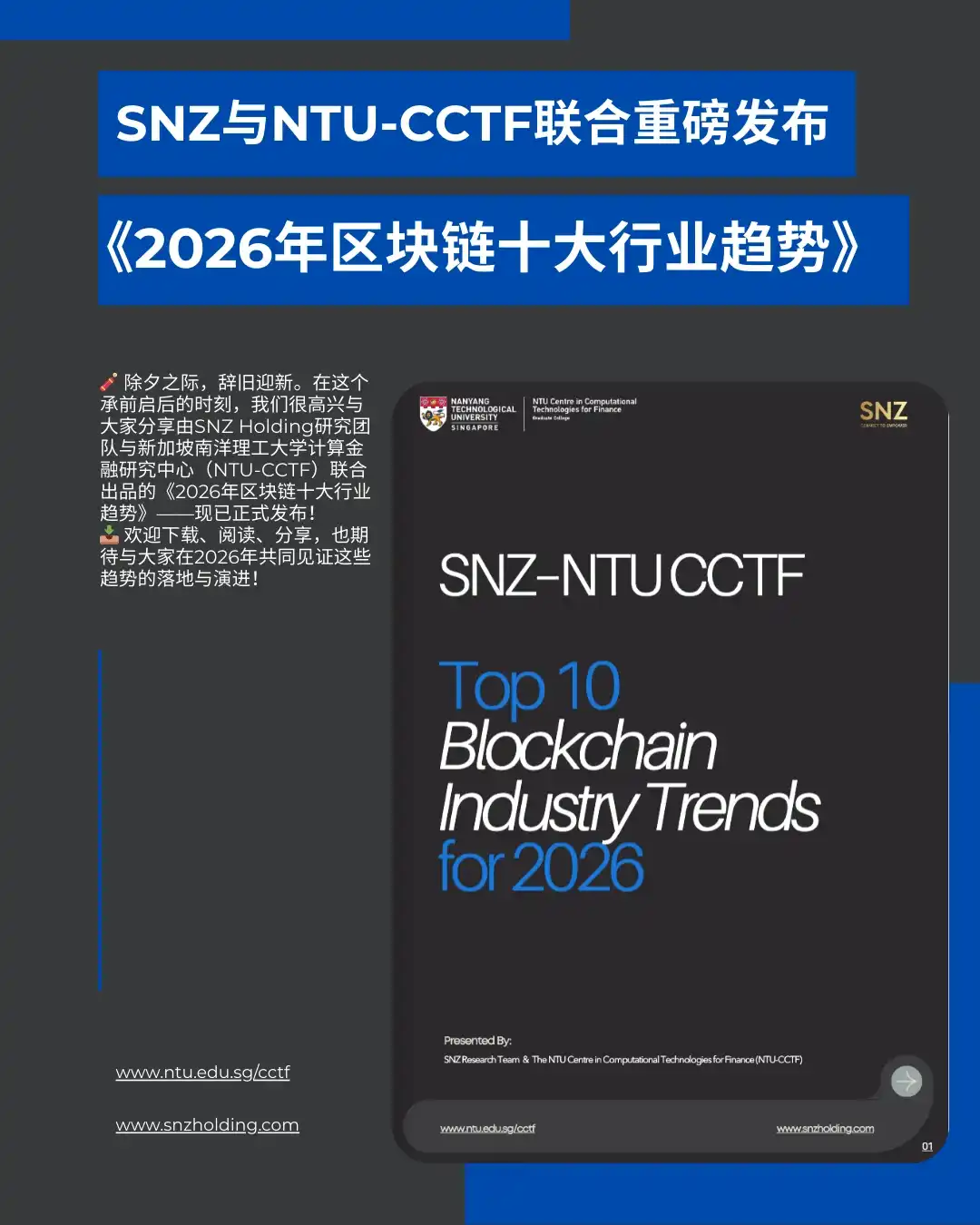
Looking back from the beginning of 2026, Web3 is undergoing a profound transformation: evolving from early speculative experiments to verifiable financial infrastructure. Stablecoins are no longer just units of account in the crypto market but are widely discussed as a settlement layer for global payments; RWA assets have moved beyond the pilot stage to become composable financial instruments in DeFi; technologies such as smart accounts, intent-based execution, and zero-knowledge proofs are bringing on-chain interactions into the mainstream user experience as expected.

Based on a systematic review of technological advancements, market dynamics, and cutting-edge academic research, we have distilled the top ten trends most worth watching in 2026:

1. On-chain Treasury Bonds and Cash Management: RWA Transitions from Concept to Product;

2. Stablecoins: The New Focus of Global Payments in 2026;

3. The Era of Smart Accounts: Returning On-Chain Interactions to Everyday User Experience;

4. From "Manual Transaction Construction" to "Goal-Based Execution + Backend Bidding";

5. Zero-Knowledge Proofs: From Privacy Features to Verifiable Computing Infrastructure;

6. Privacy and Compliance: From Trade-offs to Verifiable Engineering Balance;

7. Shared Security and Restaking: Redefining Security Budgets as Tradable Economic Resources;

8. DePIN Networks: From Incentive-Driven Narratives to Verifiable Engineering;

9. Decentralized AI: From Narrative Hype to Engineering Practice;

10. Token Governance: Returning from Voting Procedures to Institutionalized Design of Rights and Responsibilities.

This report combines SNZ Holding's industry insights in the Web3 space with NTU-CCTF's academic research, aiming to provide a forward-looking and practical reference guide for industry builders, researchers, and decision-makers.

We welcome you to download, read, and share the report, and we look forward to witnessing the implementation and evolution of these trends together in 2026! Happy New Year's Eve, and may the Year of the Bingwu bring new joy!


Perguntas relacionadas

QWhat is the main focus of the 'Top 10 Blockchain Industry Trends for 2026' report published by SNZ Holding and NTU-CCTF?

AThe report focuses on the transformation of Web3 from early speculative experiments to verifiable financial infrastructure, highlighting key trends such as stablecoins, RWA, smart accounts, zero-knowledge proofs, and decentralized AI.

QWhich trend in the report discusses the evolution of Real World Assets (RWA) in the blockchain space?

AThe trend 'On-chain Treasury and Cash Management: RWA from Concept to Product' discusses RWA moving out of the pilot phase and becoming composable financial tools in DeFi.

QHow does the report describe the role of stablecoins in 2026?

AThe report describes stablecoins as no longer just a unit of account in crypto markets but as a widely discussed settlement layer for global payments.

QWhat technological advancements are mentioned as improving the mainstream user experience in blockchain interactions?

ASmart accounts, intent-based execution, and zero-knowledge proofs are mentioned as technologies bringing on-chain interactions into the mainstream user experience.

QWhich trend emphasizes a shift from voting procedures to institutionalized design of responsibilities in token governance?

AThe trend 'Token Governance: From Voting Procedures to Institutionalized Design of Responsibilities' emphasizes this shift.

Leituras Relacionadas

How Many Tokens Away Is Yang Zhilin from the 'Moon Chasing the Light'?

The article explores the intense competition between two leading Chinese AI companies, DeepSeek and Kimi (Moon Dark Side), and the mounting pressure on Yang Zhilin, the founder of Kimi. While DeepSeek re-emerged after 15 months of silence with its powerful V4 model—boasting 1.6 trillion parameters and low-cost, long-context capabilities—Kimi has been focusing on long-context processing and multi-agent systems with its K2.6 model. Yang faces a threefold challenge: technological rivalry, commercialization pressure, and investor expectations. Despite Kimi’s high valuation (reaching $18 billion), its revenue heavily relies on a single product with low paid conversion rates, while DeepSeek’s strategic silence and open-source influence have strengthened its market position and valuation prospects, now targeting over $20 billion. Both companies reflect broader trends in China’s AI ecosystem: Kimi aims for global influence through open-source contributions and agent-based advancements, while DeepSeek prioritizes foundational innovation and hardware independence, notably shifting to Huawei’s chips. Their competition is seen as vital for China’s AI progress, with the gap between top Chinese and U.S. models narrowing to just 2.7% on the Elo rating scale. Ultimately, the article argues that this rivalry, though anxiety-inducing for leaders like Zhilin, is essential for driving innovation and solidifying China’s role in the global AI landscape.

marsbitHá 30m

How Many Tokens Away Is Yang Zhilin from the 'Moon Chasing the Light'?

marsbitHá 30m

TechFlow Intelligence Bureau: ChatGPT Helps Amateur Mathematician Crack 60-Year-Old Problem, CFTC Sues New York Regulator Over Coinbase and Gemini

An amateur mathematician, with the assistance of ChatGPT, has solved a combinatorial mathematics puzzle originally proposed by Hungarian mathematician Paul Erdős in the 1960s. This marks another milestone in AI-aided mathematical research, demonstrating the evolving capabilities of large language models in formal reasoning. In other AI developments, OpenAI introduced a new privacy filter tool for enterprise API usage, automatically screening sensitive data. Meanwhile, the Qwen3.6-27B model achieved 100 tokens per second on a single RTX 5090 GPU using quantization, significantly lowering the cost barrier for local AI deployment. In crypto and Web3, the U.S. CFTC sued New York’s financial regulator, challenging its oversight of Coinbase and Gemini—a first-of-its-kind federal-state regulatory clash. Following a vulnerability, KelpDAO and major DeFi protocols established a recovery fund. Tether froze $344 million in assets linked to Iran’s central bank upon U.S. Treasury request, highlighting the centralized control risks in stablecoins. Separately, Litecoin underwent a 3-hour chain reorganization to undo a privacy-layer exploit. In the U.S., former President Trump invoked the Defense Production Act to address power grid bottlenecks affecting AI data centers and dismissed the entire National Science Board, raising concerns over research independence. A retail trader gained 250% on a $600k Intel options bet amid AI-related speculation. Xiaomi announced its first performance electric vehicle, targeting rivals like Tesla. Meanwhile, iPhone users reported devices automatically reinstalling a hidden app daily, suspected to be MDM-related. A Chinese securities report noted that A-share institutional crowding has reached its second-longest streak since 2007, signaling high valuations and potential style rotation. The day’s developments reflect a dual narrative: AI is enabling unprecedented individual breakthroughs, while centralized power structures—whether governmental or corporate—are becoming more assertive, underscoring that decentralization is as much a political-economic challenge as a technical one.

marsbitHá 52m

TechFlow Intelligence Bureau: ChatGPT Helps Amateur Mathematician Crack 60-Year-Old Problem, CFTC Sues New York Regulator Over Coinbase and Gemini

marsbitHá 52m

Trading

Spot
Futuros
活动图片