"Six Walnuts" Diversifies into AI Investment, Stock Price Triples in One Year

marsbitPublicado em 2026-06-24Última atualização em 2026-06-24

Resumo

"Six Walnuts," a popular Chinese beverage brand under Yangyuan Food and Beverage, has pivoted aggressively into AI and semiconductor investments. Despite its core walnut milk drink business facing sustained decline—with revenues shrinking 41% over a decade—the parent company has channeled nearly all its annual profits for three consecutive years into a 40 billion yuan investment fund targeting AI hardware, chips, and storage. This bold move has transformed the firm into an AI-themed stock, propelling its share price up nearly 300% in one year, even as consumer stocks broadly struggled. A key bet is a 1.6 billion yuan investment in memory chipmaker Yangtze Memory, whose potential IPO could deliver substantial returns. Other investments span AI vision, edge AI chips, and GPUs, though many remain unrealized or at a paper loss. While maintaining its beverage base, Yangyuan is pursuing a dual-track strategy: steady income from its traditional business and high-risk, high-reward exposure to hard tech. Its future valuation now heavily depends on the success of these tech investments, particularly Yangtze Memory's listing. Failure could lead to significant market correction as AI expectations unwind.

Author: Think AI, Aaron

"Use your brain often, drink more Six Walnuts" is a well-known advertising slogan.

As the blockbuster beverage of Yangyuan Beverage Company, Six Walnuts once swept across the country. Few would have imagined that this beverage company would be linked to AI chips.

In fact, the parent company of Six Walnuts is almost all-in on AI, having invested nearly its entire annual net profit into AI-related industries for three consecutive years.

Although it hasn't yet made actual money from the AI industry, its stock price soared from around 17.7 yuan at the beginning of last year to a high of 52 yuan in May, a 293% increase, nearly tripling.

The market already views Yangyuan Beverage as an AI concept stock.

In contrast, similar consumer stocks have had a terrible year over the same period. Across the A-share market, 1653 individual stocks hit new lows for the year, with consumer sector stocks accounting for a very high proportion. "Six Walnuts" has become a bright spot in the market.

Why has the parent company of Six Walnuts continued to ramp up investments in hard-tech sectors like AI since 2021? If these investments fail, what will the future hold?

Main Business Shrinking, Founding Team Needs Imagination

There was a time when Yangyuan Beverage was a dominant force. In 2015, its revenue reached a historical peak of 9.1 billion yuan, making founder Yao Kuizhang the richest person in Hebei province that year.

From 2015 to 2018, Yangyuan maintained rapid development, with net profit reaching a historical maximum of 2.8 billion yuan in 2018.

At that time, Yangyuan held a 90% market share in the walnut milk industry, almost monopolizing the entire sector.

Annual net profits exceeding 2 billion yuan also made the company a cash cow.

But by the present, in 2025, Yangyuan's revenue is only around 5.3 billion yuan, a 41% decline over 10 years, and profits have halved to just 1.2 billion yuan compared to the peak.

More troubling is that the decline is not isolated. Yangyuan is under pressure in its main sales regions like East China, Central China, and North China, with declines in regions like Northeast and Northwest China even exceeding 30%. Traditional peak seasons have also failed to reverse the downturn.

Yangyuan heavily relies on core products like Six Walnuts, with walnut milk accounting for over 80% of all product sales.

New products have remained lukewarm, while walnut milk itself is losing market share to alternatives like nut milks and oat milk. The gifting attribute of Six Walnuts has also gradually weakened, placing the main business in a long-term shrinking track.

Faced with weak products, the company did not choose to increase R&D efforts, innovate with new products, or compete on the product front.

Instead, it chose a more imaginative route of AI investment. Yangyuan's overall investment philosophy is relatively simple: invest in whatever is hot.

Setting aside the question of right or wrong, let's first look at which sectors Yangyuan has heavily entered, what results it has achieved, and then we will predict Yangyuan's possible endgame.

Cross-Border Gambling Spree

Since 2021, Yangyuan Beverage has focused on laying out the upstream and downstream of AI hardware. It launched a 3-billion-yuan fund, later expanding it by another 1 billion yuan in October last year, continuously increasing bets on AI, semiconductors, and new energy.

So far, 2.95 billion yuan has been spent, with 1.05 billion yuan still idle, awaiting new projects to invest in.
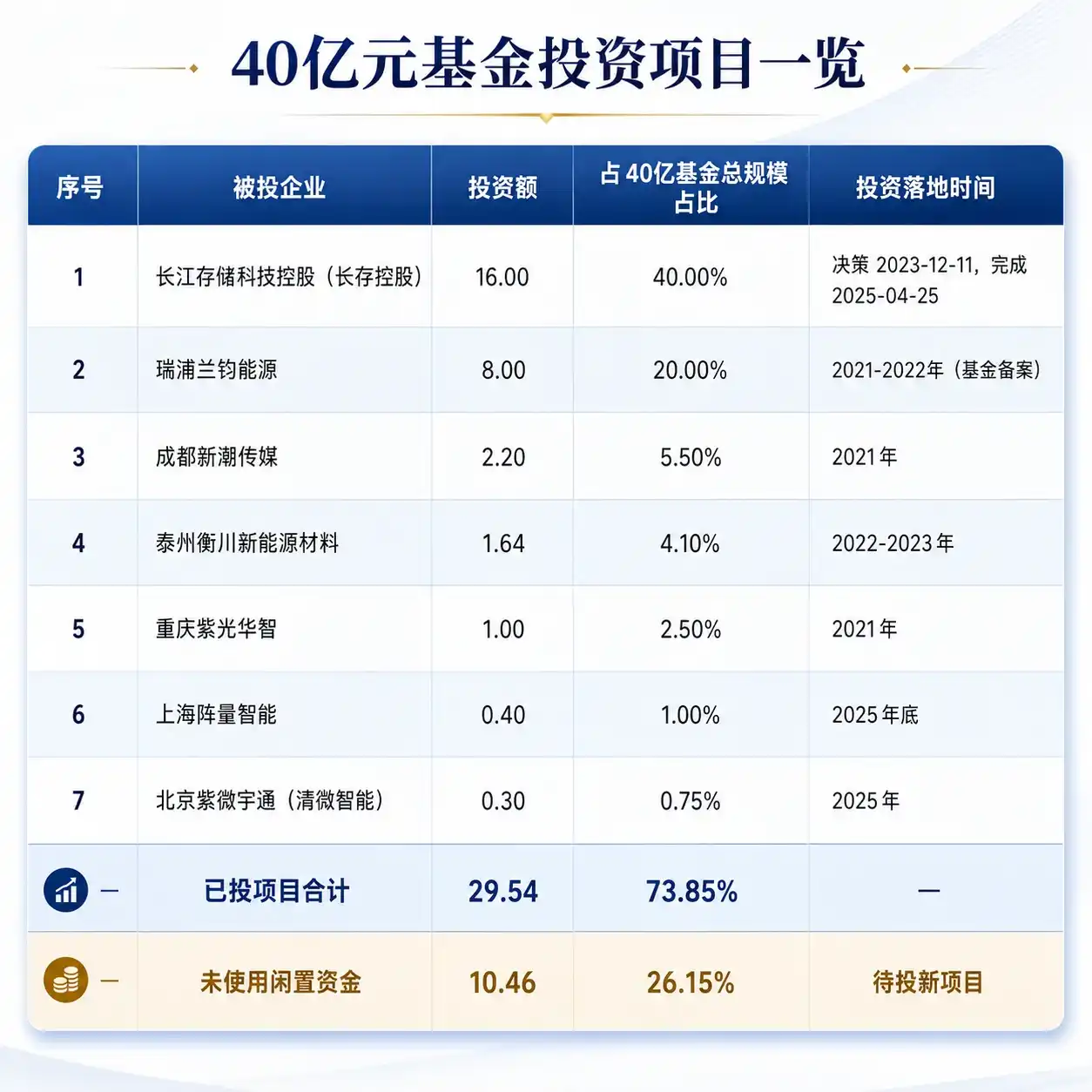
Among its 4-billion-yuan fund, one major investment drew attention: a 1.6-billion-yuan investment completed in April last year into Yangtze Memory Technologies Co., Ltd. (YMTC), acquiring a 0.99% equity stake.

1.6 billion yuan is equivalent to Yangyuan's entire annual profit. Investing the whole amount into a long-cycle industry like memory storage shows the company's boldness.

And YMTC has become hot this year, with reports of a potential domestic IPO and valuations ranging from 500 billion to 1 trillion yuan. Compared to last year's investment valuation, this represents a tripling in value.

If YMTC can successfully list, this single investment will mark the success of Yangyuan's industrial investments.

Because most of the other investments are currently at a floating loss, but Yangyuan has not exited, opting to continue holding long-term.

Among them, an 800-million-yuan investment in REPT Battero, a new energy power battery company, was fully cashed out after its 2023 Hong Kong IPO, realizing a book gain of approximately 241 million HKD.

The acquisition of Xinchao Media by Focus Media was valued at only 8.3 billion yuan, far below the 16.1 billion yuan valuation at the time of investment. Exit has not been executed yet, the fund still holds the equity, and it is currently at a floating loss.

The other AI-related companies are concentrated in areas like AI vision, edge-side AI chips, and GPUs for large model training, forming a relatively complete AI industry chain layout.

What's Next for Yangyuan?

In the coming years, Yangyuan Beverage is unlikely to completely transform into a VC company. Instead, it will likely maintain a dual-wheel model of "consumer main business as the foundation, equity investments for elasticity."

Six Walnuts will still be the company's basic business, but the walnut milk category has passed its high-growth period and will find it difficult to return to its past peak of 10 billion yuan annual revenue.

The 4-billion-yuan Quanhong Fund will remain an industrial fund worth watching.

Yangyuan's future capital will likely continue to flow into the upstream of AI computing power, including hard-tech directions like memory storage, edge-side AI chips, and industrial vision. Non-core tracks like new energy and media will gradually be marginalized.

If YMTC successfully lists, the investment gains could rewrite the income statement in one go, transforming the company's valuation from a traditional beverage stock to a dual pricing of "consumer + hard-tech shadow stock."

Conversely, if YMTC's listing is delayed or the semiconductor cycle turns cold, the stock price could also sharply retreat due to unmet tech expectations.


Criptomoedas em alta

Perguntas relacionadas

QWhat is the main reason behind Yangyuan Beverage's (parent company of 'Six Walnuts') heavy investment in AI and related industries since 2021?

AThe primary reason is the continuous decline of its core beverage business, 'Six Walnuts.' The company faces shrinking revenues and profits in its main product line, with market share being eroded by alternatives like nut milk and oat milk. Instead of intensifying product R&D, the company has chosen to invest in high-growth, high-imagination sectors like AI to seek new growth drivers and boost its market valuation.

QWhat was the most significant AI/hard tech investment made by Yangyuan Beverage's fund, and what is its current status?

AThe most significant investment was a 1.6 billion RMB injection into Yangtze Memory Technologies Co., Ltd. (YMTC) in April of last year, acquiring a 0.99% stake. YMTC is reportedly planning a domestic IPO with a valuation estimated between 500 billion and 1 trillion RMB. If successful, this investment could triple in value and be a major success for Yangyuan's industrial investment strategy.

QHow has Yangyuan Beverage's stock price performed following its shift towards AI investments, and how does this contrast with the broader market?

AYangyuan Beverage's stock price surged from a low of around 17.7 RMB in early last year to a high of 52 RMB in May, representing a gain of approximately 293% (nearly tripling). This performance starkly contrasts with the broader A-share consumer sector, where many stocks hit yearly lows, making 'Six Walnuts' a standout performer in the market.

QAccording to the article, what is the likely future business model for Yangyuan Beverage?

AThe article suggests Yangyuan Beverage will likely maintain a dual-wheel business model: its traditional consumer beverage business (primarily 'Six Walnuts') as a stable foundation, combined with equity investments (particularly in AI and hard tech via its Quanhong Fund) to seek higher growth and valuation elasticity. It is not expected to transform completely into a venture capital firm.

QWhat are the potential risks for Yangyuan Beverage if its major AI/hard tech investments, like in YMTC, do not meet expectations?

AIf key investments like YMTC face delays in their IPO or if the semiconductor industry cycle turns downward, Yangyuan Beverage could experience a significant drop in its stock price as market expectations for tech-driven growth fail to materialize. This would lead to a sharp valuation correction. The company's financial performance would also be impacted without the anticipated large investment returns to offset the decline in its core beverage business.

Leituras Relacionadas

Goldman Sachs In-Depth Report: Who Will Be the Long-Term Winners in China's AI Large Model Industry?

Goldman Sachs Report: China's AI Models at an Inflection Point China's open-source/open-weight large language models (LLMs) have reached performance parity with top global proprietary models, according to a Goldman Sachs report. This is driven by architectural innovations and higher parameter efficiency, allowing Chinese models to achieve comparable capabilities at 2%-10% the parameter size and significantly lower cost. The market is evolving into a two-tiered structure: a high-end segment (e.g., GLM5.2, Qwen3.7 Max) with premium pricing and a low-end, price-sensitive segment for global SMEs and individual users. Key points: * **Cost & Performance:** Innovations like Mixture of Experts (MoE) enable high performance with smaller models. Projects like Meituan's LongCat 2.0, trained on domestic hardware, highlight progress in tech self-sufficiency. * **Open-Source Strategy:** Most Chinese players use open-source/open-weight models for flexibility and ecosystem growth. However, Goldman notes this may underreport actual deployment and revenue. A shift toward "open-weight + community license" models with revenue sharing (e.g., MiniMax) could improve monetization. * **Market Shift & Global Expansion:** Enterprise AI adoption is shifting from "token maximization" to "ROI-first." International expansion, especially in non-US markets, is a major growth driver. Chinese models are increasingly available on global platforms like AWS Bedrock and Microsoft Copilot. * **Competitive Landscape:** Using a framework based on pricing power, cost advantage, and financial strength, Goldman identifies **Zhipu AI and DeepSeek** as the strongest in foundational text models, and **ByteDance** as the leader in multimodal/video generation. The report maintains Buy ratings on MiniMax and Kuaishou. * **Market Growth:** China's AI model API and subscription revenue is projected to grow from an estimated ¥35 billion in 2026 to ¥879 billion by 2030.

marsbitHá 13m

Goldman Sachs In-Depth Report: Who Will Be the Long-Term Winners in China's AI Large Model Industry?

marsbitHá 13m

Goldman Sachs Deep Dive Report: Who Will Become the Long-Term Winners in China's AI Large Model Industry?

Goldman Sachs Report: Who Will Be the Long-Term Winners in China's AI Large Model Industry? China's AI large model sector is at a historic inflection point. Goldman Sachs argues that the intelligence of Chinese open-source/open-weight models is approaching top global proprietary models. Rapid adoption by domestic enterprises and global SMEs is creating a data flywheel effect that will further drive model iteration. The evolution is summarized as moving from "DeepSeek's cost-efficiency moment last year to GLM's model-intelligence moment this year." Chinese models achieve near-state-of-the-art performance at significantly lower cost, primarily due to architectural innovations like Mixture of Experts (MoE) and higher parameter efficiency. Models like DeepSeek V4 Pro (1.6T params), GLM5.2 (0.7T), and MiniMax M3 (0.4T) are much smaller than global leaders. Recent advancements in coding capability are attributed to better data curation and RLHF. Landmarks like Meituan's LongCat 2.0, trained fully on domestic AI chips, demonstrate progress in hardware stack independence. The market is forming a "two-tiered structure." The high-end tier (e.g., GLM5.2, Alibaba's Qwen3.7 Max) prices around $1 per million tokens, about 10-25% of US top models, with estimated inference gross margins of 10-20%. The low-end tier (priced as low as $0.06-$0.2 per million tokens) targets price-sensitive global SMEs and individuals. MiniMax derives 60-70% of revenue overseas. Goldman forecasts China's AI model API/subscription revenue to grow from an estimated RMB 35bn in 2026 to RMB 879bn by 2030. Most Chinese players adopt open-source/open-weight strategies for deployment flexibility and community feedback, though this limits monetization as deployments on third-party platforms (e.g., Alibaba Cloud) may not generate direct revenue. A shift towards "open-weight + community license" models with revenue-sharing agreements (like MiniMax's approach) could improve unit economics. International expansion, particularly in non-US markets, is the key growth driver. The global enterprise AI paradigm is shifting from "token maximization" to "ROI prioritization." Chinese models are already hosted on major global platforms like AWS Bedrock and are under consideration for integration into Microsoft Copilot. Using a competitive framework based on pricing power, cost advantage, and financial strength, Goldman identifies the strongest players: In foundational text models, Zhipu AI (initiated coverage) and DeepSeek lead. In multimodal/video generation, ByteDance's Seed is the frontrunner, with Kuaishou's Kling and MiniMax's Hailuo also well-positioned. Goldman maintains a Buy rating on MiniMax, citing its attractive valuation.

链捕手Há 17m

Goldman Sachs Deep Dive Report: Who Will Become the Long-Term Winners in China's AI Large Model Industry?

链捕手Há 17m

Is Ethereum Truly a "World Computer"?

Title: Is Ethereum Really a "World Computer"? Ethereum, envisioned as a "world computer" by its founder Vitalik Buterin, aims to be a decentralized platform for global applications. However, a recent analysis by Four Pillars raises questions about whether it is more accurately a "Western computer," based on the geographical distribution of its validators. Currently, the United States dominates with 38.19% of all validators, followed by Germany at 13.04%. Combined, these two countries account for over half of the network. In contrast, Asian representation is minimal, with Singapore holding only 3.15%. The concentration is partly due to affordable cloud hosting services like Hetzner and OVH in Europe and North America, as well as the prevalence of residential validators in the U.S., where individuals run nodes via home internet connections. When examining professionally operated validators, the distribution becomes more balanced. The U.S. share drops to 25.81%, while Asian countries like Singapore (7.28%), Hong Kong (6.44%), Japan (6.38%), and South Korea (4.59%) collectively approach the U.S. level. This shift reflects strategic deployments by institutions to meet regulatory requirements and reduce latency for local users. However, regions like South America, the Middle East, and Africa remain underrepresented. Ethereum's peer-to-peer network mechanisms, such as gossipsub, disadvantage areas with low node density, creating a feedback loop where delayed message propagation reduces validator performance and rewards. This imbalance challenges Ethereum's promises of censorship resistance and global accessibility. Despite these issues, opportunities exist for growth in underrepresented regions. As demand for localized staking infrastructure rises, early entrants in areas like the Middle East could establish dominant positions by offering compliant, low-latency solutions. The evolving validator landscape highlights both the structural challenges and the potential for Ethereum to move closer to its "world computer" ideal.

Foresight NewsHá 2h

Is Ethereum Truly a "World Computer"?

Foresight NewsHá 2h

Trading

Spot

Artigos em Destaque

Como comprar ONE

Bem-vindo à HTX.com!Tornámos a compra de Harmony (ONE) simples e conveniente.Segue o nosso guia passo a passo para iniciar a tua jornada no mundo das criptos.Passo 1: cria a tua conta HTXUtiliza o teu e-mail ou número de telefone para te inscreveres numa conta gratuita na HTX.Desfruta de um processo de inscrição sem complicações e desbloqueia todas as funcionalidades.Obter a minha contaPasso 2: vai para Comprar Cripto e escolhe o teu método de pagamentoCartão de crédito/débito: usa o teu visa ou mastercard para comprar Harmony (ONE) instantaneamente.Saldo: usa os fundos da tua conta HTX para transacionar sem problemas.Terceiros: adicionamos métodos de pagamento populares, como Google Pay e Apple Pay, para aumentar a conveniência.P2P: transaciona diretamente com outros utilizadores na HTX.Mercado de balcão (OTC): oferecemos serviços personalizados e taxas de câmbio competitivas para os traders.Passo 3: armazena teu Harmony (ONE)Depois de comprar o teu Harmony (ONE), armazena-o na tua conta HTX.Alternativamente, podes enviá-lo para outro lugar através de transferência blockchain ou usá-lo para transacionar outras criptomoedas.Passo 4: transaciona Harmony (ONE)Transaciona facilmente Harmony (ONE) no mercado à vista da HTX.Acede simplesmente à tua conta, seleciona o teu par de trading, executa as tuas transações e monitoriza em tempo real.Oferecemos uma experiência de fácil utilização tanto para principiantes como para traders experientes.

328 Visualizações TotaisPublicado em {updateTime}Atualizado em 2026.06.02

Como comprar ONE

Discussões

Bem-vindo à Comunidade HTX. Aqui, pode manter-se informado sobre os mais recentes desenvolvimentos da plataforma e obter acesso a análises profissionais de mercado. As opiniões dos utilizadores sobre o preço de ONE (ONE) são apresentadas abaixo.

活动图片