Show me 'The Lord of the Rings', Karpathy Recommends New Benchmark for Large Model Evaluation

marsbitPublicado em 2026-08-03Última atualização em 2026-08-03

Resumo

In a new benchmark for evaluating large language models, Andrej Karpathy proposes replacing the once-popular "pelican riding a bicycle" SVG test with a more complex challenge: generating a 3D scene from the opening text of *The Lord of the Rings*. Using Anthropic's Opus 5 model and the Three.js library, the task consumed approximately 1 million tokens, 2 hours, and 5,500 lines of code to produce a rudimentary, low-polygon animation of the Shire. While the output is visually crude with notable glitches like floating characters, it demonstrates the model's ability to parse narrative text and translate it into a functional, programmatic 3D world with defined objects, cameras, lighting, and basic animation. This "Lord of the Rings benchmark" is argued to test a model's capacity for long-horizon project planning, spatial reasoning, and maintaining consistency across thousands of code lines—capabilities not fully captured by simpler single-output tests. The initiative has sparked community experimentation, with users generating other 3D worlds like a low-poly San Francisco, a data-driven New York City model, and even a virtual Kanye West concert. Karpathy suggests a future pipeline where code-generated scenes provide the structural "bones" for video-to-video models to enhance visual fidelity. While some debate the computational cost and specificity to Three.js, proponents see it as a test of a model's general ability to structure its understanding of the world into an executable ...

Without further ado, let's start the daily slump (doge)!

Just moments ago, the great Karpathy announced that "we" at Anthropic have started using a brand new way to push large models to their limits—

"The Lord of the Rings."
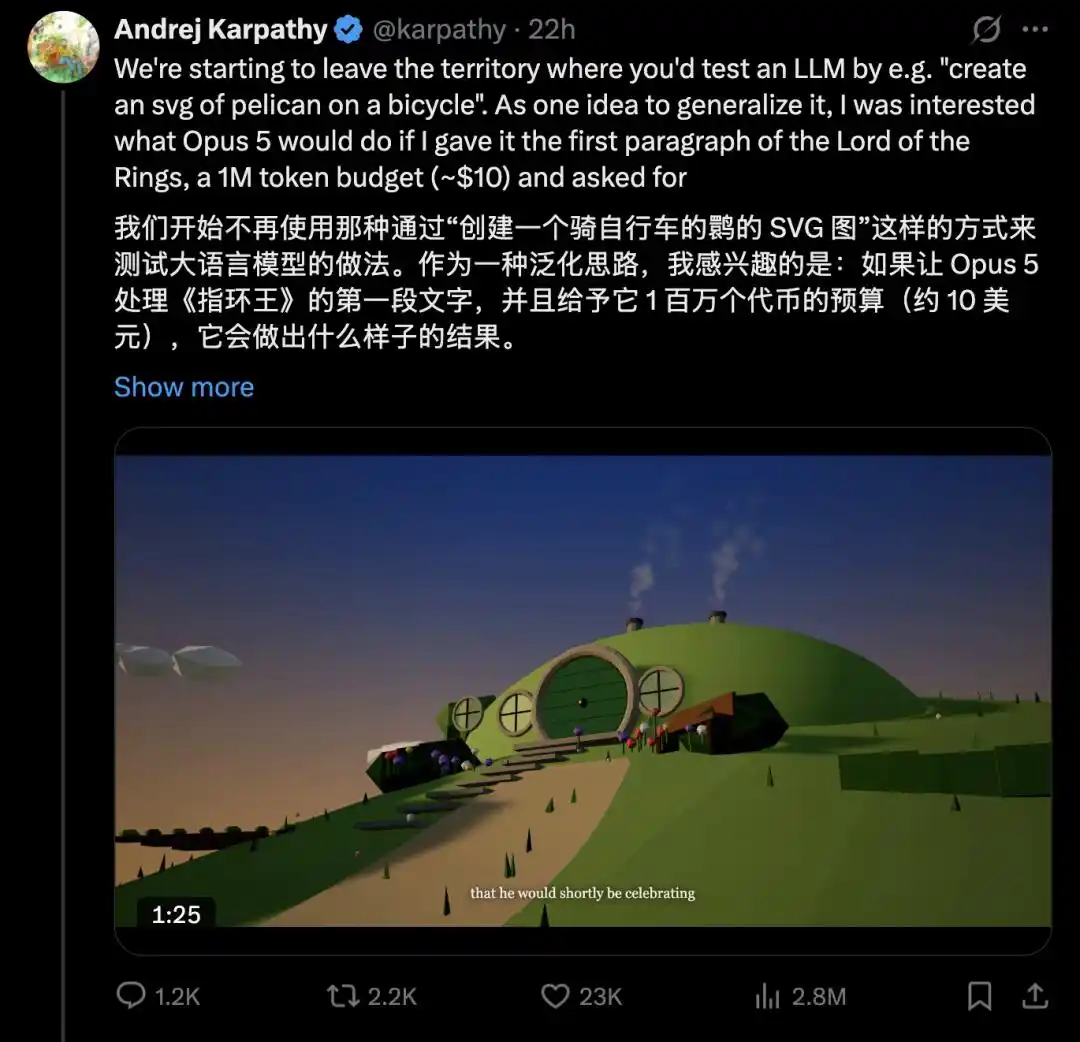
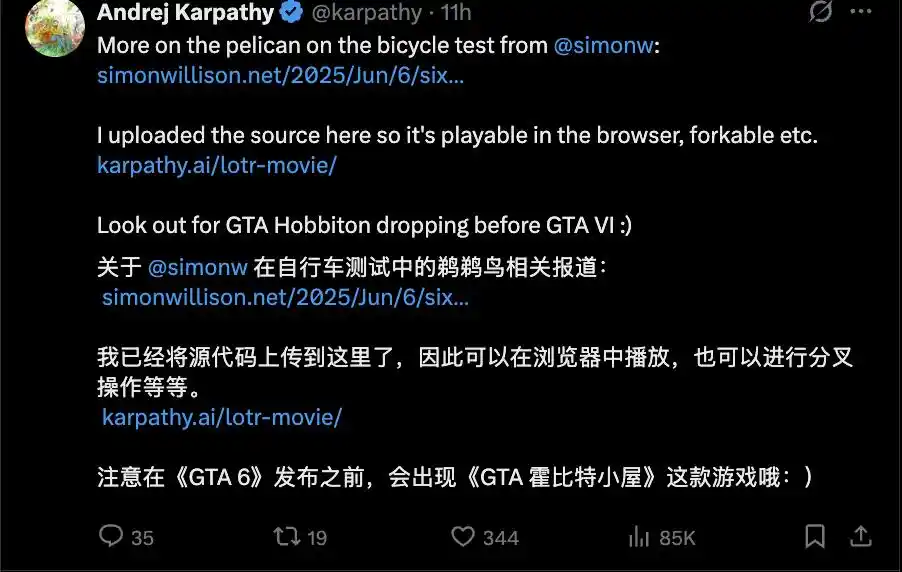
According to Karpathy, this "Lord of the Rings benchmark" is taking over from the once-popular "Pelican Riding a Bicycle" SVG test.
Specifically, Karpathy directly fed the beginning of "The Lord of the Rings" to Opus 5, instructing the model to use Three.js to craft an entire "Middle-earth" world on the spot.

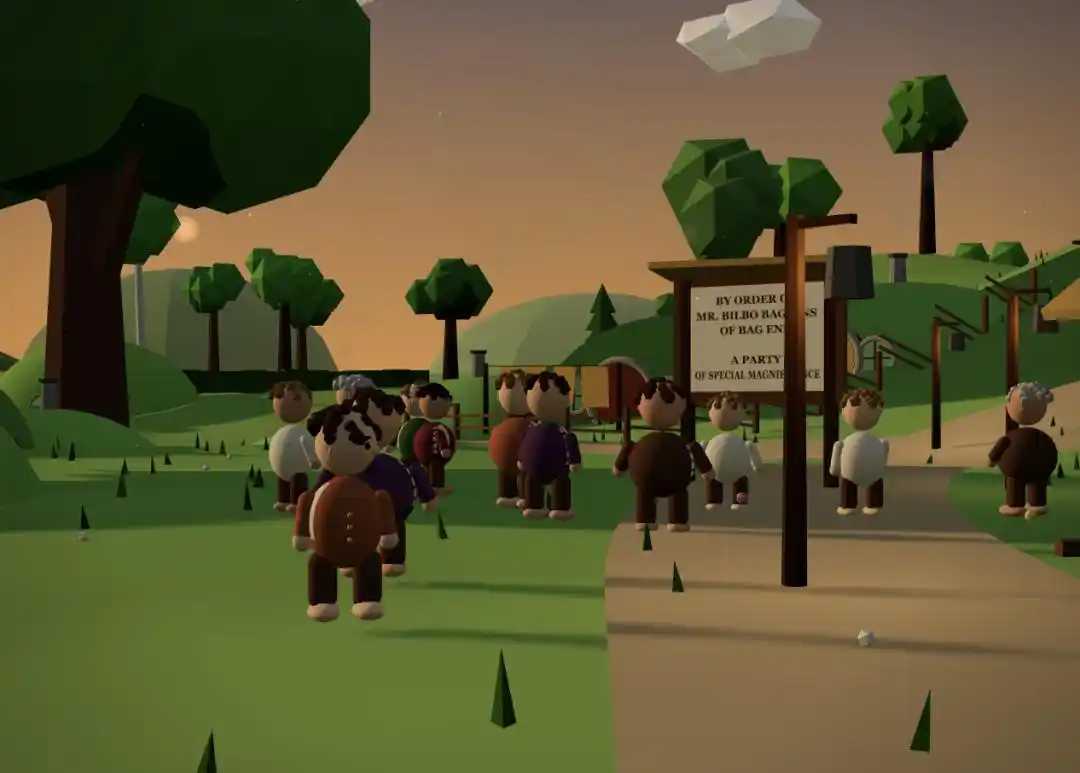
As for the final effect... well, it somewhat resembles domestic 3D animations from the late 1990s and early 2000s: very rough and quite abstract.

But objectively speaking, if you look closely for a while and happen to be familiar with the "Lord of the Rings" filming location Hobbiton in New Zealand, you can indeed catch a hint of its flavor~

However, this seemingly unpolished creation genuinely cost Opus 5: 1 million tokens, 2 hours, and 5,500 lines of code.

Of course, it's not just the Claude model shining solo on this stage.

The most hilarious part is probably the new offering from netizens—a DeepSeek V4 Flash version.

It's a complete "Chinese people can fly" situation, with all characters floating in the air.

Faced with these currently obvious goofs, Karpathy was quite fair.

He pointed out that Opus 5 still cannot truly "enter" the world it generates; it can only continuously take screenshots at different time points and slowly check where things went wrong.

And this precisely exposes a significant shortcoming of current large models:

They can already write code, build scenes, and generate games, but they still cannot truly understand videos, nor can they actually play the games they create.

Two Hours, Crafting Middle-earth by Hand

Let's first look at how this "Lord of the Rings" test was conducted.

If taken literally from Karpathy's tweet, the main prompt input for Opus 5 should be the beginning of Chapter One, "A Long-expected Party," from "The Lord of the Rings" novel.

When Mr. Bilbo Baggins of Bag End announced that he would shortly be celebrating his eleventy-first birthday with a party of special magnificence, there was much talk and excitement in Hobbiton...

Interested folks can try it themselves.

In addition, Karpathy also specified Three.js in the prompt—a JavaScript library for building 3D scenes with code.

Thus, the task for Opus 5 was to first comprehend the text at the beginning of "The Lord of the Rings," and then translate it into a 3D world that could run in real-time in a browser.
Throughout the process, Opus 5 needed to use polygons to piece together characters, buildings, and props, place them one by one into x, y, z coordinate systems, and then arrange cameras, lighting, and animations.

When characters should move, where the camera should turn, how lighting should change, and how objects in the scene should interact—all needed to be defined by the model using code.

Although the final visuals aren't exactly refined, and issues like clipping and floating frequently occur—for example, characters' bodies and heads separating... but at least the entire scene was genuinely built.
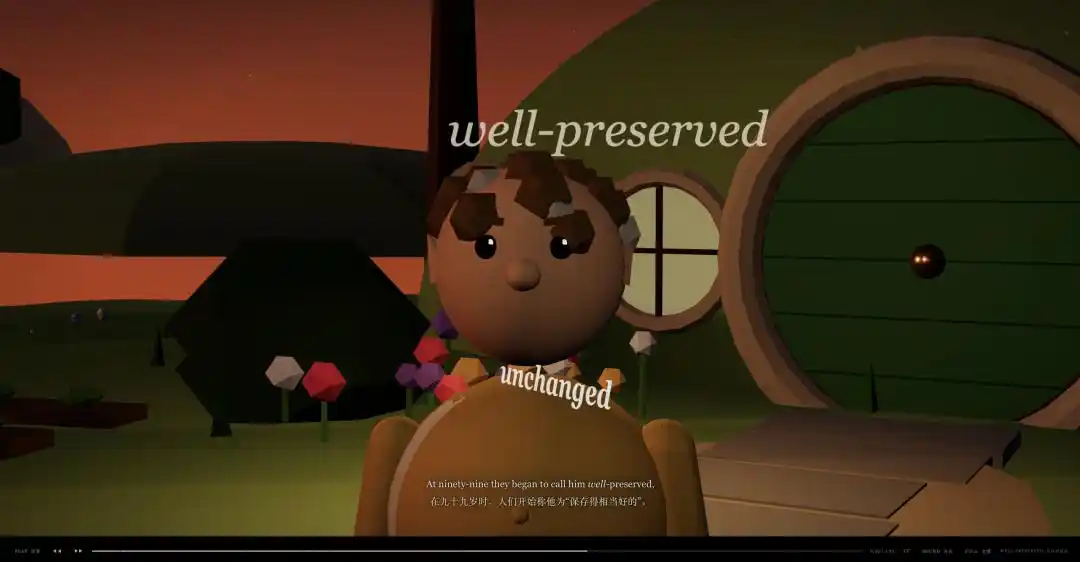
It's important to note that this is not the same as video models directly generating pixel frames.

Three.js first needs to build characters, objects, and scenes as 3D objects, then calculate their positions, angles, and motion states in real-time based on the code.

Therefore, the demo we see is not a regular AI-generated video, but a recording of a running 3D web scene.

However, Karpathy also mentioned in the comments that procedural 3D and video generation are not an either-or choice.

A netizen suggested that this rough Three.js recording could be fed to Sora as a reference video, letting the video model render it again with higher visual quality.
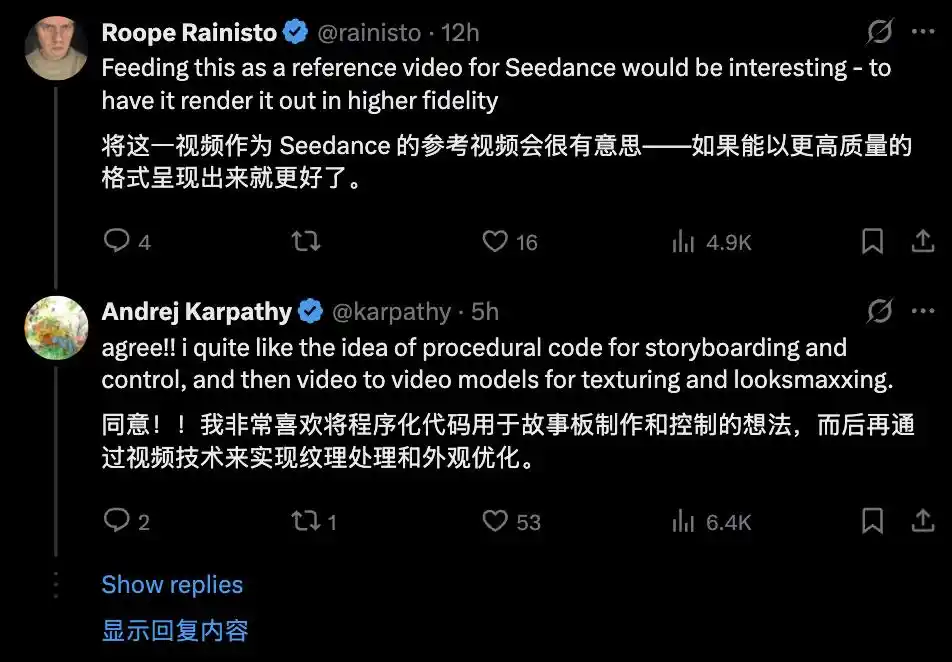
Karpathy quickly agreed.

According to his vision, procedural code could handle storyboarding and control, first finalizing the skeleton: where characters stand, how the camera moves, and how the plot progresses.

Then, the recording could be passed to a Video-to-Video model to add textures, lighting, shadows, and details, enhancing the overall "appeal" of the Middle-earth world.

As for audio, Opus 5 didn't handle it all this time.

Karpathy stated that, due to personal requirements for sound quality, he ultimately used ElevenLabs.
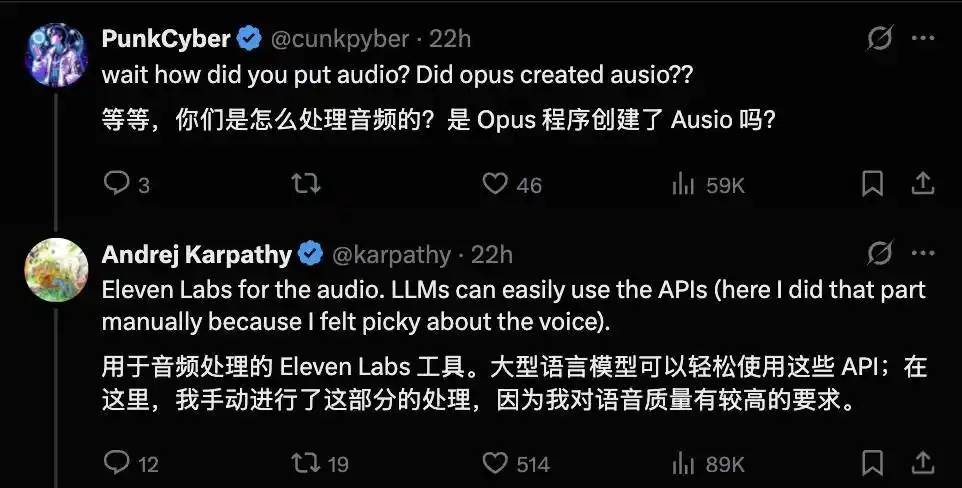
Thus, that "Lord of the Rings" demo with visuals, camera work, and narration at the beginning came into being.

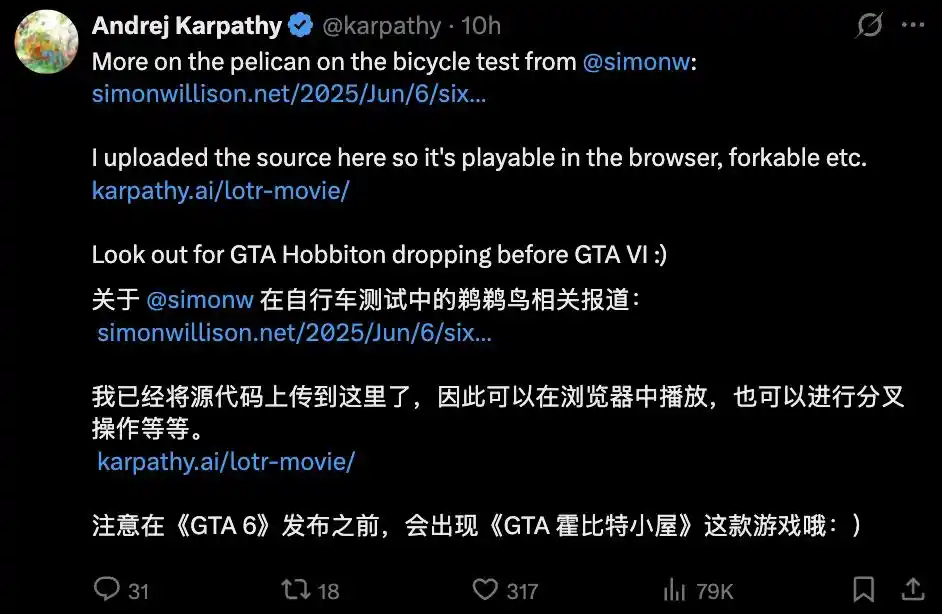
Karpathy has also open-sourced the entire project; the specific link can be found at the end.
Netizens Are More Interesting Than Karpathy

After Karpathy released the demo, many netizens also rushed to test it out.

Looking at the overall response, one can only say:

This bunch of netizens is more imaginative than Karpathy.

Someone used Claude to launch an 'Earth Online' project, aiming to build the entire Earth bit by bit with a group of AI Agents.

Currently, the Agents haven't finished the whole Earth, having only built a low-poly-style San Francisco waterfront area. But from the available visuals, the building proportions, character scales, and overall style remain quite consistent.

This effect is somewhat like those Lego-world animations. The art style isn't complex, but characters, scenes, and actions can operate stably within the same world.

Continuing in this direction, simple-styled animations and lightweight games are already showing a hint of AI-native potential.

Another netizen used Fable 5 and GPT-5.6 Sol to build a 3D digital model of New York City, incorporating real-time data into it.

The model not only had to position New York's streets and buildings correctly but also maintain spatial relationships between different areas. The author thus proposed that this task of generating virtual worlds could perhaps become a new benchmark for spatial reasoning.

Even more exaggerated examples followed.

One netizen couldn't get tickets to Kanye West's concert, so they simply used AI to host a private concert for themselves in the browser.

The entire project was still built with Three.js. It consisted of a single HTML file, without calling any pre-made 3D models; the stage, characters, and lighting were all generated by code.

The concert prepared 14 songs in total, each with independent lighting design and a dedicated set of spherical stage visuals.

Regular users could listen to clips; after connecting a Spotify Premium account, they could play full songs and the entire show.

Couldn't get tickets? Just generate a private show for yourself. Incredible!

And there's more!!!

Karpathy also envisioned in the original post that gameplay could be added to these 3D worlds later, allowing players to enter as observers, NPCs, or even story characters.

Before Karpathy could arrange a game version, netizens had already made one.
This project also used Opus 5 and Three.js. It could not only run and be interactive but also had audio added.

More 3D design cases kept appearing. From building proportions and spatial layouts to scene style, Opus 5 could already maintain relatively stable consistency across fairly large-scale projects.

There are many similar examples; we won't showcase them all here.

Objectively speaking, these works still have some distance from truly mature games.

Whether the dazzling array of gameplay is fun, if it runs stably over long periods, and if players would genuinely stay for 15 minutes—all these questions currently lack answers.

But the barrier to creating real-time 3D content and playable prototypes has indeed been significantly lowered.

Moreover, having a new way to test model capabilities that is also sufficiently fun and interesting—isn't that a beautiful thing?

The Pelican Has Ridden Far Enough

So, why suddenly ask large models to generate "The Lord of the Rings"?

This goes back to the wildly popular "Pelican Riding a Bicycle" test from a few years ago.

This problem originated from developer Simon Willison, with only one sentence as the requirement:

Generate an SVG image of a pelican riding a bicycle.
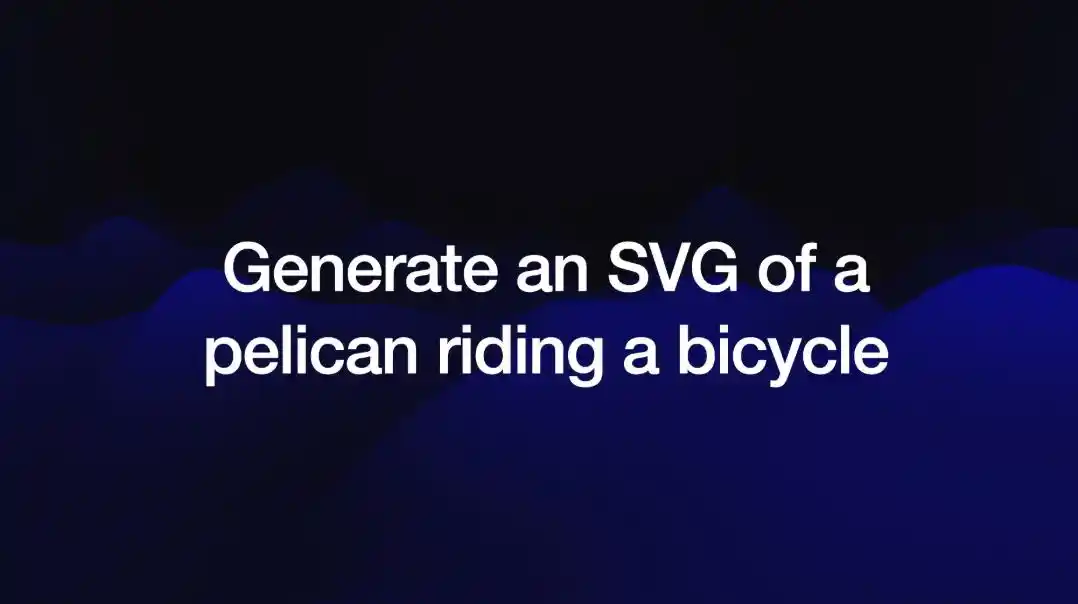
Although this problem seems simple, it actually tests models quite significantly.

Because an SVG looks like an image, but its underlying structure is a string of code.

The model not only needs to know what a pelican and a bicycle look like separately but also must break them down into lines, circles, and polygons, then arrange the positional relationships of each component using coordinates.
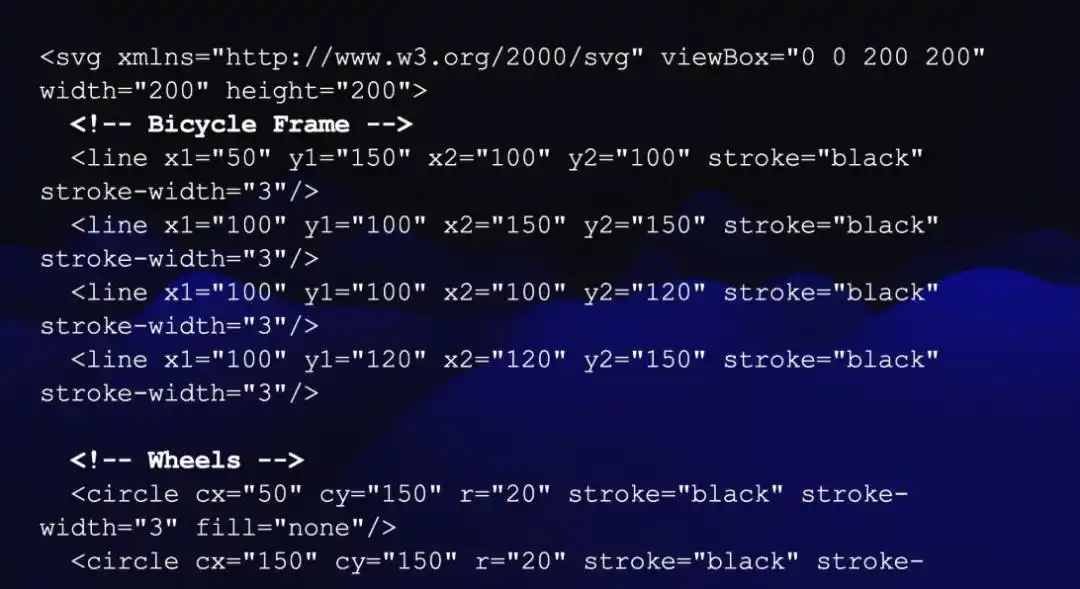
More crucially, pelicans and bicycles themselves are not a natural fit.

The bicycle's frame, tires, and pedals must maintain correct geometric structures; the pelican has a large beak, short legs, and a physique that doesn't look at all suited for pedaling.
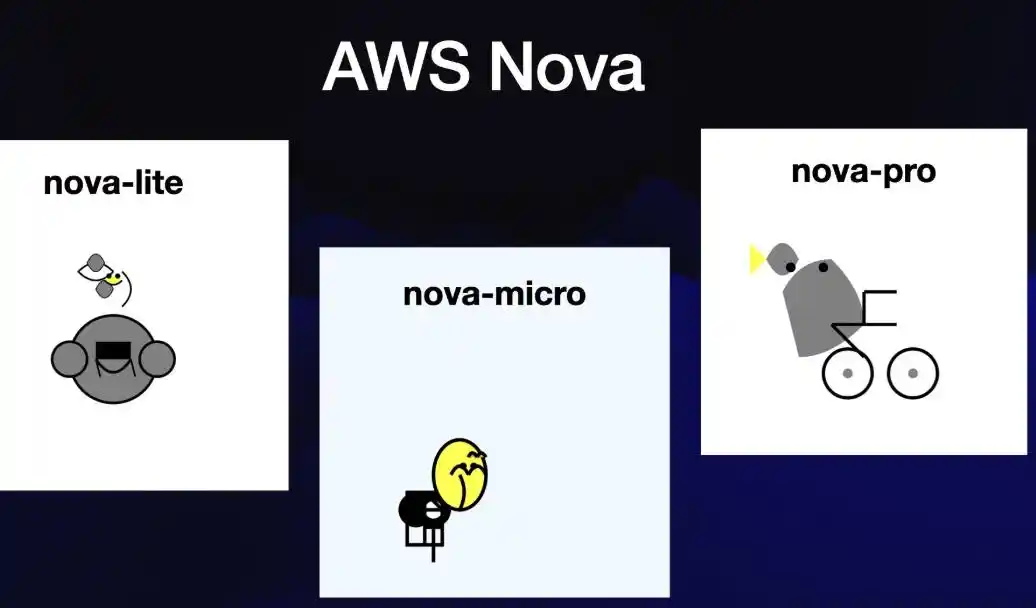
Combined, whether the model truly understands spatial relationships becomes almost immediately apparent:

Are the wheels crooked? Are the feet stepping on the pedals? Is the bird actually riding, or has it been dismembered by the bike frame?

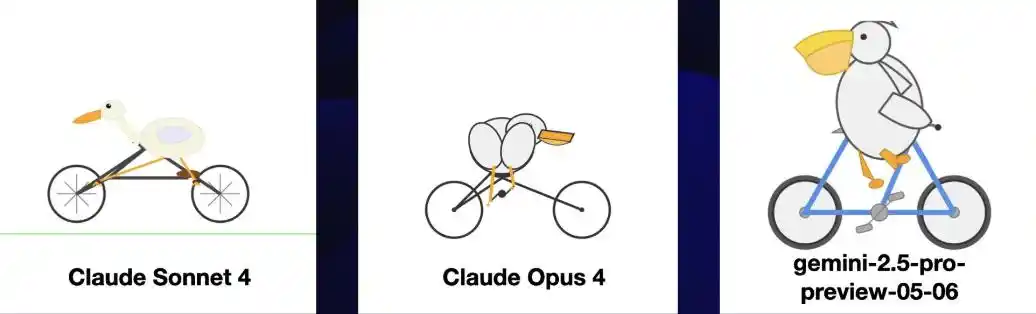
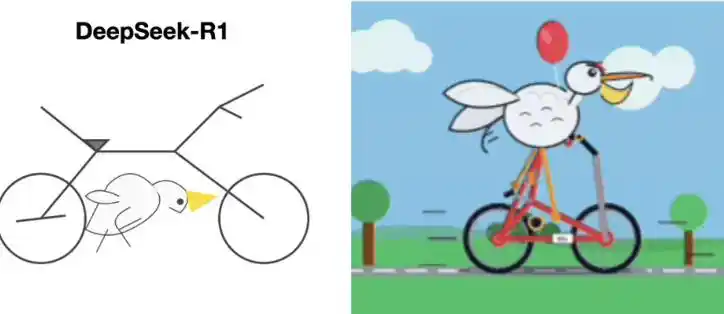
Take a look at these demos from late 2024 above~

For this reason, "Pelican Riding a Bicycle" once became a classic folk test for observing large models' spatial understanding, object composition, and code generation abilities.
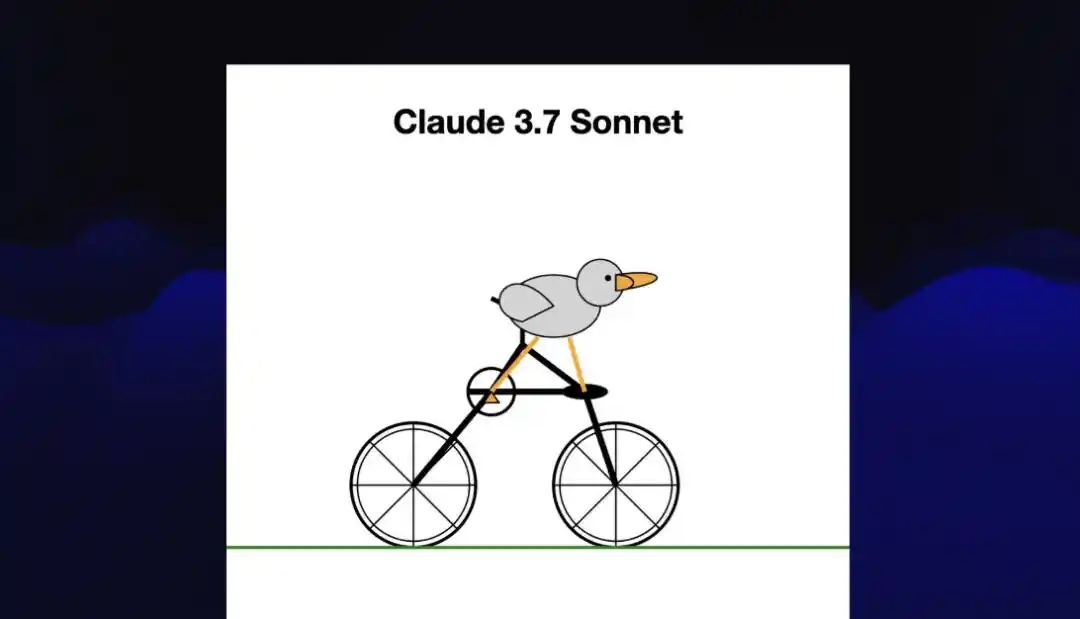
But as models grew stronger, this pelican's ride is nearing its end.

Just look at the performance of DeepSeek R1 and DeepSeek V4 below. Nowadays, models can handle this problem quite decently.
More importantly, a single SVG can only test a model's one-time output.

It cannot measure whether a model can plan a complex project, work continuously for hours, and repeatedly check and correct its own mistakes across thousands of lines of code.

Thus, Karpathy replaced a small "draw a picture" problem with a major "build a world" project—

The pelican can dismount now; Middle-earth officially takes over.
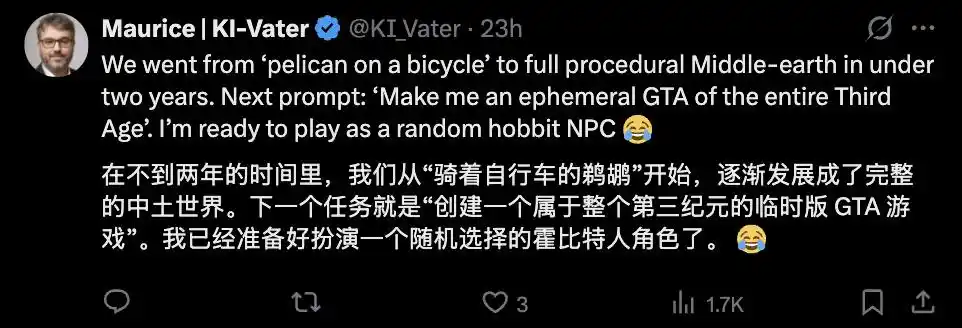
Karpathy's Pelican

Soon, news that Karpathy was preparing to change the "Pelican test" problem also spread to various communities.

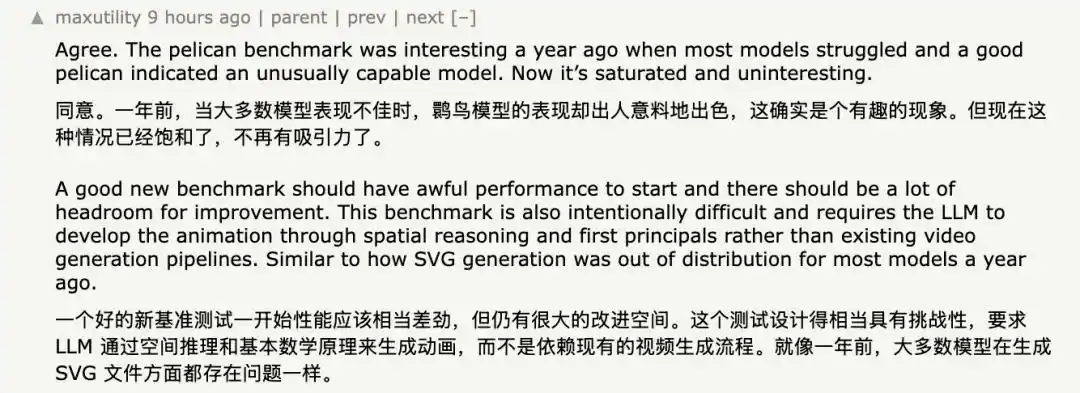
High-rated comments on Hacker News argued that although the visual quality of these demos is generally low, this precisely indicates we need a new test more challenging than generating a single image.

The new benchmark shouldn't just see if the model can draw the picture correctly; it should also examine whether it can comprehend a world.
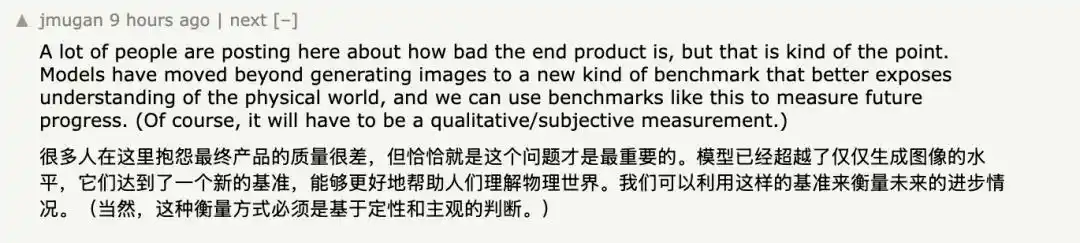
After all, "Pelican Riding a Bicycle" has been used for too long.

Models continuously optimize for this type of task on leaderboards, making the differences between them harder to discern.

In contrast, generating a complete 3D world requires the model to understand spatial relationships between characters and objects, handle camera, motion, and scene changes—not simply call a video generation model to spit out a sequence of frames.
Of course, there were opposing opinions as well.

The Pelican test is sufficiently concise, low-cost, and its results are easy to compare.

Consuming so many Tokens to generate an entire 3D world just to test a model once seems a bit like setting off fireworks with computing power.
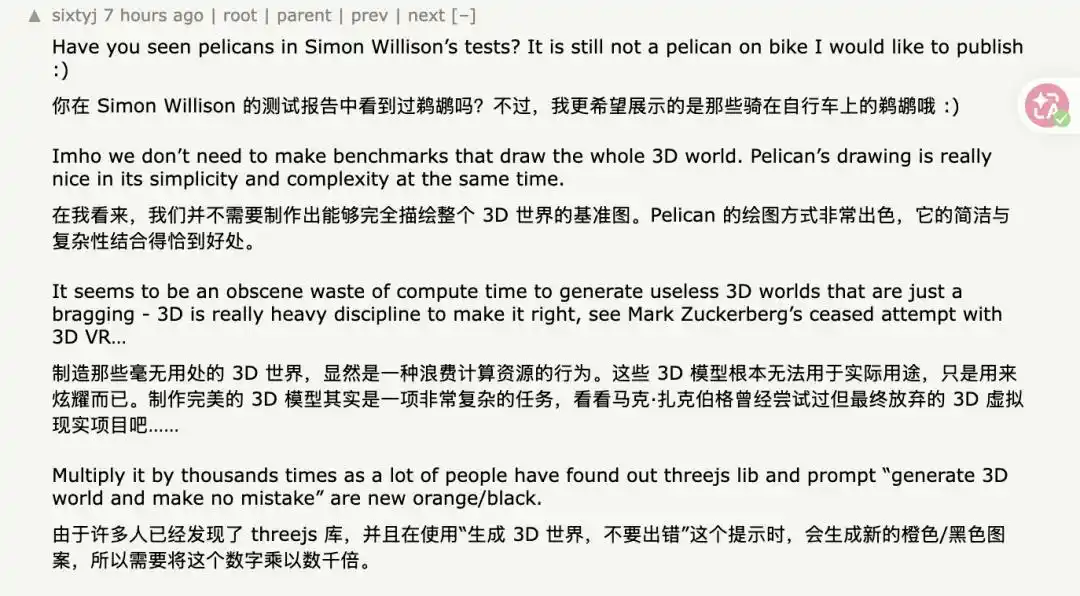
Simultaneously, whether Three.js itself can measure a large model's comprehensive abilities was also questioned.

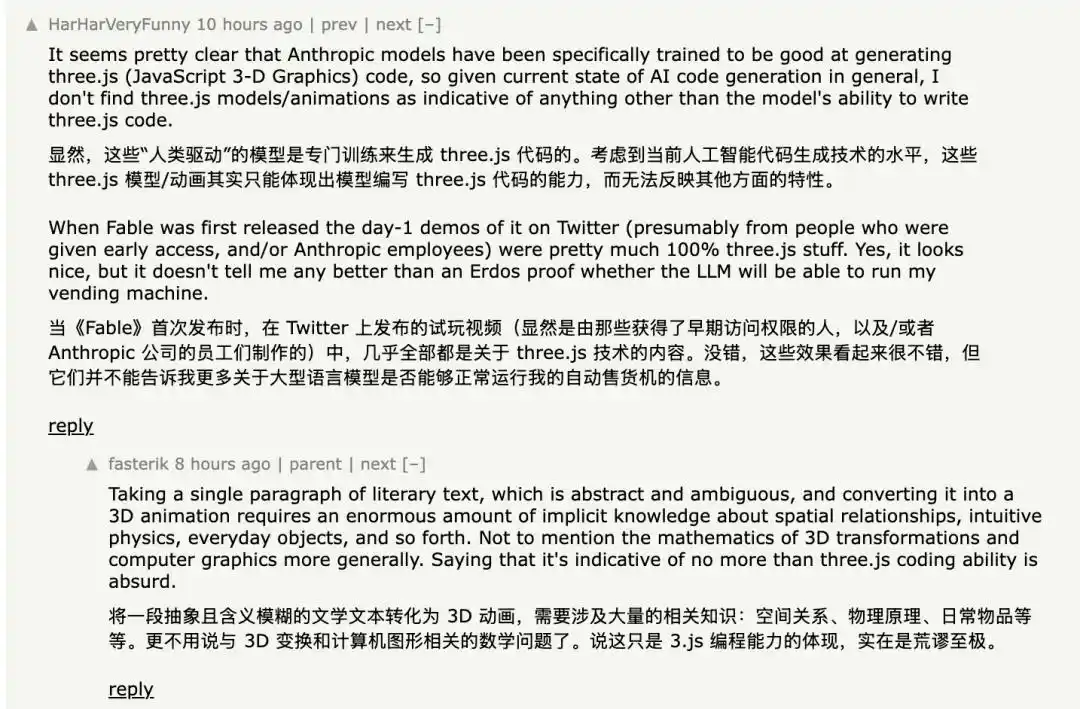
Some argued that such demos can at most prove that Anthropic has trained well on Three.js code, not that the model truly understands space and the physical world.

But soon, netizens rebutted:

Transforming an abstract, ambiguous literary text into a 3D animation requires the model to simultaneously handle spatial relationships, physical laws, everyday objects, as well as mathematical problems in 3D transformations and computer graphics.

If this is still considered merely "knowing how to write Three.js," that somewhat underestimates these 5,500 lines of code.
Another netizen raised an even more open question:

Is so-called "spatial reasoning" truly different from the reasoning large models typically perform when processing text and code?

One view holds that whether a scene holds up depends on whether the model understands spatial relationships like "front/back, inside/outside, near/far, occlusion," as well as the distance, angles, and relative sizes of objects from different viewpoints.
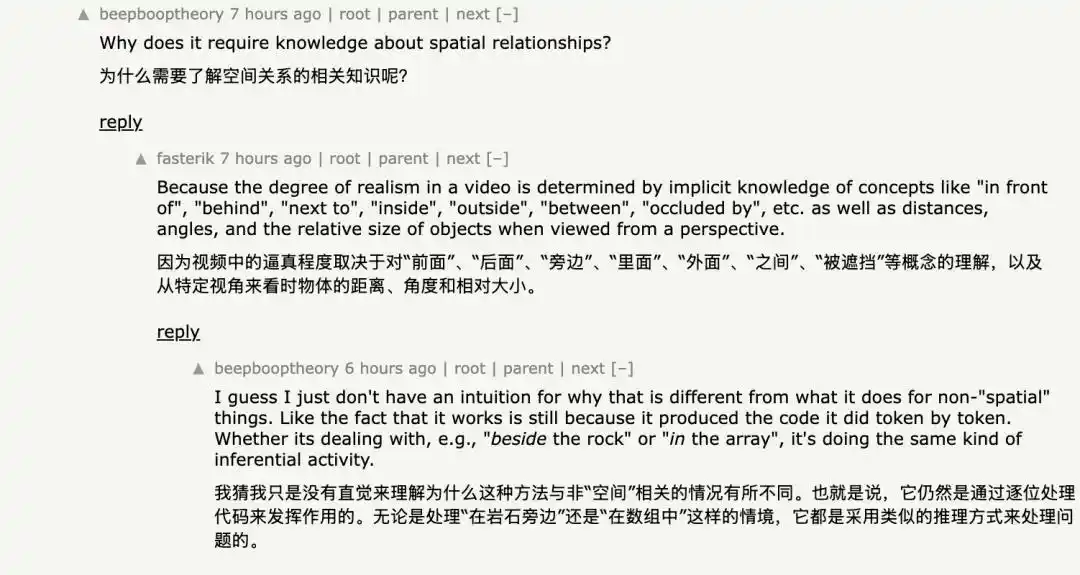
But another view argues that whether the model processes "beside a stone" or "inside an array," it might be doing the same thing: generating Tokens one by one based on context, completing reasoning in the process.

If so, then what Opus 5 demonstrates is not just a suddenly emerging "spatial ability."

A more likely scenario is that the general reasoning ability originally used by large language models to understand text and code has begun naturally extending into the three-dimensional world.

From drawing a pelican to building Middle-earth, the problem seems to have changed, but what's being tested behind the scenes might always be the same question:

Can the model transform its understanding of the world into a structure that can truly run.

And finally, perhaps there's an even more outrageous question—

If general large models can already write code to build 3D worlds themselves, then call APIs like Sora and ElevenLabs to complete visuals and audio, how much need is there left for users to personally open a specialized video generation product and input a Prompt?

Reference Links

[1]https://karpathy.ai/lotr-movie/

[2]https://simonwillison.net/2025/Jun/6/six-months-in-llms/

[3] https://x.com/wizardbrainz/status/2083012159341203708

[4]https://x.com/aniketjart/status/2083645765097033845

[5]https://x.com/davidfromkansas/status/2075691129899528254

[6]https://x.com/MindaugasLT/status/2083488027343470939

This article is from the WeChat public account "QbitAI," author: henry

Criptomoedas em alta

Perguntas relacionadas

QWhat is the 'Lord of the Rings benchmark' proposed by Karpathy, and what does it test?

AThe 'Lord of the Rings benchmark' is a new test proposed by Andrej Karpathy for evaluating large language models. It involves giving a model, like Anthropic's Opus 5, the opening text from 'The Lord of the Rings' and instructing it to generate an interactive 3D scene using Three.js code. This benchmark tests a model's ability to comprehend complex narratives, understand and reason about spatial relationships, plan and execute large-scale projects (generating thousands of lines of code over hours), and translate abstract textual descriptions into a functional, multi-element digital world.

QHow does the 'Lord of the Rings' benchmark differ from the previous 'Pelican Riding a Bicycle' SVG test?

AThe 'Pelican Riding a Bicycle' test required models to generate a single SVG image, testing basic spatial understanding and object composition in a simple, static output. The new 'Lord of the Rings' benchmark is significantly more complex. It replaces a simple image generation task with the creation of a dynamic, multi-scene 3D world. It assesses a model's capability for long-term planning, multi-step reasoning, maintaining consistency across a large codebase, and managing interactive elements like camera angles, lighting, and character animations over time.

QWhat were some limitations or humorous failures observed when other models attempted the new benchmark?

AWhen other models attempted the task, notable failures included the DeepSeek V4 Flash version generating a scene where all characters were floating in the air, humorously described as 'Chinese people can fly.' Other common issues across demos included characters' bodies detaching from their heads, objects clipping through each other ('穿模'), and generally rough, abstract 3D graphics reminiscent of early 2000s animations. These highlight current model shortcomings in precise spatial reasoning and physical consistency.

QAccording to the article, what major shortcoming of current large models does this benchmark expose?

AThe benchmark exposes that while current large models can write code, build scenes, and generate game prototypes, they lack the ability to truly 'understand' or interact with the worlds they create. Karpathy pointed out that Opus 5 cannot 'enter' its generated world to playtest it; it can only inspect it by taking screenshots at different points in time. This reveals a gap in capabilities: models can create interactive content but cannot perceive it visually (understand video) or agency-based understanding (play the game) to debug or refine the experience autonomously.

QWhat future applications or possibilities does the article suggest based on the success of these 3D world-generation demos?

AThe article suggests several future possibilities: 1) Lowering the barrier for creating real-time 3D content and playable prototypes, enabling more AI-native simple animations and lightweight games. 2) A hybrid workflow where procedural code (from the LLM) handles scene composition and camera control, and a video-to-video model enhances the visual fidelity. 3) The potential for users to rely on general-purpose LLMs that can orchestrate multiple specialized APIs (for 3D, video, audio) to create complex media, reducing the need to use separate, specialized tools for each task. 4) The concept of AI agents collaboratively building large-scale virtual worlds like an 'Earth Online.'

Leituras Relacionadas

Soaring 20% Then Dropping 5%: When Will the Bottom of the Korean Stock Market Be?

"South Korean stocks face a turbulent period as the KOSPI index, after a 20% surge, fell 5% to 6257 points. The market is grappling with severe issues: over 500,000 leveraged retail accounts have been liquidated, and more than 24 trillion won has flowed from stocks into bank deposits for safety. This reflects a significant loss of market liquidity and shaken investor confidence. In response, Korean financial regulators are taking action. They have tripled the minimum保证金 (margin) requirement for single-stock leveraged ETF trades to 30 million won and are considering granting themselves "emergency intervention" powers. These could include capping leverage ratios and setting investment limits on these ETFs, seen by many as amplifying market volatility. Initial results show a 75% drop in these products' trading volume post-regulation. The market downturn has political repercussions, pushing President Yoon Suk-yeol's approval rating to a new low. Meanwhile, foreign investors made a record net purchase of 7.18 trillion won during a recent rebound, while domestic retail investors sold off massively. Morgan Stanley has upgraded South Korean stocks to "overweight," citing the ongoing "leverage unwinding" and potential for a 36% upside, with giants like Samsung Electronics and SK Hynix providing valuation support. However, analysts caution that the market's structure remains vulnerable to foreign capital flows, and the current low may not be the bottom."

marsbitHá 10m

Soaring 20% Then Dropping 5%: When Will the Bottom of the Korean Stock Market Be?

marsbitHá 10m

Goldman Sachs Stakes a Clear Position: This Is the Largest Capital Demand Cycle in Human History, and the Fed Is Just an Observer

Goldman Sachs argues that the world is entering the most capital-intensive investment cycle in history, driven by concurrent massive demands from AI infrastructure, reindustrialization, defense reinvestment, power grid rebuilding, supply chain realignment, and sovereign debt financing. This structural competition for capital is pushing its cost higher, fundamentally altering investment paradigms. Goldman's Mark Wilson states that the Federal Reserve is merely a "passenger, not the driver" in this shift, with rising yields rooted in these real economy demands rather than just monetary policy. While major indices appeared calm in July, underlying market movements were historic, featuring extreme stock dispersion and a severe momentum factor crash, leading to significant de-risking by fund managers. Wilson cautions against expecting a quick reversal in August, citing ongoing digestion of higher rates, disrupted risk models, and typically muted market performance ahead of US midterm elections. Corporate fundamentals remain robust with strong earnings, though growth rates are peaking in the US while accelerating in Europe. Notably, hyperscale cloud companies like Amazon and Microsoft are announcing staggering capital expenditure projections for 2027-2028, justified by explosive AI-related revenue growth and high returns. Amazon revealed its AI revenue run-rate exceeds $25 billion, growing triple-digits annually, and expressed confidence that AWS could become a trillion-dollar revenue business. The report concludes that a transitional period is underway, marked by a growing tension between aggressively investing private tech giants and increasingly capital-constrained sovereign governments. The AI super-cycle continues, with August likely being a consolidation phase.

marsbitHá 15m

Goldman Sachs Stakes a Clear Position: This Is the Largest Capital Demand Cycle in Human History, and the Fed Is Just an Observer

marsbitHá 15m

Outflow of Stablecoins from South Korea Continues for 18 Consecutive Months, Exceeding $360 Million in June

In June 2026, South Korea experienced a net outflow of stablecoins to overseas crypto exchanges, amounting to 560.3 billion won ($367 million). This represents approximately 78% of the net value of foreign stocks purchased by Korean investors in the same period. According to the Financial Supervisory Service (FSS), this marks the 18th consecutive month of net outflows, a trend ongoing since January 2025. The FSS reported that 2.76 trillion won ($1.8+ billion) in stablecoins were withdrawn from the country's five major exchanges to foreign platforms in June, while 2.2 trillion won ($1.4 billion) flowed back in. The second quarter of 2026 saw a significant net outflow of 1.69 trillion won (~$1.1 billion), surpassing net sales of foreign stocks in the same period. Analysts cite access to unavailable domestic financial instruments as a primary driver. Foreign platforms offer crypto derivatives, spot and futures products tied to major Korean stocks like Samsung and Hyundai, along with RWA tokenization, DeFi, staking, and leveraged products. Lawmaker Lee Jong-wook warned that the stablecoin outflows constitute capital flight, exposing investors to risks on unregulated foreign platforms. He called for accelerated regulatory reform and enhanced investor protection measures. The government is reportedly working on a digital assets law to foster the blockchain sector.

cryptonews.ruHá 20m

Outflow of Stablecoins from South Korea Continues for 18 Consecutive Months, Exceeding $360 Million in June

cryptonews.ruHá 20m

Trading

Spot

Artigos em Destaque

O que é G$

Compreender o GoodDollar ($G$): Um Plano para um Rendimento Básico Universal Descentralizado Introdução No panorama em constante evolução das criptomoedas e da tecnologia blockchain, iniciativas que procuram abordar questões sociais prementes têm ganhado uma atenção crescente. Um desses projetos é o GoodDollar ($G$), uma solução de rendimento básico universal (UBI) baseada na Web3. O GoodDollar esforça-se para enfrentar a desigualdade e reduzir a disparidade de riqueza, criando e distribuindo recursos econômicos acessíveis aos que mais precisam. Através da sua utilização inovadora das finanças descentralizadas (DeFi), o GoodDollar apresenta um modelo único que poderia potencialmente reconfigurar a forma como a assistência financeira é percebida e entregue globalmente. O que é o GoodDollar ($G$)? O GoodDollar é um protocolo de criptomoeda que facilita a emissão e distribuição de tokens digitais, referidos como $G$, aos seus utilizadores registados diariamente. Esses tokens funcionam como uma forma de rendimento básico universal, promovendo o empoderamento financeiro de indivíduos de diversas origens, especialmente aqueles tradicionalmente excluídos do sistema financeiro. Operando na blockchain, o GoodDollar utiliza múltiplas cadeias, incluindo Ethereum, Celo e Fuse, assegurando acesso amplo e usabilidade. O objetivo fundamental do GoodDollar é tornar as criptomoedas acessíveis e benéficas para todos, independentemente do seu ponto de partida econômico. O Criador do GoodDollar ($G$) Os detalhes sobre o criador do GoodDollar permanecem um pouco obscuros. No entanto, é notavelmente destacado que o projeto tem um forte apoio da eToro, uma plataforma de investimento amplamente reconhecida que forneceu o financiamento inicial e o suporte fundamental para o desenvolvimento do GoodDollar. A visão por trás do projeto não é apenas orientada para o lucro, mas inclina-se fortemente para o empreendedorismo social, visando uma mudança sistémica na acessibilidade econômica. Investidores do GoodDollar ($G$) O GoodDollar goza do apoio financeiro e operacional da eToro. Esta parceria desempenhou um papel significativo no lançamento do protocolo e nos seus desenvolvimentos subsequentes. Enquanto a eToro foi instrumental na estabelecer a fundação do projeto, o GoodDollar visiona uma transição para um modelo financiado pela sua comunidade a longo prazo. Esta mudança para o financiamento comunitário está em linha com o compromisso do GoodDollar com a descentralização, permitindo que os seus utilizadores tenham uma participação direta no futuro do projeto. Como Funciona o GoodDollar ($G$)? O framework operacional do GoodDollar baseia-se fortemente nos princípios de DeFi para gerar juros a partir de criptomoedas em stake. Este mecanismo permite ao projeto cunhar e distribuir tokens $G$ como um rendimento básico digital para utilizadores em todo o mundo. Várias características-chave contribuem para a singularidade e inovação do GoodDollar: Rendimento Básico Universal (UBI): Todos os dias, os utilizadores registados recebem tokens gratuitos, estabelecendo um fluxo de rendimento automático destinado a aliviar as pressões financeiras. Modelo Económico Sustentável: A tokenómica do projeto visa equilibrar a oferta e a procura de tokens $G$, garantindo que o valor permaneça estável ao longo do tempo. Tokens Garantidos por Reservas: Cada token $G$ é garantido por uma reserva de criptomoedas, conferindo-lhe um valor inerente e fiabilidade, um aspecto crucial para manter a confiança dos utilizadores. Governança Descentralizada: O GoodDollar incorpora uma abordagem democrática à tomada de decisões através de governança descentralizada com poder de tokens. Isso permite que os membros da comunidade participem ativamente na definição da trajetória do projeto, tornando-o verdadeiramente orientado pela comunidade. Acessibilidade Global: O GoodDollar estabeleceu uma considerável pegada comunitária, com mais de 640.000 membros espalhados por 181 países. Tal alcance generalizado é instrumental na facilitação do UBI em escala global. Cronologia do GoodDollar ($G$) A evolução do GoodDollar é marcada por vários marcos significativos ao longo da sua história: 2019: O lançamento da carteira GoodDollar marcou o primeiro passo para operacionalizar a sua visão de entregar UBI através de criptomoeda. 2020: Após o bem-sucedido lançamento da carteira, o protocolo GoodDollar fez a sua estreia oficial. Isso marcou uma fase crucial na sua missão de fornecer rendimento diário distribuído. 2021: O projeto avançou ainda mais com a introdução da sua Organização Autónoma Descentralizada (DAO), promovendo um maior nível de envolvimento e governança comunitária. 2022: O GoodDollar revelou a sua versão 2 (V2) amiga das DeFi, esforçando-se por um maior envolvimento dos utilizadores e eficiência operacional. O mesmo ano também viu a transição para uma estrutura de governança descentralizada através do GoodDAO. 2022: Um novo roteiro foi conceptualizado, focando em iniciativas como um programa de subsídios destinado a promover empreendimentos relacionados com $G$ e um Mercado GoodDollar atualizado. Características Principais do GoodDollar ($G$) O projeto GoodDollar introduz inúmeras características críticas destinadas a redefinir o cenário do rendimento básico: Rendimento Básico Universal: A entrega diária de tokens gratuitos aos seus utilizadores sublinha fundamentalmente a sua missão de eliminar a precariedade económica. Operação Multi-Cadeia: A utilização de múltiplas redes de blockchain melhora a acessibilidade e escalabilidade, assegurando uma participação mais ampla. Envolvimento com Finanças Descentralizadas: O uso de DeFi permite o financiamento sustentável do modelo UBI, reforçando a sua viabilidade como uma solução económica. Envolvimento e Governança Comunitária: O GoodDollar imagina um modelo onde a comunidade influencia as operações através da participação democrática, promovendo transparência e responsabilidade. Comunidade Global: Com uma comunidade global diversificada, o projeto pode implementar soluções de UBI adaptadas a vários contextos culturais e económicos. Conclusão O GoodDollar representa um salto transformador para a incorporação dos princípios de rendimento básico universal através da lente inovadora da tecnologia blockchain. Ao aproveitar as finanças descentralizadas, o projeto não apenas fornece uma solução para a desigualdade financeira, mas também envolve ativamente os utilizadores na sua governança e operações. Com uma comunidade em crescimento e um roteiro em evolução, o GoodDollar destaca-se como um jogador significativo na interseção entre criptomoeda e bem social, abrindo caminho para um futuro financeiro mais equitativo. À medida que continua a evoluir, a jornada do GoodDollar poderá, em última análise, inspirar outras iniciativas a considerar modelos semelhantes, promovendo ainda mais a causa do empoderamento económico para todos.

83 Visualizações TotaisPublicado em {updateTime}Atualizado em 2024.12.03

O que é G$

Como comprar G

Bem-vindo à HTX.com!Tornámos a compra de Gravity (G) simples e conveniente.Segue o nosso guia passo a passo para iniciar a tua jornada no mundo das criptos.Passo 1: cria a tua conta HTXUtiliza o teu e-mail ou número de telefone para te inscreveres numa conta gratuita na HTX.Desfruta de um processo de inscrição sem complicações e desbloqueia todas as funcionalidades.Obter a minha contaPasso 2: vai para Comprar Cripto e escolhe o teu método de pagamentoCartão de crédito/débito: usa o teu visa ou mastercard para comprar Gravity (G) instantaneamente.Saldo: usa os fundos da tua conta HTX para transacionar sem problemas.Terceiros: adicionamos métodos de pagamento populares, como Google Pay e Apple Pay, para aumentar a conveniência.P2P: transaciona diretamente com outros utilizadores na HTX.Mercado de balcão (OTC): oferecemos serviços personalizados e taxas de câmbio competitivas para os traders.Passo 3: armazena teu Gravity (G)Depois de comprar o teu Gravity (G), armazena-o na tua conta HTX.Alternativamente, podes enviá-lo para outro lugar através de transferência blockchain ou usá-lo para transacionar outras criptomoedas.Passo 4: transaciona Gravity (G)Transaciona facilmente Gravity (G) no mercado à vista da HTX.Acede simplesmente à tua conta, seleciona o teu par de trading, executa as tuas transações e monitoriza em tempo real.Oferecemos uma experiência de fácil utilização tanto para principiantes como para traders experientes.

542 Visualizações TotaisPublicado em {updateTime}Atualizado em 2026.06.02

Como comprar G

O que é @G

Graphite Network, $@G: A Conexão entre TradFi e Web3 Introdução ao Graphite Network, $@G No vibrante mundo das criptomoedas e projetos web3, o Graphite Network emerge como um farol de inovação. Com o seu token nativo, $@G, esta blockchain de Camada 1, Proof-of-Authority (PoA) é projetada para preencher a lacuna entre as finanças tradicionais (TradFi) e o ecossistema Web3 em rápida evolução. À medida que as moedas digitais ganham tração, o Graphite Network esforça-se por oferecer uma plataforma blockchain que prioriza a segurança, conformidade e velocidade, apresentando-se como um facilitador de confiança e responsabilidade. O que é o Graphite Network, $@G? O Graphite Network não é apenas mais um projeto de blockchain; visa redefinir como a descentralização, segurança e responsabilidade do utilizador são percebidas no domínio das finanças digitais. O projeto possui uma série de características distintas: Blockchain Baseada em Reputação: No seu núcleo, o Graphite Network implementa uma política de um utilizador, uma conta, reforçada com mecanismos integrados de Know Your Customer (KYC) e de pontuação. Este design assegura um equilíbrio entre a privacidade do utilizador e a transparência—um aspecto crítico das operações financeiras no mundo digital de hoje. Rendimento de Nós de Ponto de Entrada: A rede incentiva os utilizadores a configurar nós de ponto de entrada, permitindo que os operadores ganhem recompensas a partir das transações da rede. Este modelo de geração de rendimento não só aumenta o envolvimento dos utilizadores, mas também reforça a saúde e descentralização da rede. Compatibilidade com EVM: Com uma máquina virtual (VM) compatível com Ethereum, o Graphite Network permite a integração sem costura de aplicações descentralizadas (dApps) e contratos inteligentes existentes em Solidity, convidando assim os desenvolvedores a aproveitar as suas capacidades sem modificações extensivas. Integração de KYC: Numa era em que a conformidade é primordial, o quadro KYC integrado com múltiplos níveis de verificação melhora o controlo sobre as operações financeiras sem participação obrigatória, estabelecendo um precedente para a autonomia do utilizador. Quem é o Criador do Graphite Network, $@G? O Graphite Network nasce dos esforços da Graphite Foundation, uma organização sem fins lucrativos dedicada ao desenvolvimento, manutenção e evolução do Graphite Network. O compromisso da fundação sublinha a visão do projeto de criar um ambiente blockchain seguro e sustentável, focado no envolvimento genuíno dos utilizadores e na conformidade. Quem são os Investidores do Graphite Network, $@G? Atualmente, há informações limitadas disponíveis sobre os investidores específicos que apoiam a iniciativa Graphite Network. A organização fundadora, a Graphite Foundation, funciona de forma independente na promoção do crescimento do projeto, enquanto procura parcerias que ressoem com a sua visão de uma plataforma blockchain acessível e em conformidade. Como Funciona o Graphite Network, $@G? A operação do Graphite Network está fundamentada no seu mecanismo de consenso único Proof-of-Authority, que encontra um impressionante equilíbrio entre alta capacidade de processamento e descentralização. Vamos explorar os vários componentes que definem a sua operação: Nós de Transporte: Servindo como nós de ponto de entrada, estes são críticos para o ecossistema. Os operadores podem ganhar receita a partir das transações que atravessam a rede, o que não só empodera os utilizadores individuais, mas também reforça a descentralização da rede. Nós Autorizados: No coração do Graphite Network estão os validadores principais que passam por rigorosos testes de conformidade, abrangendo uma verificação KYC robusta juntamente com avaliações técnicas. Este nível de confiança é essencial para garantir que as transações dentro da rede mantenham um alto nível de integridade. Sistema de Tickers: O Graphite Network utiliza um sistema de ticker distinto para os seus tokens embrulhados, denotados como @G. Esta característica melhora a clareza na integração de ativos, tornando as transações dos utilizadores compreensíveis e diretas. A abordagem inovadora do Graphite Network reflete um passo significativo na resolução das questões cruciais das finanças digitais, posicionando-se favoravelmente para o futuro à medida que mais utilizadores transitam de formas tradicionais de finanças para o mundo das aplicações descentralizadas. Cronologia do Graphite Network, $@G Para entender a progressão e os marcos do Graphite Network, é benéfico rever eventos-chave na sua cronologia: 2021: A incepção do Graphite Network pela Graphite Foundation marca o início de um novo capítulo no desenvolvimento de blockchain, focando na conformidade e no empoderamento do utilizador. Desenvolvimentos Chave: Após o seu lançamento, a introdução do rendimento de nós de ponto de entrada, o estabelecimento de um modelo baseado em reputação, a verificação KYC integrada e a provisão de compatibilidade EVM representam avanços significativos no projeto. Atividades Recentes: O contínuo desenvolvimento e esforços de nutrição da Graphite Foundation têm-se concentrado em aumentar as características da rede enquanto fomentam o crescimento do ecossistema, demonstrando um compromisso a longo prazo com a sustentabilidade e inovação. Pontos Adicionais Além dos seus componentes fundamentais, o Graphite Network abrange várias ferramentas e características que reforçam a sua usabilidade: Graphite Wallet: Uma extensão do Chrome fácil de usar que facilita o acesso a várias características e aplicações da rede em cadeias compatíveis com Ethereum, melhorando a conveniência do utilizador. Graphite Bridge: Esta utilidade permite transferências sem costura de ativos Graphite entre diferentes redes, promovendo um ecossistema integrado e interoperável. Graphite Explorer: Servindo como uma ferramenta essencial dentro do ecossistema, esta característica permite aos utilizadores visualizar e verificar o código-fonte dos contratos inteligentes, rastrear transações e explorar outras informações vitais em tempo real. Graphite Testnet: O projeto fornece um ambiente de teste robusto para desenvolvedores, permitindo-lhes garantir estabilidade e escalabilidade antes da implementação na mainnet. Esta iniciativa não só empodera os desenvolvedores, mas também melhora a fiabilidade de toda a rede. Conclusão O Graphite Network, com o seu token nativo $@G, representa um avanço significativo na conexão entre as finanças tradicionais e a tecnologia blockchain de ponta. Ao focar na segurança, conformidade e descentralização, esta plataforma inovadora está pronta para liderar a transição para a era Web3. À medida que o envolvimento dos utilizadores cresce e mais projetos aproveitam as suas capacidades, o Graphite Network está posicionado para fazer contribuições duradouras para o panorama digital em rápida evolução. Em conclusão, o Graphite Network é um testemunho do que pode ser alcançado quando o pensamento inovador encontra as crescentes demandas das finanças e tecnologia modernas. À medida que o mundo explora o potencial das finanças descentralizadas, o Graphite Network sem dúvida continuará a ser um jogador notável nesta arena.

43 Visualizações TotaisPublicado em {updateTime}Atualizado em 2025.01.06

O que é @G

Discussões

Bem-vindo à Comunidade HTX. Aqui, pode manter-se informado sobre os mais recentes desenvolvimentos da plataforma e obter acesso a análises profissionais de mercado. As opiniões dos utilizadores sobre o preço de G (G) são apresentadas abaixo.

活动图片