Should Bitcoin rush its move to post-quantum cryptography?

ambcryptoPublicado em 2026-04-08Última atualização em 2026-04-08

Resumo

The Bitcoin community is divided on the urgency of migrating to post-quantum cryptography (PQC) by the 2029 deadline. JAN3 founder Samson Mow warns against rushing untested PQC solutions, arguing it could expose Bitcoin to attacks from classical computers, reduce transaction throughput due to larger signature sizes, and potentially introduce hidden backdoors. He advocates for solving the quantum computing (QC) problem later rather than sooner. This debate follows a Google Quantum AI report suggesting quantum processors could break Bitcoin's encryption sooner than previously estimated, potentially requiring only 1,200–1,450 logical qubits. Google urges a PQC upgrade by 2029 to protect nearly 7 million BTC. In contrast, figures like Adam Back and Grayscale's Zach Pandl believe practical quantum computers are still years away, posing no immediate threat. However, they agree efforts to prepare for a post-quantum future should accelerate. The issue is complicated by Bitcoin's history of contentious protocol changes and potential for significant technical trade-offs.

The Bitcoin community is divided on whether there is really a need to rush to meet the 2029 deadline of migrating to a quantum-secure network.

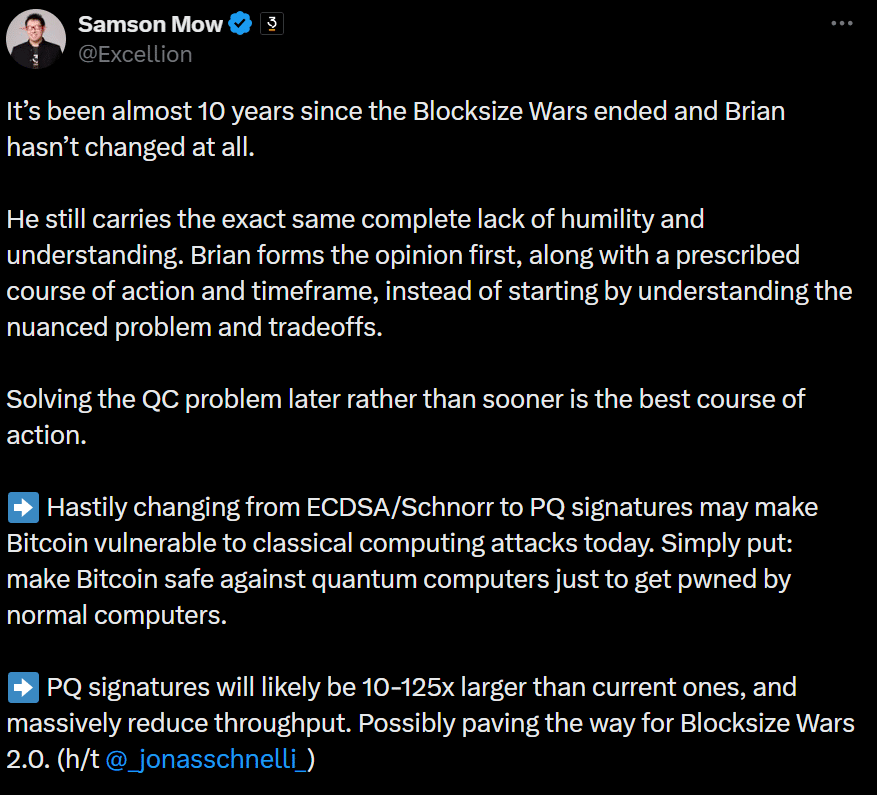
For his part, Samsom Mow, founder of JAN3, an advisory for nation-state BTC adoption, has warned against a hurried push for untested and unverified post-quantum (PQ) solutions. He cautioned that,

Solving the QC problem later rather than sooner is the best course of action.
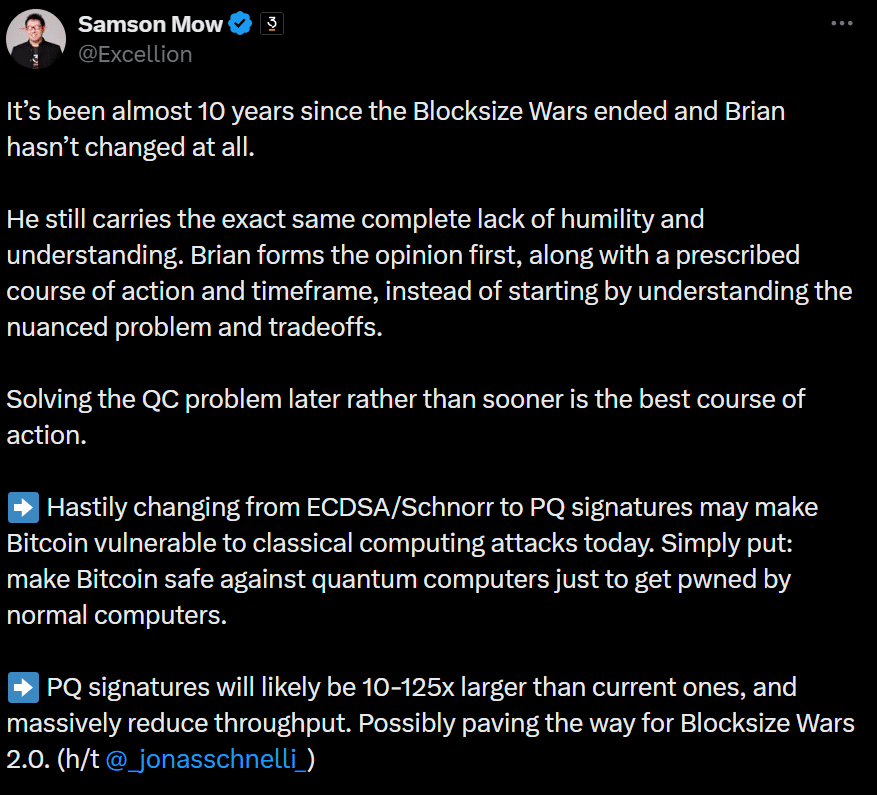
Source: X/Samson Mow

Mow slammed Coinbase CEO Brian Armstrong’s call for a ‘sooner’ PQ upgrade. He stated that it could expose BTC to attack from current classical computers.

Additionally, the proposed PQ solutions would reduce Bitcoin transactions due to larger block sizes.

PQ signatures will likely be 10-125x larger than current ones, and massively reduce throughput. Possibly paving the way for Blocksize Wars 2.0.

In fact, Solana, one of the fastest blockchains, has reported a potential 90% slowdown if current PQ solutions are implemented.

Finally, Mow pointed out the possibility of the U.S. NSA (National Security Agency) pushing current PQ solutions as standards with hidden ‘backdoors’ to infiltrate future systems.

Google urges fast PQ Bitcoin upgrade before 2029

The renewed debate follows a recent report by Google Quantum AI, which found that Bitcoin and most blockchain encryption could be broken sooner than earlier estimates suggested.

According to the findings, advanced quantum processors may require around 500,000 physical qubits or 1,200–1,450 stable logical qubits to compromise crypto security.

This was contrary to the prior estimates of millions of qubits. Google had urged a PQ upgrade by 2029 to prevent nearly 7 million BTC from being at risk.

In short, there is less than three years before further quantum advancement threatens BTC.

Bitcoin’s history complicates this. Protocol changes often take time and spark disagreement.

In fact, Charles Edwards of Capriole Investment projected that BTC will never reach a new all-time high unless it migrates to PQ.

However, some crypto and cypherpunks like Adam Back still hold that physical quantum computers are years away from hitting the market despite recent advancements.

Grayscale’s head of research, Zach Pandl, reinforced a similar stance and noted,

Investors should not fret. In our view, there is no security threat to public blockchains from quantum computers today. But it’s time to accelerate efforts to prepare for our post-quantum future.
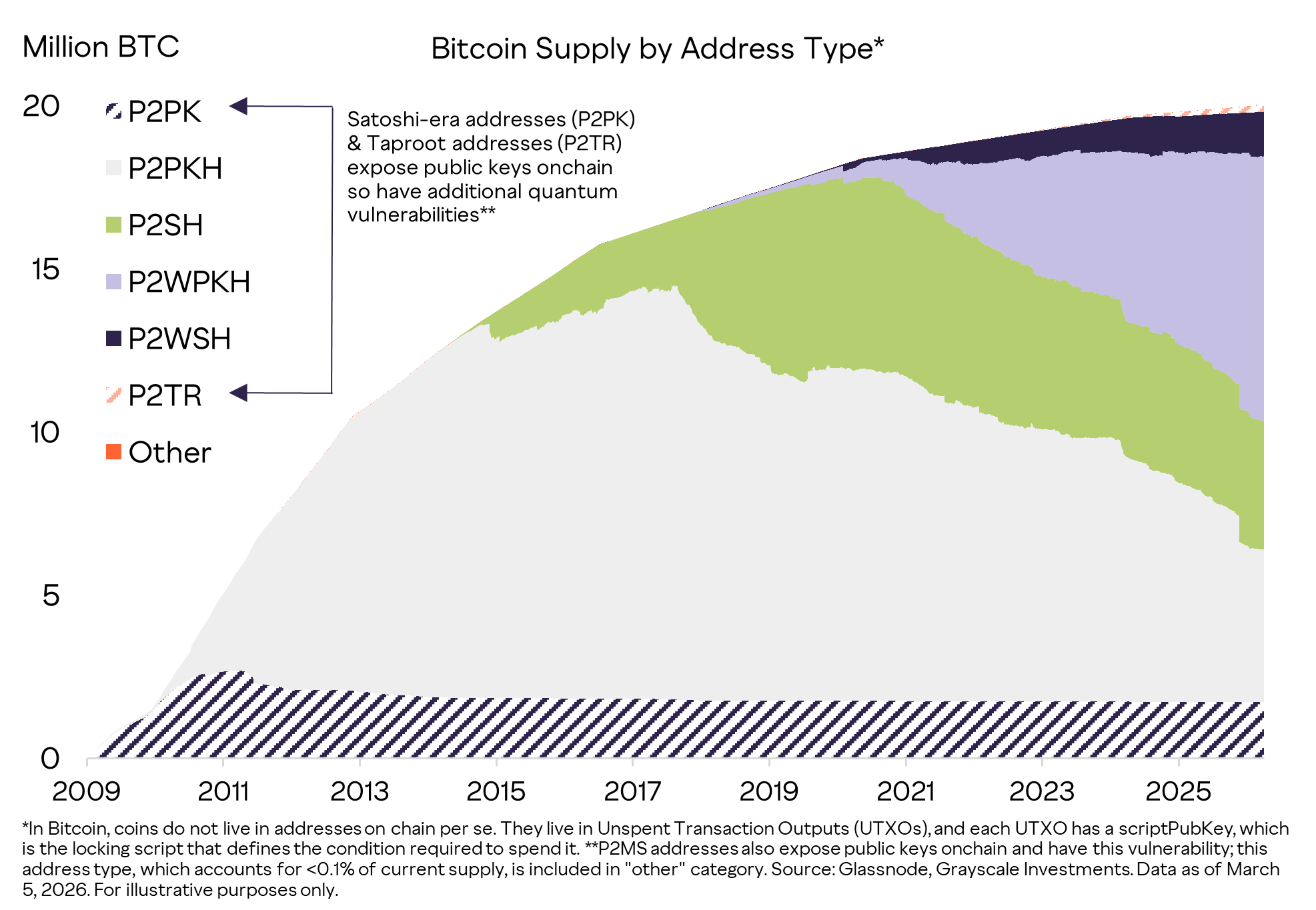
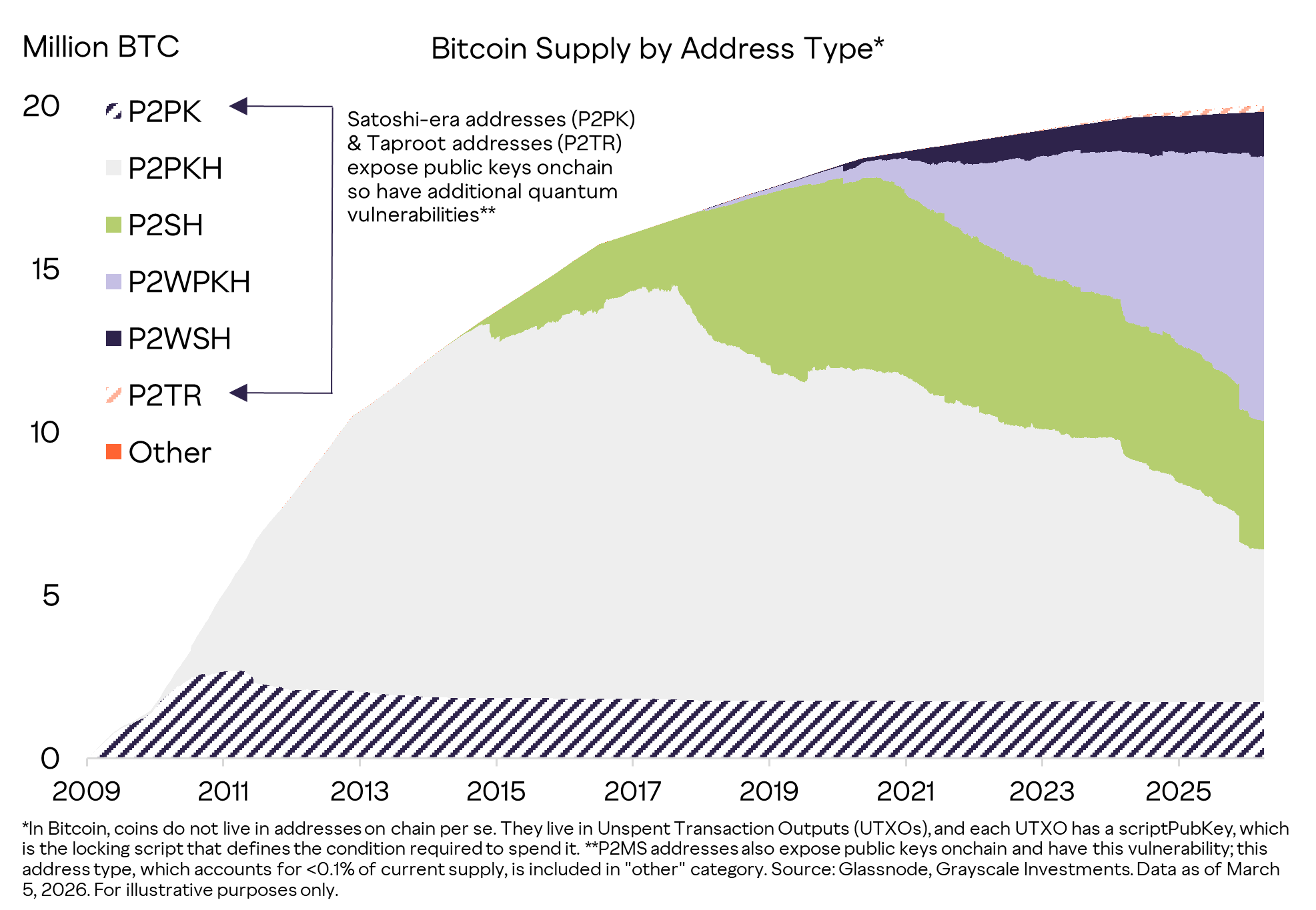
Source: Grayscale

Apart from the Satoshi-era and Taproot wallets, most investors have migrated to relatively more resistant addresses (Segwit, P2WPKH).


Final Summary

  • Jan3’s Samson Mow blasted Coinbase CEO for rushed push for PQ upgrade for Bitcoin, citing transfer speed risks and further attacks.
  • Grayscale said QC was not a problem just yet, but urged players to accelerate PQ upgrades.

Perguntas relacionadas

QWhat is the main point of disagreement within the Bitcoin community regarding post-quantum cryptography?

AThe Bitcoin community is divided on whether there is a need to rush to meet the 2029 deadline for migrating to a quantum-secure network, with some warning against hurriedly implementing untested solutions.

QAccording to Samson Mow, what are the two main risks of rushing a post-quantum upgrade for Bitcoin?

ASamson Mow warned that a rushed upgrade could expose Bitcoin to attacks from current classical computers and that the proposed solutions would reduce transaction throughput due to significantly larger signature sizes.

QWhat did the Google Quantum AI report find regarding the threat to Bitcoin's encryption?

AThe Google Quantum AI report found that advanced quantum processors may require far fewer qubits than previously estimated (around 500,000 physical or 1,200–1,450 stable logical qubits) to compromise crypto security, urging an upgrade by 2029.

QWhat is the stance of Grayscale's head of research, Zach Pandl, on the quantum computing threat?

AZach Pandl stated that quantum computers pose no security threat to public blockchains today, but he urged the community to accelerate efforts to prepare for a post-quantum future.

QWhat potential negative impact did Samson Mow suggest a post-quantum upgrade could have on Bitcoin's network?

AMow suggested that post-quantum signatures, being 10-125x larger than current ones, would massively reduce transaction throughput and could potentially lead to a 'Blocksize Wars 2.0'.

Leituras Relacionadas

You Bet on the News, the Pros Read the Rules: The True Cognitive Gap in Losing Money on Polymarket

The article explains that the key to profiting on Polymarket, a prediction market platform, lies not just predicting real-world events correctly, but in meticulously understanding the specific rules that govern how each market will be resolved. It illustrates this with examples, such as a market on Venezuela's 2026 leader, where the official rules defining "officially holds" the office overruled the intuitive answer of who was in practical control. Other examples include debates over the definition of a "token" or what constitutes an "agreement." The core argument is that a "reality vs. rules" gap creates pricing discrepancies that savvy traders ("车头" or "whales") exploit. The platform has a formal dispute resolution process managed by UMA token holders to settle ambiguous outcomes. This process involves proposal submission, a challenge window, a discussion period, and a final vote. However, the article highlights a critical flaw in this system compared to a traditional court: the lack of separation between the arbiters (UMA voters) and the interested parties (traders with financial stakes in the outcome). This conflict of interest undermines the discussion phase, leads to herd mentality, and results in opaque final decisions without explanatory rulings. Consequently, the system lacks a body of precedent, making it difficult for users to learn from past disputes. The ultimate takeaway is that success on Polymarket requires a lawyer-like scrutiny of the rules to identify and capitalize on the cognitive gap between how events appear and how they are contractually defined for settlement.

marsbitHá 49m

You Bet on the News, the Pros Read the Rules: The True Cognitive Gap in Losing Money on Polymarket

marsbitHá 49m

Will the Fed Still Cut Interest Rates? Tonight's Data Is Crucial

The core debate surrounding the Federal Reserve's potential interest rate cuts is intensifying amid geopolitical conflict and rebounding inflation. The key question is whether high energy prices will cause persistent inflation or weaken consumer demand enough to force the Fed to cut rates. Citigroup presents a bullish case for cuts, arguing that oil supply disruptions from the Strait of Hormuz are temporary and will not lead to lasting inflationary pressure. They point to receding bond yields and oil prices as evidence the market is pricing in a short-lived shock. Citi's data also shows tightening financial conditions, a stabilizing labor market, and healthy tax returns, supporting their view that the path to lower rates remains open. Conversely, Deutsche Bank offers a starkly contrasting, more hawkish outlook. They argue the Fed's current policy is already neutral and expect rates to remain unchanged indefinitely. Their view is based on stalled disinflation progress and a shift toward more hawkish rhetoric from key Fed officials like Waller, who cited risks from prolonged Middle East conflict and tariffs. Other officials, including Williams and Hammack, signaled rates would likely stay on hold for a "considerable time." The market pricing has shifted dramatically, now forecasting zero cuts in 2026. The imminent release of the March retail sales "control group" data is highlighted as a critical test. This metric, which excludes gas station sales, will reveal if high gasoline prices are eroding consumer spending in other areas. A weak reading could support the case for imminent rate cuts, while a strong one would bolster the argument for the Fed to hold steady. This data is pivotal for determining the near-term policy path.

marsbitHá 1h

Will the Fed Still Cut Interest Rates? Tonight's Data Is Crucial

marsbitHá 1h

Trading

Spot
Futuros

Artigos em Destaque

Como comprar MOVE

Bem-vindo à HTX.com!Tornámos a compra de Movement (MOVE) simples e conveniente.Segue o nosso guia passo a passo para iniciar a tua jornada no mundo das criptos.Passo 1: cria a tua conta HTXUtiliza o teu e-mail ou número de telefone para te inscreveres numa conta gratuita na HTX.Desfruta de um processo de inscrição sem complicações e desbloqueia todas as funcionalidades.Obter a minha contaPasso 2: vai para Comprar Cripto e escolhe o teu método de pagamentoCartão de crédito/débito: usa o teu visa ou mastercard para comprar Movement (MOVE) instantaneamente.Saldo: usa os fundos da tua conta HTX para transacionar sem problemas.Terceiros: adicionamos métodos de pagamento populares, como Google Pay e Apple Pay, para aumentar a conveniência.P2P: transaciona diretamente com outros utilizadores na HTX.Mercado de balcão (OTC): oferecemos serviços personalizados e taxas de câmbio competitivas para os traders.Passo 3: armazena teu Movement (MOVE)Depois de comprar o teu Movement (MOVE), armazena-o na tua conta HTX.Alternativamente, podes enviá-lo para outro lugar através de transferência blockchain ou usá-lo para transacionar outras criptomoedas.Passo 4: transaciona Movement (MOVE)Transaciona facilmente Movement (MOVE) no mercado à vista da HTX.Acede simplesmente à tua conta, seleciona o teu par de trading, executa as tuas transações e monitoriza em tempo real.Oferecemos uma experiência de fácil utilização tanto para principiantes como para traders experientes.

279 Visualizações TotaisPublicado em {updateTime}Atualizado em 2025.03.21

Como comprar MOVE

Discussões

Bem-vindo à Comunidade HTX. Aqui, pode manter-se informado sobre os mais recentes desenvolvimentos da plataforma e obter acesso a análises profissionais de mercado. As opiniões dos utilizadores sobre o preço de MOVE (MOVE) são apresentadas abaixo.

活动图片