Short Positions Have Been Squeezed Out: Will the Next Leg of the U.S. Stock AI Rally Continue in Seoul?

marsbitPublicado em 2026-05-12Última atualização em 2026-05-12

Resumo

"Short Squeeze Exhausted: Will the Next Leg of the AI Rally Continue in Seoul?" A Nomura report suggests the US AI stock rally, which saw the S&P 500 rise ~16.6% in 28 days largely driven by 10 key stocks, may be pausing. The fuel from short covering, CTA fund positioning, and volatility-control strategies is nearing its limit. For the rally to continue, new momentum from retail and sentiment-driven FOMO (Fear Of Missing Out) is needed. South Korea's market provided a potential answer on the very day the report was published. The KOSPI index surged 4.32%, triggering a buy-side circuit breaker, led by massive gains in chip giants SK Hynix (+11.98%) and Samsung. This surge is characterized by retail "hynix FOMO" and overseas funds precisely buying into AI themes via chip-focused ETFs, shifting from broad Korean market ETFs. The Korean rally is a high-beta extension of the US AI capital expenditure story, as major cloud providers plan massive infrastructure spending, directly benefiting memory chip leaders. However, this linkage also implies vulnerability. The sustainability of this next leg depends on whether US tech stocks correct, the trajectory of US inflation (with upcoming CPI data key), and geopolitical tensions around the Strait of Hormuz. Seoul has emerged as the new epicenter of the AI trade, but its fate remains tied to these broader macro and market dynamics.

Author: Claude, Deep Tide TechFlow

Deep Tide Introduction: A key judgment in Nomura's May 11th research report stated: "At least for U.S. stocks, the AI rally may be taking a breather." On the very same day, the KOSPI surged 4.32% in a single day to 7822.24 points, triggering a buy-side sidecar during the session. SK Hynix soared 11.98%, with its market cap surpassing Eli Lilly for the first time, becoming the 14th largest globally. The report's call that "the next leg depends on Korean FOMO" occurred almost simultaneously with the Korean stock surge. The driving force behind the U.S. stock AI trade is shifting from a "short squeeze" to "retail FOMO."

The U.S. stock AI rally is not over. The S&P 500 accumulated gains of about 16.6% over 28 trading days. However, the source of the funds lifting the index and the remaining fuel for the rally are undergoing subtle changes. Nomura's assessment is that the phase driven by short covering and institutional positioning is nearing its end. For the AI trade to continue, a new wave of capital must take the baton. The Korean market provided a sample case on the very day the report was released, with the KOSPI crossing the 7000, 7400, and 7800 levels within a week, retail investors falling into "hynix FOMO," and foreign capital concentrating on chip stocks via DRAM ETFs. The narrative is shifting from the Nasdaq to the KOSPI.

U.S. Stocks Appear Normal, But the Anomalous "Spot Up/Volatility Also Up" Combo is Flashing

The surface readings of the U.S. stock AI trade remain strong. Saxo's options briefing on May 11th showed the VIX closing at 17.19, up 0.64% for the day. This level is below its historical average, but the VIX rising while the index hits record highs is itself an anomalous signal. The CBOE SKEW Index rose to 138.21 (+1.54%), the VVIX (measuring VIX volatility) rose to 96.78 (+3.39%). The simultaneous rise of these three indicators suggests institutional investors have not abandoned hedging even as the index hits new highs.

Nomura's May 11th report described this combination as an "anomalous state" for U.S. tech stocks. The report noted the Nasdaq exhibited a pattern of "spot prices rising, but volatility also rising," with the VIX continuing its decline while the VXN (Nasdaq volatility) rebounded noticeably. The option skew for U.S. tech stocks (the difference between the implied volatility of 1-month 25-delta puts and 25-delta calls) has rapidly fallen to near historical lows, back to levels around October 2025. A declining skew means the premium for put protection relative to calls has been compressed, indicating more crowded pricing for tech stock upside.

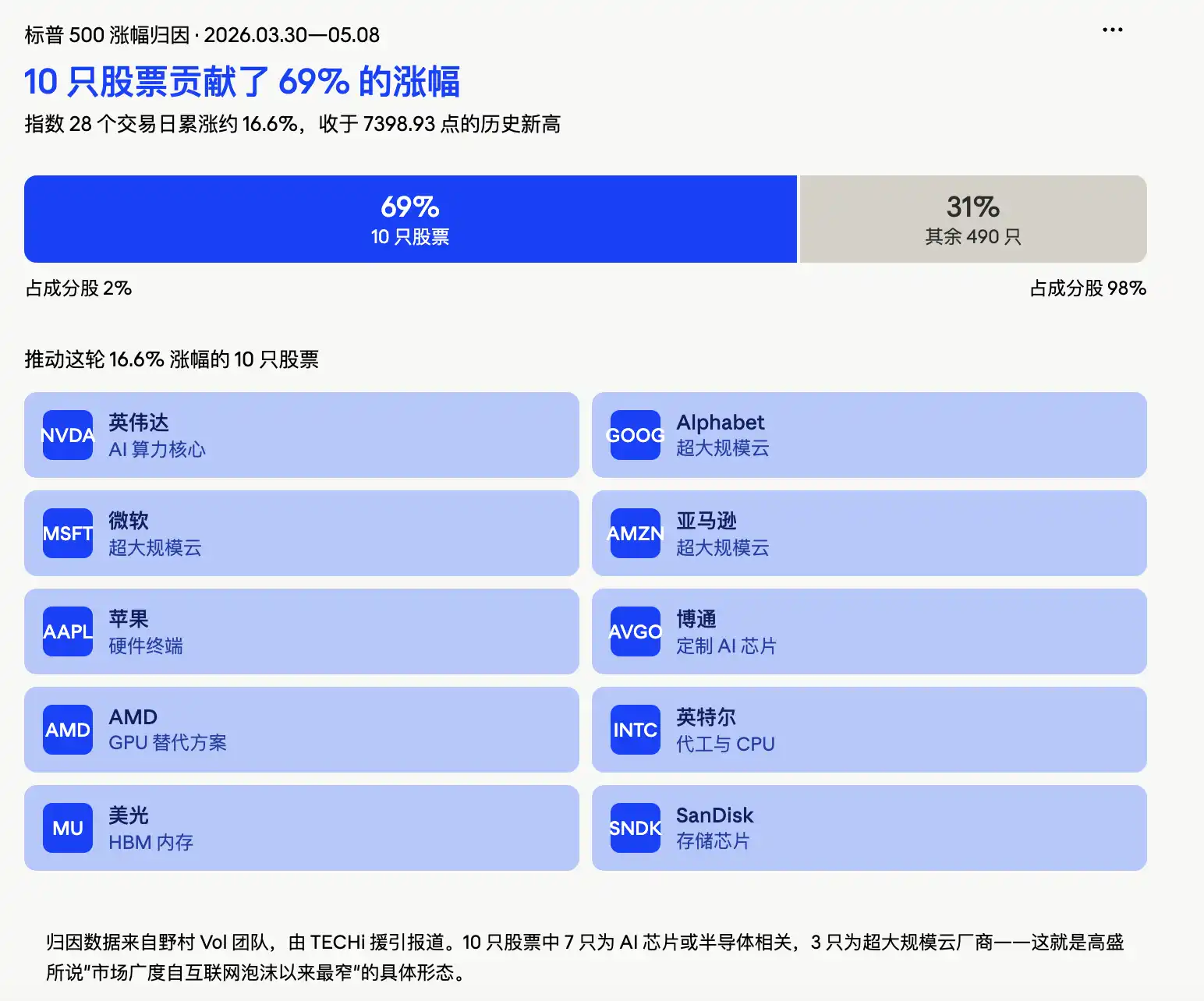
More concerning is the structure of this rally. According to a return attribution chart from Nomura's Vol team cited by TECHi, of the S&P 500's roughly 16% gain since March 30th, 10 stocks contributed 69%: Alphabet, Nvidia, Amazon, Broadcom, Intel, Micron, Apple, AMD, Microsoft, SanDisk. The remaining 490 constituents contributed only 31%. Goldman Sachs' U.S. equity strategy chief Ben Snider also pointed out that current market breadth has fallen to one of the narrowest levels since the dot-com bubble era. Goldman lists "AI Megaprojects" and "Iran Conflict" as the two clearest stock market risks for the coming weeks.
The Shorts Have Been Squeezed Out, Who Will Push the Next Leg?

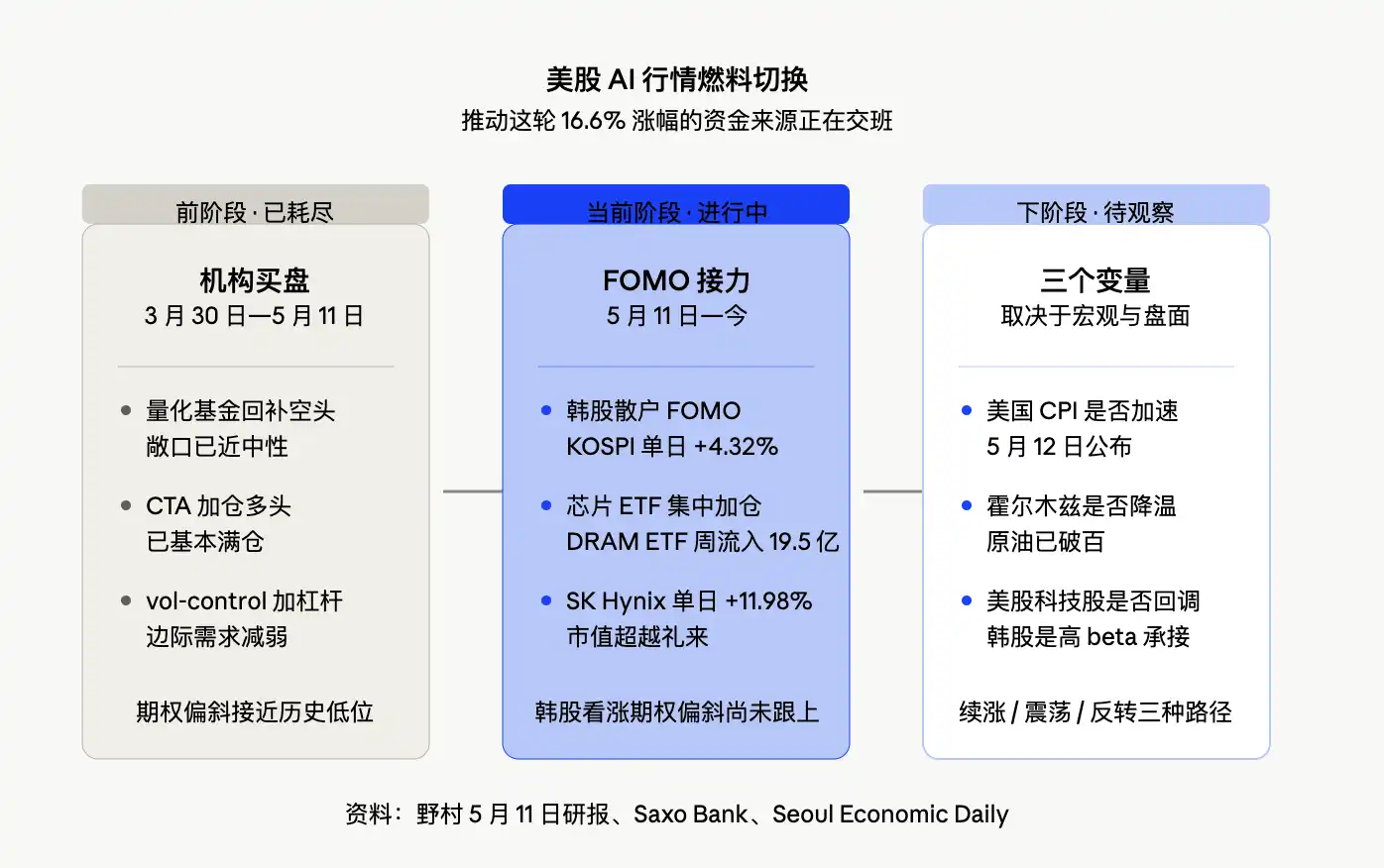
The real killer judgment in Nomura's report isn't the "anomalous combo" itself, but its dissection of fund flows: Quant funds' equity exposure has recovered to near neutral, and the process of forced buying and short covering is largely complete. CTA (Commodity Trading Advisor) funds have largely returned to full long positions, and the marginal incremental demand from volatility control strategies is also waning.

In other words, the three main buying forces that drove AI stocks higher in recent weeks—shorts being squeezed, CTAs adding positions, and declining volatility prompting vol-control funds to add leverage—are all nearing their limits. If AI stocks are to continue rising, they can no longer primarily rely on the "short squeeze" buying force.

It's important to note that Nomura's estimates of quant fund, CTA, and macro fund positioning are based on model calculations, not actual measured holdings. This makes them better suited as a temperature gauge for marginal changes rather than a precise positioning table. Even so, the direction is clear: Programmatic buying from the institutional side is nearing its limits, and subsequent upward momentum must rely more on retail and sentiment-driven capital.

Goldman's trading desk largely agrees with Nomura's assessment. Goldman's One-Delta trading desk head Rich Privorotsky recently described the current pace as "semi-irrational chasing," drawing a comparison to 1999, when overflowing telecom equipment orders provided a "physical bottleneck narrative," similar to the current logic of AI compute scarcity. Goldman's volatility trading desk characterized recent dynamics as "spot up, volatility up," which limits the space for systematic strategies to add further positions.

This assessment means the U.S. stock AI trade isn't breaking, but the script of "pushing higher by squeezing shorts" is nearing its end.

Korean Stocks Provide the Answer: On the Day of Nomura's Report, KOSPI Surges 4.32%, Triggering Buy-Side Sidecar

Another judgment in Nomura's report was: For the AI trade to have another leg, the true signal for continuation would be to watch for a resurgence of FOMO in Korea.

The Korean market responded with an extreme outburst on the very day the report was released. The KOSPI closed at 7822.24 points, up 4.32% for the day, touching 7899.32 points during the session, which triggered a buy-side sidecar. SK Hynix surged 11.98% to 1.888 million KRW, with its market cap surpassing Eli Lilly for the first time to become the 14th largest globally. Samsung Electronics rose 6.33% to 285,500 KRW. The combined market cap of the two companies exceeded 3,000 trillion KRW, accounting for nearly half of the KOSPI's total market cap. The combined market cap of the Korean stock market (KOSPI and KOSDAQ) exceeded 7,000 trillion KRW for the first time, just 8 trading days after breaking 6,000 trillion KRW on October 27th.

During the May 12th session, the KOSPI further broke above 3900 points (the 7900-point level), setting another new all-time high. However, data from the same day revealed the other side of FOMO: Of the 948 stocks on the KOSPI, only 186 rose while 696 fell; approximately 30% of the index constituents have fallen year-to-date. Gains were entirely concentrated in the two semiconductor heavyweights, Samsung and SK Hynix.

A retail FOMO has already spawned new market vocabulary. Korean financial media uses "hynix FOMO" to describe the psychological divide among retail investors: on one side, the regret of missing out ("I should have bought at 800,000 KRW"), and on the other, the anxiety of "should I jump in now?" and "a correction is coming soon." Retail communities are flooded with discussions about "Samjeon-nix" (a portmanteau of Samsung + Hynix). This is a typical retail-driven chasing pattern, highly consistent with the "FOMO signal" Nomura defined.

The flow of foreign capital is even more telling. According to a Seoul Economic Daily report on May 10th, the iShares MSCI Korea ETF (EWY) saw net outflows of $1.0145 billion between May 1st and 7th, a signal of passive fund withdrawal from the Korean market. However, during the same period, the Roundhill Active DRAM ETF saw net inflows of $1.9538 billion. This ETF has a 25.94% weighting in SK Hynix and 21.62% in Samsung Electronics, totaling about 48%. Foreign capital isn't selling Korea, they are selling broad-based ETFs and buying chips, a precise overweighting of the AI theme.

One detail warrants caution. Nomura's May 11th report pointed out that the KOSPI 200 also showed "spot up, volatility up," but the call skew didn't rise alongside it. This doesn't look like volatility expansion driven by call-buying chase demand. In other words, as of the report's release, the Korean market had not yet entered a typical "fear of missing out, scrambling for calls" state. Whether this signal reverses quickly after the KOSPI's surge that day will be key to judging the sustainability of the FOMO.
Korean Stocks are an Extension of the U.S. AI Capex Chain; How Long the Next Leg Lasts Depends on the "Pyramid's Apex"

The Korean FOMO is not an isolated event; it's essentially a high-beta extension of the U.S. stock AI capital expenditure story.

Data directly anchors this transmission chain. According to Bridgewater estimates, Alphabet, Amazon, Meta, and Microsoft are projected to collectively invest around $650 billion in AI-related infrastructure in 2026. Goldman Sachs cites data showing that the consensus estimate for the largest cloud infrastructure companies' 2026 capex jumped by $130 billion last quarter to $670 billion, equivalent to over 90% of these companies' projected operating cash flow. Microsoft's Q3 capex reached $31.9 billion, Alphabet's Q1 property and equipment purchases were $35.7 billion, and Meta raised its 2026 capex guidance to a range of $125-145 billion.

This money flows into data centers, GPUs, memory, networking, power systems, and cloud capacity. SK Hynix and Samsung sit at the core of this money flow, with HBM4 memory and high-bandwidth memory being snapped up by hyperscale cloud providers. According to a Reuters report, SK Hynix recently received "unprecedented" order proposals from major tech companies, with some customers proactively offering to help finance new production lines and ASML lithography machines. Chip capacity is essentially sold out. This is why the KOSPI's single-day 4.32% surge is narratively coherent—Korean stocks are essentially the "second derivative" of the U.S. AI story.

But this linkage also implies vulnerability. If U.S. tech stocks experience a full-scale reversal, Korean stocks would be the most direct high-beta asset to bear the selling pressure. Another risk path mentioned by Nomura is a resurgence of inflation forcing global central banks to be more hawkish. This week's (May 12th) U.S. CPI is a key event, yet the premium in options markets for this event remains low; the market hasn't paid a high insurance premium for this risk yet.

There's one more variable in the macro backdrop: The Strait of Hormuz. WTI crude closed at $100.09 on May 8th (+4.89%), Brent crude at $105.66 (+4.31%). Conflict near the Strait of Hormuz continues to escalate. Nomura's judgment is: As long as the Strait remains obstructed and the U.S. and Iran remain divided on ceasefire terms, the AI-dominated market environment may last longer than expected. Energy price shocks will lift inflation expectations but could also make the market even more reluctant to leave "the AI story that's making money."

Layering these clues together: The phase of the U.S. stock AI rally driven by "squeezing shorts" is nearing its end. Korean FOMO has been ignited, with retail and foreign chip ETFs adding positions in sync, but the option skew hasn't caught up yet. How long the next leg lasts depends on whether U.S. tech stocks correct, whether U.S. CPI signals accelerating inflation, and whether the Strait of Hormuz ultimately cools down. Nomura's report's judgment framework is being validated one by one by market action. Seoul is becoming the latest epicenter of this AI trade.

Perguntas relacionadas

QAccording to Nomura's report, what are the three main forces behind the recent AI stock rally in the US market, and why is their influence now considered to be nearing its limit?

AThe three main forces identified are: 1) Short covering (shorts being squeezed), 2) CTA (Commodity Trading Advisors) funds adding long positions, and 3) Volatility-control strategies increasing leverage as volatility receded. Their influence is nearing its limit because quantitative fund equity exposure is back near neutral, CTAs are mostly back to full long positions, and the 'spot up, VIX up' dynamic has limited the room for further systematic buying from these strategies.

QWhy does the article suggest South Korea's stock market (KOSPI) has become a focal point for the next phase of the AI trade, and what evidence supports this?

AThe article suggests South Korea is the next focal point because its market exhibited classic FOMO (Fear Of Missing Out) behavior driven by retail investors, precisely as predicted by Nomura's report. Evidence includes: KOSPI's 4.32% single-day surge triggering a buy-side circuit breaker; SK Hynix rising nearly 12% and Samsung Electronics rising over 6%; massive inflows into the Roundhill Active DRAM ETF concentrated on chip stocks; and the emergence of 'hynix FOMO' sentiment among Korean retail investors.

QWhat does the 'spot up, volatility up' dynamic observed in US indices like the Nasdaq indicate, and why is it considered an 'abnormal signal'?

AThe 'spot up, volatility up' dynamic means that while stock indices are hitting record highs, the CBOE Volatility Index (VIX) and Nasdaq Volatility Index (VXN) are also rising. This is considered an abnormal or contrary signal because typically, when markets rally to new highs, investor fear subsides, leading to lower volatility (VIX down). The concurrent rise suggests institutional investors are still hedging against potential downside even as prices climb, indicating underlying caution and crowded positioning.

QHow is the Korean stock market's AI rally fundamentally linked to the AI capital expenditure story in the US?

AThe Korean stock market's AI rally is a high-beta extension of the US AI capital expenditure story. Massive AI infrastructure spending by US tech giants like Alphabet, Amazon, Meta, and Microsoft (estimated at hundreds of billions annually) flows directly into data center components, including high-bandwidth memory (HBM) and DRAM chips. South Korean firms SK Hynix and Samsung Electronics are dominant suppliers in this critical segment. Therefore, the surge in their stock prices reflects the intense demand and 'scarcity narrative' downstream from US tech capital spending.

QAccording to the article, what are the key risks that could determine how long the current phase of the AI trade, centered on Korea, can last?

AThe key risks are: 1) A significant correction or reversal in US tech stocks, which would directly pressure high-beta Korean chip stocks. 2) US CPI data showing accelerating inflation, which could force central banks into more hawkish policies and disrupt the low-rate environment favorable for growth stocks. 3) Escalation of conflict around the Strait of Hormuz, which could spike oil prices, increase inflation fears, and create broader market instability.

Leituras Relacionadas

AI Relay Stations Spark Heated Debate on Zhihu: Behind Cheap Tokens, What Are Users Really Worried About?

A discussion on Zhihu about "AI relay stations" shifted the niche developer topic of "cheap tokens" into broader user awareness. Users moved beyond simply questioning the legitimacy of these services to focus on practical concerns: Where do cheap tokens truly come from? Is the model being accessed the real one? Can relay stations see prompts, code, and API keys? For occasional users, are the risks worth it? The core debate centered less on price and more on trust. A primary worry is model authenticity—the risk of "model swapping," where users paying for a premium model might be routed to a cheaper one, creating an information asymmetry. Others argued that cost comparisons matter; while cheaper than official pay-as-you-go APIs, relay stations may not be the lowest-cost option versus subscriptions, domestic models, or free tiers, making user needs assessment crucial. Speculation about token sources ranged from legitimate bulk discounts to gray-area methods like account sharing or exploiting regional pricing. This opacity makes risk assessment difficult for users. Data security emerged as a critical concern, especially for enterprise use. When processing sensitive information like code, contracts, or client data, the inability to verify a relay station's data handling, retention, or access policies poses significant compliance and confidentiality risks. The evolving consensus suggests relay stations can be used cautiously for low-sensitivity, disposable tasks (e.g., summarizing public info, simple translation). However, they should not be the default for sensitive, professional, or production workflows involving proprietary data, Agents, or automated systems. Recommendations include avoiding large prepayments, not relying on a single service, using test prompts to monitor quality, anonymizing data where possible, and keeping official channels as backups. Ultimately, the discussion framed tokens not just as a billing unit but as a measure of real cost encompassing price, model integrity, data security, and service stability. The popularity of relay stations highlights user demand for affordable access, but the debate underscores a key trade-off: the savings from cheap tokens may come at the price of trust, transparency, and control over one's data and AI experience.

marsbitHá 11m

AI Relay Stations Spark Heated Debate on Zhihu: Behind Cheap Tokens, What Are Users Really Worried About?

marsbitHá 11m

In-Depth Research Report on TradFi: The Convergence Wave of Crypto and Traditional Finance

In 2026, the crypto industry is undergoing a profound infrastructure-level transformation—TradFi assets are migrating on-chain at an unprecedented pace. According to CoinGecko's Q1 2026 report, the total value locked (TVL) of tokenized real-world assets (RWA) has surpassed $31 billion, a nearly 4x increase from $7.8 billion at the beginning of 2025, with the sector’s aggregate market capitalization reaching $19.3 billion. Among these, the market cap of tokenized stocks surged from $2 million to $486 million, with Q1 spot trading volume reaching $15.1 billion—a single quarter already surpassing the entire second half of 2025. RWA perpetual contract Q1 trading volume reached a staggering $524.8 billion, far exceeding the $313 billion for all of 2025. Meanwhile, BlackRock's BUIDL fund has reached $2.3 billion in scale and has filed for two new tokenized funds, signaling that the world's largest asset manager's tokenization strategy is evolving from pilot to product suite expansion. HTX, as a core participant in the crypto exchange sector, officially launched TradFi perpetual futures products including NVDA, AAPL, MSFT, META, and SPY in 2026, enabling crypto users to gain 24/7 trading access to core U.S. equities. Boston Consulting Group predicts that global tokenized asset scale could reach $16 trillion by 2030, while McKinsey offers a conservative estimate of approximately $2 trillion. The on-chain migration of TradFi assets is no longer a "future narrative" but a structural transformation unfolding in real time, as crypto exchanges evolve from single crypto asset trading platforms toward "multi-asset-class trading infrastructure."

HTX LearnHá 13m

In-Depth Research Report on TradFi: The Convergence Wave of Crypto and Traditional Finance

HTX LearnHá 13m

Blocked Its Own Treasure, WeChat AI Steps Up

Tencent's stock surged over 10% on June 2nd amid reports that WeChat, with 1.43 billion monthly users, is finalizing tests for a native AI Agent. The reported feature, accessible by swiping right from the main interface, allows users to issue commands in natural language. The AI then decomposes tasks and automatically calls upon relevant Mini Programs within WeChat to complete actions like ordering food, booking tickets, or making payments, creating a closed-loop service execution system. This strategic shift follows the internal conflict and subsequent "blocking" of Tencent's standalone AI app, Yuanbao, by WeChat for violating sharing rules during a 2026 Spring Festival promotion. The incident highlighted a lack of internal consensus and exposed the weakness of competing in the standalone AI assistant arena against rivals like ByteDance's Doubao (345M MAU) and Alibaba's Qianwen. The new WeChat AI Agent aims to leverage WeChat's unique assets—its massive user base, standardized Mini Program APIs, WeChat Pay, and identity system—to move from simple content generation to actual task execution. Analysts note this changes the competitive landscape from model benchmarks to which AI can connect to more real-world services. However, success depends on key variables: the capability of Tencent's underlying Hunyuan model, managing massive inference costs, and redesigning incentives for Mini Program developers whose traffic might be bypassed. The move is seen as an attempt to keep user service intent within WeChat's ecosystem as AI begins to redefine how users access services.

marsbitHá 1h

Blocked Its Own Treasure, WeChat AI Steps Up

marsbitHá 1h

ByteDance Adopts Arm CPUs, Jensen Huang: So Sad I Didn't Buy Arm

**Summary:** At Computex 2026, Arm CEO Rene Haas announced that ByteDance and Oracle have adopted Arm's self-designed Arm AGI data center CPU. The company expects significant revenue growth from this product, projecting $20 billion in demand for the 2027/2028 fiscal years. Haas noted that restricting AI-capable CPUs from the US to China is nearly impossible due to their widespread applications. Arm's stock has surged dramatically this year, notably rising 16% after NVIDIA's Arm-based Vera CPU and RTX Spark announcements. A highlight was the informal, humorous on-stage conversation between Haas and NVIDIA CEO Jensen Huang. Huang joked about NVIDIA's failed attempt to acquire Arm and playfully lamented selling his Arm shares. Both executives showed a clear sense of camaraderie and shared regret over the missed merger. Key technical topics were discussed: 1. **AI PC Design:** Huang explained NVIDIA's RTX Spark superchip (with a 20-core Arm CPU) is designed for future AI agents that will autonomously run and use tools on PCs, blending local and cloud processing. 2. **Agent vs. OS:** Huang emphasized the operating system remains crucial, as AI agents rely on its APIs and tools to function. 3. **Growth Constraints:** He identified the shift to "useful AI" that generates profitable tokens as a primary driver for immense, almost limitless, computational demand. Haas outlined Arm's strategy across PC and data centers. For PCs, Arm collaborates with partners like NVIDIA and MediaTek, offering its compute subsystem (CSS) for custom SoCs. In data centers, its Arm AGI CPU (built on TSMC's 3nm process) has gained major partners including OpenAI, Meta, and now ByteDance and Oracle. Arm presented a multi-year roadmap for its in-house CPU line. The article concludes that while GPUs dominated the AI training race, the explosion of AI agents is shifting significant focus to CPUs for inference, state management, and tool orchestration. The industry is trending towards vertical integration, with companies like cloud providers designing chips and chip/IP firms offering full solutions, all competing to deliver more efficient computing per watt.

marsbitHá 1h

ByteDance Adopts Arm CPUs, Jensen Huang: So Sad I Didn't Buy Arm

marsbitHá 1h

Trading

Spot
Futuros

Artigos em Destaque

Como comprar NOM

Bem-vindo à HTX.com!Tornámos a compra de Nomina (NOM) simples e conveniente.Segue o nosso guia passo a passo para iniciar a tua jornada no mundo das criptos.Passo 1: cria a tua conta HTXUtiliza o teu e-mail ou número de telefone para te inscreveres numa conta gratuita na HTX.Desfruta de um processo de inscrição sem complicações e desbloqueia todas as funcionalidades.Obter a minha contaPasso 2: vai para Comprar Cripto e escolhe o teu método de pagamentoCartão de crédito/débito: usa o teu visa ou mastercard para comprar Nomina (NOM) instantaneamente.Saldo: usa os fundos da tua conta HTX para transacionar sem problemas.Terceiros: adicionamos métodos de pagamento populares, como Google Pay e Apple Pay, para aumentar a conveniência.P2P: transaciona diretamente com outros utilizadores na HTX.Mercado de balcão (OTC): oferecemos serviços personalizados e taxas de câmbio competitivas para os traders.Passo 3: armazena teu Nomina (NOM)Depois de comprar o teu Nomina (NOM), armazena-o na tua conta HTX.Alternativamente, podes enviá-lo para outro lugar através de transferência blockchain ou usá-lo para transacionar outras criptomoedas.Passo 4: transaciona Nomina (NOM)Transaciona facilmente Nomina (NOM) no mercado à vista da HTX.Acede simplesmente à tua conta, seleciona o teu par de trading, executa as tuas transações e monitoriza em tempo real.Oferecemos uma experiência de fácil utilização tanto para principiantes como para traders experientes.

206 Visualizações TotaisPublicado em {updateTime}Atualizado em 2026.06.02

Como comprar NOM

Discussões

Bem-vindo à Comunidade HTX. Aqui, pode manter-se informado sobre os mais recentes desenvolvimentos da plataforma e obter acesso a análises profissionais de mercado. As opiniões dos utilizadores sobre o preço de NOM (NOM) são apresentadas abaixo.

活动图片