Sentient: Why $51K long liquidations put SENT’s $0.015 at risk

ambcryptoPublicado em 2026-03-28Última atualização em 2026-03-28

Resumo

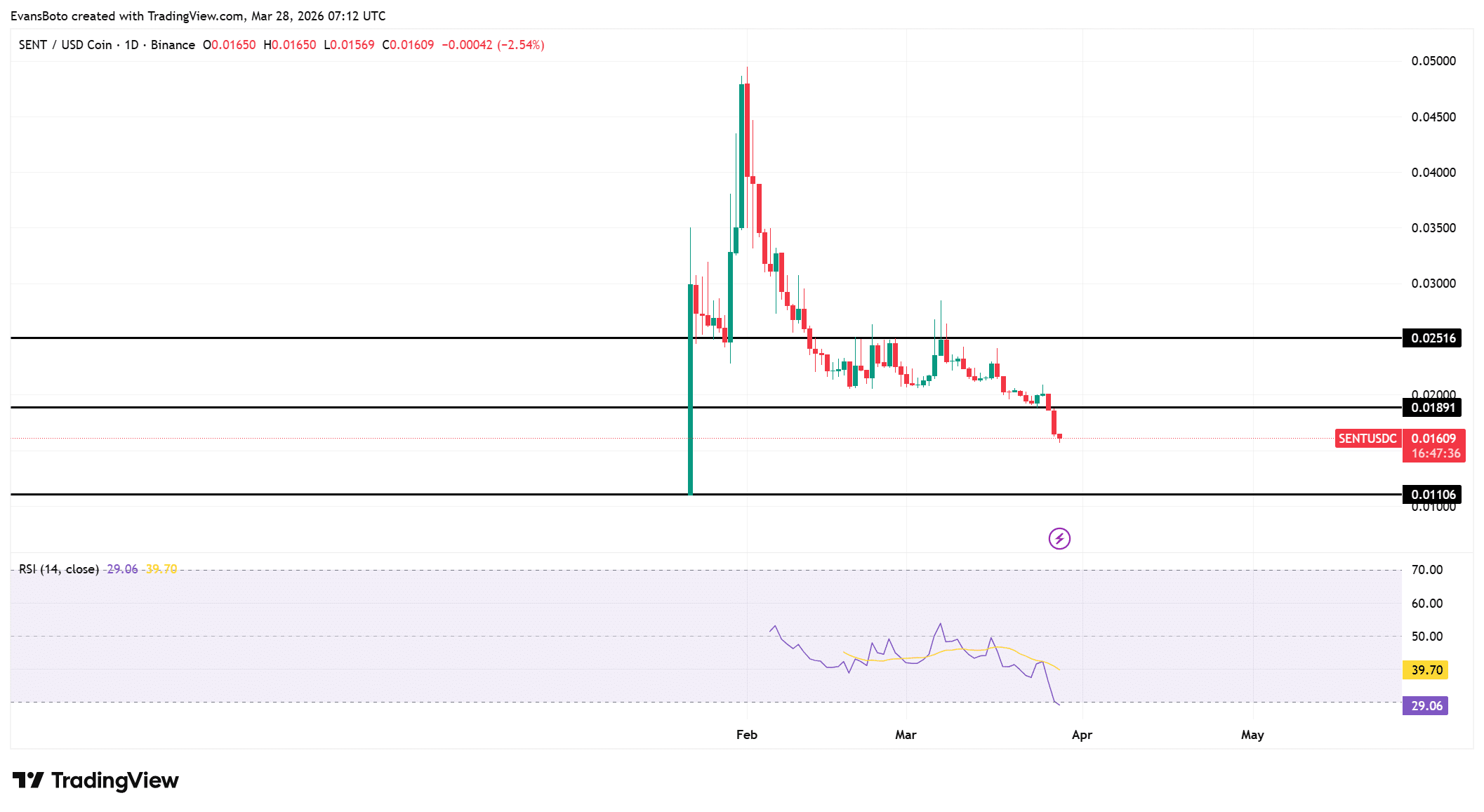
Sentient (SENT) dropped 14.3% to $0.01585 amid a 65% surge in trading volume, signaling strong sell-side pressure despite increased market activity. The price broke below the $0.01891 support level, indicating a continued bearish trend toward the $0.01106 demand zone. RSI fell to 29.06, confirming oversold conditions but suggesting persistent weakness rather than a short-term rebound. Open Interest declined by 16.30%, reflecting capital withdrawal and reduced participation from leveraged traders. Long liquidations dominated with $51K wiped out compared to only $96 in short liquidations, accelerating downward momentum. Current market structure, liquidations, and capital outflows align against recovery, indicating SENT may drift lower before stabilization attempts emerge.

Sentient [SENT] drops 14.3% to $0.01585 as volume surges 65% to $24.32 million at press time, reflecting aggressive sell-side activity despite rising market participation.

Sellers continue to dominate order flow, pushing price lower despite increased liquidity entering the market. Volume expansion under declining price conditions usually signals that participants are exiting positions rather than accumulating.

As a result, this structure shows clear sell-side control, where each attempt to stabilize gets absorbed quickly. The market reflects urgency from participants reducing exposure, which reinforces the ongoing SENT downside pressure.

SENT breakdown below support exposes

SENT price has broken below the $0.01891 support level and continues to extend lower toward the $0.01106 demand zone. This breakdown confirms that previous consolidation has failed to hold, shifting structure into a continuation phase.

Lower highs have remained intact across recent sessions, which reinforces bearish control over the trend. Attempts to reclaim the lost support have lacked follow-through, showing weak buyer commitment.

As price trades below key levels, market structure reflects continuation rather than reversal. This positioning suggests that sellers continue to dictate direction as the asset searches for a stronger demand base.

At press time, RSI dropped to 29.06, pushing Sentient into oversold territory and confirming the intensity of recent selling pressure. This reading reflects persistent downside strength rather than a temporary pullback.

While oversold conditions sometimes hint at short-term relief, the broader structure still aligns with continued weakness.
Source: TradingView

Falling OI signals capital withdrawal

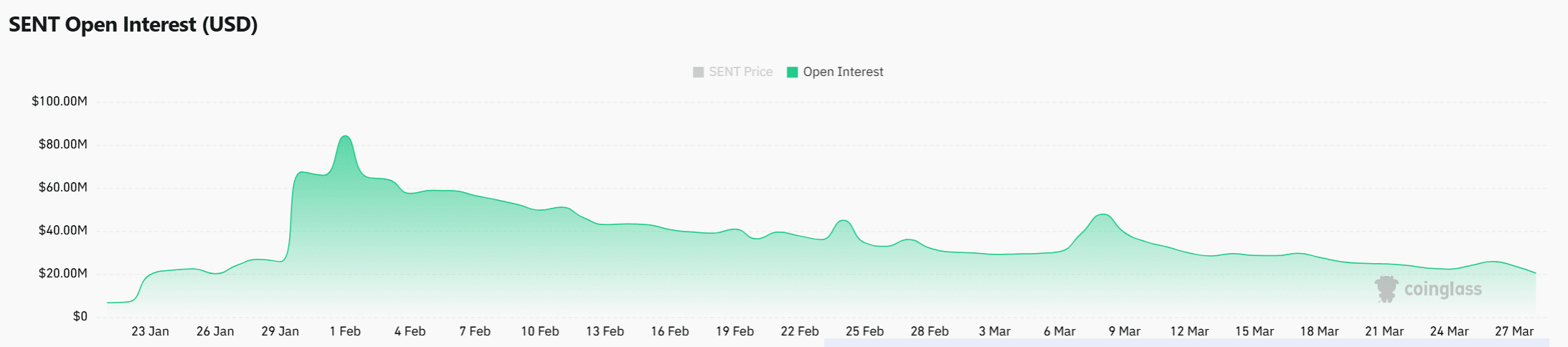
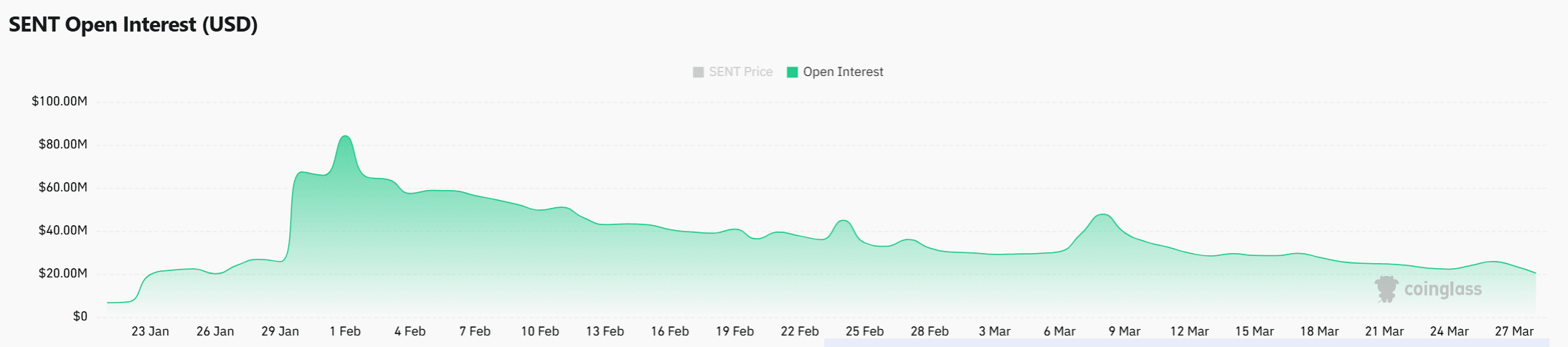
Open Interest (OI) has declined 16.30% to $19.76 million, indicating that leveraged traders are closing positions rather than opening new ones. This drop reflects a clear reduction in market participation from derivatives traders, especially those previously positioned on the long side.

As positions close, liquidity exits the market, which reduces the probability of immediate recovery. The decline in OI aligns closely with the price drop, confirming that traders are stepping away instead of defending positions. This behavior highlights a broader shift toward risk reduction across the market.
Source: CoinGlass

Long liquidations dominate across exchanges

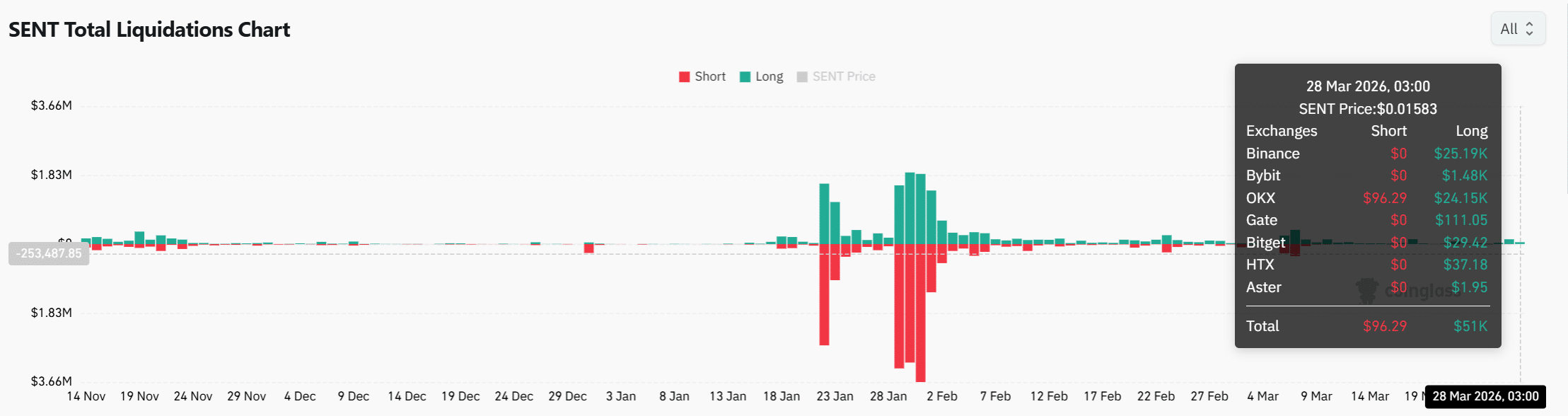
Liquidation data shows that long positions have faced heavy losses, with approximately $51K in longs wiped out compared to just $96 in short liquidations. This imbalance reflects aggressive forced exits, particularly across major exchanges like Binance and OKX.

When long positions get liquidated at this scale, they amplify downward pressure as positions close automatically. This cascade effect accelerates price declines and weakens bullish positioning further.

The dominance of long liquidations confirms that traders who expected upside continuation have exited under pressure, leaving the market tilted toward sellers.
Source: CoinGlass

Is SENT nearing stabilization or further downside?

SENT continues to face sustained downside pressure as structure, liquidations, and capital outflows align against recovery.

The breakdown below support, combined with the OI drop and dominant long liquidations, reflects a market still unwinding bullish exposure. Although RSI has entered oversold territory, current conditions do not support a stable rebound.

SENT would likely continue drifting lower toward the $0.01106 zone before any meaningful stabilization attempt emerges.


Final Summary

  • Sentient shows weakening structure as sellers maintain control and buyers fail to defend key levels effectively.
  • Market positioning reflects reduced confidence, suggesting price would continue drifting lower before any meaningful stabilization emerges.


Perguntas relacionadas

QWhat is the current price of Sentient (SENT) and how much has it dropped?

ASentient (SENT) is currently priced at $0.01585, representing a drop of 14.3%.

QWhat key support level did SENT break below, and what is the next potential demand zone?

ASENT broke below the $0.01891 support level and is extending lower toward the $0.01106 demand zone.

QWhat does the 16.30% decline in Open Interest (OI) to $19.76 million indicate?

AThe decline in Open Interest indicates that leveraged traders are closing their positions rather than opening new ones, signaling a reduction in market participation and capital withdrawal.

QHow did long liquidations compare to short liquidations, and what does this imbalance reflect?

ALong liquidations dominated with approximately $51,000 wiped out, compared to only $96 in short liquidations. This reflects aggressive forced exits of bullish positions, amplifying downward price pressure.

QDespite the RSI reading of 29.06 indicating oversold conditions, why does the article suggest further downside is likely?

AThe article suggests further downside is likely because the broader market structure, capital outflows, and dominant sell-side control align against recovery. Oversold conditions alone are not enough to support a stable rebound without a change in these underlying factors.

Leituras Relacionadas

Why Do You Always Lose Money on Polymarket? Because You're Betting on News, While the Pros Read the Rules

Why do you always lose money on Polymarket? Because you bet on news, while the pros study the rules. This article explains how top traders ("che tou") profit by meticulously analyzing market rules, not just predicting events. Polymarket, a prediction market platform, often sees disputes over event outcomes due to ambiguous rule wording. For instance, a market asking "Who will be the leader of Venezuela by the end of 2026?" was misinterpreted by many who bet on Delcy Rodríguez, assuming she held power. However, the rules specified "officially holds" as the formally appointed, sworn-in individual. Since Nicolás Maduro was still recognized as president officially, he won the market—even being in prison. To resolve such disputes, Polymarket uses a decentralized arbitration system via UMA protocol. The process involves: 1. Proposal: Anyone can propose a market outcome by staking 750 USDC, earning 5 USDC if unchallenged. 2. Dispute: A 2-hour window allows challenges with a 750 USDC stake; successful challengers earn 250 USDC. 3. Discussion: A 48-hour period on UMA Discord for evidence and debate. 4. Voting: UMA token holders vote in two 24-hour phases (blind then public). Outcomes require >65% consensus and 5M tokens voted; otherwise, four re-votes occur before Polymarket intervention. 5. Settlement: Results are final and automatic. Unlike traditional courts, Polymarket’s system lacks separation between arbitrators and stakeholders—voters often hold market positions, creating conflicts of interest. This leads to herd mentality in discussions and non-transparent outcomes without explanatory rulings, preventing precedent formation. Thus, success on Polymarket hinges on deep rule interpretation, not just event prediction, exploiting gaps between reality and contractual wording.

marsbitHá 28m

Why Do You Always Lose Money on Polymarket? Because You're Betting on News, While the Pros Read the Rules

marsbitHá 28m

DeepSeek Funding: Liang Wenfeng's 'Realist' Pivot

DeepSeek, a leading Chinese AI company, has initiated its first external funding round, aiming to raise at least $300 million at a valuation of no less than $10 billion. This move marks a significant shift from its founder Liang Wenfeng’s previous idealistic stance of rejecting external capital to maintain independence. Despite strong financial backing from its parent company, quantitative trading firm幻方量化 (Huanfang Quant), which provided an estimated $700 million in revenue in 2025 alone, DeepSeek faces mounting challenges. Key issues include a 15-month gap in major model updates, delays in its flagship V4 release, and the loss of several core researchers to competitors offering significantly higher compensation. The company is also undergoing a strategic pivot by migrating its infrastructure from NVIDIA’s CUDA to Huawei’s Ascend platform, a move aligned with China’s push for technological self-reliance amid U.S. export controls. However, DeepSeek lags behind rivals like智谱AI and MiniMax—both now publicly listed—in areas such as product ecosystem, multimodal capabilities, and commercialization. The funding round, though relatively small in scale, is seen as a way to establish a market-validated valuation anchor, making employee stock options more competitive and facilitating talent retention. It also signals DeepSeek’s transition from a pure research-oriented organization to a commercially-driven player in the global AI ecosystem.

marsbitHá 1h

DeepSeek Funding: Liang Wenfeng's 'Realist' Pivot

marsbitHá 1h

Trading

Spot
Futuros
活动图片