Senator Cynthia Lummis urges CLARITY Act rush: ‘Let’s get it done, once and for all’

ambcryptoPublicado em 2026-03-23Última atualização em 2026-03-23

Resumo

After months of stalemate over stablecoin yield regulations, a breakthrough has been reached on the CLARITY Act. Following intense negotiations in March, the White House and Senators agreed on a compromise: passive rewards for simply holding stablecoins are prohibited, but activity-based rewards for using them in transactions are permitted. Senator Cynthia Lummis urged swift passage, warning that if the Senate Banking Committee doesn't approve the bill by April's end, progress could stall until 2027 due to the upcoming midterm elections. Market sentiment has improved, with prediction markets showing a 10% increase in the act's passage odds. This legislation aims to establish clear crypto regulations, positioning the U.S. as a global digital asset hub.

For months, the U.S. crypto space has been stuck on one key issue: yield. This refers to the rewards people earn on stablecoins.

The clash between traditional banks and crypto firms went beyond slowing progress and nearly blocked the Digital Asset Market CLARITY Act. At one point, it even risked pushing innovation outside the U.S.

Now, things are starting to move. After intense meetings between the White House and lawmakers this March, a breakthrough seems close.

Executives are confident about the CLARITY Act passage

Senator Cynthia Lummis said negotiations are done, suggesting a deal on stablecoin rewards is almost here, but the obstacles are not over yet.

With an important Senate review coming in April and midterm elections approaching in 2026, time is running out. If a deal isn’t reached by May, progress on clear crypto rules could be delayed for a long time.

Senator Lummis said,

President Trump pledged to make America the digital asset capital of the world. The CLARITY Act is how we make that happen. Let’s get it done, once and for all.

What changed?

For those unaware, things took a big turn on the 20th of March. Patrick Witt, the White House’s top crypto advisor, said that the Senate and the administration had reached an “agreement in principle.”

He called it a major step forward, as it finally breaks the long-standing deadlock. He also gave credit to Senators Thom Tillis and Angela Alsobrooks for helping both sides reach a compromise.

The deal finally found a middle path. As per the latest discussion, it will not allow passive rewards, meaning users won’t earn interest just for holding stablecoins, which was a concern for banks.

But it will allow activity-based rewards, where users can earn benefits by using stablecoins for payments or on platforms.

Crypto community is optimistic

Nic Puckrin, CEO of Coin Bureau, also stressed that time is running out. He said that if the CLARITY Act doesn’t pass the Senate Banking Committee by the end of April, it could be “dead” until 2027, as lawmakers will soon shift focus to the 2026 midterm elections.

Still, Puckrin is cautiously hopeful, as he said,

Yesterday, the stablecoin yield deal happened. Senators + the White House reached a compromise on the exact issue that’s been blocking this for months.

He added,

This isn’t done yet. But the path just opened. Watch April closely.

Polymarket odds rise

This shift is already visible in market sentiment. On Polymarket, the chances of the CLARITY Act becoming law in 2026 jumped from 60% to 70% in just one day after the update on the 20th of March.
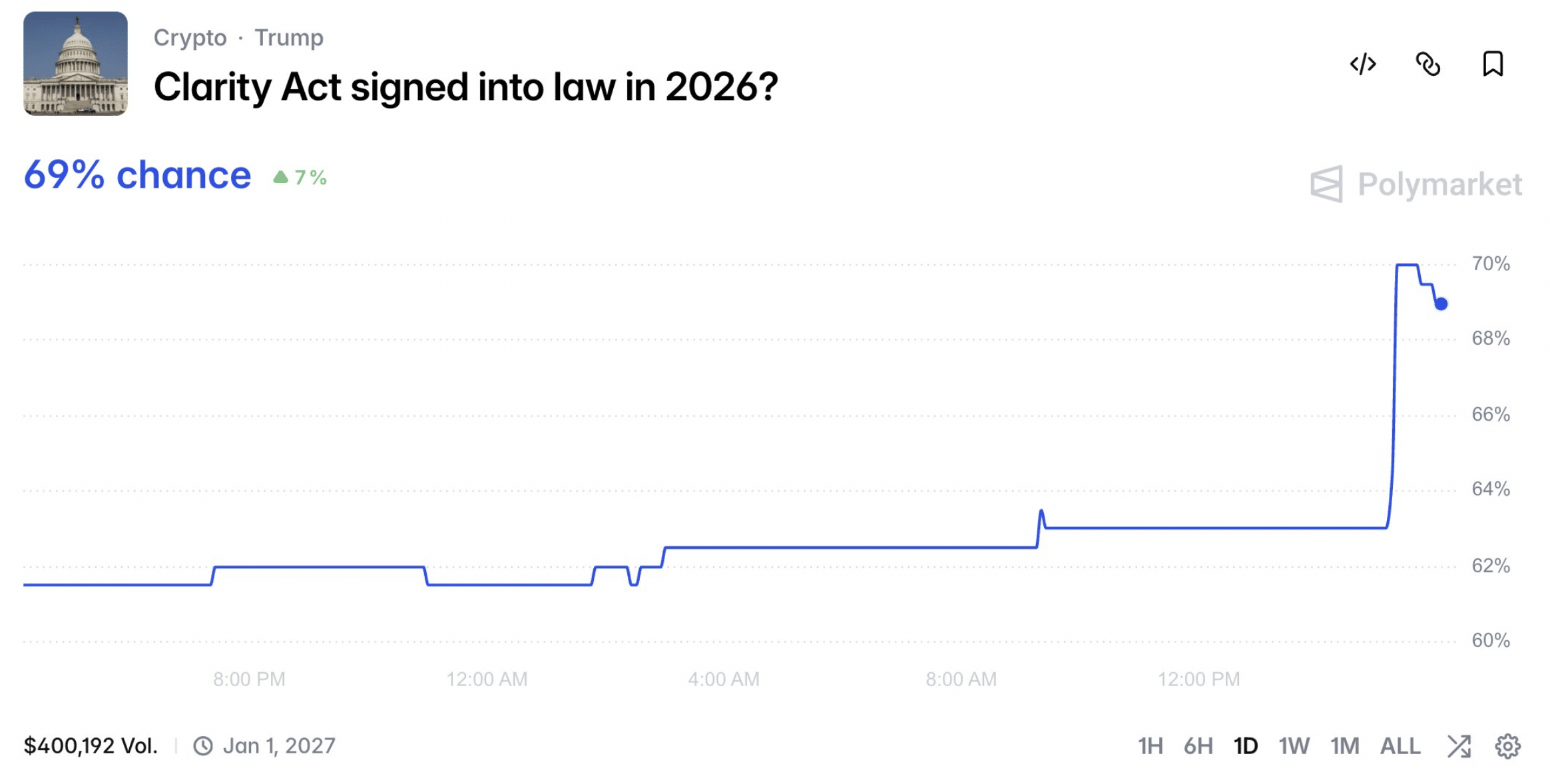
Source: Polymarket

This shows that more people now believe the long delay in decision-making might finally end.

If this momentum continues and the bill passes between April and May, it could have a massive impact. It may bring in large amounts of investment and make the crypto market work more efficiently.

More importantly, it would replace unclear regulation and position the U.S. as a global crypto hub. Ergo, as expected, all eyes are on what comes next for the CLARITY Act.


Final Summary

  • The stablecoin yield compromise has broken a months-long deadlock, bringing the CLARITY Act closer to reality.
  • Political pressure from the upcoming 2026 midterms could delay progress if deadlines are missed.

Perguntas relacionadas

QWhat is the main issue that has been stalling progress in the U.S. crypto space according to the article?

AThe main issue has been the debate over yield, specifically the rewards people earn on stablecoins.

QWhat key compromise was reached between the Senate and the White House regarding stablecoin rewards?

AThe compromise allows for activity-based rewards, where users can earn benefits by using stablecoins for payments or on platforms, but it will not allow passive rewards (earning interest just for holding stablecoins).

QWhy is there a sense of urgency to pass the CLARITY Act by the end of April?

AIf the act doesn't pass the Senate Banking Committee by the end of April, progress could be delayed until 2027 because lawmakers will soon shift their focus to the 2026 midterm elections.

QHow did the market prediction platform Polymarket react to the news of the compromise?

AOn Polymarket, the prediction odds of the CLARITY Act becoming law in 2026 jumped from 60% to 70% in just one day after the announcement on March 20th.

QWhat did Senator Cynthia Lummis say is the purpose of the CLARITY Act?

ASenator Lummis stated that the CLARITY Act is how the U.S. will achieve President Trump's pledge to make America the digital asset capital of the world.

Leituras Relacionadas

Dialogue with a Macro Analyst: AI Drains All Liquidity from U.S. Stocks, $40K Bitcoin is the True Bottom

In a recent discussion, macro strategist Luke Groman, founder of FFT LC, presented a sobering analysis of current markets. He argues that while the S&P 500 hits new highs, this is largely driven by just seven AI stocks, which are "sucking all the oxygen and liquidity out of the room." Bitcoin, which he calls the "last working smoke alarm for liquidity," is signaling trouble, having entered a difficult period. Groman explains that the AI boom is fueled by accounting practices that front-load revenue, creating an illusion of high profits while cash is being depleted. He warns this cycle could reverse sharply when construction slows. His base case is that stocks will rise in dollar terms but fall significantly when measured in gold or Bitcoin, highlighting that long-term US Treasury futures have already lost 90% of their value against gold over the past decade. He points to major structural risks, including China's dominance in rare earths—a small commodity market underpinning trillions in tech stock value—and the prolonged closure of the Strait of Hormuz, which he calls a "Suez Moment" for the US. This, combined with a shift towards a "no ticky, no washy" proof-of-work system for settling trade (using gold, not trust), signals deeper systemic distrust. Regarding US debt, Groman notes that historically, all 58 countries that reached a 130% debt-to-GDP ratio defaulted, primarily through inflation. The US crossed this threshold in 2020. He also highlights a contradiction in the AI narrative: if it's as transformative as claimed, it must destroy white-collar jobs, threatening half of US tax revenue—a reality at odds with the "no job loss" messaging from tech leaders. On Bitcoin, Groman sold most of his position near the top and hasn't fully re-entered. Citing technical analysis from Northstar Bad Charts, he suggests a potential bottom around $40,000 could materialize in Q3 or Q4. He concludes that while he may be labeled a doomsayer, his view is simply realistic, grounded in historical precedents and current macro pressures.

marsbitHá 6h

Dialogue with a Macro Analyst: AI Drains All Liquidity from U.S. Stocks, $40K Bitcoin is the True Bottom

marsbitHá 6h

Trading

Spot
Futuros

Artigos em Destaque

Como comprar ONE

Bem-vindo à HTX.com!Tornámos a compra de Harmony (ONE) simples e conveniente.Segue o nosso guia passo a passo para iniciar a tua jornada no mundo das criptos.Passo 1: cria a tua conta HTXUtiliza o teu e-mail ou número de telefone para te inscreveres numa conta gratuita na HTX.Desfruta de um processo de inscrição sem complicações e desbloqueia todas as funcionalidades.Obter a minha contaPasso 2: vai para Comprar Cripto e escolhe o teu método de pagamentoCartão de crédito/débito: usa o teu visa ou mastercard para comprar Harmony (ONE) instantaneamente.Saldo: usa os fundos da tua conta HTX para transacionar sem problemas.Terceiros: adicionamos métodos de pagamento populares, como Google Pay e Apple Pay, para aumentar a conveniência.P2P: transaciona diretamente com outros utilizadores na HTX.Mercado de balcão (OTC): oferecemos serviços personalizados e taxas de câmbio competitivas para os traders.Passo 3: armazena teu Harmony (ONE)Depois de comprar o teu Harmony (ONE), armazena-o na tua conta HTX.Alternativamente, podes enviá-lo para outro lugar através de transferência blockchain ou usá-lo para transacionar outras criptomoedas.Passo 4: transaciona Harmony (ONE)Transaciona facilmente Harmony (ONE) no mercado à vista da HTX.Acede simplesmente à tua conta, seleciona o teu par de trading, executa as tuas transações e monitoriza em tempo real.Oferecemos uma experiência de fácil utilização tanto para principiantes como para traders experientes.

311 Visualizações TotaisPublicado em {updateTime}Atualizado em 2026.06.02

Como comprar ONE

Discussões

Bem-vindo à Comunidade HTX. Aqui, pode manter-se informado sobre os mais recentes desenvolvimentos da plataforma e obter acesso a análises profissionais de mercado. As opiniões dos utilizadores sobre o preço de ONE (ONE) são apresentadas abaixo.

活动图片













