Semiconductors up 78% annually, software down 12% annually: The 'Liquidity Siphon' is playing out within tech stocks

marsbitPublicado em 2026-05-26Última atualização em 2026-05-26

Resumo

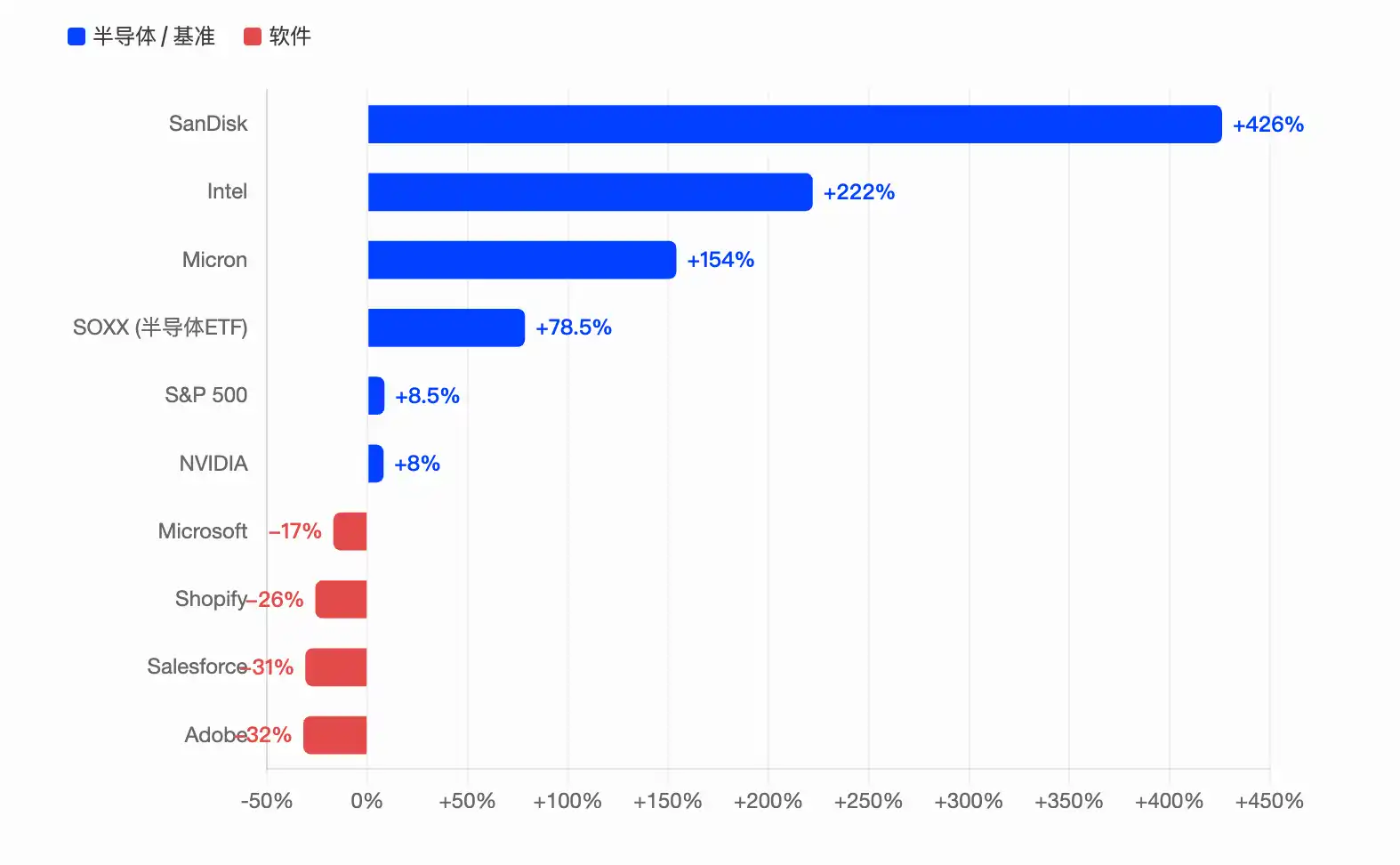
Semiconductor ETFs like SOXX have surged 78.5% year-to-date, while software ETFs like IGV have dropped 12.5%, creating a record performance gap exceeding 90 percentage points. This reflects a major "liquidity suction" within tech stocks, with capital flooding into semiconductors as software faces selling pressure. Driving the semiconductor boom are staggering capital expenditure plans from hyperscalers like Microsoft, Alphabet, Amazon, and Meta, whose combined 2026 capex is projected near $700 billion. This fuels demand for chips, with companies like SanDisk (up 426%), Intel (up 222%), and Micron (up 154%) leading the S&P 500. In contrast, major software firms like Microsoft, Adobe, and Salesforce are all down over 17% year-to-date. The software sector faces a dual challenge: capital is being redirected to semiconductors, and the rise of AI agents like Claude Code threatens traditional SaaS business models, triggering a narrative of AI displacement. Key unanswered questions remain: How long can hyperscalers sustain their massive capex, given potential free cash flow pressures? And will capital eventually rotate back into the deeply oversold software sector? While some analysts warn of a potential semiconductor bubble akin to the dot-com era, the sector's powerful momentum continues, making market timing exceptionally difficult.

Author: Claude, Deep Tide TechFlow

Deep Tide Introduction: The Semiconductor ETF (SOXX) has surged 78.5% year-to-date, while the Software ETF (IGV) has fallen 12.5% over the same period, creating a performance gap of over 90 percentage points, a historically extreme level.

SanDisk leads the S&P 500 with a 426% annual gain, Intel has tripled, Micron is up 154%, while Microsoft, Adobe, and Salesforce have all dropped more than 17% year-to-date. The four hyperscale compute companies' combined capital expenditures for 2026 are nearing $700 billion. Capital is pouring into the chip supply chain like a black hole, while the software sector faces a double squeeze from AI displacement narratives and fund outflows.

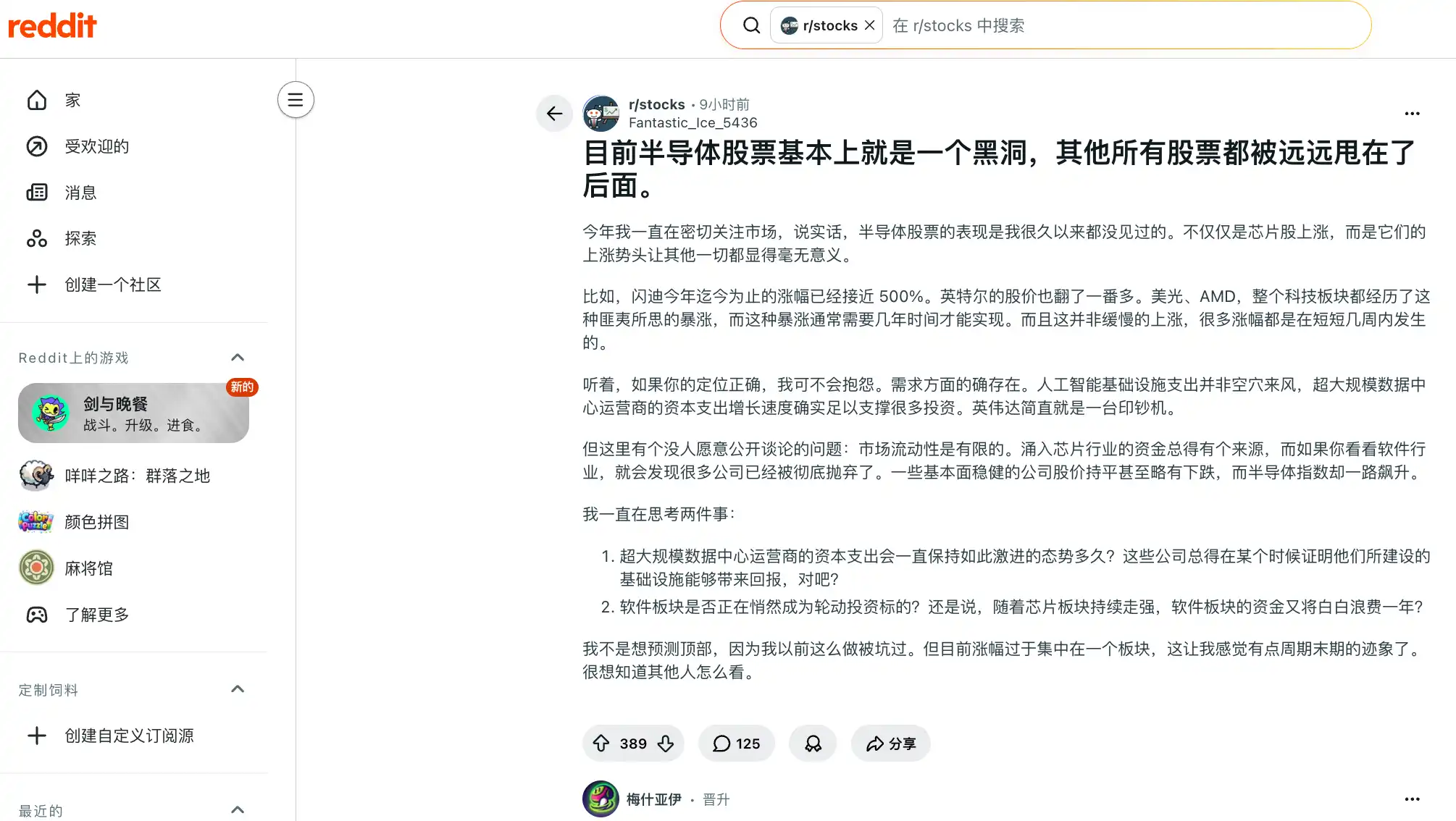
Recently, a hot post on the Reddit investment forum overseas stated that semiconductor stocks are "basically a black hole sucking everything else in," which resonated widely.

Data confirms this intuition. As of the May 22nd close, the iShares Semiconductor ETF (SOXX) has returned 78.5% year-to-date, while the iShares Expanded Tech-Software ETF (IGV) has returned -12.5%. Two ETFs belonging to the same broad technology category show a year-to-date performance gap exceeding 90 percentage points.

According to Tickeron statistics, all software stocks in the S&P 500 are currently trading below their 200-day moving averages, while about 89% of semiconductor stocks remain above their 200-day moving averages. Both sectors fell in sync to the zero line during the 2022 bear market, after which their trajectories completely diverged. This split was not gradual but explosive.
SanDisk up 426% leads S&P 500, Intel's triple gain crushes AMD

The numbers are even more dramatic at the individual stock level.

According to Benzinga Pro data, SanDisk (SNDK) has risen about 426% year-to-date, making it the best-performing stock in the S&P 500 in 2026, following a 559% surge in 2025. This storage chip company, spun off from Western Digital, has seen NAND flash prices rise over 200% year-over-year driven by AI, with March quarter revenue growing 250% to $5.95 billion and non-GAAP gross margins reaching a high 78.4%.

According to 24/7 Wall Street, Intel (INTC) has risen about 222% year-to-date to $225, doubling AMD's gain. Intel's rebound comes from an extremely low base, coupled with progress on its 18A process node, rumors of Apple foundry orders, and yield improvement data disclosed by CEO Patrick Gelsinger in a CNBC interview. Short sellers have been severely squeezed; according to S3 Partners data, since the March 30th low point, Intel's market cap has increased over $440 billion, resulting in paper losses exceeding $12 billion for short sellers.

Micron (MU) has risen about 154% year-to-date, with a cumulative gain of 661% over the past 12 months. Earnings support this move; for the fiscal 2026 second quarter, revenue was $23.9 billion, up 196% year-over-year, with adjusted earnings per share of $12.20, far exceeding market expectations of $9.21. DRAM accounted for 79% of total revenue, with High Bandwidth Memory (HBM) being a key driver. SK Hynix Chairman Chey Tae-won even predicted that the memory chip shortage could last until 2030.

In contrast, NVIDIA (NVDA), the true "money printer" of AI compute, has risen about 8% to $15 year-to-date, performing far worse than the aforementioned second-tier semiconductor companies. According to The Motley Fool, NVIDIA's current forward P/E ratio is about 21.5x, almost on par with the S&P 500's 20.3x. This means the market is no longer paying a growth premium for NVIDIA; capital is instead flowing towards chip companies with lower valuations and greater potential upside.
$700 Billion in Capex: The Hyperscale Compute Companies' 'Arms Race'

Behind the semiconductor surge is real money.

According to data compiled by the Financial Times and multiple institutions, the combined capital expenditures for 2026 by the four hyperscale compute companies—Microsoft, Alphabet (Google's parent), Amazon, and Meta—are projected to be between $650 billion and $725 billion, nearly doubling from about $410 billion in 2025. This represents the largest concentrated infrastructure investment cycle in tech history.

According to Tom's Hardware, Jefferies analyst Brent Thill stated bluntly: "The AI economy is healthy. The bear thesis is garbage."

Specifically: Amazon leads with a single-quarter capex of $44.2 billion, with AWS growing 28%; Alphabet's Q1 capex was $35.67 billion, doubling year-over-year, with Google Cloud backlog jumping above $460 billion; Microsoft's calendar 2026 capex is projected at $190 billion, with about $25 billion attributed to price increases in memory chips and components; Meta raised its full-year capex guidance to $125-$145 billion.

According to statistics from Om Malik's blog, three of the hyperscale compute companies recorded significant non-cash investment gains in their Q1 earnings: Alphabet recorded $36.8 billion (primarily from Anthropic equity appreciation), Amazon recorded $16.8 billion, and Microsoft recorded $5.9 billion (from OpenAI). While capital expenditures are burning cash fiercely, the AI investment targets themselves are also appreciating.

Software Stocks Slaughtered by AI Displacement Narrative, IGV Posts Worst Drop Since 2008

The other side of the coin is the brutal collapse of software stocks.

According to The Motley Fool, after Anthropic released Claude Code in early 2026, the software sector experienced a sharp decline—the market's logic was not to reward AI innovation but to punish those SaaS companies potentially displaced by AI. IGV recorded its largest drop since 2008 at one point.

As of late May, Microsoft is down about 17% year-to-date, Adobe down about 32%, Salesforce down about 31%, and Shopify down about 26%. The S&P 500 Software & Services Index is about 21% below its 200-day moving average, the largest such deviation since June 2022. According to Goldman Sachs and other institutional data, short positions in mid-to-large software companies have surged sharply over the past three months, with cybersecurity and SaaS companies being the most heavily targeted areas for shorts.

Two layers of logic underlie this divergence. The first is direct capital siphoning: market liquidity is finite. When $700 billion in capex pushes chip stocks into parabolic moves, capital must be withdrawn from somewhere. As the author of that Reddit post said: "Fundamentally decent software companies just sit there or bleed slowly, while the semiconductor index goes vertical."

The second is a revaluation of the narrative. The rapid evolution of AI agents is prompting the market to re-evaluate the moats of SaaS business models: when AI can automate programming, form-filling, and customer service, how long can subscription models based on per-seat fees last? The Motley Fool points out that software companies likely to survive will need features like real data, proprietary workflows, and deep customer integration that are difficult for AI to replicate.

Cycle Peak or Structural Shift? Two Key Questions Remain Unanswered

That Reddit user ended the post with two questions, representing investors' ultimate doubts about whether the semiconductor rally can persist.

However, these two questions remain unanswered.

First: How long can the hyperscale compute companies' capital expenditures be sustained?

According to CNBC, Pivotal Research projects Alphabet's 2026 free cash flow will plunge nearly 90% from $73.3 billion in 2025 to $8.2 billion. Of Microsoft's $190 billion annual capex, $25 billion is consumed just by price increases in memory chips and components. These companies are betting future profits on AI revenue that has not yet fully materialized.

Second: Is software the next rotation target?

According to Bank of America's Chief Investment Officer Hartnett's previous judgment in the Flow Show report, software is one of the best contrarian long positions for Q2 2026, given the extreme deviation of the sector relative to its 50-day and 200-day moving averages.

However, this does not mean the semiconductor rally is over. The Philadelphia Semiconductor Index (SOX) recorded a historic streak of 18 consecutive daily gains on April 25th, rising about 45% during that period. According to Intellectia analysis, some veteran analysts are beginning to compare the current move to the 1999-2000 internet bubble, warning of a potential 25% to 30% correction. But SOX has been up in 22 of the past 23 trading days, setting 15 intraday record highs; this momentum is itself a signal.

As that Reddit user said: "I don't want to call a top because I've been slapped in the face too many times before. But the extreme concentration of gains in a single sector is starting to smell like the late stages of a cycle."


Perguntas relacionadas

QWhat is the central theme of the article regarding the performance of tech stocks in 2026?

AThe central theme is a 'liquidity siphon' or 'black hole' effect within tech stocks, where capital is being aggressively pulled from software stocks and funneled into the semiconductor sector, creating a historic performance gap.

QWhich two ETFs are highlighted to demonstrate the extreme divergence between the semiconductor and software sectors?

AThe iShares Semiconductor ETF (SOXX) and the iShares Expanded Tech-Software ETF (IGV) are highlighted. SOXX was up 78.5% year-to-date, while IGV was down 12.5%, a gap exceeding 90 percentage points.

QWhat is driving the massive capital expenditure from the 'hyperscale' companies, and what is the estimated total for 2026?

AThe massive capital expenditure is driven by the AI infrastructure 'arms race'. The combined capex of Microsoft, Alphabet (Google), Amazon, and Meta is estimated to be between $650 billion and $725 billion for 2026, nearly double the 2025 figure.

QWhat are the two main reasons given for the severe underperformance of software stocks?

AThe two main reasons are: 1) Direct liquidity siphoning, where funds flow from software into the surging semiconductor sector. 2) A valuation narrative shift, where AI's capabilities (like automated coding) threaten the traditional SaaS subscription business model, raising questions about its long-term viability.

QWhat two critical unresolved questions about the market trend does the article present at the end?

AThe two unresolved questions are: 1) How long can the hyperscale companies sustain their enormous capital expenditures? 2) Is software poised to become the next sector for a rotational rally, or is the semiconductor momentum still strong?

Leituras Relacionadas

Bloomberg Uncovered: How Do China's Wealthy Circumvent the Annual $50,000 Limit to Transfer Assets?

**Summary: How Wealthy Chinese Circumvent $50,000 Annual Foreign Exchange Limits** Despite China's strict capital controls, including an annual $50,000 per person foreign exchange quota, an estimated $150 billion in funds still leaves the country annually via various gray and underground channels. This report outlines the evolution of China's "capital wall" and the methods used to bypass it. **The Evolving Capital Controls:** * **Foundation (1994):** The system of "current account convertibility with strict capital account controls" was established. * **Quota Set (2007):** The $50,000 individual annual forex purchase limit was formalized. * **Crackdown Begins (2015-2017):** Following market volatility, enforcement tightened. Banks were required to scrutinize transactions, and channels like using UnionPay cards for Hong Kong insurance premiums or buying overseas property were blocked. * **Digital & Legal Upgrades (2024-2026):** Enhanced algorithms now flag suspicious patterns (e.g., "smurfing"). The Common Reporting Standard (CRS) provides Chinese tax authorities with data on citizens' offshore accounts. Unlicensed cross-border brokers have been targeted. **Five Primary Methods for Moving Capital:** 1. **Underground Banking / "Hawala" (Duiqiao):** The largest-scale method. No money crosses borders. Clients pay RMB to a domestic account; an overseas associate deposits equivalent foreign currency into the client's offshore account. Risks include high fees, account freezes, and legal penalties. 2. **"Smurfing" or "Ant Moving":** Using multiple individuals' $50,000 quotas to pool funds for one offshore recipient. Increasingly detected by anti-money laundering algorithms. 3. **Trade Invoice Manipulation:** Businesses over-invoice imports or under-invoice exports via offshore shell companies, creating a pretext to transfer excess funds abroad under the guise of trade. 4. **Channel Migration:** After a crackdown on internet brokers, funds flow toward more compliant but costly channels like major banks' cross-border wealth management services or Qualified Domestic Institutional Investor (QDII) quotas. 5. **Structural Arrangements:** High-net-worth individuals use complex, high-cost legal structures involving offshore trusts, insurance, and investment migration programs to transfer asset ownership. **Regulatory Response: Focusing on People, Not Just Money** The current strategy extends oversight from enterprises to **individual residents**. Tools like CRS allow retroactive visibility into offshore assets. Cryptocurrencies, once seen as a potential loophole, are now actively monitored and prosecuted as an illegal channel. The underlying driver remains: with significant wealth concentrated among millions of affluent households seeking diversification amid domestic economic shifts, the incentive to move assets offshore persists despite regulatory barriers.

marsbitHá 19m

Bloomberg Uncovered: How Do China's Wealthy Circumvent the Annual $50,000 Limit to Transfer Assets?

marsbitHá 19m

Ethereum's Ballmer Moment: As Everyone Is Bearish, the Circulating Supply Is Disappearing

"Ethereum's Ballmer Moment: Circulation Shrinks Amid Bearish Sentiment" Amid widespread bearish sentiment, with prominent figures like Bankless founder David Hoffman selling ETH and young developers flocking to Solana, some argue Ethereum is entering its "Ballmer era"—akin to Microsoft's perceived stagnation under Steve Ballmer. While surface-level criticisms about slow protocol development, cautious leadership, and competitive pressure are valid, underlying fundamentals tell a different story. Approximately 30% of ETH is staked, major holders like BitMine are accumulating, and spot ETFs continue to absorb supply. Regulatory clarity, including the SEC/CFTC's March ruling on staking rewards and the potential passage of the CLARITY Act, is transforming crypto from a regulatory threat into a legitimized framework. This institutionalization, alongside a shrinking circulating supply (with net issuance around 0.23% annually), creates significant buy-side pressure independent of fee-based value capture. The broader crypto total addressable market is expanding through regulated stablecoins, tokenized assets, and institutional adoption. While public chains face competition from permissioned alternatives, the winning model appears to be permissioned assets settling on public chains like Ethereum and Solana. The author advocates a non-maximalist, barbell strategy: holding ETH for its institutional role and supply squeeze, SOL for consumer/throughput trends, BTC as a macro hedge, and a basket of next-gen L1s. Key bullish drivers for ETH include rapid circulation shrinkage, potential Q2 staked ETF approvals, regulatory tailwinds solidifying its role as a default settlement layer, and the optionality of an eventual "Satya moment" leadership shift. Despite bearish consensus, the current setup—where crypto is "not hot" and regulatory groundwork is being laid—presents a compelling investment opportunity. The crypto cycle's focus may have shifted to AI, but blockchain infrastructure is gaining a legal and institutional foothold precisely while attention is elsewhere.

marsbitHá 20m

Ethereum's Ballmer Moment: As Everyone Is Bearish, the Circulating Supply Is Disappearing

marsbitHá 20m

Claude Code Introduces Dynamic Workflows: Enabling AI to Form Teams and Collaborate

Claude Code introduces dynamic workflows, enabling AI to coordinate teams of specialized agents for complex tasks. This transforms Claude from a code assistant into a programmable workbench. Workflows address key limitations of single-agent systems: agentic laziness (premature task completion), self-preferential bias (favoring own outputs), and goal drift (losing sight of original objectives). The system allows Claude to dynamically create execution frameworks using JavaScript. It can split tasks, dispatch parallel agents for isolated work (e.g., in separate worktrees), implement adversarial validation, run tournaments, and synthesize results. This multi-agent approach is valuable for tasks requiring deep research, factual verification, code migration, root cause analysis, large-scale triage, and qualitative sorting. Key patterns include: classify-and-route, fan-out-and-synthesize, adversarial verification, generate-and-filter, tournaments, and loop-until-done. While token usage is higher, workflows excel where tasks resemble programming—needing problem decomposition, isolated context, hypothesis testing, and handling many details. They extend Claude Code's utility beyond technical work to areas like business plan review, resume screening, and naming brainstorm. The feature is not a universal solution but points to a future where AI tool competitiveness depends on organizing reliable, reusable, and auditable execution flows for complex goals.

marsbitHá 1h

Claude Code Introduces Dynamic Workflows: Enabling AI to Form Teams and Collaborate

marsbitHá 1h

Trading

Spot
Futuros
活动图片




