Securitize Capital becomes SEC-registered investment adviser

cointelegraphPublicado em 2026-07-27Última atualização em 2026-07-27

Resumo

Securitize Capital, a subsidiary of tokenization platform Securitize, has registered with the U.S. Securities and Exchange Commission as an investment adviser. This registration allows the firm to expand its regulated advisory services for institutional clients. It adds to Securitize's existing regulated offerings, which include a broker-dealer and transfer agent. CEO Carlos Domingo stated this enhances their ability to help institutions manage investment strategies for on-chain capital markets. Previously an exempt reporting adviser, the firm is now subject to stricter compliance and disclosure rules. Securitize is noted as the largest tokenization platform by on-chain asset value, managing approximately $4.8 billion in tokenized assets for major firms like BlackRock and KKR. The company began trading on the NYSE in early July following a merger, though its share price has declined significantly since its debut.

Securitize Capital, a subsidiary of tokenized asset platform Securitize, has registered with the US Securities and Exchange Commission (SEC) as an investment adviser, allowing the company to expand its regulated investment advisory business for institutional clients, Securitize said Monday.

The registration adds investment advisory capabilities to Securitize’s existing regulated businesses, which include an SEC-registered broker-dealer, alternative trading system, transfer agent and fund administration services.

CEO Carlos Domingo said the registration strengthens Securitize’s ability to help institutions develop and manage investment strategies for onchain capital markets. Securitize Capital previously operated as an exempt reporting adviser and is now subject to additional disclosure, compliance, recordkeeping and examination requirements under the Investment Advisers Act.

Securitize is the largest tokenization platform by onchain asset value, with around $4.8 billion in tokenized assets across funds from BlackRock, Apollo, KKR, VanEck, Hamilton Lane and other asset managers.

The company began trading on the New York Stock Exchange under the ticker SECZ on July 2 after completing a merger with Cantor Equity Partners II. Shares have since fallen about 46% from their first-day closing price.
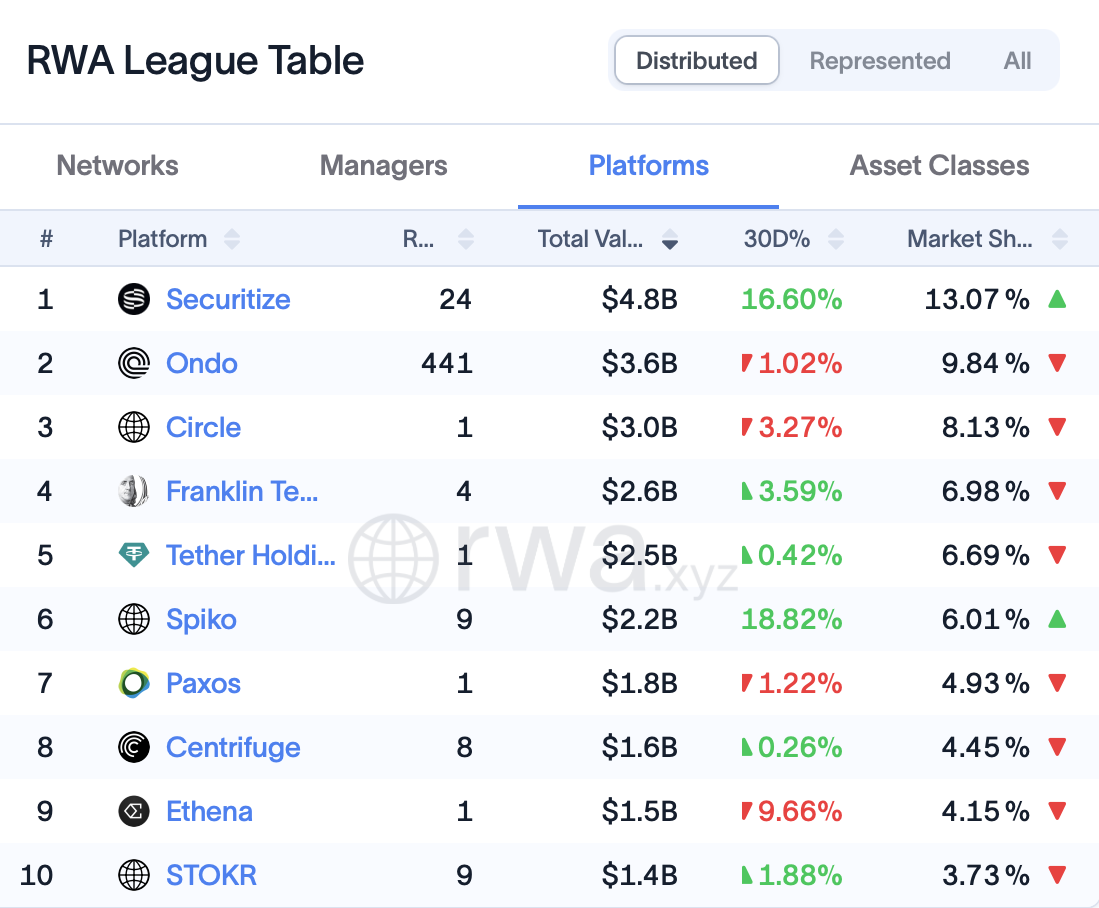
Top RWA tokenization platforms. Source: RWA.xyz

Magazine: CLARITY hopes fade, BitMEX shuts as lawsuit looms: Hodler’s Digest, July 26

Perguntas relacionadas

QWhat is the primary significance of Securitize Capital's recent SEC registration?

AThe primary significance is that Securitize Capital has become a registered investment adviser with the SEC. This allows the company to expand its regulated investment advisory services for institutional clients and strengthens its ability to help institutions develop and manage investment strategies for onchain capital markets.

QWhat regulated services did Securitize already offer before this registration as an investment adviser?

ABefore registering as an investment adviser, Securitize's existing regulated businesses included an SEC-registered broker-dealer, an alternative trading system, a transfer agent, and fund administration services.

QHow does the status change for Securitize Capital from being an exempt reporting adviser to a registered investment adviser?

AAs a registered investment adviser, Securitize Capital is now subject to additional disclosure, compliance, recordkeeping, and examination requirements under the Investment Advisers Act, compared to its previous status as an exempt reporting adviser.

QAccording to the article, what makes Securitize the largest tokenization platform?

ASecuritize is the largest tokenization platform by onchain asset value, with approximately $4.8 billion in tokenized assets across funds from major asset managers like BlackRock, Apollo, KKR, VanEck, and Hamilton Lane.

QWhat was the performance of Securitize's stock (SECZ) after it began trading on the NYSE?

AAfter beginning to trade on the New York Stock Exchange under the ticker SECZ on July 2 following a merger, the company's shares have fallen about 46% from their first-day closing price.

Leituras Relacionadas

Global Market Share Survey: Japanese Firms Lead in Semiconductor Materials

Global Market Share Survey: Japanese Firms Lead in Semiconductor Materials According to the 2025 "Major Goods and Services Market Share Survey" by Nikkei, Japanese companies maintain strong positions in semiconductor-related materials. In silicon wafers, Shin-Etsu Chemical ranks first with a 26.3% share, followed by SUMCO at 17.8%. Together, they hold 44.1% of the market, widening their lead over competitors from Taiwan, Germany, and South Korea. In photoresists, Tokyo Ohka Kogyo, JSR, and Shin-Etsu Chemical occupy the top three spots, with a combined share of 60.5%. Despite their strength in materials, Japanese firms have a weaker presence in core semiconductor segments like DRAM and NAND flash memory, where South Korean and U.S. companies dominate. For instance, SK Hynix and Samsung lead in DRAM, while China’s CXMT doubled its share to 6% in 2025. The semiconductor market is projected to grow rapidly, with WSTS forecasting a 90% increase to $1.5112 trillion by 2026. Major players like Samsung, SK Hynix, and Micron are making massive investments to expand capacity. To maintain their edge in materials, Japanese companies must similarly commit to large-scale, risk-taking investments. In contrast, Japan’s automotive sector shows stagnation. Toyota remains the global leader but with only a slight share increase to 12.3%, while Japanese brands are absent from the top five in the EV market. In shipbuilding, Imabari Shipbuilding rose to third place globally with a 7.2% share, benefiting from large container ship deliveries. However, Chinese and South Korean firms dominate the sector, holding the top two positions. Japan aims to revitalize its shipbuilding industry through government and corporate efforts, targeting a near doubling of output by 2035. Addressing labor shortages and adopting advanced technologies like physical AI will be critical for competitiveness.

marsbitHá 9m

Global Market Share Survey: Japanese Firms Lead in Semiconductor Materials

marsbitHá 9m

STRC Major De-pegging's First Financial Report, How Will Strategy Repair Its Capital Flywheel?

Bitcoin treasury company Strategy released its Q2 2026 earnings report on July 31. Despite a 6.9% year-over-year revenue increase to $122 million, the company recorded a net loss of $8.22 billion, largely due to $8.32 billion in unrealized losses from Bitcoin price fluctuations. As of quarter-end, Strategy holds 843,775 BTC with an average cost of $75,000 per coin, and Bitcoin per share increased. The report highlights a critical shift in Strategy's capital model following the de-pegging of its key financing tool, STRC (Strategic Coin), which fell below its $100 target. Management's top priority is restoring STRC to its target value, aiming for a recovery by September 8. They rule out discounted STRC issuances and plan to maintain its dividend yield at 12%, instead focusing on bolstering its $3.75 billion cash reserve. Strategy has moved from a one-way "buy-and-hold" Bitcoin strategy to active capital management. This new approach, part of its "Digital Credit Capital Framework," involves flexibly managing its balance sheet across four elements: BTC, USD cash, common stock (MSTR), and digital credit securities like STRC. This allows for BTC monetization (having sold $218.4 million in BTC so far), strategic repurchases of discounted securities, and debt optimization, as seen with a $1.5 billion convertible bond buyback. The company's future hinges on two key tests: successfully re-pegging STRC to restore market confidence in its digital credit system, and a long-term recovery in Bitcoin's price to ultimately support its growth thesis.

marsbitHá 54m

STRC Major De-pegging's First Financial Report, How Will Strategy Repair Its Capital Flywheel?

marsbitHá 54m

STRC's First Financial Report Post-Depegging, How is Strategy Restoring the Capital Flywheel?

On July 31, 2026, Bitcoin treasury company Strategy released its Q2 financial report. Despite a 6.9% year-over-year increase in revenue to $122 million, the company recorded a substantial net loss of $8.22 billion, primarily due to $8.32 billion in unrealized losses from Bitcoin holdings. While Strategy's core Bitcoin strategy remains intact—its holdings grew 11% to 843,775 BTC—the company is undergoing a fundamental shift in its capital model. Following the de-pegging of its key financing tool, the STRCoin (STRC), from its $100 target in May, Strategy has pivoted from a one-directional "raise funds, buy Bitcoin" cycle to a more dynamic, multi-asset capital management approach. A key part of this new framework is the "Monetization Program," through which Strategy has sold approximately $218.4 million worth of BTC to bolster liquidity. The company's top priority is repairing STRC's peg, committing not to issue discounted shares until it returns to its target range. It has initiated a $1 billion buyback program for discounted digital credit securities, having repurchased $28.9 million face value of STRC so far. Management aims to restore the peg around September 8, 2026. Strategy now actively manages a matrix of assets: Bitcoin (for accumulation or strategic sales), USD cash reserves (now at $3.75 billion), common stock (MSTR), and digital credit securities like STRC. This allows for tactical moves like repurchasing discounted debt or equity to capture value. The future success of Strategy's "capital flywheel" hinges on two factors: the short-term ability to successfully re-peg STRC to restore market confidence in its digital credit system, and the long-term price trajectory of Bitcoin, upon which its entire investment thesis ultimately depends.

Odaily星球日报Há 59m

STRC's First Financial Report Post-Depegging, How is Strategy Restoring the Capital Flywheel?

Odaily星球日报Há 59m

Trading

Spot
活动图片