Securitize announces ‘real’ tokenized stocks, touts DeFi integration

cointelegraphPublicado em 2025-12-17Última atualização em 2025-12-17

Resumo

Securitize has announced plans to launch what it claims will be the first compliant, on-chain trading experience for tokenized public stocks, representing real share ownership rather than synthetic exposure. The product, expected in Q1 2026, will use tokens issued directly on the issuer’s cap table and recorded onchain. Trading will occur through a DeFi-style swap interface, enabling real-time transactions even outside traditional market hours. The company criticized existing tokenized stock offerings for lacking true ownership, compliance, and proper KYC/AML controls, often relying on offshore structures. In contrast, Securitize emphasizes regulatory compliance, whitelisted wallets, and its role as an SEC-registered transfer agent to ensure tokens represent legally recognized shares. Beyond faster settlement, the firm highlights programmability—enabling integration with DeFi and smart contracts while maintaining investor protections—as a key upgrade to traditional finance.

Securitize, a company focused on tokenizing securities, said Tuesday it plans to launch what it calls the first compliant, onchain trading experience for public stocks that are issued as tokens representing real share ownership.

According to the announcement, Securitize’s stock product is expected to launch in the first quarter of 2026. The company said the offering is designed to avoid structures that mirror stock prices without conveying ownership, and instead, the tokens “are real, regulated shares: issued onchain, recorded directly on the issuer’s cap table.”

It also said trading will be presented in a “swap-style” interface familiar to users of decentralized finance, or decentralized finance (DeFi).

Securitize argued that natively tokenized public stocks, in which tokens represent actual stock ownership, were held onchain but mostly traded through traditional offchain processes. Its pitch is that buyers and sellers will be able to trade “fully on-chain” in real time, including during hours when traditional markets are closed.
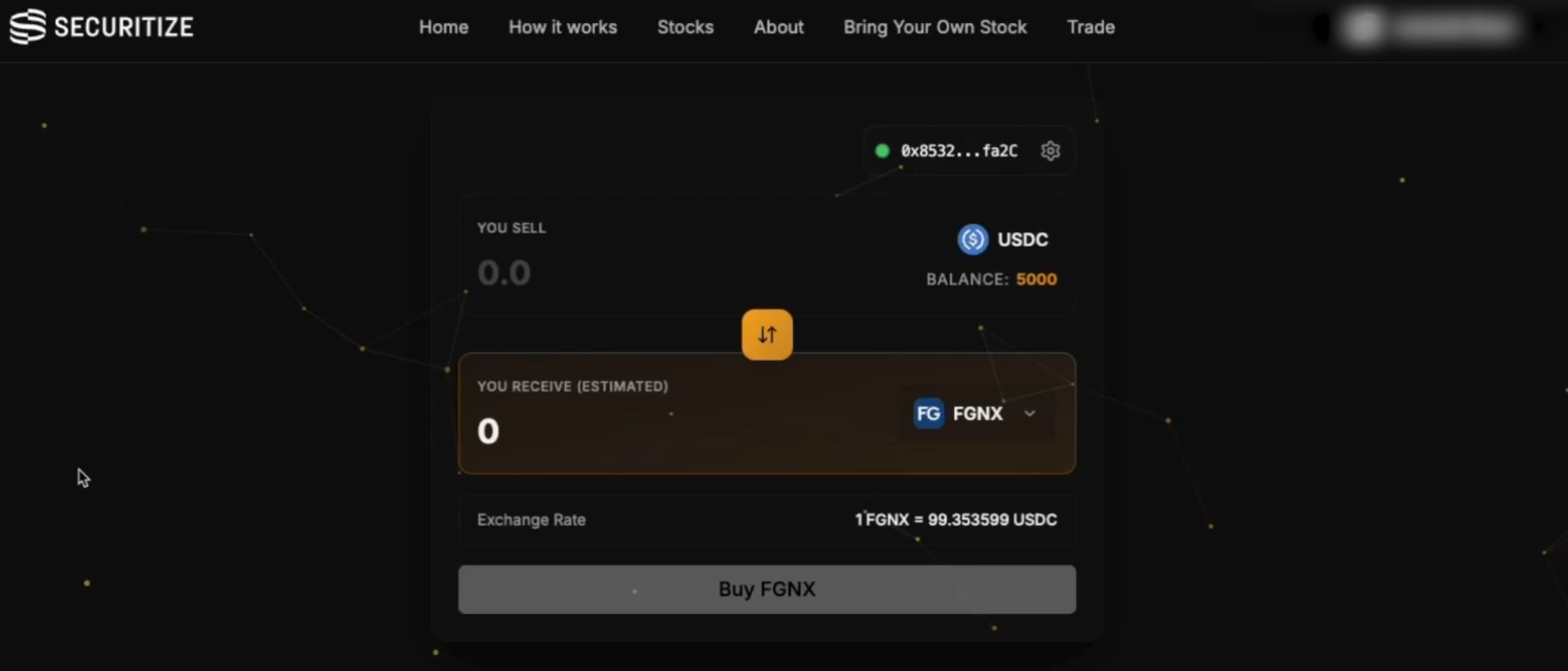
Securitize’s tokenized stock trading user interface. Source: Securitize

Related: Binance hints at stock perps in push to join global tokenized equities race

A compliant tokenized stock ecosystem

Securitize criticized the recent wave of tokenized stock products, claiming they “offer exposure, not ownership.” The company said some products rely on special-purpose vehicles or offshore structures that can add counterparty risk or create pricing mismatches.

It also criticized tokenized stock products, which it said “are not even compliant, since they are issued as permissionless assets without Know Your Customer (KYC) or Anti-Money Laundering (AML) controls.

Still, the company notes that traditional stock infrastructure is antiquated and needs disintermediation and rebuilding, with investors rarely holding “shares in their own name, settlement takes at least a day.”

“If tokenization is going to matter at public-market scale, it must deliver ownership, real securities and maintain investor protections.“

Securitize said its approach is built around regulated securities and compliance requirements, including controls that limit transfers to approved, or whitelisted, wallets.

Related: Ondo wins Liechtenstein approval to offer tokenized stocks in Europe

Regulated shares make their way to DeFi

Securitize said it will act as the transfer agent for the shares, describing itself as registered with the US Securities and Exchange Commission. Transfer agents maintain shareholder records and process changes in ownership. By pairing that role with blockchain-based issuance, the company said the tokens would be legally recognized shares rather than a proxy claim.

Securitize downplayed faster settlement as the main selling point, saying the larger opportunity is programmability, or the ability for tokenized securities to interact with smart contracts and onchain financial applications.

It further argued that this programmability allows tokenized securities to be integrated with DeFi platforms “without compromising compliance or user protections.”

“This is not about replacing traditional finance. It’s about upgrading it,“ Securitize said.

Leituras Relacionadas

Within Strategy's Framework, STRC's Dividend Yield Remains at 12% as Share Price Stays Below Par Value

Michael Saylor, Executive Chairman of Strategy (MSTR), confirmed that the dividend rate for its STRC perpetual preferred shares will remain at 12.00% through August 2026. The rate has increased from 9% at its July 2025 launch to the current high via a "ratchet" mechanism, which permanently raises the rate by 0.5% whenever the share price falls below $95. This mechanism is intended to push the price back toward its $100 par value and support Strategy's "at-the-market" (ATM) program for issuing new shares to fund Bitcoin purchases. However, the mechanism has not worked as intended. STRC shares closed at $89.46 on July 31, remaining about 10-11% below par value despite the record-high dividend. Competition from rival Strive's higher-yielding SATA securities has pressured demand. The persistent discount has forced Strategy to suspend new STRC issuances via its ATM program, limiting this funding channel for Bitcoin acquisitions. STRC's struggles reflect Bitcoin's own volatility, as the preferred shares historically move in tandem. Analysts have warned the ratchet structure carries long-term, one-way risk. A law firm is investigating Strategy's ability to maintain dividend payments if Bitcoin's price stays low. Retail investors own roughly 83% of outstanding STRC shares, a group seen as prone to panic selling during downturns. In response, Strategy has established financial reserves, including a liquidity cushion covering about 26 months of dividend/interest obligations, and a $2 billion share buyback program alongside a Bitcoin monetization framework, though the company emphasized it is not obligated to sell any Bitcoin.

cryptonews.ruHá 40m

Within Strategy's Framework, STRC's Dividend Yield Remains at 12% as Share Price Stays Below Par Value

cryptonews.ruHá 40m

Analyst: Bitcoin's Price Will Drop to $60k in August, Then Rebound to $70k

Financial analyst Andrey Poroshin has provided a new forecast for Bitcoin's price dynamics in August. Poroshin, an analyst at the Bitbanker exchange, expects the cryptocurrency market to experience a downturn this month, with prices retesting the $60,000 level due to a lack of supportive macroeconomic catalysts. He noted that the recent US Federal Reserve decision to hold interest rates did not significantly impact the market, while inflation remains above the 2% target. Poroshin stated that Bitcoin is ending July under pressure from moderate volatility and a lack of new macroeconomic stimuli, leading to continued market caution. According to his base scenario, Bitcoin will drop to a range of $60,000 to $62,000 before recovering to $70,000. He pointed out that even $70,000 remains below the cost of mining in the US, which has prompted some miners to shift towards AI data center operations. Poroshin cited the winding down of BitMEX's operations as a potential catalyst for a price rebound, suggesting the exit of weaker players often coincides with market reversals and reduced short-term selling pressure. He believes Bitcoin is currently less susceptible to geopolitical shocks, such as the Iran-US conflict, and does not expect significant market changes in August related to the pending CLARITY Act. Looking ahead, Poroshin forecasts that September will bring more active price fluctuations driven by potential Fed rate decisions and possible discussions or approval of the CLARITY Act.

cryptonews.ruHá 40m

Analyst: Bitcoin's Price Will Drop to $60k in August, Then Rebound to $70k

cryptonews.ruHá 40m

Trading

Spot
活动图片




