Author: Byron Gilliam
Compiled by: Deep Tide TechFlow
Deep Tide Guide: The SEC's newly proposed Safe Harbor rule for crypto assets allows tokens to be exempt from securities laws once the project is 'functional and usable,' rather than waiting for full decentralization. This gives project teams room to continue development and provides a clearer compliance path for token issuance and exit, directly impacting practitioners and investors.
"It's important to set rules that good people can follow." — Hester Peirce

U.S. regulators have long said that tokens representing decentralized protocols are not subject to securities laws.
The problem is getting to that point of decentralization.
It's not easy. Crypto protocols are, at their core, products, and building products people want to use typically requires a lot of centralized activity: fundraising, developing software, iterating on ideas, marketing.
The journey to community ownership—and thus freedom from securities laws—requires precisely the kind of essential managerial efforts that make an asset a security in the first place.
As SEC Commissioner Hester Peirce said in 2020: "It is difficult to demonstrate utility to a token before the token has been widely distributed to users."
She saw it as a catch-22:
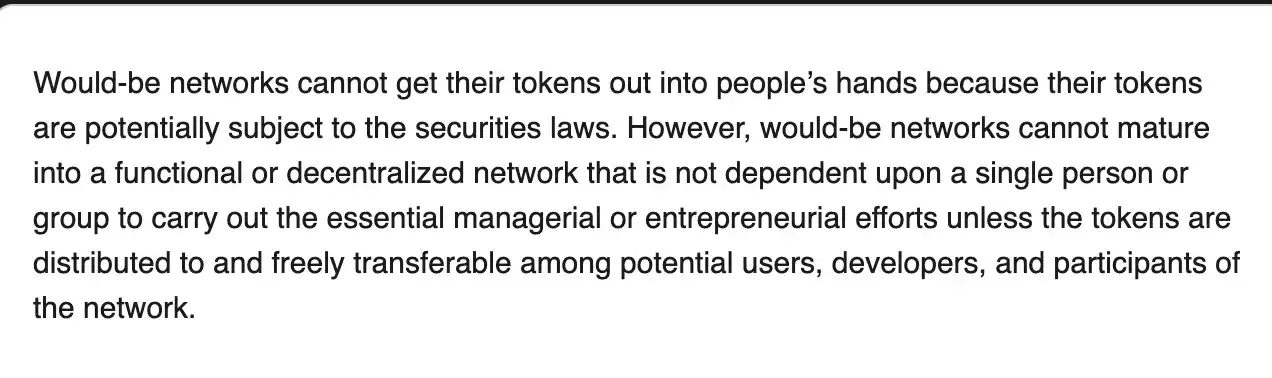
Potential networks cannot put tokens in people's hands because their tokens may be subject to the securities laws. But, without the ability to distribute tokens to potential users, developers, and network participants and allow them to transfer freely, potential networks cannot grow into functioning or decentralized networks that are not dependent on a single person or group to carry out essential managerial or entrepreneurial efforts.
Six years later, Peirce's crypto-focused working group at the SEC has proposed a solution—letting growing crypto assets shed securities laws like a butterfly sheds its chrysalis.
The Safe Harbor provision of the proposed Regulation of Crypto Assets (RCA) suggests tokens would be set free when their issuer has "completed or otherwise permanently ceased" all essential managerial efforts related to the represented protocol.
Until that point, tokens sold to investors would be treated as investment contracts (and thus securities). But the RCA provides a temporary exemption from securities laws during the period the protocol is centrally managed.
This would give developers up to four years to do what crypto protocols were originally meant to do: run without centralized control.
I phrase that awkwardly because the proposal doesn't necessarily require a protocol to be decentralized for its tokens to no longer be investment contracts.
It can also just be "functioning."
Specifically, the proposal explains that the regulatory off-ramp occurs when the protocol "matures into a decentralized or functioning network that is not dependent on a single person or group to carry out essential managerial or entrepreneurial efforts."
What exactly constitutes "functioning" isn't fully spelled out.
But this distinction makes for a significant concession: crypto developers can keep working on their projects even after their tokens are exempt from securities laws.
The proposal states: "We believe that services provided to secure, maintain, improve, or enhance such networks or applications and their functionality, or to foster network effects, whether through sponsoring or funding development efforts or other similar activities, would not constitute essential managerial efforts."
In short, the securities law exemption doesn't require developers to abandon their projects.
The rule doesn't demand every protocol be as perfectly decentralized as Bitcoin, only that it relies on a broader community: "After a network or application is functioning, the activities and contributions of many participants—including the issuer, other developers, validators and/or miners, liquidity providers, users, and crypto asset holders—influence the success or failure of the relevant crypto network or crypto application."
In this sense, "functioning" reads like a very pragmatic version of "decentralized."
It's a generous concession to the crypto industry—and one that might make the industry better.
The SEC's "functioning" standard seems to preclude crypto projects that are decentralized in name only. The common practice where a protocol is managed by a handful of developers controlling a multi-sig wallet, who can execute DAO votes or simply ignore them.
On this point, the SEC seems to be taking the crypto industry's own professed principles of community governance seriously—perhaps more seriously than the industry often takes them itself.
How many protocols are truly governed by their token-holding communities? Various studies suggest not many.
Despite the industry's poor track record here, the SEC is proposing to let crypto projects judge for themselves when they've achieved functional decentralization.
Their exit from the securities law Safe Harbor test is based on promise fulfillment: protocols need to self-certify that their essential managerial efforts have successfully led to a decentralized or functioning network.
This spares the SEC from having to be the referee, precisely arbitrating what counts as decentralized or functioning. That's welcome.
But it also creates a strange incentive: developers will be inclined to promise less—the less promised, the easier it is to say it's been achieved.
A bit odd. It could lead to developers being less transparent about what they're actually doing.
But also useful? For an industry that has long over-promised and under-delivered, dialing down the hype a notch might not be a bad thing.
Could the SEC ultimately even make crypto live up to its original promise?
The most interesting thing about the Regulation of Crypto Assets might be that it finally gives crypto a reason to become what it has always claimed to be: truly decentralized—or at least functionally decentralized.
The crypto industry spent years trying to convince regulators that decentralization is the whole point.
Now, maybe it's the regulators' turn to convince crypto.
— Byron Gilliam