SEC Promotes Tokenized Stocks, Is the Traditional Finance Industry Starting to Worry?

marsbitPublicado em 2026-05-22Última atualização em 2026-05-22

Resumo

The U.S. Securities and Exchange Commission (SEC) is preparing to formally release an "innovation exemption" framework this week. This framework would allow third parties to tokenize U.S. stocks like Apple and Tesla without approval from the listed companies. The move, rooted in a deregulatory vision proposed by pro-crypto commissioners earlier this year, could accelerate the migration of traditional stock markets to blockchain. This development poses a structural threat of "fragmentation" to traditional finance. Core concerns are liquidity fragmentation—where trading volume disperses across multiple blockchains and platforms, leading to price disparities and reduced market efficiency—and revenue fragmentation—where trading fees and intermediary income shift away from domestic exchanges to overseas or competing platforms. The report compares the traditional stock market to a monopolistic "supermarket." Tokenization enables countless "street stalls" to operate outside this system, threatening the exchange's dominance, diluting liquidity for large orders, and slicing into revenue streams. Evidence of this capital fragmentation is already emerging. On the same day the SEC signaled the framework, decentralized platform Hyperliquid saw its RWA (real-world asset) open interest hit a record $2.6 billion, driven by demand for 24/7 on-chain trading of traditional assets. Traditional institutions face a dilemma: either collaborate to build tokenization infrastructure proactively or...

Author: Tiger Research

Compiled by: AididiaoJP, Foresight News

The U.S. Securities and Exchange Commission (SEC) is preparing to formally announce an "innovation exemption" framework this week, which will allow third parties to tokenize U.S. stocks like Apple and Tesla without approval from the listed companies. This move could accelerate the migration of traditional stock markets to blockchain, while also raising deep concerns among exchanges about liquidity fragmentation and revenue loss.

According to a Bloomberg report on May 18, this framework originates from the deregulation vision proposed by pro-crypto commissioners Paul Atkins and Hester Peirce in February. Coinbase and the Blockchain Association had previously submitted formal letters of support, strongly advocating for granting third parties the right to tokenize. However, the guidance issued by Peirce on May 22 is narrower in scope than market expectations, applying only to on-chain stock instruments that fully retain shareholder rights and explicitly excluding synthetic stock tokens that do not carry voting or dividend rights.

Two Core Threats: Liquidity Fragmentation and Revenue Fragmentation

The core impact of tokenized stocks lies in "fragmentation." While the crypto industry often discusses liquidity aggregation, the traditional finance world views it as a structural threat.

  • Liquidity Fragmentation: When the same stock is tokenized on different blockchains and decentralized platforms, the trading volume and order flow originally concentrated on the NYSE or Nasdaq will disperse across multiple venues. This will lead to price disparities between platforms, increased slippage for large orders, and reduced overall market efficiency.
  • Revenue Fragmentation: With the dispersion of trading venues, transaction fees and intermediary revenues that originally belonged to domestic exchanges will flow to overseas or competing platforms, directly impacting national financial competitiveness.
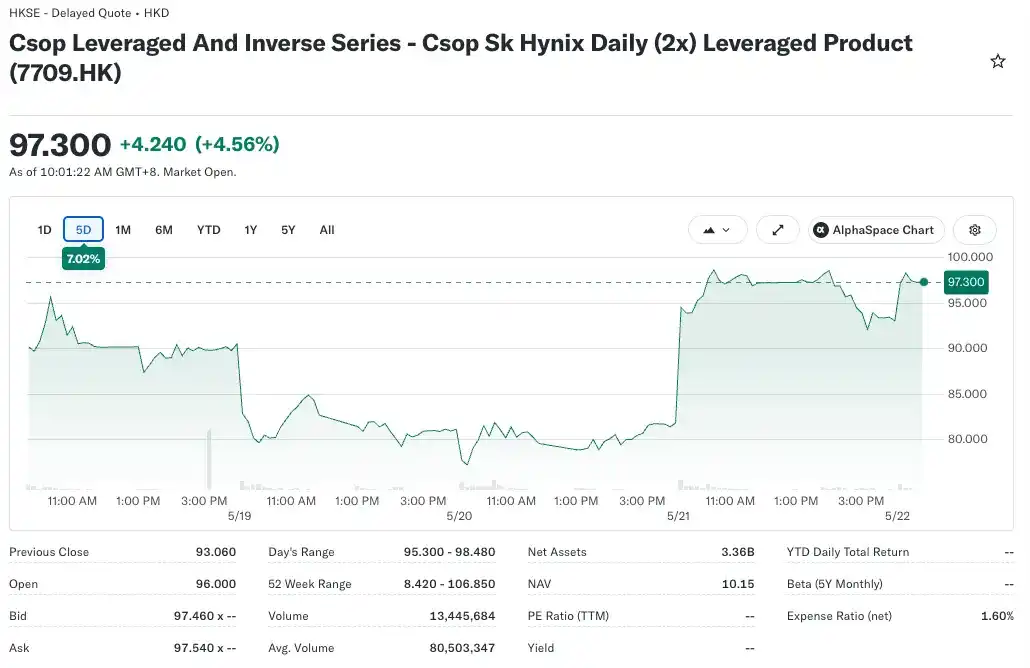
A Tiger Research report uses South Korea as an example: The SK Hynix 2x Leveraged ETF launched by Hong Kong asset manager CSOP has grown into the world's largest single-stock leveraged ETF, with assets exceeding 110 billion won (approximately $80 billion). If South Korea could have taken the lead in launching similar products through regulatory sandboxes, these management fees and financial revenues could have stayed within the country.

The End of Traditional Exchanges' "Supermarket" Monopoly
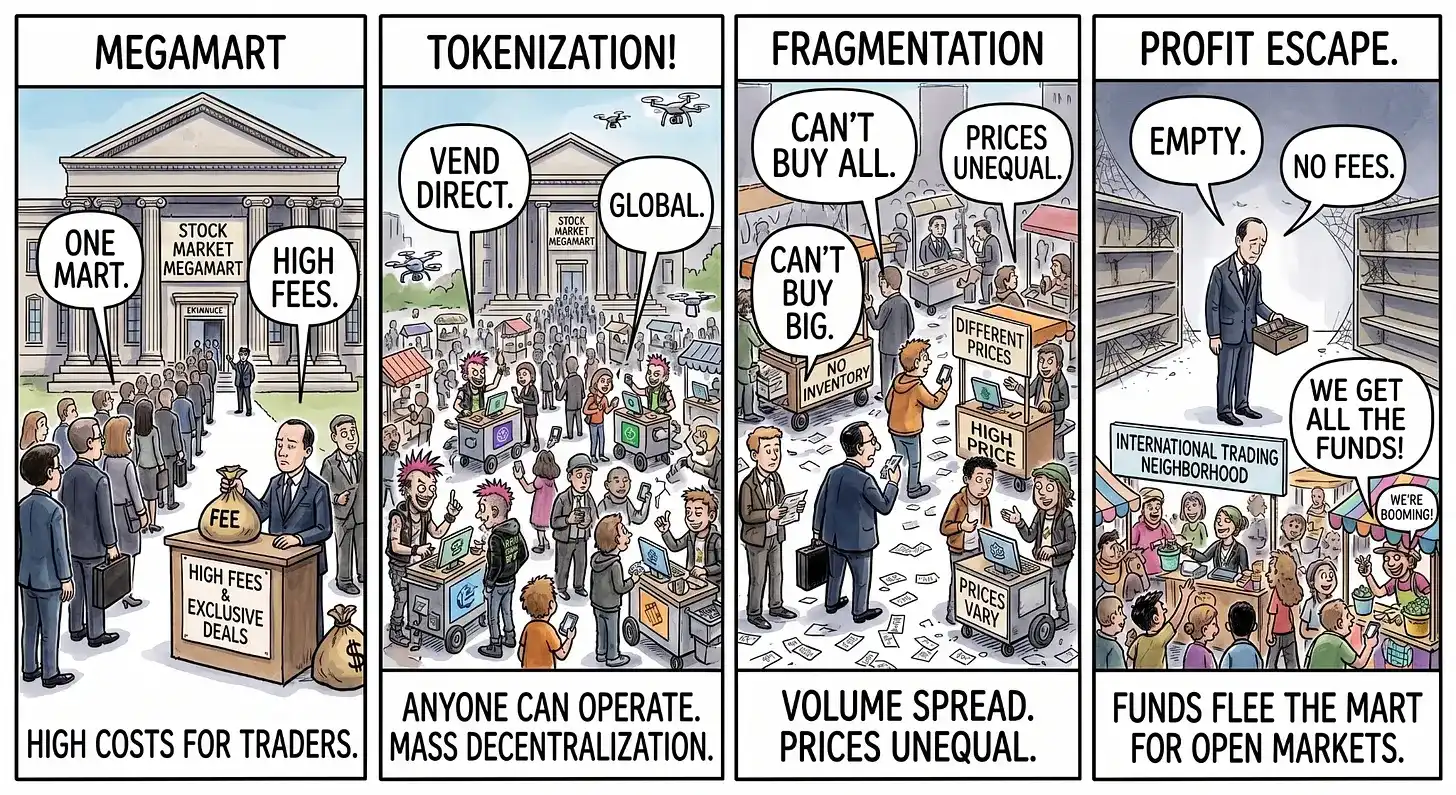
The report uses a vivid metaphor to describe this change: the traditional stock market is like a dominant supermarket where all buyers and sellers are concentrated, and the exchange monopolizes transactions and collects fees. Tokenized stocks are akin to allowing anyone to set up thousands of street stalls without permission, conducting trades directly outside the supermarket.

This dispersion will lead to buyer loss, thinner inventory at each stall, difficulty in executing large trades, and the slicing up of revenue sources. If domestic exchanges hesitate due to regulatory constraints, competing platforms in other jurisdictions will rush to seize global capital flows and intermediary revenues.

Capital Fragmentation Is Already Happening
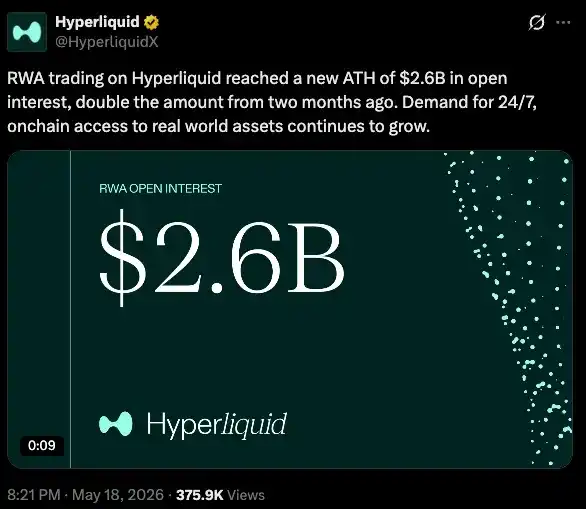
On the same day the SEC signaled the framework (May 18), the open interest for RWAs (Real World Assets) on the decentralized platform Hyperliquid surpassed $2.6 billion, reaching a record high. Driven by the demand for 24/7 on-chain trading of traditional assets, RWA trading volume on perpetual DEXs is expected to surge further.

Traditional financial institutions and regulators face a dilemma: one option is to proactively build tokenization infrastructure through cooperation, like the NYSE; the other is to lobby regulators to block innovation to protect existing revenues. Regulators are also conflicted—they must control the pace of innovation while preventing domestic revenue from being siphoned off by overseas platforms.

Even if the framework is formally announced, potential conflicts are just beginning. Future focal points will include:

  • A second "clarity war" surrounding shareholder rights;
  • How to bring platforms like Hyperliquid, which have grown in regulatory gray areas, into the regulatory system. If deemed unlicensed exchanges, this could trigger a new wave of liquidity and uncertainty shocks.

In the era of digital assets, if financial institutions and jurisdictions do not act quickly, they will permanently lose their long-monopolized fee rights and financial leadership, and capital will continue to disperse in all directions.


Perguntas relacionadas

QWhat is the SEC's upcoming 'innovation exemption' framework expected to allow, according to the article?

AThe SEC's upcoming 'innovation exemption' framework is expected to allow third parties to tokenize stocks like Apple and Tesla on the blockchain without requiring approval from the companies themselves, provided the tokenized instruments fully retain shareholder rights such as voting and dividends.

QWhat are the two main 'fragmentation' threats that tokenized stocks pose to traditional finance, as outlined in the Tiger Research report?

AThe two main 'fragmentation' threats are liquidity fragmentation and revenue fragmentation. Liquidity fragmentation means trading volume spreads across multiple blockchain platforms, causing price discrepancies and higher slippage. Revenue fragmentation refers to the diversion of trading fees and intermediary income away from national exchanges to competing or foreign platforms.

QWhat example does the article use to illustrate the financial loss a country can suffer by not moving quickly with tokenized products?

AThe article uses the example of South Korea. A Hong Kong-based asset manager's leveraged ETF on SK Hynix has grown into the world's largest single-stock leveraged ETF. The report suggests that if South Korea had acted faster through a regulatory sandbox, the management fees and financial revenue from such a product could have remained within the country.

QWhat platform's RWA (Real World Asset) open interest hit a record high on the same day the SEC signaled its new framework?

AOn the same day (May 18), the decentralized platform Hyperliquid saw its RWA open interest surge to a record high, exceeding $2.6 billion.

QWhat are the two strategic options traditional financial institutions and regulators face in response to tokenization, as mentioned in the article?

AThe two strategic options are: 1) To proactively build tokenization infrastructure through partnerships, similar to what the NYSE is doing. 2) To lobby regulators to block innovation in order to protect existing revenue streams.

Leituras Relacionadas

STRC Breaks Below $95: Why Does It Continue to Depeg? Is There Default Risk?

"STRC Falls Below $95: Why the Persistent Depegging and Is There Default Risk?" The article discusses the recent decline in the price of STRC, a perpetual preferred stock issued by Strategy (MSTR) designed to trade around a $100 par value. As of publication, STRC traded at $94.65, raising market concerns. STRC is described as a high-yield cash flow product, offering an 11.50% annual dividend paid monthly. Its "preferred" status grants it priority over common stock for dividends and in liquidation. Key reasons cited for the price depegging include: 1. **Bitcoin's Price Drop:** MSTR's assets are heavily tied to Bitcoin (BTC), which fell over 21% from its recent high, pressuring all Strategy-related products. 2. **Competitive Pressure:** Rival Strive Asset Management's similar product, SATA, offers daily dividends and has maintained its $100 par value with a ~13% yield. In response, Strategy has proposed changing STRC's dividend frequency from monthly to bi-weekly, pending shareholder vote. 3. **Technical Selling:** A break below $100 may have triggered algorithmic selling and stop-losses, exacerbating the decline. Regarding default risk, the analysis suggests it is currently low. Strategy founder Michael Saylor confirmed the June 2026 dividend rate remains at 11.50% with no cuts or suspensions. The company's massive reserve of 843,706 BTC provides a significant backstop for its obligations. Industry opinions are mixed. Some analysts view the BTC holdings as reliable support for dividends, while critics like Peter Schiff warn of potential dividend cuts leading to price crashes and lawsuits. Others highlight inflation risk and the company's ability to reduce dividends without a formal default. In summary, STRC's drop is attributed to BTC volatility, competition, and technical factors. While immediate default risk appears contained, the product faces challenges from market conditions and competitive dynamics.

marsbitHá 1h

STRC Breaks Below $95: Why Does It Continue to Depeg? Is There Default Risk?

marsbitHá 1h

Trading

Spot
Futuros
活动图片




