SEC confirms years-long director bans for former Alameda, FTX executives

cointelegraphPublicado em 2025-12-19Última atualização em 2025-12-19

Resumo

The U.S. Securities and Exchange Commission (SEC) has obtained final consent judgments against former Alameda Research CEO Caroline Ellison and former FTX executives Gary Wang and Nishad Singh. They are barred from holding company leadership roles for eight to 10 years due to their involvement in misusing FTX investor funds from 2019 to 2022. Ellison received a 10-year ban, while Wang and Singh each accepted eight-year bans. All three are also subject to five-year conduct-based injunctions. The SEC alleged that, with Ellison's knowledge, FTX co-founder Sam Bankman-Fried and the other executives exempted Alameda from risk measures and provided it with an unlimited line of credit using FTX customer funds. Ellison, who testified against Bankman-Fried, was sentenced to two years in prison and is scheduled for early release on February 20. Wang and Singh also cooperated with authorities and received time-served sentences. Bankman-Fried was sentenced to 25 years for his central role in the exchange’s collapse.

Former Alameda Research CEO Caroline Ellison and former FTX executives Gary Wang and Nishad Singh will be barred from assuming company leadership roles for eight to 10 years following a court judgment.

In a Friday notice, the US Securities and Exchange Commission said that it had obtained final consent judgments against Ellison, Wang and Singh for their roles in the misuse of investor funds at FTX from 2019 to 2022.

The former Alameda CEO consented to a 10-year officer-and-director bar, while Wang and Singh consented to eight-year officer-and-director bars each. All three are also subject to five-year ”conduct-based injunctions,” according to the SEC.

“In reality, as alleged in the complaints, [Sam] Bankman-Fried, Wang, and Singh, with Ellison’s knowledge and consent, had exempted Alameda from the risk mitigation measures and provided Alameda with a virtually unlimited ‘line of credit’ funded by FTX’s customers,” said the SEC. “The complaints also alleged that Wang and Singh created FTX’s software code that allowed FTX customer funds to be diverted to Alameda, and that Ellison used misappropriated FTX customer funds for Alameda’s trading activity.”
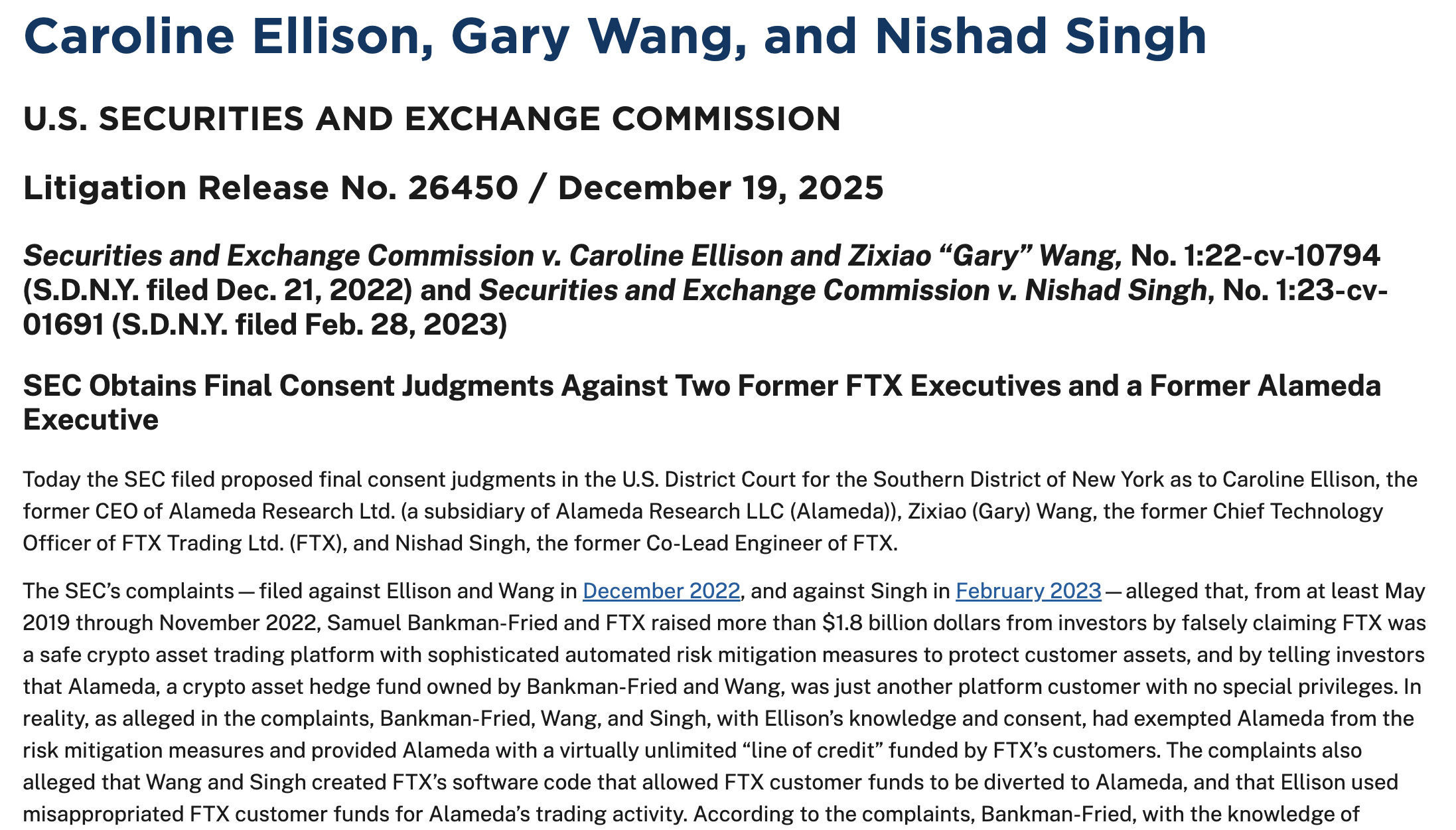
Source: SEC

Former FTX CEO Sam “SBF” Bankman-Fried received a 25-year sentence for his role in the exchange’s collapse. He is awaiting the results of an appeal in the US Court of Appeals for the Second Circuit, where a hearing was held on Nov. 4.

Related: Caroline Ellison blames Sam Bankman-Fried for misuse of FTX user funds at trial

Ellison was sentenced to two years as part of a plea deal in which she testified against Bankman-Fried. Wang and Singh testified against SBF at his criminal trial and were sentenced to time served in 2024.

Ellison will soon be released from custody

The former Alameda CEO, who largely stayed out of the public spotlight between FTX’s collapse and her testimony at SBF’s trial in October 2023, was recently transferred from prison to a Residential Reentry Management field office in New York City.

According to the Federal Bureau of Prisons, she is scheduled to be released on Feb. 20, about nine months before the end of her two-year sentence. The timing suggested she may have been eligible for good-conduct credits to reduce her prison time.

Magazine: When privacy and AML laws conflict: Crypto projects’ impossible choice

Perguntas relacionadas

QWhat are the specific officer-and-director bar durations for Caroline Ellison, Gary Wang, and Nishad Singh as ordered by the SEC?

ACaroline Ellison consented to a 10-year officer-and-director bar, while Gary Wang and Nishad Singh each consented to an 8-year officer-and-director bar.

QAccording to the SEC, what was the primary allegation against Sam Bankman-Fried, Gary Wang, and Nishad Singh regarding Alameda Research?

AThe SEC alleged that Sam Bankman-Fried, Gary Wang, and Nishad Singh, with Caroline Ellison's knowledge and consent, exempted Alameda from risk mitigation measures and provided it with a virtually unlimited 'line of credit' funded by FTX's customers.

QWhat was the role of Gary Wang and Nishad Singh in the misuse of FTX customer funds as stated in the complaints?

AThe complaints alleged that Gary Wang and Nishad Singh created FTX's software code that allowed FTX customer funds to be diverted to Alameda.

QWhat is the current status of Sam Bankman-Fried's legal case as mentioned in the article?

ASam Bankman-Fried received a 25-year sentence and is awaiting the results of an appeal in the US Court of Appeals for the Second Circuit, where a hearing was held on November 4.

QWhen is Caroline Ellison scheduled to be released from custody and what is the reason for her early release?

ACaroline Ellison is scheduled to be released on February 20, about nine months before the end of her two-year sentence, likely due to being eligible for good-conduct credits to reduce her prison time.

Leituras Relacionadas

Circle CEO's Seoul Visit: No Korean Won Stablecoin Issuance, But Met All Major Korean Banks

Circle CEO Jeremy Allaire's recent activities in Seoul indicate a strategic shift for the company, moving away from issuing a Korean won-backed stablecoin and instead focusing on embedding itself as a key infrastructure provider within Korea’s financial and crypto ecosystem. Despite Korea accounting for nearly 30% of global crypto trading volume—with a market characterized by high retail participation and altcoin dominance—Circle has chosen not to compete for the role of stablecoin issuer. Instead, Allaire met with major Korean banks (including Shinhan, KB, and Woori), financial groups, leading exchanges (Upbit, Bithumb, Coinone), and tech firms like Kakao. This approach reflects a broader industry transition: the core of stablecoin competition is shifting from issuance rights to systemic positioning. With Korean regulators still debating whether banks or tech companies should issue stablecoins, Circle is avoiding regulatory uncertainty by strengthening its role as a service and technology partner. The company is deepening integration with trading platforms, building connections, and promoting stablecoin infrastructure. This positions Circle to benefit regardless of which entity eventually issues a won stablecoin. Allaire also noted the potential for a Chinese yuan stablecoin in the next 3–5 years, underscoring a regional trend of stablecoins becoming more regulated and integrated with traditional finance. Ultimately, Circle’s strategy highlights that future influence in the stablecoin market will belong not necessarily to the issuers, but to the foundational infrastructure layers that enable cross-system transactions.

marsbitHá 4m

Circle CEO's Seoul Visit: No Korean Won Stablecoin Issuance, But Met All Major Korean Banks

marsbitHá 4m

SpaceX Ties Up with Cursor: A High-Stakes AI Gambit of 'Lock First, Acquire Later'

SpaceX has secured an option to acquire AI programming company Cursor for $60 billion, with an alternative clause requiring a $10 billion collaboration fee if the acquisition does not proceed. This structure is not merely a potential acquisition but a strategic move to control core access points in the AI era. The deal is designed as a flexible, dual-path arrangement, allowing SpaceX to either fully acquire Cursor or maintain a binding partnership through high-cost collaboration. This "option-style" approach minimizes immediate regulatory and integration risks while ensuring long-term alignment between the two companies. At its core, the transaction exchanges critical AI-era resources: SpaceX provides its Colossus supercomputing cluster—one of the world’s most powerful AI training infrastructures—while Cursor contributes its AI-native developer environment and strong product adoption. This synergy connects compute power, models, and application layers, forming a closed-loop AI capability stack. Cursor, founded in 2022, has achieved rapid growth with over $1 billion in annual revenue and widespread enterprise adoption. Its value lies in transforming software development through AI agents capable of coding, debugging, and system design—positioning it as a gateway to future software production. For SpaceX, this move is part of a broader strategy to evolve from a aerospace company into an AI infrastructure empire, integrating xAI, supercomputing, and chip manufacturing. Controlling Cursor fills a gap in its developer tooling layer, strengthening its AI narrative ahead of a potential IPO. The deal reflects a shift in AI competition from model superiority to ecosystem and entry-point control. With programming tools as a key battleground, securing developer loyalty becomes crucial for dominating the software production landscape. Risks include questions around Cursor’s valuation, technical integration challenges, and potential regulatory scrutiny. Nevertheless, the deal underscores a strategic bet: controlling both compute and software development access may redefine power dynamics in the AI-driven future.

marsbitHá 44m

SpaceX Ties Up with Cursor: A High-Stakes AI Gambit of 'Lock First, Acquire Later'

marsbitHá 44m

Trading

Spot
Futuros
活动图片





