SEC Chairman Explains Why NFTs Are Not Securities: 'Like Buying Trading Cards'

marsbitPublicado em 2026-03-19Última atualização em 2026-03-19

Resumo

SEC Chairman Paul Atkins explained in a CNBC interview why NFTs are generally not considered securities, comparing them to collectibles like baseball cards. The SEC recently issued guidance identifying four categories of digital assets not classified as securities: digital commodities, digital tools, digital collectibles (including NFTs), and stablecoins. Atkins emphasized that NFTs are typically "bought and held" assets rather than investment contracts, which are central to the definition of a security. He noted that each asset is evaluated based on its specific facts and circumstances, but digital collectibles are generally viewed as immutable purchases not intended for trading like traditional securities. This reflects a broader shift in the SEC’s approach under Atkins’ leadership, moving away from enforcement-driven regulation toward clearer guidance and a more predictable framework. The change aligns with the Trump administration's crypto-friendly stance, with Atkins criticizing past regulatory missteps that he believes set the U.S. back in crypto innovation.

Author: Sam Bourgi

Compiled by: Deep Tide TechFlow

Deep Tide Introduction: SEC Chairman Paul Atkins further explained in a CNBC interview why NFTs generally do not constitute securities. The SEC recently released an interpretive document listing four categories of digital assets that are not securities: digital commodities, digital instruments, digital collectibles (including NFTs), and stablecoins.

Atkins compared NFTs to baseball cards, emphasizing that such assets are "bought and held" and do not involve investment contracts. This is the latest move by the SEC under Atkins' leadership to shift from "enforcement-driven" to "guidance-driven" regulation.

Full text as follows:

After the U.S. Securities and Exchange Commission (SEC) listed four major categories of digital assets not subject to securities laws, Chairman Paul Atkins further explained why non-fungible tokens (NFTs) generally do not meet the definition of securities.

In a CNBC interview on Wednesday, Atkins reiterated the four categories of digital assets identified in the SEC's recent interpretive document that are typically not considered securities: digital commodities, digital instruments, digital collectibles like NFTs, and stablecoins.

During the interview, host Andrew Ross Sorkin pressed the issue of digital collectibles, noting that depending on their structure, they could more easily be classified as securities.

Atkins responded, "That's true of anything." He emphasized that the SEC's analysis still depends on the specific facts and circumstances of each asset, particularly whether it involves an investment contract under long-standing legal precedent.

Atkins stated that digital collectibles are generally viewed as items to be bought and held, similar to physical collectibles, rather than investment contracts. Investment contracts are a core defining feature of securities.

He said, "These collectibles, like baseball cards, memes, memecoins, NFTs, are things someone buys. It's an immutable purchase...unlike other assets that people trade."
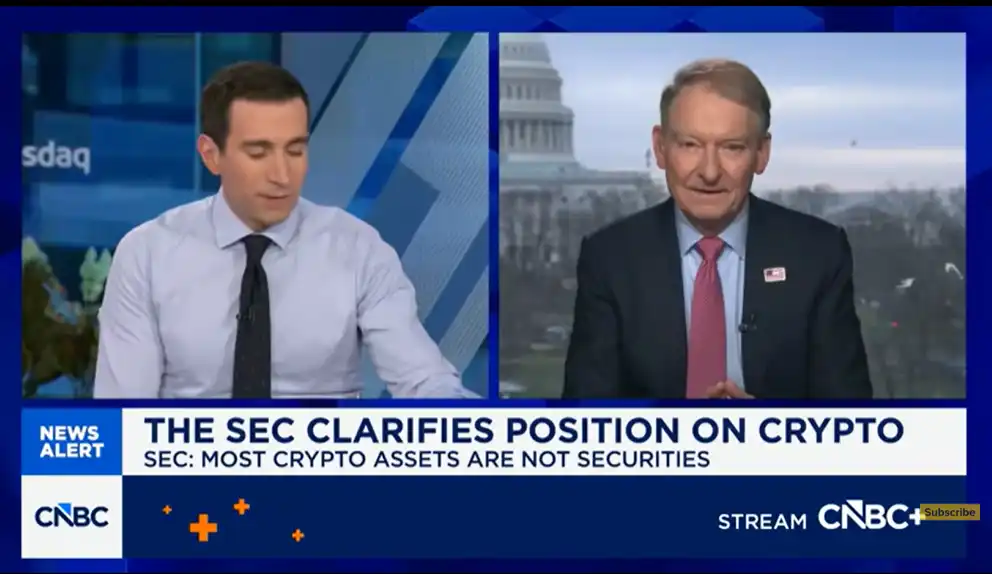
Caption: Paul Atkins interviewed on CNBC. Source: CNBC

SEC Continues to Move Away from "Enforcement-Driven" Crypto Policy

Under Atkins' leadership, the SEC's approach to regulating digital assets has undergone a noticeable adjustment. This shift coincides with the Trump administration, which is more crypto-friendly and took office in early 2025.

Atkins said in the CNBC interview, "We are breaking with the past." He described the SEC's efforts to promote clearer guidance and a more predictable regulatory framework.

Last year, Atkins criticized the SEC's previous reliance on "regulation by enforcement" and promised to move away from this approach. He also noted that tokenization is a key innovation that regulators should support rather than restrict.

Since then, he has repeatedly stated that past regulatory missteps have set the U.S. back by as much as a decade in crypto development and vowed to reverse this situation.


Perguntas relacionadas

QWhat are the four categories of digital assets that the SEC recently identified as typically not being considered securities?

AThe four categories are digital commodities, digital tools, digital collectibles (including NFTs), and stablecoins.

QHow did SEC Chairman Paul Atkins compare NFTs to explain why they are not securities?

AHe compared NFTs to baseball cards, stating they are 'bought and held' items, similar to physical collectibles, and do not involve investment contracts.

QWhat shift in regulatory approach has the SEC undergone under Chairman Paul Atkins' leadership?

AThe SEC has shifted from an 'enforcement-driven' approach to a 'guidance-driven' one, focusing on clearer guidance and a more predictable regulatory framework.

QAccording to the article, what did Paul Atkins say about the impact of past regulatory mistakes on the U.S. crypto industry?

AHe stated that past regulatory missteps set the U.S. back by as much as a decade in crypto development and vowed to reverse this situation.

QWhat key feature did Atkins emphasize as central to the definition of a security in the context of digital assets?

AHe emphasized that the key feature is whether the asset involves an investment contract under long-standing legal precedent.

Leituras Relacionadas

Annual Salary of Millions Competing for Electricians, Meta Rushes to Open Its Own Technical School

The AI boom is facing an unexpected bottleneck: a severe shortage of skilled construction workers and electricians. As tech giants like Meta, OpenAI, and Alphabet race to build massive data centers—such as OpenAI's $16 billion "Stargate" project—they are hitting a critical labor wall. The U.S. needs an estimated 130,000 more electricians, 240,000 construction workers, and 150,000 supervisors by 2030 for AI infrastructure alone, but tens of thousands of electrician jobs go unfilled each year. While AI companies offer high premiums, with electricians earning up to $280,000 annually, worker scarcity still causes massive losses—delays on a single project can cost $14.2 million per month. The complexity of building AI data centers, which require immense power (equivalent to powering hundreds of thousands of homes), sophisticated electrical systems, and advanced liquid cooling solutions, demands highly skilled technicians who are in short supply. To combat this, companies are investing heavily in training. Meta has committed $115 million to a free training school offering tuition, housing, and stipends, targeting 5,000 new workers. OpenAI is partnering with unions to secure skilled labor. These efforts are paying off, with a significant rise in Gen Z interest in trade schools over college. However, the power demands are staggering. AI data centers are driving a rapid surge in electricity consumption, projected to account for up to 12% of U.S. power use by 2028 and raising costs for consumers. Furthermore, the construction boom is project-based, leading to a potential future glut of trained workers once building peaks, which could depress wages industry-wide. The race for AI supremacy now depends as much on skilled hands as on advanced chips.

marsbitHá 1h

Annual Salary of Millions Competing for Electricians, Meta Rushes to Open Its Own Technical School

marsbitHá 1h

OpenAI No Longer Sells Its Most Expensive Model for Profit

OpenAI is shifting its business strategy away from promoting its most expensive, flagship models for every task. Recent price cuts—80% for GPT-5.6 Luna and 20% for Terra—signal a deeper change: the company now actively advises users that many tasks don't require the most powerful model. Instead, OpenAI recommends a tiered approach: use the high-end GPT-5.6 Sol for complex planning and analysis, then delegate execution to cheaper models like Luna. This mirrors moves by Anthropic, which recently launched Claude Opus 5 at half the price of its top model, Fable 5. Both companies are de-emphasizing flagship models as primary revenue drivers, using them instead for brand prestige and technological showcases. The industry is entering a "mass-market" phase, similar to automotive, where high-volume, cost-effective models handle daily operations and drive scale. OpenAI's price reductions are partly enabled by AI models themselves optimizing underlying code and infrastructure, creating a self-reinforcing cycle of efficiency gains and cost reduction. Competition is shifting from "who is smartest" to "who offers the best value." The goal is no longer selling individual models but fostering widespread API adoption and ecosystem lock-in. By making AI calls cheap and ubiquitous, companies like OpenAI aim to become the indispensable, utility-like infrastructure powering automated workflows—the "water and electricity" of software, quietly embedded everywhere.

marsbitHá 1h

OpenAI No Longer Sells Its Most Expensive Model for Profit

marsbitHá 1h

Trading

Spot
活动图片



