Saylor Categorizes Digital Assets into Four Categories on the Monetary Spectrum

cryptonews.ruPublicado em 2026-08-13Última atualização em 2026-08-13

Resumo

MicroStrategy Chairman Michael Saylor has categorized digital assets on a monetary spectrum from most volatile to most stable. In an August 13th post, he identified Bitcoin as "digital capital," his company's MicroStrategy equity (STRC) as "digital credit," the token SR-strcUSX as "digital money," and Tether's USDT as "digital currency." He positioned Bitcoin as the ideal store of value and stablecoins like USDT as the ideal medium of exchange, with MicroStrategy's products bridging the gap. Saylor described STRC, variable-rate perpetual preferred shares paying 12% annual cash dividends, as a semi-stable, high-yield store of value or "digital credit." He stated financial engineering transforms this credit into "digital money," exemplified by the SR-strcUSX token on Solana, which offers targeted 7% yields from STRC exposure. Separately, he highlighted the launch of a Brazilian ETF (DIGY11) providing access to STRC with monthly real-denominated payments. Saylor's framework suggests assets on the left (like Bitcoin) are for growth, while those on the right (like stablecoins) are for stability and utility.

Michael Saylor, Chairman of the Board of MicroStrategy (NASDAQ: MSTR), placed Bitcoin, two of his company's income products, and Tether on a unified monetary scale.

Observers claim that Saylor is trying to hint to investors which digital assets to hold for growth and which for stability; however, he has not confirmed this.

Four Labels, One Sliding Scale

Saylor shared his thoughts in an X post on August 13, where he classified assets from the most volatile to the most stable.

Bitcoin was one of the assets Saylor calls "digital capital." Saylor classified MicroStrategy's STRC as "digital debt," the SR-strcUSX token as "digital money," and Tether's $USDT as "digital currency."
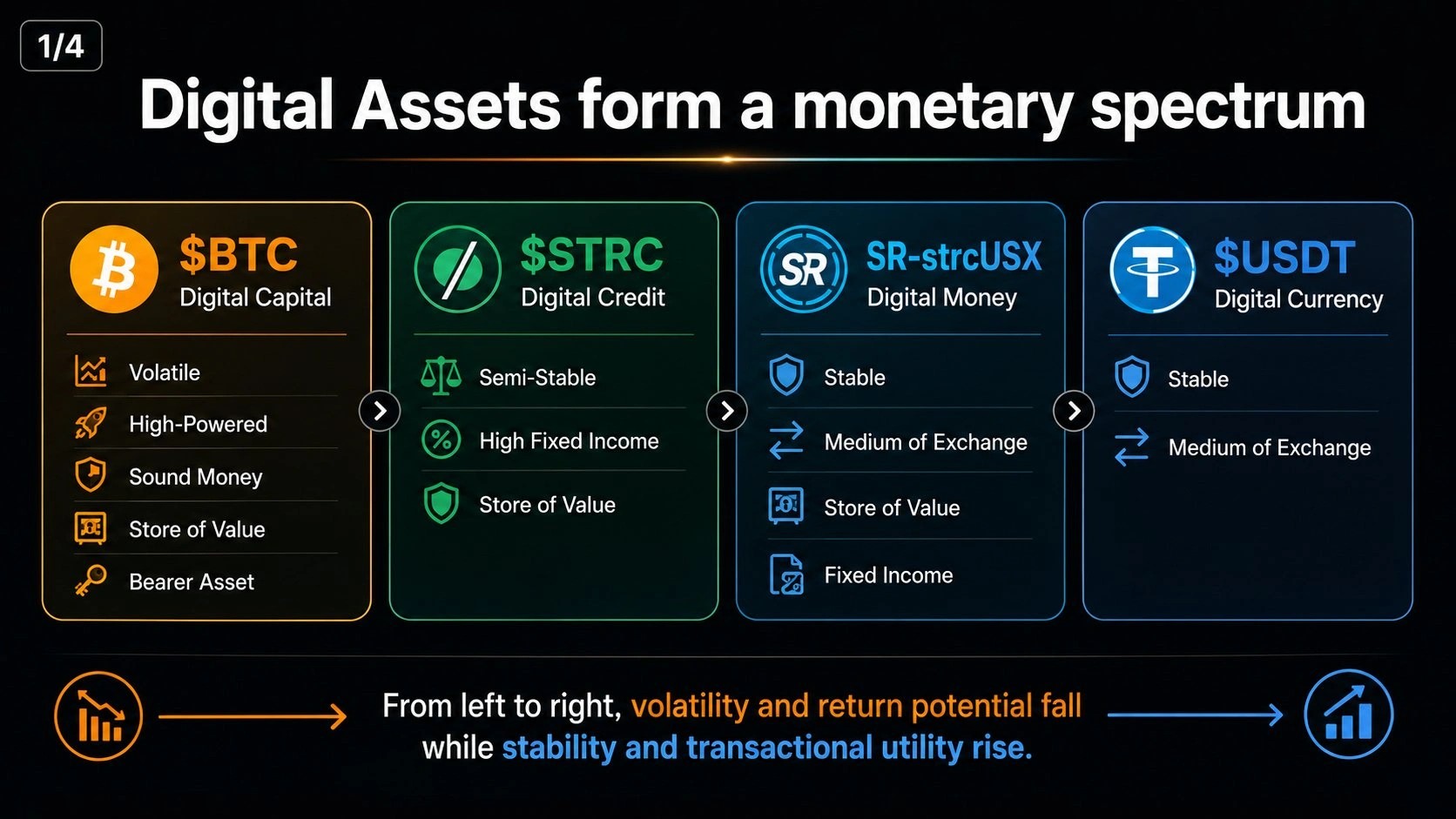
The volatility spectrum of digital assets. Source: Michael Saylor via X/Twitter.

The assets were arranged in a table, starting on the left with Bitcoin, followed by STRC, SR-strcUSX, and $USDT. Saylor noted that volatility and potential return decrease moving to the right, while stability and utility in everyday life increase.

According to Saylor, Bitcoin is the perfect store of value, while a stablecoin like $USDT is the perfect medium of exchange in the digital economy. The two MicroStrategy-linked instruments filled the gap between them.

What's STRC's Place in All This?

STRC, nicknamed "Stretch," is the element doing the main work in the middle tier of Saylor's composition.

It is a variable-rate perpetual preferred stock from MicroStrategy, currently paying 12% annual cash dividends twice a month. MicroStrategy's board sets this rate and must announce each payment, and the shares can continue paying cash even if their market price declines.

Saylor now calls this digital debt and claims it is a semi-stable, high-yield store of value. He stated that it is financial engineering production that transforms digital debt into digital money.

Saylor wrote: "Digital money combines digital currency technology with digital capital economics: stability, yield, transactional utility, and store-of-value function."

However, this is not the first time Saylor has mentioned digital debt. On August 7, he told his followers that anyone looking for "the next billion-dollar fintech unicorn" should "study digital debt."

MicroStrategy, which holds corporate Bitcoin, reinvests $BTC into the preferred shares. On August 10, the company sold 1,690 Bitcoin for $108.6 million and used that cash to redeem approximately 1.15 million shares of STRC, leaving it with 840,447 $BTC.

A Bridge to Solana

For the "digital money" tier, Saylor points to strcUSX, a product that Solstice Finance launched on Solana this week. Solstice Finance, which describes STRC as a bridge between Bitcoin and stablecoins, created a vault that gives users exposure to STRC's dividend yield and price risk without actually passing the shares to them.

Depositors contribute Solstice's USX settlement token and receive one of two tranches. The first tranche pays out to the senior token, SR-strcUSX, with a target annual yield of 7%. Solstice calls it the first STRC-linked instrument on Solana.

Digital Debt Heads to Brazil

Hours before posting the digital asset monetary article, Saylor wrote about digital debt coming to Brazil. He reacted to an announcement by OranjeBTC about the launch of DIGY11, which the company calls "the first Bitcoin ecosystem preferred equity ETF with monthly payments."

Saylor stated that DIGY11, a B3-category exchange-traded fund, will provide access to STRC in the Brazilian market with monthly payouts in reais, daily liquidity, and currency hedging.


Perguntas relacionadas

QWhat are the four categories of digital assets on the money spectrum as presented by Michael Saylor?

AMichael Saylor categorized digital assets into four categories on a money spectrum: Digital Capital (Bitcoin), Digital Credit (Strategy's STRC), Digital Money (SR-strcUSX), and Digital Currency (Tether's USDT).

QAccording to the article, what is the primary characteristic and purpose of Bitcoin and Tether (USDT) respectively on this spectrum?

AOn the money spectrum, Bitcoin is characterized as the ideal store of value, while Tether's USDT is characterized as the ideal medium of exchange in the digital economy.

QWhat is STRC, and what role does it play in Michael Saylor's composition?

ASTRC (nicknamed 'Stretch') is Strategy's variable rate perpetual preferred stock. Saylor classifies it as 'Digital Credit.' It acts as the main workhorse in the middle tier of his composition, being a semi-stable, high-yield store of value that bridges Bitcoin and stablecoins.

QWhat is the 'Digital Money' layer in Saylor's framework, and what product is cited as an example?

AThe 'Digital Money' layer combines the technology of digital currency with the economics of digital capital. The product cited as an example is 'strcUSX,' a tokenized offering by Solstice Finance on the Solana blockchain, specifically the senior tranche 'SR-strcUSX' which offers a target 7% annual yield.

QHow is Saylor's concept of 'Digital Credit' being expanded into the Brazilian market according to the article?

AThe 'Digital Credit' concept, represented by STRC, is being expanded into Brazil through a new ETF called DIGY11. Launched by OranjeBTC, it is described as the first ETF of Bitcoin ecosystem preferred stocks in Brazil, offering monthly payments in Reals, daily liquidity, and currency hedging.

Leituras Relacionadas

Token Buyback Volumes Continue to Rise, But Price Lows Keep Falling

The volume of token buybacks continues to grow, but the minimum price level is constantly declining, according to an internal memo by Bitwise CIO Matt Hogan. He argues that most crypto tokens, except Bitcoin, are undervalued as investors are unaware of the revenue now being returned to holders. He highlights the example of Hyperliquid, which has bought back and burned $1.3 billion worth of its $HYPE token. Hogan posits that tokens are beginning to trade based on revenue, similar to stocks and bonds, marking the end of an era where scaling networks provided little token utility. He links token valuation to strengthening protocol revenue, noting that Hyperliquid has earned over $800 million in the past year and spends nearly all fees on $HYPE buybacks. Following this model, protocols like Uniswap and Aave have implemented fee mechanisms to buy back and burn their own tokens. The trend has also affected base chains like Solana and Aptos, which have proposed or enacted higher fee burns. However, the memo acknowledges that reducing token supply has not reliably boosted prices. A Cryptopolitan report found many tokens with regular buybacks still underperformed the market. Even Hyperliquid's upward trend broke, and Pump.fun conducted significant buybacks near token lows. Hogan cautions that token buybacks differ from stock buybacks due to the lack of contractual claims on profits or assets, as governance rules can always be rewritten.

cryptonews.ruHá 12m

Token Buyback Volumes Continue to Rise, But Price Lows Keep Falling

cryptonews.ruHá 12m

NullReceiver abandons the recording address that made EtherHiding easy to detect

**Sonatype Research Labs has uncovered six malicious npm packages that retrieve command-and-control server addresses from an attacker's Ethereum wallet.** Three of the packages are legitimate, popular libraries that were compromised: `@kolbo/mcp`, `agentgui`, and `godot-kit`. The other three are purely malicious packages: `envpack-conf`, `postcss-initial-provider`, and `tailwindcss-motion-advanced`. All six deploy the same payload. The malware loader queries the Ethereum blockchain for the latest outgoing transaction from a specific wallet. It extracts bytes from the recipient field of that transaction, converts them into two IPv4 addresses, and uses these as primary and backup command-and-control servers. After connecting, it fetches, decodes, and executes a second-stage payload using `eval()` or by spawning a child process. This method, dubbed **"NullReceiver,"** is an evolution of the earlier "EtherHiding" technique. While EtherHiding hid data in transaction fields and sent funds to a fixed "burner" address (creating a monitoring point), NullReceiver sends no funds and generates unique, dynamic receiver addresses, making detection harder. OpenSourceMalware has linked this activity to the North Korean Lazarus group's "Contagious Interview" campaign. Sonatype advises developers to remove the affected package versions immediately and check their systems for signs of secondary payload execution.

cryptonews.ruHá 14m

NullReceiver abandons the recording address that made EtherHiding easy to detect

cryptonews.ruHá 14m

Cryptomarket Loses $14 Billion Due to Hacks. What Was Special About 2026?

The cryptocurrency market lost over $14 billion due to hacks and code exploits from 2016 to 2026, according to a CoinGecko report. The year 2026 has seen a significant spike, with 164 separate incidents recorded as of August—a 70% increase from all of 2025. Although the total financial loss for 2026 currently stands at about $1.2 billion, still below the peak of $2.77 billion in 2022, the number of attacks is unprecedented. Analysts attribute this rise to improved tracking methods and increased malicious activity, possibly fueled by advancements in artificial intelligence. Notable 2026 breaches include the April hacks of Drift and Kelp protocols, resulting in losses of $295 million and $293 million, respectively. The Kelp exploit, linked to North Korean hackers, involved minting unbacked tokens via a LayerZero bridge vulnerability, which were then used as collateral on Aave. This triggered a massive withdrawal of liquidity from Aave and the broader DeFi sector, leading to over $20 billion in sector-wide outflows by August, despite the eventual recovery of the stolen Kelp funds. The report also highlights that market reactions to hacks often inflict greater financial damage than the exploits themselves. For instance, following the BonkDAO hack, the token's market cap fell by nearly $140 million, far exceeding the $21 million direct loss. Other examples include the DRIFT token dropping 80% and Step Finance's token losing over 99% of its value, leading to the protocol's bankruptcy. The analysis notes that the real total damage is likely higher, as it excludes individual wallet breaches and broader ecosystem losses.

cryptonews.ruHá 16m

Cryptomarket Loses $14 Billion Due to Hacks. What Was Special About 2026?

cryptonews.ruHá 16m

Trading

Spot
活动图片