SaucerSwap Unveils Redesigned Platform and New Brand Identity for Hedera DeFi

TheNewsCryptoPublicado em 2025-12-17Última atualização em 2025-12-17

Resumo

SaucerSwap Labs, the team behind Hedera's leading decentralized exchange, has unveiled a fully redesigned platform and a refreshed brand identity. The update modernizes navigation, integrates analytics, and introduces a new visual design, while preserving the existing audited smart contracts and non-custodial architecture. CEO Peter Campbell stated the platform is rebuilt to feel "fast, trusted, and intuitive." Since its 2022 launch, SaucerSwap has grown into Hedera's dominant DeFi protocol. The redesign organizes the platform into clear, action-driven sections for trading, liquidity provisioning, staking, and governance. It also features a bridge to external networks like Base and BNB Chain. The interface is designed to serve all user types, from retail to professional traders, and scales to accommodate future upgrades. The core protocol remains unchanged; all existing user positions and rewards are intact. This marks the beginning of SaucerSwap's next chapter with a new design and capabilities, upholding its mission to be Hedera's most efficient and secure liquidity protocol.

Fernandina Beach, USA/Florida, December 15th, 2025, Chainwire

SaucerSwap Labs, the team behind Hedera’s leading decentralized exchange, today unveiled a fully redesigned platform and refreshed brand identity. The update delivers modernized navigation, integrated analytics, and a new visual design system while preserving the audited smart contracts and non-custodial architecture that users rely on.

“Whether you’re discovering Hedera DeFi for the first time or you’re a professional trader, everything has been rebuilt to feel fast, trusted, and intuitive,” said Peter Campbell, CEO and Co-founder of SaucerSwap Labs. “This is a serious workstation for capital.”

A New Era for Hedera’s Liquidity Protocol

Since launching in 2022, SaucerSwap has grown from an early-stage automated market maker into Hedera’s dominant DeFi protocol, routing the majority of on-chain liquidity and processing tens of millions of swaps. The redesigned platform brings the user experience in line with that scale, introducing clearer information architecture and analytics built directly into every workflow.

The launch also introduces a refreshed visual identity for SaucerSwap, including an updated logo, new color palette, and a modern design system that reflects the protocol’s evolution from startup to infrastructure.

Navigation Built Around Real Workflows
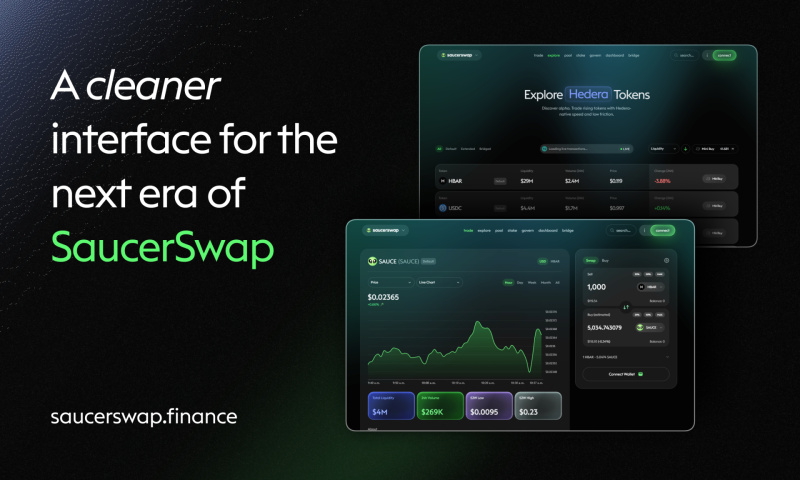
The platform is now organized into clear, action-driven sections. Trading, token discovery, liquidity provisioning, staking, governance, and portfolio monitoring each have dedicated views. Users can move from a token swap to providing liquidity, staking SAUCE, or voting on a governance proposal in seconds.

A bridge modal connects Hedera to external networks including Base and BNB Chain, making it easier to move capital in and out of the ecosystem.

The redesign standardizes how information is displayed across the platform: pair and pool charts, liquidity depth, fee APYs, LP position analytics, historical performance, and protocol health metrics all follow consistent visual patterns. These components are designed to scale with SaucerSwap’s roadmap, including the planned V3 protocol upgrade, perpetuals, limit orders, dollar cost averaging, and ETF-style products.

“The interface was designed so that complex features feel simple,” said Markus Bergvinson, Chief Strategy Officer at SaucerSwap Labs. “Whether it’s swaps today or advanced derivatives tomorrow, it all lives inside one consistent experience.”

Built for Every Type of User

The platform is tuned for different audiences. Retail users and newcomers get clear copy and guided flows that feel similar to modern banking apps. Advanced users and liquidity providers gain faster access to deeper analytics and more powerful LP tools. Builders and token projects can rely on the interface for token launches and liquidity programs. Professional partners can bridge assets from other networks and interact with a protocol that matches their expectations for security and longevity.

Protocol Unchanged, Experience Upgraded

The redesign does not change SaucerSwap’s audited smart contracts, non-custodial architecture, on-chain governance via SAUCE and xSAUCE, or any existing LP positions, stakes, or rewards. Everything users have built on SaucerSwap remains intact.

This launch marks the beginning of SaucerSwap’s next chapter: new design, new brand, and new capabilities, with the same mission of being the most efficient, accessible, and secure liquidity protocol on Hedera.

About SaucerSwap

SaucerSwap is Hedera’s leading decentralized exchange and liquidity protocol, enabling fast, low-cost token swaps with integrated analytics. Governed by the SaucerSwap DAO through SAUCE and xSAUCE, the protocol powers Hedera-native and cross-chain liquidity for retail users, builders, and institutional partners.

For more information, users can visit the SaucerSwap Docs and explore the new SaucerSwap platform.

Contact

CEO
Peter Campbell
SaucerSwap Labs LLC
outreach@saucerswap.finance

Leituras Relacionadas

Analysis of the Latest Portfolio Adjustment by the "Top Player" in the U.S. Stock Market: $9 Billion Short on NVIDIA, Shifting Focus to Power and Memory Sectors

AI investor Leopold Aschenbrenner has made a significant portfolio shift, taking a $9 billion nominal short position against top AI infrastructure stocks like NVIDIA, ASML, and Oracle. Simultaneously, he is redirecting capital towards what he sees as the next critical bottlenecks in the AI boom: power, memory, and data center networking, alongside private investments in AI model companies like Anthropic. This move is interpreted not as a call that the AI bubble has burst, but as a rotation within the infrastructure stack. The analysis highlights NVIDIA's recent $25 billion bond issuance as a potential signal, questioning why a cash-rich company would seek external debt despite high profits and increased dividends/buybacks. The core investment thesis is that the initial, crowded "picks and shovels" trade in semiconductors is maturing. The next wave of capital is expected to flow into the physical and logistical constraints of AI expansion: electricity supply, memory chip capacity, data center construction, and enabling technologies like optical networking (fiber) for high-bandwidth communication, where copper remains crucial for short distances. Aschenbrenner's substantial (approx. 20% of fund) private stake in Anthropic is noted as a key part of his strategy—investing directly in the "mine" (AI models) rather than just the "shovels." The discussion concludes that while certain segments may be overvalued, the overarching AI infrastructure demand driven by real product usage remains robust. The most promising long-term investments are seen in essential, non-sexy infrastructure—particularly energy and power companies—whose demand is viewed as a global constant irrespective of AI's cyclicality.

marsbitHá 20m

Analysis of the Latest Portfolio Adjustment by the "Top Player" in the U.S. Stock Market: $9 Billion Short on NVIDIA, Shifting Focus to Power and Memory Sectors

marsbitHá 20m

BIT Research: Liquidity is Disappearing, Will Bitcoin Replay the Bottoming Pattern of 2022?

The crypto market is currently in an adjustment phase driven by policy expectations and liquidity shifts. Despite a brief rebound fueled by geopolitical easing and SpaceX's strong IPO performance, unexpectedly hawkish signals from new Fed Chair Kevin Warsh have removed anticipated easing support. Concurrently, stablecoin liquidity is shrinking, with insufficient new capital inflows, pushing the market into a typically quiet summer period. Pricing lacks catalysts for a sustained rally. Daily trading volume has significantly contracted, stablecoin growth has slowed markedly, and the supportive effect of Strategy's (formerly MicroStrategy) STRC preferred stock-financed Bitcoin purchases is fading. Amid policy uncertainty, seasonal weakness, and liquidity contraction, Bitcoin faces near-term downward pressure. Warsh's hawkish pivot and refusal to provide a clear policy outlook have increased risk premiums, historically unfavorable for Bitcoin. Technically, the trend remains bearish below $73,700, with $62,446 as critical support. A break below could accelerate declines, though a prolonged consolidation phase, similar to 2022's bottoming process, is possible. Liquidity is a core constraint. Current daily volume is around $500 billion, roughly 25% of the peak during the July-Oct 2025 rally. The 12-month growth rates for USDT and USDC have fallen to ~20%, with 6-month growth near zero, indicating weak new inflows. Bitcoin ETF and Strategy-driven inflows have also weakened, with a 30-day rolling net outflow. With inflation at 4.2% above the Fed's target, combined hawkish policy, seasonal factors, and liquidity shortages challenge Bitcoin's ability to hold above $60,000. However, this adjustment phase may be forming a cyclical low this summer, potentially setting the stage for the next bull cycle.

marsbitHá 49m

BIT Research: Liquidity is Disappearing, Will Bitcoin Replay the Bottoming Pattern of 2022?

marsbitHá 49m

Who Makes the Best Use of Claude Code? The Answer Might Not Be Programmers

Claude Code Usage Report Summary (Based on ~400k sessions) Core Finding: In agentic programming with Claude Code, a clear division of labor has emerged: humans primarily decide *what* to build (planning decisions), while Claude decides *how* to build it (execution decisions). Key Insights: 1. **Effectiveness is not limited to programmers.** In code-generation tasks, success rates for users in non-technical fields (law, finance, management, research) are nearing those of software engineers. What matters most is the user's domain expertise and understanding of the problem to be solved. 2. **Domain expertise drives success and efficiency.** Sessions where users exhibited "expert" proficiency in the task's domain saw verified success rates double compared to "novice" sessions. Experts also delegated more work per instruction, with Claude executing more actions and producing more output. 3. **AI is amplifying, not replacing, domain knowledge.** Claude Code lowers the *implementation* barrier, not the *judgment* barrier. The value of knowing the "what" and "why" is increasing relative to just knowing the "how" to code. 4. **Usage is evolving.** Over a 7-month period (Oct '25 - Apr '26), the share of sessions for debugging halved, while use for software operations, data analysis, and non-code writing roughly doubled. The estimated economic value of typical tasks increased by ~25%. Conclusion: The data suggests coding agents are making programming background less critical for completing technical tasks. However, they reward and amplify deep domain understanding. The ability to successfully direct an AI agent stems more from mastery of a specific field than from coding skill itself. The primary gains come from being competent in a domain; deep specialization adds only marginal additional advantage. This may signal a shift where software creation becomes integrated into various professions.

marsbitHá 1h

Who Makes the Best Use of Claude Code? The Answer Might Not Be Programmers

marsbitHá 1h

Trading

Spot
Futuros
活动图片