Author: Winnie, CryptoPulse Labs
On May 28th, Samsung Securities announced that it will spend approximately 306.37 billion won (about $203 million) to acquire about 2% of the shares in Dunamu, the operator of South Korea's largest cryptocurrency exchange, Upbit.
This is not just an ordinary equity investment; it may signify a deeper shift in the South Korean financial system. This is because South Korean regulators have recently begun signaling a possible future relaxation of the 'separation of finance and virtual assets' policy—a long-standing restriction between financial institutions and the virtual asset industry.
And Samsung Securities' investment is, in essence, South Korean traditional financial capital preemptively seizing the next-generation digital financial gateway.
I. South Korean Financial Capital Formally Enters the Crypto Industry
For a long time, South Korea has been one of the world's most active crypto markets.
South Korean youth have an extremely high level of participation in Crypto. Whether it's Bitcoin, altcoins, Memes, AI Agents, or on-chain trends, the South Korean market is often one of the most active trading regions globally. And Upbit is almost the core of the South Korean crypto market.
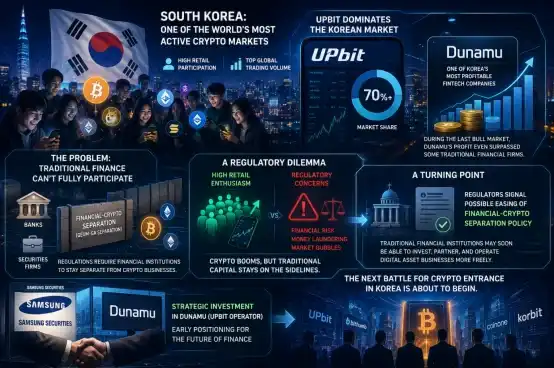
As South Korea's largest cryptocurrency exchange, Upbit has long occupied the vast majority of the trading share in the South Korean market. Its operator, Dunamu, is also one of the most profitable fintech companies in the country.
During the last bull market, Dunamu's profits even surpassed those of some traditional financial institutions in South Korea for a period.
But over the past few years, one issue has persisted. Although South Korean traditional financial institutions were aware of the immense traffic and profits in the crypto industry, they were unable to truly participate deeply.
This was due to South Korea's long-standing implementation of the so-called 'separation of finance and virtual assets' policy. In simple terms, there had to be a certain separation between financial institutions and the virtual asset industry; traditional financial institutions like banks and securities firms could not directly and deeply enter the Crypto industry chain.
The logic behind this regulation essentially reflects South Korea's long-standing dependency on and wariness towards the crypto industry. On one hand, South Korean retail investor trading enthusiasm is extremely high; on the other, regulators worry about financial risks, money laundering risks, and market bubbles.
Thus, over the past few years, a very peculiar situation emerged in South Korea. The Crypto market was extremely prosperous, yet traditional financial capital was largely absent. Now, this situation is changing.
Recently, South Korea's financial regulatory authorities have begun hinting that the separation of finance and virtual assets policy may be gradually relaxed in the future. This means that traditional financial institutions might in the future be able to invest in, cooperate with, or even operate digital asset businesses more freely. Samsung Securities' investment in Dunamu at this moment is essentially a preemptive move to secure a position.
Because all traditional financial institutions know that once regulations are truly loosened, the South Korean financial industry will inevitably erupt into a new round of competition for the crypto gateway.
II. Why is Samsung Securities Betting on Upbit Now?
Samsung Securities' investment in Dunamu appears on the surface to be just a financial investment. But in reality, it reflects the anxiety of South Korean traditional financial institutions about future changes in the financial system.
Over the past decade or more, the biggest change in the global financial industry has not been internet finance, but financial digitization. For example, the digitization of payments, the electronification of securities, the ETF-ification, and stablecoins. More and more financial activities are gradually migrating on-chain.
And crypto exchanges have also evolved from mere crypto trading platforms to become the next generation of financial infrastructure. Whether it's Coinbase, Robinhood, Hyperliquid, or Upbit, they are no longer just trading platforms.
They are more like new types of brokerages, new asset issuance platforms, new payment gateways, and even core nodes of future on-chain financial networks. What South Korean traditional securities firms fear most is that young users are gradually moving away from traditional securities markets.
Nowadays, more and more young users are no longer enthusiastic about traditional stocks. Instead, they are more interested in Crypto, stablecoins, and on-chain assets—these new financial trends are drawing away a massive amount of young user traffic.
For Samsung Securities, if it continues to remain within the traditional business logic, it may gradually lose its voice among young users and in the new financial markets in the future. Therefore, investing in Dunamu is essentially buying a ticket to the future digital financial era.
More importantly, what Upbit possesses is not just a trading business. It also has South Korea's largest crypto user base, the most mature Korean Won on/off-ramp system, the strongest virtual asset liquidity, and the most comprehensive Web3 ecosystem gateway in Korea.
In the future, whether it's RWA, stablecoins, on-chain securities, or digital ETFs, Upbit could potentially become one of South Korea's core financial gateways.
Samsung Securities' early investment now is equivalent to locking in future Korean digital financial infrastructure. And it's worth noting that the main sellers of the shares this time are Kakao-affiliated capital, not Dunamu's founding team.
This means Dunamu is not raising funds because it needs money, but rather it's more of a capital adjustment at the shareholder level. In other words, Samsung Securities is proactively securing a ticket at a high valuation stage.
This, in turn, indicates that traditional financial institutions have begun to genuinely and long-term believe in Crypto. Because only those who truly believe in the future are willing to position themselves early while the industry is still controversial.
III. South Korea is Entering the Era of Comprehensive On-Chain Finance
If we zoom out our perspective, we can see that what is happening in South Korea now is actually very similar to the trend in the United States over the past two years.
The biggest change in the US in recent years is not the rise in Bitcoin's price.
It's that Wall Street has begun to fully accept Crypto. BlackRock pushing for Bitcoin ETFs, Fidelity's foray into digital asset custody, Morgan Stanley opening up to crypto asset allocation, and more and more US banks researching stablecoins and on-chain settlement. In essence, the US has begun to incorporate Crypto into the traditional financial system.
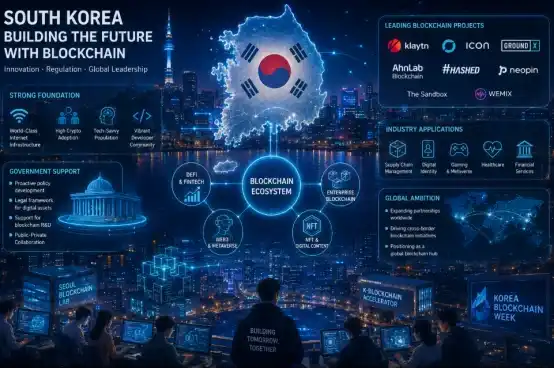
South Korea is now heading down the same path. Samsung Securities' investment in Dunamu is essentially the South Korean version of the 'traditional securities firm plus Coinbase' model.
In the coming years, several important trends are likely to emerge in the South Korean market.
First, traditional financial institutions will comprehensively enter the virtual asset industry. This includes crypto ETFs, digital asset custody, on-chain securities, etc.
Because all financial institutions understand that the next round of financial infrastructure upgrade will likely happen on-chain.
Second, crypto exchanges will become further financialized. In the past, many exchanges were essentially just matching trades. But in the future, they may gradually transform into comprehensive financial platforms.
Not only can they trade Crypto, but in the future, they might even trade on-chain stocks, digital bonds, and stablecoin yield products.
Third, South Korea may become Asia's new on-chain financial hub. In the past, Asia's digital finance competition was mainly concentrated in Hong Kong, Singapore, and Dubai. But South Korea has an extremely strong retail investor base, internet culture, and a highly active trading ecosystem.
Once regulations are truly relaxed, South Korea could quickly become one of Asia's most important on-chain financial markets. Especially in terms of young user participation, the South Korean market might even be more aggressive than Japan's.
And Dunamu's valuation of approximately 15.3 trillion won also sends a very crucial signal. The capital market has already begun to redefine crypto exchanges.
In the past, many considered exchanges to be highly volatile, high-risk cyclical businesses. But now, more and more capital is starting to see them as the next generation of financial infrastructure.
What is truly valuable is no longer just a particular Token. It's the users, liquidity, asset issuance capabilities, and the gateway status in the future digital financial world.
From this perspective, what Samsung Securities bought is not just 2% of Dunamu's shares. It's more like purchasing a seat at the table in South Korea's next-generation financial order.
Conclusion
Over the past few years, there has been a debate within the crypto industry. Will Crypto replace traditional finance, or will it eventually be absorbed by traditional finance?
Now the answer seems increasingly clear. The future financial world is likely not traditional finance VS Crypto, but traditional finance going fully on-chain.
Samsung Securities' investment in Upbit is the most typical epitome of this trend. South Korean financial capital has formally begun to enter the deep waters of Crypto.