Samourai Co-Founder Writes From Prison After Surrender: ‘Confusing And Unnatural’

bitcoinistPublicado em 2025-12-27Última atualização em 2025-12-27

Resumo

Keonne Rodriguez, co-founder of Bitcoin privacy tool Samourai Wallet, has written a letter from a US federal prison after beginning a five-year sentence. Dated Christmas Eve, the letter describes the intake process and his initial days behind bars as "confusing and unnatural" but manageable, noting respectful treatment from fellow inmates. Rodriguez was sentenced on November 19 for charges related to his role in a crypto mixing protocol. His case has sparked a significant legal and ethical debate over whether developers of privacy software can be held criminally liable for misuse by others. This mirrors concerns in the prosecution of Tornado Cash co-founder Roman Storm, raising questions about the legal treatment of open-source code. Supporters argue the case threatens free speech and software development, with a clemency petition gathering over 12,000 signatures. They claim no direct victims were harmed by his work. Prosecutors, however, contend that the tools were structured and promoted in ways that enabled illicit transactions. US President Donald Trump has acknowledged he will "take a look" at the case, keeping the possibility of a pardon in public discourse. The situation highlights the ongoing tension between neutral technology and its potential for criminal use, drawing attention from developers, legal experts, and privacy advocates.

Keonne Rodriguez, a co-founder of the Bitcoin privacy tool Samourai Wallet, began serving a five-year sentence and wrote a letter from inside a US federal prison on Christmas Eve.

The letter, shared publicly, offers a short, personal account of intake procedures, the move into housing, and his first days behind bars. He wrote that the place was “confusing and unnatural”, yet “manageable”, and that fellow inmates had treated him with respect.

Inside The Prison Letter

Rodriguez wrote that he had gone through searches and medical checks during intake, and that he was settling in after what he called an emotional goodbye to family days before the holiday.

The note was dated Christmas Eve and marked his seventh day at the facility. Reports said his wife was scheduled as his first visitor on Christmas Day. Those details make the timing — and the human side of the story — hard to miss.
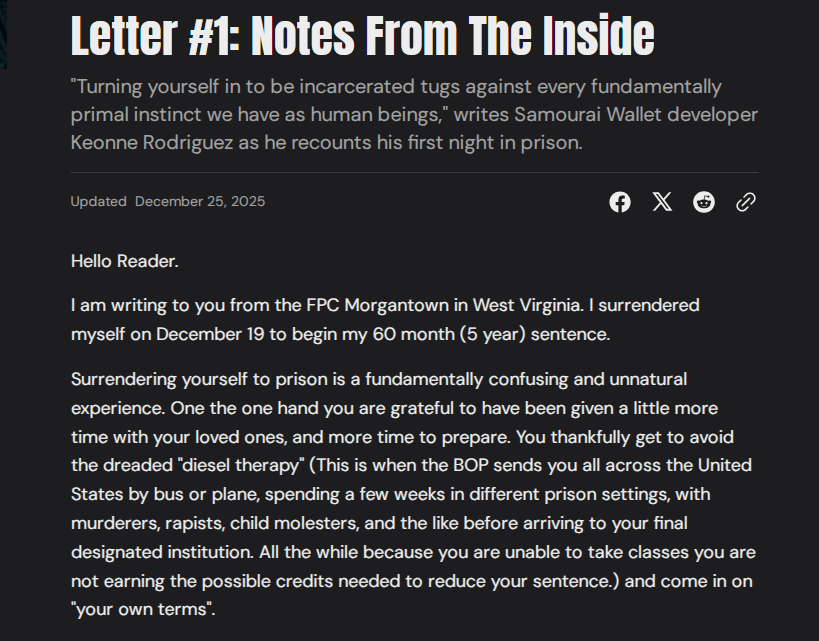
Source: The Rage/ Letter of Keonne Rodriguez, co-founder of Bitcoin privacy tool Samourai Wallet.

Rodriguez was sentenced on Nov. 19 on charges tied to his role in a crypto mixing protocol. His case has become a touchpoint for a wider dispute about whether building or maintaining privacy software can carry criminal liability when others misuse those tools.

The debate has drawn comparisons to the prosecution of Roman Storm, a co-founder of Tornado Cash, and raised questions about how the law treats open-source code and the people who write it.

Total crypto market cap at $2.96 trillion on the daily chart: TradingView

Samourai: Legal Debate Over Code And Crime

Supporters say Rodriguez’s prosecution threatens free speech and software development. A petition asking for clemency gathered more than 12,000 signatures, and many privacy advocates argue that no direct victims were harmed by his work.

In public posts, Rodriguez framed his case as “lawfare” and criticized regulators and judges for targeting innovation. Those claims have been repeated widely in crypto circles.

Prosecutors argue differently. They point to the structure and promotion of certain tools and say some actors used them to hide illicit transfers.

Courts have faced the hard question of where to draw the line between code as neutral technology and code used to facilitate crime. That tension is central to why Rodriguez’s sentence has drawn such attention from developers, legal scholars, and privacy groups.
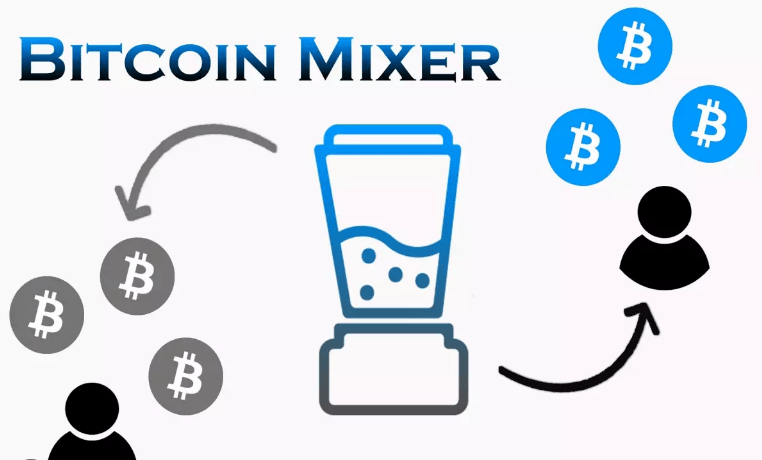
Image: Blockmanity

Samourai Drama: Calls For Clemency Gain Traction

US President Donald Trump said on Dec. 16 that he would “take a look” at Rodriguez’s case after it gained public attention. That brief remark kept the possibility of executive clemency in public view, though such reviews do not always lead to action. Rodriguez publicly appealed to the president for a pardon as he began serving his sentence.

Public reaction has been mixed. Some see the petition and media coverage as a push to protect open-source developers. Others stress that courts will weigh evidence about intent and conduct, not just the code itself.

What remains clear is that this case has pulled the issue into the open and made it harder for lawmakers and courts to ignore.

Featured image from Cyber Security News, chart from TradingView

Perguntas relacionadas

QWho is Keonne Rodriguez and what is his current situation?

AKeonne Rodriguez is a co-founder of the Bitcoin privacy tool Samourai Wallet. He is currently serving a five-year sentence in a US federal prison after being convicted on charges related to his role in a crypto mixing protocol.

QWhat was the main sentiment expressed in Rodriguez's prison letter?

AIn his letter, Rodriguez described the prison environment as 'confusing and unnatural' but also 'manageable'. He noted that his fellow inmates treated him with respect.

QWhy has Rodriguez's case become a significant topic of debate?

AHis case has become a touchpoint for a wider dispute about whether building or maintaining privacy software can carry criminal liability when others misuse those tools. It raises questions about the legal treatment of open-source code and its developers.

QWhat action did US President Donald Trump take regarding this case?

AUS President Donald Trump said on Dec. 16 that he would 'take a look' at Rodriguez's case, keeping the possibility of executive clemency in public view.

QWhat is the core legal argument made by prosecutors against Rodriguez?

AProsecutors argue that the structure and promotion of certain tools, like the crypto mixer, were used by some actors to hide illicit transfers, thus making the developers criminally liable.

Leituras Relacionadas

From Theft to Re-entry: How Was $292 Million "Laundered"?

A sophisticated crypto laundering operation was executed following the $292 million hack of Kelp DAO on April 18. The attack, attributed to the North Korean Lazarus group, began with anonymous infrastructure preparation using Tornado Cash to fund wallets untraceably. The hacker exploited a vulnerability in Kelp’s cross-chain bridge, stealing 116,500 rsETH. To avoid crashing the market, the attacker used Aave and Compound as laundering tools—depositing the stolen rsETH as collateral to borrow $190 million in clean, liquid ETH. This move triggered a bank run on Aave, causing an $8 billion drop in TVL. After consolidating funds, the attacker fragmented them across hundreds of wallets to evade detection. A major breakpoint was THORChain, where over $460 million in volume—30 times its usual activity—was processed in 24 hours, converting ETH into Bitcoin. This shift to Bitcoin’s UTXO model exponentially increased tracing complexity by shattering funds into countless untraceable fragments. The final destination was Tron-based USDT, the primary channel for illicit crypto flows. From there, funds were cashed out via OTC brokers in China and Southeast Asia, using unlicensed underground banks and UnionPay networks outside Western sanctions scope. Ultimately, the laundered money supports North Korea’s weapons programs, which rely heavily on crypto hacking for foreign currency. The incident underscores structural challenges in DeFi: its openness, composability, and lack of central control make such laundering not just possible, but inherently difficult to prevent.

marsbitHá 1h

From Theft to Re-entry: How Was $292 Million "Laundered"?

marsbitHá 1h

Google and Amazon Simultaneously Invest Heavily in a Competitor: The Most Absurd Business Logic of the AI Era Is Becoming Reality

In a span of four days, Amazon announced an additional $25 billion investment, and Google pledged up to $40 billion—both direct competitors pouring over $65 billion into the same AI startup, Anthropic. Rather than a typical venture capital move, this signals the latest escalation in the cloud wars. The core of the deal is not equity but compute pre-orders: Anthropic must spend the majority of these funds on AWS and Google Cloud services and chips, effectively locking in massive future compute consumption. This reflects a shift in cloud market dynamics—enterprises now choose cloud providers based on which hosts the best AI models, not just price or stability. With OpenAI deeply tied to Microsoft, Anthropic’s Claude has become the only viable strategic asset for Google and Amazon to remain competitive. Anthropic’s annualized revenue has surged to $30 billion, and it is expanding into verticals like biotech, positioning itself as a cross-industry AI infrastructure layer. However, this funding comes with constraints: Anthropic’s independence is challenged as it balances two rival investors, its safety-first narrative faces pressure from regulatory scrutiny, and its path to IPO introduces new financial pressures. Globally, this accelerates a "tri-polar" closed-loop structure in AI infrastructure, with Microsoft-OpenAI, Google-Anthropic, and Amazon-Anthropic forming exclusive model-cloud alliances. In contrast, China’s landscape differs—investments like Alibaba and Tencent backing open-source model firm DeepSeek reflect a more decoupled approach, though closed-source models from major cloud providers still dominate. The $65 billion bet is ultimately about securing a seat at the table in an AI-defined future—where missing the model layer means losing the cloud war.

marsbitHá 7h

Google and Amazon Simultaneously Invest Heavily in a Competitor: The Most Absurd Business Logic of the AI Era Is Becoming Reality

marsbitHá 7h

Trading

Spot
Futuros

Artigos em Destaque

O que é WL

I. Introdução ao ProjetoWorldLand é uma L2 ou side chain do Ethereum, concebida como uma solução de baixo para cima para melhorar o ecossistema Ethereum.II. Informação sobre o Token1) Informação BásicaNome do token: WL (WorldLand)III. Links RelacionadosWebsite:https://worldland.foundation/Exploradores:https://bscscan.com/address/0x8aaB31fbc69C92fa53f600910Cf0f215531F8239Redes Sociais:https://x.com/WorldLand_space Nota: A introdução ao projeto provém dos materiais publicados ou fornecidos pela equipa oficial do projeto, que é apenas para referência e não constitui aconselhamento de investimento. A HTX não se responsabiliza por quaisquer perdas diretas ou indiretas resultantes.

213 Visualizações TotaisPublicado em {updateTime}Atualizado em 2026.03.28

O que é WL

Como comprar WL

Bem-vindo à HTX.com!Tornámos a compra de WorldLand (WL) simples e conveniente.Segue o nosso guia passo a passo para iniciar a tua jornada no mundo das criptos.Passo 1: cria a tua conta HTXUtiliza o teu e-mail ou número de telefone para te inscreveres numa conta gratuita na HTX.Desfruta de um processo de inscrição sem complicações e desbloqueia todas as funcionalidades.Obter a minha contaPasso 2: vai para Comprar Cripto e escolhe o teu método de pagamentoCartão de crédito/débito: usa o teu visa ou mastercard para comprar WorldLand (WL) instantaneamente.Saldo: usa os fundos da tua conta HTX para transacionar sem problemas.Terceiros: adicionamos métodos de pagamento populares, como Google Pay e Apple Pay, para aumentar a conveniência.P2P: transaciona diretamente com outros utilizadores na HTX.Mercado de balcão (OTC): oferecemos serviços personalizados e taxas de câmbio competitivas para os traders.Passo 3: armazena teu WorldLand (WL)Depois de comprar o teu WorldLand (WL), armazena-o na tua conta HTX.Alternativamente, podes enviá-lo para outro lugar através de transferência blockchain ou usá-lo para transacionar outras criptomoedas.Passo 4: transaciona WorldLand (WL)Transaciona facilmente WorldLand (WL) no mercado à vista da HTX.Acede simplesmente à tua conta, seleciona o teu par de trading, executa as tuas transações e monitoriza em tempo real.Oferecemos uma experiência de fácil utilização tanto para principiantes como para traders experientes.

238 Visualizações TotaisPublicado em {updateTime}Atualizado em 2026.03.28

Como comprar WL

Como comprar BASED

Bem-vindo à HTX.com!Tornámos a compra de Based (BASED) simples e conveniente.Segue o nosso guia passo a passo para iniciar a tua jornada no mundo das criptos.Passo 1: cria a tua conta HTXUtiliza o teu e-mail ou número de telefone para te inscreveres numa conta gratuita na HTX.Desfruta de um processo de inscrição sem complicações e desbloqueia todas as funcionalidades.Obter a minha contaPasso 2: vai para Comprar Cripto e escolhe o teu método de pagamentoCartão de crédito/débito: usa o teu visa ou mastercard para comprar Based (BASED) instantaneamente.Saldo: usa os fundos da tua conta HTX para transacionar sem problemas.Terceiros: adicionamos métodos de pagamento populares, como Google Pay e Apple Pay, para aumentar a conveniência.P2P: transaciona diretamente com outros utilizadores na HTX.Mercado de balcão (OTC): oferecemos serviços personalizados e taxas de câmbio competitivas para os traders.Passo 3: armazena teu Based (BASED)Depois de comprar o teu Based (BASED), armazena-o na tua conta HTX.Alternativamente, podes enviá-lo para outro lugar através de transferência blockchain ou usá-lo para transacionar outras criptomoedas.Passo 4: transaciona Based (BASED)Transaciona facilmente Based (BASED) no mercado à vista da HTX.Acede simplesmente à tua conta, seleciona o teu par de trading, executa as tuas transações e monitoriza em tempo real.Oferecemos uma experiência de fácil utilização tanto para principiantes como para traders experientes.

217 Visualizações TotaisPublicado em {updateTime}Atualizado em 2026.03.30

Como comprar BASED

Discussões

Bem-vindo à Comunidade HTX. Aqui, pode manter-se informado sobre os mais recentes desenvolvimentos da plataforma e obter acesso a análises profissionais de mercado. As opiniões dos utilizadores sobre o preço de A (A) são apresentadas abaixo.

活动图片














