Same Case, Different Verdicts: Why Was Uniswap Acquitted While Tornado Cash Was Not?

marsbitPublicado em 2026-03-03Última atualização em 2026-03-03

Resumo

In a landmark ruling, the New York Southern District Court dismissed a class-action lawsuit against Uniswap and its founder, Hayden Adams, holding them not liable for scam tokens traded on the platform. The court, presided over by Judge Katherine Polk Failla, compared the case to holding a self-driving car developer responsible for crimes committed using the vehicle, emphasizing that open-source developers should not bear responsibility for misuse by third parties. This decision contrasts sharply with the legal outcome for Tornado Cash developers. Despite the same judge being involved, Tornado Cash co-developer Roman Storm was convicted for operating an unlicensed money-transmitting business, while another developer, Alexey Pertsev, received a prison sentence in the Netherlands for money laundering. The U.S. Treasury had previously sanctioned Tornado Cash for allegedly facilitating over $7 billion in money laundering, including for North Korean hackers. The divergent rulings highlight a key regulatory stance: decentralization is permissible, but privacy tools enabling illicit activities face strict scrutiny. The author suggests that while Uniswap’s legal victory aligns with principles of developer immunity for open-source code, Tornado Cash’s case underscores that protocols knowingly aiding crime, especially at a state level, won’t be tolerated. The piece concludes by questioning if Uniswap, despite its legal win, should take more proactive steps to screen for scams to prot...

Original Author: Eric, Foresight News

At 3 a.m. Beijing time on March 3, a class action lawsuit demanding that Uniswap and its founder Hayden Adams be held responsible for scam tokens on Uniswap was dismissed by the U.S. District Court for the Southern District of New York. Brian Nistler, General Counsel of the Uniswap Foundation, called it a "landmark ruling for DeFi."
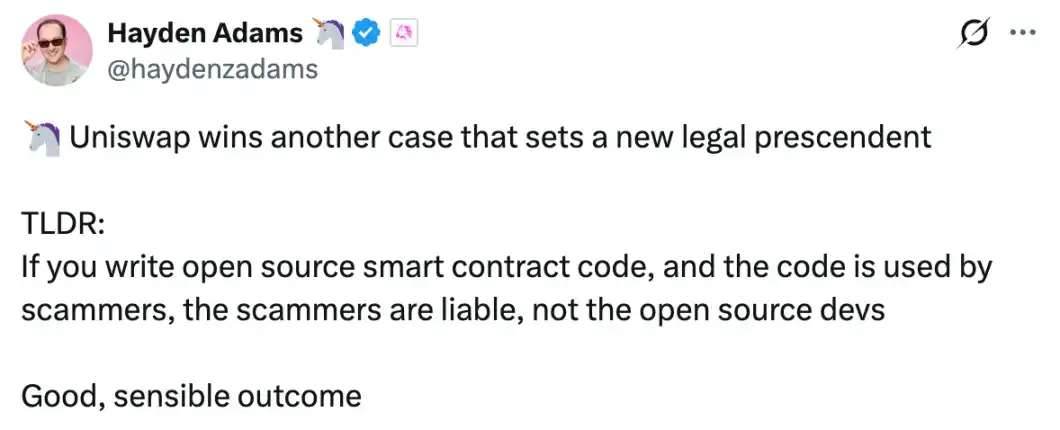
Hayden Adams also tweeted, "If you write open-source smart contract code and that code is used by scammers, the scammers are responsible, not the open-source developer. This is a reasonable and just outcome."

For Web3 developers, this is undoubtedly good news. But what is less known is that the judge who made this "just ruling" is the same person who, during the tenure of the former SEC chairman, found the developers of the mixer Tornado Cash guilty.

The Finalized Verdict

Nearly four years have passed since the class action lawsuit against Uniswap was filed and today's final resolution.

In April 2022, Uniswap users, represented by Nessa Risley, filed a class action lawsuit in court, accusing defendants including Paradigm, a16z, Uniswap, and its founder Hayden Adams of violating federal securities laws by issuing and selling unregistered securities, including UNI, in the form of tokens on Uniswap. The defendants were accused of failing to register Uniswap as an exchange or broker-dealer under applicable securities laws and failing to provide investors with registration statements for the securities they issued and sold.

This lawsuit was initiated by the law firms Kim&Serritella and Barton, representing users who traded EtherumMax, Bezoge, MatrixSamurai, Alphawolf Finance, RocketBunny, and BoomBaby.io tokens on Uniswap between April 5, 2021, and April 4, 2022.

The phrase "unregistered securities" had extraordinary destructive power for the crypto industry at the time, but this lawsuit unexpectedly quickly tilted in Uniswap's favor.

Presiding Judge Katherine Polk Failla, while agreeing that the so-called "scam tokens" were indeed securities, ruled that Uniswap did not need to be held responsible for them. Failla believed that the decentralized nature of Uniswap meant the protocol had no control over which tokens were listed on the platform or who could interact with it. "The case is more like holding the developer of a self-driving car responsible for traffic violations or bank robberies committed by third parties using the car."

Based on this, Failla dismissed the federal securities law charges in August 2023. The plaintiffs then appealed, and the Second Circuit Court of Appeals affirmed the dismissal of the federal part in 2025 but remanded the state law part for retrial.

Subsequently, the plaintiffs amended their complaint and sued again. This time, the investors who lost money accused Uniswap and other defendants of aiding and abetting fraud and misrepresentation, profiting from transactions involving scam tokens, and violating fraud laws in multiple states.

After another review by the same judge, Failla, the amended claims were dismissed again, with no further amendments allowed, bringing the case to a complete end.

The judge's reasoning this time was largely the same as before: Uniswap was not aware of the scam tokens, and even if it were, it did not provide substantial assistance. It also did not meet the definition of fraudulent behavior under any state law. Regarding unjust enrichment, Uniswap did not obtain direct benefits, and the speculative indirect benefits from such scam projects expanding the user base were too tenuous.
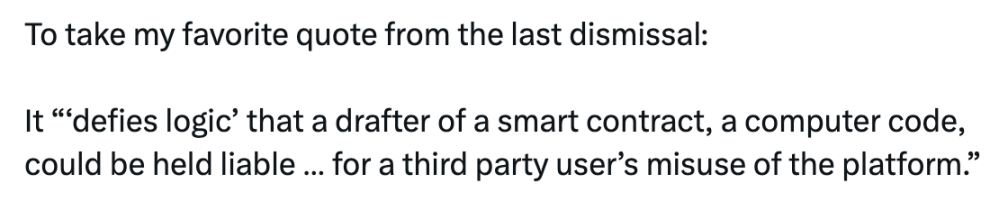
In a tweet, Brian Nistler stated, quoting a sentence from the previous ruling, that it "defies logic" to hold the drafters of smart contracts responsible for the abusive behavior of third-party users on the platform.

The Different Outcome for Tornado Cash

Facing the same judge, Roman Storm of Tornado Cash met a different fate.

Tornado Cash was first added to the sanctions list by the U.S. Treasury Department's Office of Foreign Assets Control (OFAC) on August 8, 2022, accused of helping criminals, including North Korean hackers, launder over $7 billion. Two days after being added to the sanctions list, Dutch police arrested Alexey Pertsev, one of the core developers of Tornado Cash.

On May 14, 2024, a Dutch court found Alexey Pertsev guilty of money laundering and sentenced him to 64 months in prison. The court believed that Pertsev was aware that the platform he developed and operated was used for crime but did not stop it, subjectively acquiescing to Tornado Cash being used as a money laundering tool. Alexey Pertsev is still appealing, but there have been no recent developments.

Seven months before Alexey Pertsev was found guilty, the U.S. Department of Justice sued two other developers, Roman Storm and Roman Semenov, in the Southern District of New York. Roman Storm was previously arrested in Washington State, while Roman Semenov remains at large.
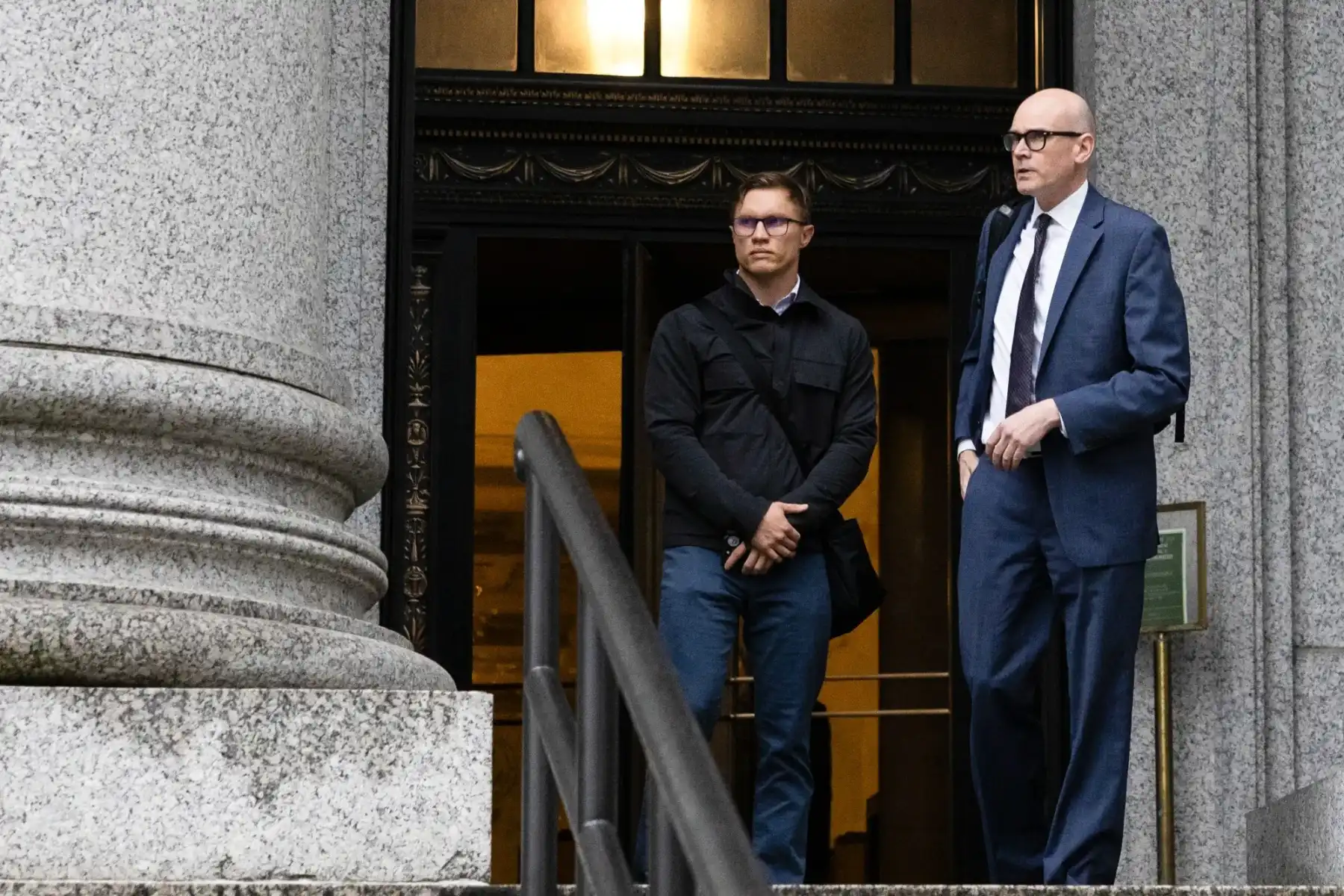
Roman Storm in court

Although an appeal later determined that OFAC's sanctions against Tornado Cash were an overreach and invalid, Roman Storm still found himself in the defendant's seat last July. After a trial presided over by Judge Katherine Polk Failla, the jury found Roman Storm guilty of "conspiracy to operate an unlicensed money transmitting business," but no formal sentencing has been announced yet.
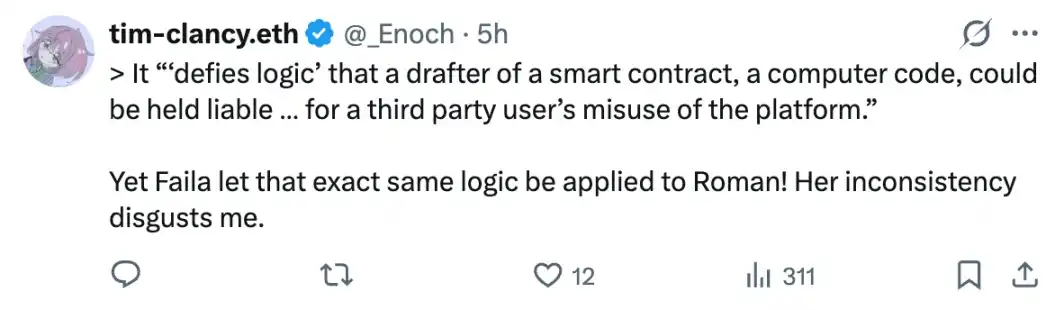
Under Brian Nistler's tweet celebrating Uniswap's victory, a comment by Sigil developer tim-clancy.eth criticizing Failla's contradictory rulings (the verdict against Roman Storm was actually made by a jury) received the most likes among all comments.

Decentralization Is Allowed, but Privacy Is Not

I am not a professional lawyer, but putting aside political factors and from a simple emotional perspective, I can roughly understand why Uniswap and Tornado Cash had different outcomes.

The core reason is that Tornado Cash's developers should have been well aware that a mixer would inevitably be used for money laundering. This clearly reveals the regulatory attitude: decentralization is acceptable, but it must be traceable. Tether once faced the same dilemma, so it later began cooperating with money laundering investigations and added freezing functionality.

Perhaps Roman Storm, behind bars, would feel unjust upon learning of today's verdict, but he should realize that even in a crypto-friendly U.S. under Trump, platforms helping North Korean state-level hackers launder money cannot be tolerated. With the current strength of Crypto, it is still not enough to对抗 national power.

Web3 practitioners sympathize with Tornado Cash's developers and cheer for Uniswap's victory. In our eyes, the two protocols are not fundamentally different; in fact, Tornado Cash is even superior in privacy protection. Uniswap's addition of front-end blocking of sanctioned addresses in 2022 once sparked some debate. Now, it seems that permissionlessness within the existing legal framework may be the only way for decentralized protocols to survive.

But that said, did Uniswap really have no responsibility at all in these scam incidents?

Strictly logically speaking, as the judge's analogy suggests, you cannot hold Mercedes responsible for a bank's losses just because a robber used a Mercedes to rob the bank. But on a commercial level, we tend to believe that giants should provide protection within their capabilities. Current security tools can already identify a large number of potential scam projects in advance. For these established projects that have benefited greatly from Web3's development, simple screening is not troublesome.

Doing their part to protect investors is not a mandatory obligation, but it is a responsibility that ordinary investors hope Uniswap and others will actively shoulder.


Perguntas relacionadas

QWhat was the outcome of the class action lawsuit against Uniswap and its founder Hayden Adams?

AThe class action lawsuit was dismissed by the U.S. District Court for the Southern District of New York. The judge ruled that Uniswap and its founder were not responsible for the scam tokens traded on the platform, as the protocol's decentralized nature meant it had no control over which tokens were listed or who interacted with it.

QWho was the judge presiding over both the Uniswap case and the Tornado Cash case involving Roman Storm?

AThe judge presiding over both cases was Katherine Polk Failla of the U.S. District Court for the Southern District of New York.

QWhy was Tornado Cash developer Roman Storm found guilty, while Uniswap was not held liable?

ARoman Storm was found guilty of conspiracy to operate an unlicensed money transmitting business because Tornado Cash mixer was used for money laundering, including by North Korean hackers. The court believed the developers were aware of its illicit use. In contrast, Uniswap was deemed a neutral, decentralized protocol with no control over user actions, similar to an autonomous vehicle developer not being liable for misuse by third parties.

QWhat does the article suggest is the key difference in regulatory treatment between Uniswap and Tornado Cash?

AThe article suggests that regulatory tolerance exists for decentralized protocols like Uniswap that are transparent and compliant (e.g., blocking sanctioned addresses), but not for privacy-focused tools like Tornado Cash that enable illicit activities such as money laundering, especially on a scale involving state actors like North Korean hackers.

QWhat responsibility does the article imply Uniswap should have, despite its legal victory?

AThe article implies that while Uniswap has no legal obligation, it has a moral or commercial responsibility to use available security tools to screen and prevent scam projects on its platform, given its influence and benefits from the Web3 ecosystem, to protect ordinary investors.

Leituras Relacionadas

No Sales Team, $20 Million in Revenue: How Did AI Employee Viktor Win Over 30,000 Companies?

The AI employee Viktor, developed by a team with DeepMind background, has achieved $20 million in annual revenue without a traditional sales team, serving over 30,000 companies. Its core innovation lies in positioning itself as a "Tier 3 AI Coworker" capable of "end-to-end execution and delivery of results," moving beyond the "draft and wait for human completion" model of typical AI assistants. Users can simply mention Viktor in Slack or Microsoft Teams using natural language commands, and it autonomously performs tasks like pulling sales data from a CRM, generating reports, or even cross-tool operations like creating board meeting PPTs by aggregating data from six different sources. Key to its growth is a pure Product-Led Growth (PLG) model, eliminating complex implementation cycles and per-seat licensing. Instead, it charges based on task credits or consumption, lowering the trial barrier with a $100 free credit offer and no credit card required. This enabled viral, bottom-up adoption within organizations. Viktor's interaction paradigm removes the barrier of prompt engineering, allowing non-technical employees to delegate complex workflows seamlessly. It also features proactive, automated task execution (e.g., overnight bookkeeping, scheduled reports) based on triggers, effectively embedding AI as an automated "process layer" within business operations. However, its expansion into Microsoft Teams—a platform with 320 million users—highlights challenges. Large enterprises require stringent IT compliance, security reviews (e.g., SOC 2), and governance, potentially hindering the frictionless, user-driven adoption that succeeded in Slack. Additionally, the "black box" nature of its autonomous decision-making raises concerns about operational risks, data integrity, and the need for robust audit logs and permission controls. Balancing efficiency gains with security and trust remains a critical hurdle for Viktor and similar AI agents aiming to become core enterprise infrastructure.

marsbitHá 17m

No Sales Team, $20 Million in Revenue: How Did AI Employee Viktor Win Over 30,000 Companies?

marsbitHá 17m

Manus Buyback Plan Emerges: Chinese Investors Plan to Repurchase Equity with $2 Billion, Path to Hong Kong IPO Becomes Clearer

According to a report by The Information, early Chinese investors of Manus, including Tencent, Sequoia Capital China, and ZhenFund, are planning to repurchase the company from Meta for $2 billion—the same price Meta paid in its acquisition last December. This move is a direct response to the Chinese government's prohibition of the foreign acquisition in April. As part of the repurchase plan, Manus is considering establishing a Sino-foreign joint venture within China. This structure is seen as a way to ensure regulatory compliance for its Chinese investors and to pave the way for a future IPO in Hong Kong. Notably, U.S. investor Benchmark will not participate in the buyback, which will concentrate ownership even more among Chinese capital. Since its acquisition by Meta, Manus's business has grown rapidly, with its annualized revenue run rate reportedly increasing four-to-fivefold to $400-$500 million in roughly six months. This strong growth underpins the investors' willingness to repurchase at the original price. Financially, the forced unwinding of the deal may benefit the early investors, allowing them to regain equity at a cost far below the company's current implied valuation, with the added prospect of an independent future listing. However, specific terms of the repurchase, including funding proportions and the joint venture's equity structure, are still under negotiation. This "repurchase-joint venture-Hong Kong IPO" approach could serve as a reference model for other Chinese AI startups navigating cross-border M&A regulations.

marsbitHá 44m

Manus Buyback Plan Emerges: Chinese Investors Plan to Repurchase Equity with $2 Billion, Path to Hong Kong IPO Becomes Clearer

marsbitHá 44m

STRC Loses Peg by 11%, Can Strategy's Perpetual Motion Machine Keep Running?

The article discusses the significant and concerning depegging of MicroStrategy's (MSTR) preferred stock, STRC. Designed to trade near its $100 target par value, STRC has recently fallen sharply, reaching a low of $83.26 and closing at $88.59, representing an over 11% discount. STRC is a core component of MicroStrategy's financial strategy. As a perpetual preferred stock, it allows the company to raise capital through an "at-the-market" (ATM) issuance program without diluting common shareholders (MSTR). This capital is primarily used to purchase Bitcoin, creating a "capital flywheel": issuing STRC → raising cash → buying BTC → increasing net assets → supporting STRC's value. The flywheel's operation depends on STRC maintaining its $100 price. To enforce this, MicroStrategy employs a dynamic dividend mechanism, recently raising the rate to 11.5% and increasing payout frequency. However, this has failed to halt the depegging, indicating market concerns extend beyond yield. Analysts cite two main reasons. First, technical factors like forced liquidations from leveraged arbitrage trades may have exacerbated the sell-off. Second, and more fundamentally, is waning confidence in MicroStrategy's financial resilience. A JPMorgan report highlighted the company's limited cash relative to its ~$1.7 billion annual dividend obligation, raising liquidity concerns. While MicroStrategy counters that its massive Bitcoin holdings provide decades of coverage, this argument relies on the potential need to sell BTC—a departure from its long-standing "never sell" narrative. The company's recent sale of a small amount of Bitcoin for "testing," despite being framed as minor, has intensified these fears. The persistent depegging threatens to cripple MicroStrategy's primary funding channel. If STRC remains discounted, the company's ability to fund further Bitcoin purchases weakens. Should cash reserves dwindle while financing is constrained, the market may increasingly price in the risk of MicroStrategy becoming a forced seller of Bitcoin to meet obligations. This shift from a major marginal buyer to a potential seller could pose significant downside risk to the broader Bitcoin market.

链捕手Há 52m

STRC Loses Peg by 11%, Can Strategy's Perpetual Motion Machine Keep Running?

链捕手Há 52m

Trading

Spot
Futuros
活动图片