Sam Bankman-Fried Backs Off New Trial Request, Keeps Pressure On Judge Removal

bitcoinistPublicado em 2026-04-24Última atualização em 2026-04-24

Resumo

Sam Bankman-Fried has withdrawn his request for a new trial, stating he does not expect a fair hearing from Judge Lewis Kaplan, who oversees his criminal case. He withdrew the motion without prejudice, meaning he can refile it after his appeal and a separate request to remove Kaplan from the case are resolved. Bankman-Fried is serving a 25-year sentence for fraud related to the collapse of FTX. The withdrawal followed a court-ordered inquiry into whether he had legal help drafting an earlier filing, which he denied. His efforts to replace the judge and appeal his conviction continue. Outside court, he has sought a pardon, but former President Trump has indicated he will not grant one.

Sam Bankman-Fried has told a federal court he does not expect a fair hearing from the judge overseeing his criminal case — and because of that, he is pulling his request for a new trial.

A Calculated Move In Federal Court

The former FTX chief executive filed a letter Wednesday in the US District Court for the Southern District of New York, withdrawing a Rule 33 motion he had been pursuing to overturn his conviction.

The withdrawal, he made clear, is not final. He dropped the motion without prejudice, meaning he can bring it back after his appeal and his separate request to have a different judge assigned to the case are resolved.

Bankman-Fried, 32, is currently held at the Federal Correctional Institution in Lompoc, California, where he is serving a 25-year sentence handed down after his 2023 conviction on fraud and related charges tied to the collapse of FTX.

At its peak, the crypto exchange was one of the largest in the world.
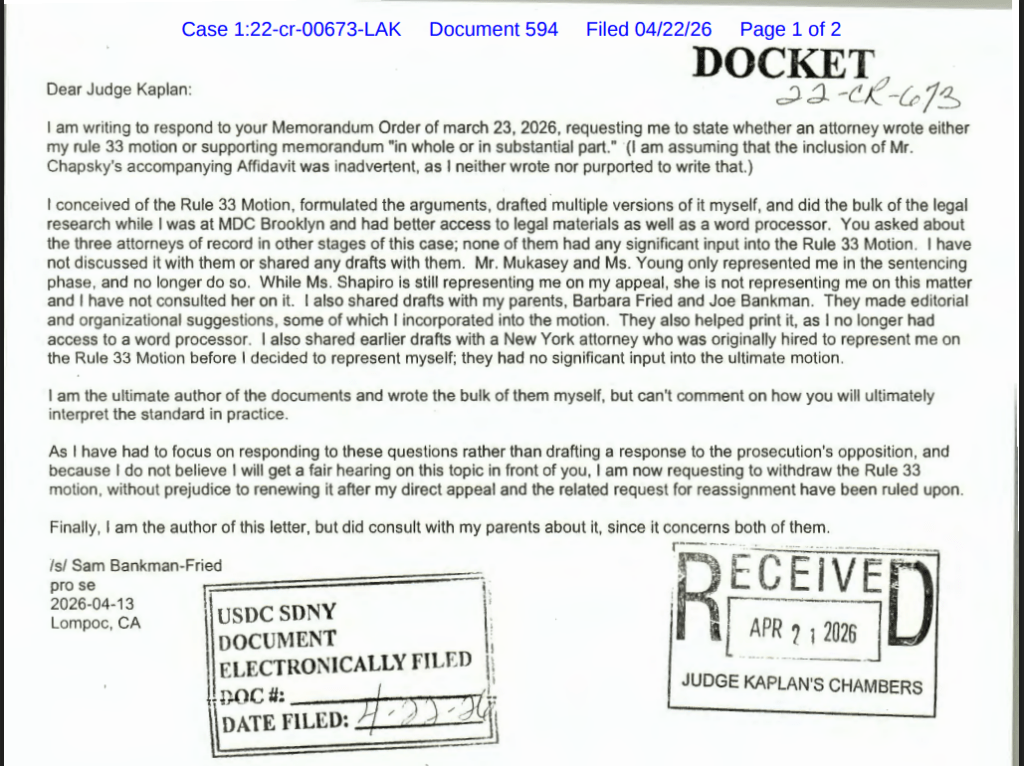
Sam Bankman-Fried's letter to Judge Kaplan released publicly Wednesday. Source: CourtListener.

His decision to pull the motion came after Judge Lewis Kaplan ordered him to explain whether lawyers had helped him draft an earlier filing — a pro se document, meaning one submitted without formal legal representation.

Federal prosecutors had raised doubts about whether Bankman-Fried had written the filing on his own, particularly after his mother, Barbara Fried, sent her own letter to the court. She had no legal standing to do so.

Questions About Who Wrote What

In his Wednesday response, Sam Bankman-Fried said he consulted with his parents while writing the letter but described himself as the “ultimate author of the documents.”

He said the need to respond to the court’s questions had taken time away from preparing a fuller response to prosecutors opposing his new trial request. That, combined with his stated belief that Judge Kaplan would not treat the matter fairly, led him to withdraw the motion.

BTCUSD currently trading at $77,600. Chart: TradingView

His bid to have Kaplan removed from the case predates Wednesday’s filing. Back in February, Bankman-Fried asked a court to assign a different judge to rule on his new trial request, accusing Kaplan of showing “extreme prejudice.”

That request remains active. So does his appeal of both his conviction and his sentence, which is pending before the US Court of Appeals for the Second Circuit.

Sam Bankman-Fried: Pardon Talk Has Done Little To Help His Cause

Outside the courtroom, Bankman-Fried has made no secret of his interest in a presidential pardon. According to reports, he has posted publicly praising US President Donald Trump’s crypto-related policies and his administration’s military moves in Iran.

But Trump has shown no sign of extending any relief. Based on reports from a January interview with The New York Times, Trump said flatly that he had no plans to pardon the convicted founder of FTX.

Featured image from Getty Images, chart from TradingView

Perguntas relacionadas

QWhy did Sam Bankman-Fried withdraw his request for a new trial?

AHe withdrew the request because he stated he does not expect a fair hearing from Judge Kaplan and the need to respond to the court's questions about who drafted an earlier filing took time away from preparing a fuller response.

QWhat is the status of Sam Bankman-Fried's request to have Judge Kaplan removed from his case?

AHis request to have a different judge assigned to the case remains active and is separate from his withdrawn motion for a new trial.

QWhat specific legal motion did Sam Bankman-Fried file and then withdraw?

AHe withdrew a Rule 33 motion, which is a request for a new trial based on newly discovered evidence.

QWhat was the reason federal prosecutors raised doubts about an earlier court filing from Sam Bankman-Fried?

AProsecutors raised doubts about whether he had written the pro se filing on his own, particularly after his mother, who has no legal standing, sent her own letter to the court.

QHas former President Donald Trump indicated he would pardon Sam Bankman-Fried?

ANo, based on a January interview with The New York Times, Trump said flatly that he had no plans to pardon the convicted founder of FTX.

Leituras Relacionadas

SpaceX, OpenAI, Anthropic: The Three AI Giants Racing for IPO, Which One Is Worth Betting On?

SpaceX, OpenAI, and Anthropic are poised for historic IPOs within weeks, potentially raising a combined $180 billion—a sum exceeding the entire internet bubble's fundraising. The hosts of the Limitless Podcast argue this isn't just individual company financing but an unprecedented capital concentration for AI infrastructure, driven by an insatiable need for compute, data centers, power, and chips. SpaceX's IPO is notable for reportedly changing market index rules to allow faster inclusion, potentially funneling trillions in passive retirement funds into its stock, despite its unproven space-based data center business model. In contrast, Anthropic demonstrates explosive growth, with ARR reportedly hitting $45 billion and approaching profitability, fueled by strong enterprise adoption of products like Claude Code. Google's separate $80 billion raise highlights the immense capital pressure, even for giants. The discussion acknowledges bubble risks but leans optimistic. The hosts contend the massive spending is building essential physical infrastructure for the next technological era. A key bottleneck isn't capital but the real-world limits of chip manufacturing and construction speed. As long as demand for AI compute outstrips supply, this investment cycle represents a foundational build-out rather than a purely financial bubble. All three companies are seen as foundational bets on the future, with Anthropic often cited as the most immediately compelling due to its proven revenue trajectory.

marsbitHá 2h

SpaceX, OpenAI, Anthropic: The Three AI Giants Racing for IPO, Which One Is Worth Betting On?

marsbitHá 2h

From 'Old Guys' to 'New Favorites': How AI Is Revaluing Old Infrastructure from Dell to Nokia?

From "Vintage Tech" to "New AI Darlings": How AI Revalues Old Infrastructure One year ago, tech giants like Dell, Nokia, Cisco, and Western Data were seen as slow-growth, low-valuation stories, far from the AI spotlight dominated by players like Nvidia. Now, these legacy tech stocks are gaining market attention, sparking debate on whether this is genuine industry revaluation or a temporary narrative. As AI moves from model parameters to real-world data centers, the market is recognizing companies with proven delivery and infrastructure capabilities. This shift marks a change in the AI investment thesis: from pure model and GPU focus to the complex systems engineering required for deployment. Companies like Dell, HPE, and Corning are being revalued not for being "sexy" AI innovators, but for their decades of accumulated expertise in supply chains, enterprise delivery, and infrastructure—assets that have become critical in the AI buildout phase. The revaluation is unfolding across three key infrastructure lines: 1. **Servers & System Integration:** Dell and HPE are emerging as crucial system integrators or "general contractors" for AI data centers, translating GPU orders into complete, deployable server racks integrated with power, cooling, and networking. 2. **Networking & Connectivity:** AI's scale demands robust high-speed connections. Corning (fiber optics), Nokia (AI-RAN, 6G), and Cisco (data center switches) are gaining importance for enabling efficient data transfer within and between AI clusters. 3. **Storage:** Beyond high-speed memory (HBM/DRAM), the AI data explosion is driving demand for high-capacity hard drives (HDDs) from companies like Western Digital and Seagate to handle training data, logs, and cold storage cost-effectively. For this revaluation to be substantive and not just a narrative, three criteria are key: 1) Concrete AI-related order and revenue growth (e.g., Dell's AI server sales), 2) Upward revisions to company financial guidance, and 3) Sustainable improvements in profit quality, not just top-line revenue spikes. In essence, AI's transition to a real construction phase is re-pricing "old assets" against "new demand." The opportunity, however, is selective. Only those legacy firms that are demonstrably integrated into the capital expenditure chains of data center and enterprise AI deployment are likely to experience a true "logic re-rating" rather than just a temporary valuation bounce.

marsbitHá 2h

From 'Old Guys' to 'New Favorites': How AI Is Revaluing Old Infrastructure from Dell to Nokia?

marsbitHá 2h

Trading

Spot
Futuros
活动图片





