Sam Bankman-Fried Appeals Conviction While Crypto Security Braces for the Quantum Era with $BMIC

bitcoinistPublicado em 2026-02-11Última atualização em 2026-02-11

Resumo

Sam Bankman-Fried, founder of FTX, has appealed his fraud conviction and 25-year sentence, reopening a major case that highlighted a catastrophic breakdown of trust in crypto. As the industry grapples with this legacy, attention is shifting toward next-generation security solutions. A key emerging threat is quantum computing, which risks breaking current encryption standards. The article highlights $BMIC as a project built to address this with a post-quantum cryptographic security stack, including quantum-resistant wallets, staking, and payments. Having raised over $446K in its presale, BMIC represents a growing investor focus on preemptive security rather than reactive fixes, positioning itself as a potential new standard in crypto infrastructure.

Sam Bankman-Fried, the disgraced founder of FTX, is officially appealing his conviction and 25-year prison sentence. The legal filing reopens one of the biggest fraud cases in crypto history, and for an industry still grappling with the fallout, it’s like pouring salt in a very old wound.
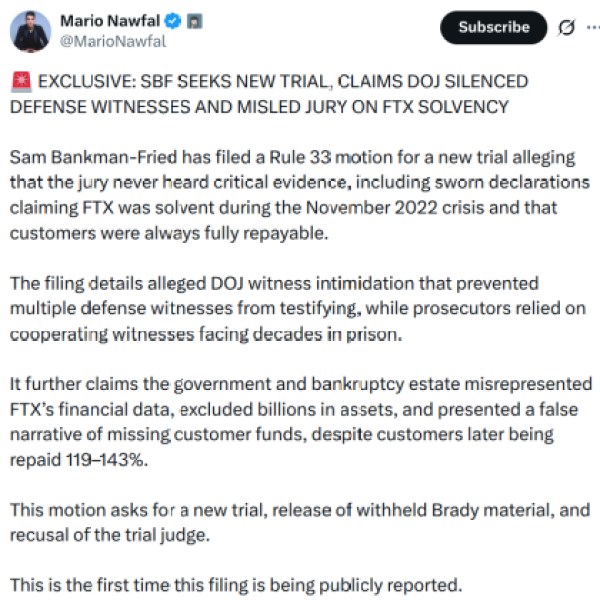
SBF’s appeal challenges various trial decisions, from witness testimony to alleged conflicts of interest. But let’s be clear: the FTX saga was never about tech failing. It was a catastrophic breakdown of trust.

Billions in user funds vanished not because of a sophisticated hack, but due to internal fraud and shockingly poor custody. That collapse forced a painful but necessary conversation across the market: How do we actually secure digital assets?

While the courts wrestle with crypto’s ghosts, innovators are already building for the future. We’re now seeing a clear shift in investor focus toward projects that prioritize provable, next-gen security over pure hype. That’s where the real story is.

The Quantum Threat and BMIC’s Future-Proof Solution

But what most market coverage misses is that while the industry defends against today’s threats, a far bigger one looms: quantum computing. State-sponsored and corporate labs are racing to build machines capable of shattering the encryption that protects everything from bank accounts to crypto wallets.

It’s a threat (one many still dismiss) known as the ‘harvest now, decrypt later’ attack, stealing encrypted data today with the plan to unlock it once quantum computers are powerful enough. For crypto, this isn’t just a problem; it’s an existential risk.

This is the exact problem BMIC ($BMIC) was engineered to solve. It isn’t just another DeFi protocol or meme coin; it’s a foundational security layer built for the quantum age. The project delivers a full stack of financial tools, wallet, staking, and payments, all shielded by post-quantum cryptography (PQC).
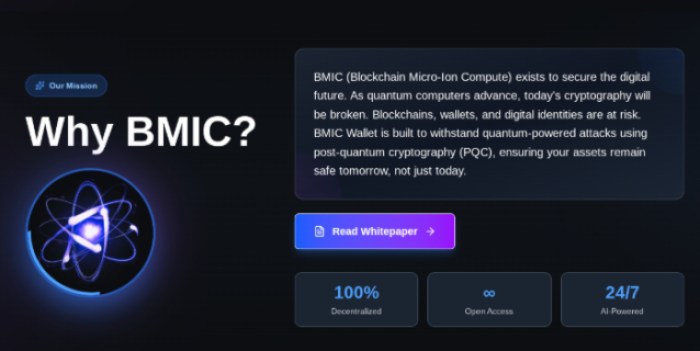
While traditional wallets expose public keys during transactions, BMIC uses ERC-4337 smart accounts and a Zero Public-Key Exposure model to protect users from both current and future threats. It even integrates an AI-enhanced threat detection system to proactively neutralize suspicious activity.

The key difference here is a shift from reactive security to preemptive protection. So, is your portfolio truly safe if its core cryptography has a known expiration date?

LEARN MORE ABOUT BMIC AND ITS QUANTUM STACK

A New Security Standard Attracting Early Investment

If history has taught us anything, it’s that after a major market failure like FTX, capital flows toward infrastructure that promises to prevent the next crisis. We’re seeing that play out right now. The early traction for the BMIC presale seems to prove the point, having already raised over $446K, with tokens currently priced at just $0.049474.

Frankly, this doesn’t look like speculative froth; it looks like a calculated investment in a long-term solution. It’s why we picked $BMIC as a best new cryptocurrency.

The project’s utility is centered on its native token, $BMIC, which powers the whole ecosystem. It’s used for staking on the quantum-secure network, participating in governance, and fueling its ‘Burn-to-Compute’ model for access to advanced security features.

The ripple effect of a successful quantum-proof platform could be immense, potentially setting a new security standard for the entire industry. The risk? As always, it comes down to execution and adoption. But in a market still scarred by FTX, a project building decentralized, future-proof security is a compelling story.

buy your $BMIC here

This article is for informational purposes only and does not constitute financial advice. All investments carry risks, and readers should conduct their own due diligence.


Criptomoedas em alta

Perguntas relacionadas

QWhat is Sam Bankman-Fried appealing and why is this significant for the crypto industry?

ASam Bankman-Fried is appealing his conviction and 25-year prison sentence for his role in the FTX fraud case. This is significant because it reopens one of the largest fraud cases in crypto history, forcing the industry to confront the catastrophic breakdown of trust and the need for better security measures.

QAccording to the article, what is the 'existential risk' facing cryptocurrency that many still dismiss?

AThe existential risk is the threat posed by quantum computing, specifically through 'harvest now, decrypt later' attacks, where encrypted data is stolen today with the intention of decrypting it once quantum computers become powerful enough to break current encryption standards.

QWhat specific problem does the BMIC ($BMIC) project claim to solve?

ABMIC ($BMIC) is engineered to provide a foundational security layer for the quantum age. It uses post-quantum cryptography (PQC) to protect a full stack of financial tools, including its wallet, staking, and payments system, from both current threats and future quantum attacks.

QHow does BMIC's security model differ from traditional crypto wallets?

AUnlike traditional wallets that expose public keys during transactions, BMIC uses ERC-4337 smart accounts and a Zero Public-Key Exposure model to protect users. It also integrates an AI-enhanced threat detection system for proactive security, shifting from a reactive to a preemptive protection model.

QWhat evidence does the article provide to suggest that BMIC is attracting serious investment rather than speculative interest?

AThe article points to the BMIC presale having raised over $446K as evidence of calculated, long-term investment. It states this early traction indicates capital is flowing toward infrastructure that promises to prevent future crises, like the FTX collapse, rather than mere speculative froth.

Leituras Relacionadas

Must-Watch Events Next Week|CLARITY Act Could Face Senate Vote; SpaceX, Circle to Report Earnings (8.3-8.9)

**Summary: Key Events and Developments to Watch (August 3-9)** The upcoming week is marked by significant financial disclosures, key legislative deadlines, and notable product updates. **Major Financial Events:** Several companies are scheduled to release their Q2 2026 earnings. American Bitcoin (ABTC) will report on August 3, followed by SpaceX and Hut 8 Mining Corp. on August 4, and Circle on August 5. Notably, a significant portion of SpaceX shares (up to 12% of total shares) will be unlocked on August 6 following their earnings release. **Key Legislative Deadline:** The U.S. Senate faces an August 7 deadline to secure 60 votes for the CLARITY Act, a bipartisan bill aiming to establish a federal regulatory framework for cryptocurrencies. The Senate may hold a full vote on the bill during the week. **Economic Data:** The U.S. July Non-Farm Payrolls report will be released on August 7, providing crucial labor market data. **Technology & Product Updates:** * **Shutdowns:** DeFi portfolio tracker Zapper and wallet app Ctrl Wallet will cease operations on August 3. * **Upgrades:** LayerZero will deprecate its v1 relayers on August 3. XRP Ledger's new version 3.3.0, featuring five new functions, is expected next week. * **AI:** Elon Musk announced that the advanced Grok 4.6 AI model is set for release around August 7. * **Bitcoin:** The BIP-110 forced signaling for a potential Bitcoin network change is scheduled to begin around August 8. **Other Notable Events:** Chinese robotics firm Unitree Tech has set its preliminary price inquiry for its IPO for August 5. South Korean exchange Upbit will delist AQT and AERGO tokens on August 3.

marsbitHá 2h

Must-Watch Events Next Week|CLARITY Act Could Face Senate Vote; SpaceX, Circle to Report Earnings (8.3-8.9)

marsbitHá 2h

Stocks Are Plummeting More Sharply Than Cryptocurrencies. Where Has the Money Gone?

Stock Markets Plunge Deeper Than Cryptocurrencies: Where Did the Money Go? In late July, Seoul's Kospi index triggered circuit breakers for two consecutive days, plummeting over 40% from its June high. The collapse was led by heavyweight stocks like SK Hynix, whose record profits still disappointed investors, and devastating leveraged ETFs, with one major product losing over 83% of its value. This signaled a global, forced deleveraging targeting the most crowded trades. Interestingly, while stocks exhibited extreme volatility akin to crypto markets, Bitcoin rose nearly 15% in July after a prior steep drop. Analysis shows the money fleeing equities did not flow into Bitcoin. Instead, Bitcoin had already absorbed its sell-off in May-June, when U.S. spot Bitcoin ETFs saw historic outflows. The true safe-haven beneficiary was gold, whose price rose over 20% year-on-year, highlighting a decoupling between Bitcoin and gold as "digital gold." The sell-off was a targeted unwinding of leveraged positions in tech and semiconductors, accelerated by broker-dealer risk management and shifts in the AI narrative, including new competition from Chinese memory chipmakers. The retreat path was clear: from high-valuation tech stocks to cash and U.S. Treasuries, then to gold. For Bitcoin to attract sustained institutional inflows, conditions like eased global liquidity pressure, a "soft-landing" Fed rate cut, and U.S. regulatory clarity via legislation like the stalled CLARITY Act are needed. Currently, Bitcoin is not a safe haven but an already-cleared asset. Its low correlation with tech stocks, however, makes it a potential diversification play for institutional portfolios once the storm passes. The money isn't here yet, but the positioning is underway.

marsbitHá 2h

Stocks Are Plummeting More Sharply Than Cryptocurrencies. Where Has the Money Gone?

marsbitHá 2h

In Conversation with Ray Dalio: We Are Currently in an AI Bubble, with 1% of My Portfolio in Bitcoin

Ray Dalio, founder of Bridgewater Associates, warns in an interview that the current AI boom shows classic bubble characteristics, which could lead to significant economic downturns as seen in past cycles like 1929 or 2000. He explains that speculative enthusiasm, fueled by debt and overvaluation, often precedes a crash when rising rates or taxation force asset sales, causing widespread losses and recession. Dalio also outlines his "Big Cycle" theory, describing an approximate 80-year pattern where widening wealth gaps, massive government deficits, and shifting geopolitical power (like China's rise) create internal conflict and global instability. He emphasizes that we are in a late-cycle, transitional phase where traditional powers like the US and UK face decline. For personal wealth protection, Dalio advises diversification beyond cash into assets like stocks, bonds, real estate, and particularly gold, which he prefers over Bitcoin. While he holds about 1% of his portfolio in Bitcoin as a non-printable hard asset, he views gold as more secure from technological or governmental threats. Regarding AI's impact, Dalio believes it will disproportionately benefit capital owners, worsening inequality by replacing both physical and cognitive labor. He suggests that human intuition and emotional intelligence, combined with AI, will be key for future workers. On taxation, Dalio argues that wealth taxes are impractical and risk triggering asset sell-offs, reducing productive investment. He points to the UK as a cautionary example of debt, low productivity, and political strife. Geopolitically, Dalio foresees a more regionalized world, with the US showing weakness in prolonged conflicts like with Iran, akin to past imperial declines. The ideal outcome, he suggests, is coexisting powerful blocs (e.g., Americas, China-Asia Pacific) without major war.

marsbitHá 5h

In Conversation with Ray Dalio: We Are Currently in an AI Bubble, with 1% of My Portfolio in Bitcoin

marsbitHá 5h

Trading

Spot

Artigos em Destaque

Como comprar ERA

Bem-vindo à HTX.com!Tornámos a compra de Caldera (ERA) simples e conveniente.Segue o nosso guia passo a passo para iniciar a tua jornada no mundo das criptos.Passo 1: cria a tua conta HTXUtiliza o teu e-mail ou número de telefone para te inscreveres numa conta gratuita na HTX.Desfruta de um processo de inscrição sem complicações e desbloqueia todas as funcionalidades.Obter a minha contaPasso 2: vai para Comprar Cripto e escolhe o teu método de pagamentoCartão de crédito/débito: usa o teu visa ou mastercard para comprar Caldera (ERA) instantaneamente.Saldo: usa os fundos da tua conta HTX para transacionar sem problemas.Terceiros: adicionamos métodos de pagamento populares, como Google Pay e Apple Pay, para aumentar a conveniência.P2P: transaciona diretamente com outros utilizadores na HTX.Mercado de balcão (OTC): oferecemos serviços personalizados e taxas de câmbio competitivas para os traders.Passo 3: armazena teu Caldera (ERA)Depois de comprar o teu Caldera (ERA), armazena-o na tua conta HTX.Alternativamente, podes enviá-lo para outro lugar através de transferência blockchain ou usá-lo para transacionar outras criptomoedas.Passo 4: transaciona Caldera (ERA)Transaciona facilmente Caldera (ERA) no mercado à vista da HTX.Acede simplesmente à tua conta, seleciona o teu par de trading, executa as tuas transações e monitoriza em tempo real.Oferecemos uma experiência de fácil utilização tanto para principiantes como para traders experientes.

548 Visualizações TotaisPublicado em {updateTime}Atualizado em 2026.06.02

Como comprar ERA

Discussões

Bem-vindo à Comunidade HTX. Aqui, pode manter-se informado sobre os mais recentes desenvolvimentos da plataforma e obter acesso a análises profissionais de mercado. As opiniões dos utilizadores sobre o preço de ERA (ERA) são apresentadas abaixo.

活动图片












