SAFE Crypto Act will have scammers shaking in their boots: Crypto lawyer

cointelegraphPublicado em 2025-12-17Última atualização em 2025-12-17

Resumo

The SAFE Crypto Act, introduced by US Senators Elissa Slotkin and Jerry Moran, aims to combat crypto fraud by enhancing coordination between the Treasury, law enforcement, regulators, and private sector entities. The legislation responds to a reported $9.3 billion in crypto-related investment scams in 2024, a 66% increase from the previous year, with seniors being the most affected group. Crypto lawyer Gabriel Shapiro stated that the act could significantly deter scammers by involving high-level officials like the Attorney General in enforcement actions. Blockchain forensic firm TRM Labs has expressed readiness to assist, emphasizing that collaboration between industry and law enforcement can disrupt illicit crypto activities in real-time.

Two US Senators have introduced legislation aimed at cracking down on crypto fraud and scams by equipping law enforcement with better tools to spot attacks and identify perpetrators.

The Strengthening Agency Frameworks for Enforcement of Cryptocurrency (SAFE) Act, introduced by Democrat Elissa Slotkin and Republican Jerry Moran on Monday, seeks to coordinate action between the US Treasury, law enforcement, regulators, and private sector players to tackle crypto fraud and scams, which have extracted millions from victims.

“This task force, established by the SAFE Cryptocurrency Act, will allow us to draw upon every resource we have to combat fraud in digital assets,” Slotkin said, while Moran added:

“As cryptocurrency becomes more widely used, this legislation would help counter threats and make certain all Americans are better protected from crypto scams.”

The Federal Bureau of Investigation reported Americans lost $9.3 billion to crypto-related investment scams in 2024, marking a 66% increase from 2023. Individuals over 60 were the most affected, accounting for losses of $2.84 billion.

It should be noted that the figure includes any investment scam that simply mentions crypto as part of its ploy. Many do not involve blockchain or cryptocurrencies.

Despite public and private efforts to raise awareness, crypto fraudsters and scammers have found more sophisticated ways to steal funds from investors.

But Gabriel Shapiro, general counsel of crypto investment firm Delphi Labs, said a successful implementation of the SAFE Crypto Act could send crypto fraudsters and scammers into panic mode.

“Scammers will probably end up shitting themselves if this goes hard,” Shapiro said in a post to X on Tuesday, while noting that the Attorney General, Director of the Financial Crimes Enforcement Network and the Director of the United States Secret Service would be among the highest-ranking officials involved in pursuing crypto criminals.
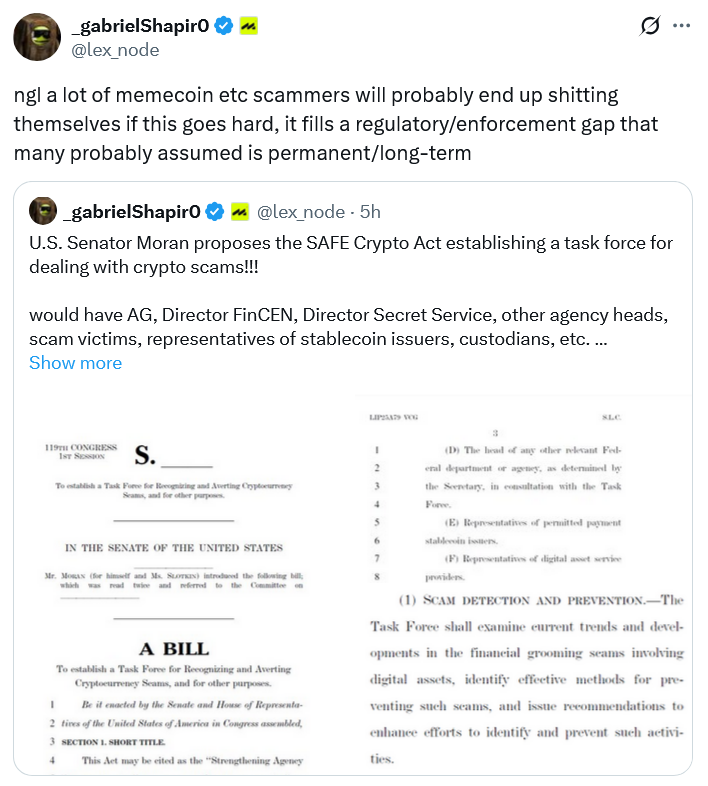
Source: Gabriel Shapiro

Shapiro said the SAFE Crypto Act could be “very useful” as the US securities and commodity regulators currently aren’t as focused on enforcement action against hackers, scammers and Ponzi scheme operators.

TRM Labs among the private players to lend a hand

Blockchain forensic firm TRM Labs is among the private sector players ready to assist US officials, with its vice president and global head of policy, Ari Redbord, stating that a collaboration would help track and disrupt illicit networks in real-time:

Related: How crypto is used in 2025: YouTube, Pokémon cards and more

“By bringing industry and law enforcement together, we can meaningfully reduce criminals’ ability to exploit transformative technologies for harm.”

Magazine: Meet the onchain crypto detectives fighting crime better than the cops

Criptomoedas em alta

Leituras Relacionadas

Bitcoin Withdrawals Continue: 8 Years of Storage in a Coldcard Cold Wallet Ended in Zero

Coldcard Hardware Wallet Hacked: Losses Mount Due to Vulnerable Seed Generation A critical vulnerability in Coldcard hardware wallets has led to a continued wave of fund thefts. According to Galaxy Research, the total stolen has reached 1,367.05 BTC (approx. $88.6 million) from 4,585 addresses, a significant increase from the initial 594.5 BTC reported on July 30, 2026. Most of the stolen funds remain on the attackers' addresses. The issue is not with the current firmware, which Coinkite has updated, but with seed phrases generated on vulnerable devices between March 2021 and the release of fixed firmware versions. Due to a programmer error, devices switched from using a hardware random number generator to the software-based Yasmarang generator, which was initialized with publicly accessible data like the chip's serial number. This made the seed phrases predictable through offline brute-force attacks, meaning wallets remain at risk until funds are moved to a new wallet generated with the patched firmware. Affected devices include Mk2/Mk3 with firmware 4.0.1–4.1.9 (and up to 5.0.3), Mk4/Mk5 up to version 5.6.0, and Q models up to 1.5.0Q. The only exceptions are seeds created with a high-entropy method like at least 50 independent dice rolls or a strong unique BIP-39 passphrase. All other owners must generate a new seed on the fixed firmware and transfer their assets. A case highlighting the human impact involves a 39-year-old long-term investor who lost 2 BTC (approx. $130,000) in minutes. He had accumulated the Bitcoin over eight years through physical labor, viewing it as a financial lifeline and a retirement plan in a country suffering from hyperinflation. His story underscores that even conservative "buy and hold in cold storage" strategies can be compromised by such underlying technical flaws. From a technical perspective, this incident echoes historical failures where weak random number generators undermined cryptographic security, challenging the assumption that offline storage is automatically foolproof.

cryptonews.ruHá 3h

Bitcoin Withdrawals Continue: 8 Years of Storage in a Coldcard Cold Wallet Ended in Zero

cryptonews.ruHá 3h

Trading

Spot

Artigos em Destaque

Como comprar SAFE

Bem-vindo à HTX.com!Tornámos a compra de Safe (SAFE) simples e conveniente.Segue o nosso guia passo a passo para iniciar a tua jornada no mundo das criptos.Passo 1: cria a tua conta HTXUtiliza o teu e-mail ou número de telefone para te inscreveres numa conta gratuita na HTX.Desfruta de um processo de inscrição sem complicações e desbloqueia todas as funcionalidades.Obter a minha contaPasso 2: vai para Comprar Cripto e escolhe o teu método de pagamentoCartão de crédito/débito: usa o teu visa ou mastercard para comprar Safe (SAFE) instantaneamente.Saldo: usa os fundos da tua conta HTX para transacionar sem problemas.Terceiros: adicionamos métodos de pagamento populares, como Google Pay e Apple Pay, para aumentar a conveniência.P2P: transaciona diretamente com outros utilizadores na HTX.Mercado de balcão (OTC): oferecemos serviços personalizados e taxas de câmbio competitivas para os traders.Passo 3: armazena teu Safe (SAFE)Depois de comprar o teu Safe (SAFE), armazena-o na tua conta HTX.Alternativamente, podes enviá-lo para outro lugar através de transferência blockchain ou usá-lo para transacionar outras criptomoedas.Passo 4: transaciona Safe (SAFE)Transaciona facilmente Safe (SAFE) no mercado à vista da HTX.Acede simplesmente à tua conta, seleciona o teu par de trading, executa as tuas transações e monitoriza em tempo real.Oferecemos uma experiência de fácil utilização tanto para principiantes como para traders experientes.

170 Visualizações TotaisPublicado em {updateTime}Atualizado em 2026.06.02

Como comprar SAFE

Discussões

Bem-vindo à Comunidade HTX. Aqui, pode manter-se informado sobre os mais recentes desenvolvimentos da plataforma e obter acesso a análises profissionais de mercado. As opiniões dos utilizadores sobre o preço de SAFE (SAFE) são apresentadas abaixo.

活动图片













