Russian Lawmaker Predicts Bitcoin Collapse While Smart Money Rotates into Layer 2 Utility

bitcoinistPublicado em 2026-02-10Última atualização em 2026-02-10

Resumo

A Russian lawmaker, Anatoly Aksakov, predicts Bitcoin's collapse due to its lack of state backing, contrasting with strong institutional investment flows. Meanwhile, capital is rotating into Layer 2 infrastructure like Bitcoin Hyper ($HYPER), which integrates Solana Virtual Machine (SVM) to enable high-speed smart contracts on Bitcoin. The project has raised over $31.3M in its presale, attracting significant whale activity. This shift aims to address Bitcoin's scalability issues, adding utility beyond "digital gold" and supporting decentralized applications. Despite regulatory skepticism, market data indicates growing investor confidence in Bitcoin's Layer-2 evolution.

Trusted Editorial content, reviewed by leading industry experts and seasoned editors. Ad Disclosure

Quick Facts:

  • ➡️ Russian official Anatoly Aksakov predicts Bitcoin’s collapse due to lack of state backing, though market data contradicts this outlook.
  • ➡️ Bitcoin Hyper counters utility concerns by integrating the Solana Virtual Machine (SVM) to bring high-speed smart contracts to Bitcoin.
  • ➡️ Sophisticated investors have poured over $31.3M into the project’s presale, signaling a shift toward Layer 2 infrastructure.
  • ➡️ Whale wallets are actively accumulating, with recent on-chain activity showing seven-figure positioning in the protocol.

Anatoly Aksakov, Chairman of the Russian State Duma Committee on Financial Market, is at it again. He has once again targeted the world’s leading cryptocurrency, asserting that Bitcoin is ‘destined to collapse.’

As a vocal fan of the Digital Ruble, Aksakov argues that without state backing, decentralized assets simply can’t survive the long haul. It’s a bold stance, especially given Russia’s mixed signals, legalizing industrial mining for tax revenue while strictly banning crypto for buying your morning coffee.

Headline-grabbing doom predictions from central bankers are nothing new (sound familiar?), but the market isn’t flinching. Institutional flows into Bitcoin products remain strong, suggesting investors see this as protectionist noise rather than serious analysis. Yet, Aksakov accidentally hits on a real issue: utility.

If Bitcoin wants to be more than just ‘digital gold’ and survive the pressures Aksakov describes, it has to evolve beyond simple storage.

Traders aren’t fleeing; they’re building. We’re seeing a massive capital rotation into high-performance infrastructure layers. Why? Because the base layer is slow and expensive. Liquidity is aggressively hunting for speed and programmability.

That’s where Bitcoin Hyper ($HYPER) enters the picture, a project aiming to bridge Bitcoin’s ironclad security with the execution speed modern finance actually demands.

Learn more about $HYPER here.

The First SVM-Powered Bitcoin Layer 2 Redefines Scalability

The main knock against Bitcoin, that it’s too rigid for mass adoption, is being fixed.

Bitcoin Hyper ($HYPER) addresses this not by altering the base layer, but by expanding it. By integrating the Solana Virtual Machine (SVM) directly as a Bitcoin Layer 2, the network allows for sub-second finality while keeping settlement anchored to Bitcoin’s proof-of-work. In plain English: it’s fast, but it’s still Bitcoin-secure.

This opens up a massive design space for developers. Before now, building complex DeFi or gaming apps on Bitcoin was a nightmare due to Script limitations. With the SVM, Bitcoin Hyper lets devs write in Rust and deploy dApps with Solana-like speeds, thousands of transactions per second, without leaving the Bitcoin ecosystem.
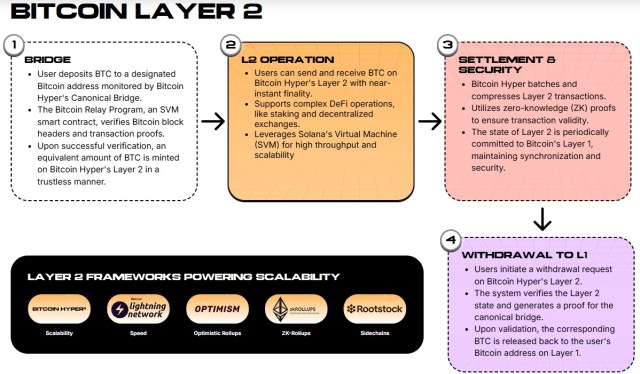
The liquidity implications are huge. A Decentralized Canonical Bridge lets holders actually use their $BTC in high-frequency trading or yield protocols instead of letting it gather dust. This utility effectively counters the ‘collapse’ narrative by turning Bitcoin from a passive rock into a programmable, active capital base.

Get your $HYPER today.

Smart Money Accumulates $31M as Whales Target Infrastructure

While regulators argue over theory, on-chain data shows where the smart money is actually going. The demand for Layer 2 infrastructure isn’t hypothetical.

According to the official presale page, Bitcoin Hyper has already raised $31.3M, signaling strong conviction from early-stage investors betting on the ‘fat protocol’ thesis applied to Bitcoin L2s.
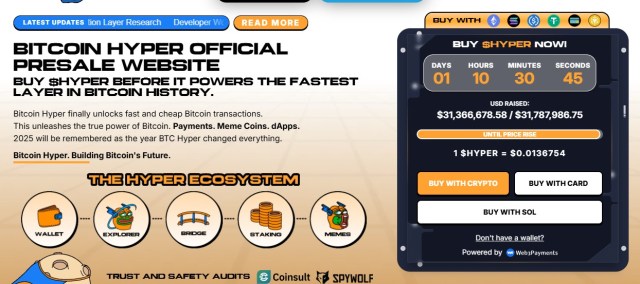
With tokens currently priced at $0.0136754, the project is attracting high-value participants hedging their Bitcoin bets. Smart money is moving.

Etherscan data confirms the trend: two high-net-worth wallets recently scooped up $1M+ worth of tokens, with the largest single buy hitting $500K. This kind of accumulation often happens right before retail catches on, large holders positioning themselves before the wider market grasps the full implications of SVM on Bitcoin.

It’s not just about price appreciation, either. The protocol offers immediate staking after the Token Generation Event (TGE). For yield-focused investors currently priced out of Ethereum’s mainnet (low APYs, high gas), this is a serious draw. By tackling the security-scalability-decentralization trilemma, this Layer 2 is shaping up to be a major liquidity sink for the next cycle.

Buy $HYPER here.

This article is for informational purposes only and does not constitute financial advice. Cryptocurrency investments are volatile and high-risk. Always conduct your own due diligence before investing.

Editorial Process for bitcoinist is centered on delivering thoroughly researched, accurate, and unbiased content. We uphold strict sourcing standards, and each page undergoes diligent review by our team of top technology experts and seasoned editors. This process ensures the integrity, relevance, and value of our content for our readers.

patrubogdan

Follow

Full Profile

Related Posts

AI Can’t Save the Market Alone, But It Can Transform It: How SUBBD Token Redefines Content Economics

Solana’s Low Fees Create Strong Competition for Base, BNB, and Polygon and Fuel SUBBD Token

Chainlink Founder Sergey Nazarov Identifies 3 Trends That Will Define the Cryptosphere as Hyper Token Soars

Bitcoin Demand Plunges Per CryptoQuant, Yet Maxi Doge Endures

Crypto Markets Catch A Breather As Outflows Begin To Slow: Analysts

SUBBD Token’s Massive Projected Impact on the Content Creation Market in 2026

Perguntas relacionadas

QWhat is Anatoly Aksakov's prediction about Bitcoin and what is his reasoning?

AAnatoly Aksakov, Chairman of the Russian State Duma Committee on Financial Market, predicts that Bitcoin is 'destined to collapse.' His reasoning is that without state backing, decentralized assets cannot survive in the long term.

QHow does Bitcoin Hyper aim to address Bitcoin's limitations?

ABitcoin Hyper ($HYPER) aims to address Bitcoin's limitations by integrating the Solana Virtual Machine (SVM) as a Bitcoin Layer 2. This allows for sub-second transaction finality and high-speed smart contracts while keeping settlement secured by Bitcoin's proof-of-work, thus adding programmability and scalability.

QWhat evidence from the market contradicts Aksakov's bearish outlook on Bitcoin?

AMarket data contradicts Aksakov's outlook, showing strong institutional flows into Bitcoin products. Furthermore, sophisticated investors have poured over $31.3 million into the Bitcoin Hyper presale, indicating a shift of capital into Bitcoin Layer 2 infrastructure rather than a flight from Bitcoin itself.

QWhat significant on-chain activity is mentioned regarding the Bitcoin Hyper token ($HYPER)?

ASignificant on-chain activity shows that high-net-worth 'whale' wallets are actively accumulating $HYPER tokens. Recent data indicates two wallets made seven-figure purchases, with the largest single buy hitting $500,000.

QWhat utility does the Bitcoin Hyper Layer 2 provide for Bitcoin holders?

ABitcoin Hyper provides utility for Bitcoin holders through a Decentralized Canonical Bridge. This allows holders to use their $BTC in high-frequency trading and yield-generating protocols on the Layer 2, transforming Bitcoin from a passive store of value into an active, programmable capital base.

Leituras Relacionadas

Anthropic Cries Wolf: Is the AGI Threat Real, or Just an IPO Story?

Anthropic has published an article titled "When AI builds itself," discussing the emerging concept of "recursive self-improvement," where AI begins to actively participate in designing, training, testing, and optimizing its own subsequent versions. The company presents internal data showing that by May 2026, over 80% of code merged into its codebase was written by Claude, its AI model. Claude's capabilities have expanded to handling complex, open-ended engineering tasks, achieving a 76% success rate in such areas, and even contributing to research processes, such as optimizing code performance and conducting AI safety experiments. Anthropic outlines an evolution from human-driven development to AI-assisted workflows, culminating in the current stage where AI agents can autonomously write, run, and delegate code. The company cautions that the path toward a "closed loop," where AI continuously improves itself, is becoming visible. It calls for coordinated global mechanisms to potentially slow or pause frontier AI development to allow safety research and societal structures to catch up. However, the timing of this warning coincides with Anthropic's preparations for an IPO, framing the narrative not just as a safety concern but also as a demonstration of Claude's advanced capabilities and its integral role in accelerating Anthropic's own R&D—creating a potential "flywheel" effect for competitive advantage. This contrasts with OpenAI's recent, more policy-oriented discussion of the same risks, highlighting the competitive dynamics in the AI industry as companies position themselves in both the technological and regulatory landscape.

marsbitHá 34m

Anthropic Cries Wolf: Is the AGI Threat Real, or Just an IPO Story?

marsbitHá 34m

BIT Research: ETF Purchases Have Slowed, Strategy (MicroStrategy) Has Slowed, What Else Can Drive Bitcoin's Rise?

Market Refocus on Inflation and Rate Expectations Weighs on Bitcoin Currently, the market is in a phase of macro-repricing dominated by inflation and interest rate expectations. Bitcoin, which previously benefited from easy liquidity and low inflation, is seeing its core bullish drivers weaken. These drivers were market expectations for interest rate cuts and strong inflows from Bitcoin ETFs and institutions like MicroStrategy (referred to as "Strategy" in the text). The logic has shifted. Recent high inflation data (e.g., CPI hitting 3.8% in a May 2026 report) has caused the market to sharply reduce its rate cut expectations for 2025 and even price in potential hikes. This is a key constraint for Bitcoin, as it lacks cash flows and is highly sensitive to rate expectations. Concurrently, institutional capital flows have slowed significantly. Following the hot CPI data, Bitcoin ETFs saw accelerated outflows, with around $4.3 billion leaving over a period. MicroStrategy's ability to keep adding substantial Bitcoin to its balance sheet is also diminishing. Together, ETF and MicroStrategy holdings total roughly $110 billion, but their momentum as growth engines is cooling. In summary, Bitcoin's current pressure stems not from its own fundamentals but from a changing macro environment. As long as inflation stays elevated, Bitcoin is likely to remain in a consolidating phase. However, historically, inflation eventually peaks. Once it recedes and rate cut expectations rebuild, institutional capital could return, potentially fueling a new and more robust recovery phase for Bitcoin.

marsbitHá 41m

BIT Research: ETF Purchases Have Slowed, Strategy (MicroStrategy) Has Slowed, What Else Can Drive Bitcoin's Rise?

marsbitHá 41m

Earning 1000 Trillion in Half a Year, 'Pocketing' 20 Million per Capita: This Round of Wealth Creation in the Korean Stock Market is Unprecedented in Scale

The South Korean stock market is experiencing an unprecedented wealth surge in 2026, with household equity and fund asset values soaring by over 1,000 trillion KRW (~$730bn) year-to-date. This translates to an average per capita wealth increase of roughly 20 million KRW, fueled by a historic 109% rally in the KOSPI index. The boom is driven by three converging forces: an AI-driven semiconductor supercycle boosting giants like Samsung and SK Hynix; the government's "Value-Up" market reforms addressing long-standing corporate governance issues; and aggressive real estate regulations that have locked capital within financial markets, preventing profits from flowing back into property. This has triggered a wealth effect, boosting high-end consumption significantly. However, the gains are highly concentrated. The two semiconductor behemoths account for over half the index's value, but retail investors own relatively low stakes in them, systematically missing the biggest rallies. Wealth and consumption benefits are skewed towards luxury goods and imported cars, bypassing mainstream retail. Further risks stem from excessive leverage, with high trading volume in leveraged ETFs, and a market sentiment heavily reliant on the AI sector's fortunes and speculative rumors. While this cycle marks a potential shift from real estate to equities as a primary wealth generator for Koreans, its sustainability, amid structural imbalances and leverage, remains a critical test.

marsbitHá 47m

Earning 1000 Trillion in Half a Year, 'Pocketing' 20 Million per Capita: This Round of Wealth Creation in the Korean Stock Market is Unprecedented in Scale

marsbitHá 47m

Trading

Spot
Futuros

Artigos em Destaque

Como comprar LAYER

Bem-vindo à HTX.com!Tornámos a compra de Solayer (LAYER) simples e conveniente.Segue o nosso guia passo a passo para iniciar a tua jornada no mundo das criptos.Passo 1: cria a tua conta HTXUtiliza o teu e-mail ou número de telefone para te inscreveres numa conta gratuita na HTX.Desfruta de um processo de inscrição sem complicações e desbloqueia todas as funcionalidades.Obter a minha contaPasso 2: vai para Comprar Cripto e escolhe o teu método de pagamentoCartão de crédito/débito: usa o teu visa ou mastercard para comprar Solayer (LAYER) instantaneamente.Saldo: usa os fundos da tua conta HTX para transacionar sem problemas.Terceiros: adicionamos métodos de pagamento populares, como Google Pay e Apple Pay, para aumentar a conveniência.P2P: transaciona diretamente com outros utilizadores na HTX.Mercado de balcão (OTC): oferecemos serviços personalizados e taxas de câmbio competitivas para os traders.Passo 3: armazena teu Solayer (LAYER)Depois de comprar o teu Solayer (LAYER), armazena-o na tua conta HTX.Alternativamente, podes enviá-lo para outro lugar através de transferência blockchain ou usá-lo para transacionar outras criptomoedas.Passo 4: transaciona Solayer (LAYER)Transaciona facilmente Solayer (LAYER) no mercado à vista da HTX.Acede simplesmente à tua conta, seleciona o teu par de trading, executa as tuas transações e monitoriza em tempo real.Oferecemos uma experiência de fácil utilização tanto para principiantes como para traders experientes.

308 Visualizações TotaisPublicado em {updateTime}Atualizado em 2026.06.02

Como comprar LAYER

Discussões

Bem-vindo à Comunidade HTX. Aqui, pode manter-se informado sobre os mais recentes desenvolvimentos da plataforma e obter acesso a análises profissionais de mercado. As opiniões dos utilizadores sobre o preço de LAYER (LAYER) são apresentadas abaixo.

活动图片













