Russia May Block Global Crypto Exchanges Ahead Of New Regulatory Framework – Report

bitcoinistPublicado em 2026-02-19Última atualização em 2026-02-19

Resumo

Russia is preparing to restrict access to global cryptocurrency exchanges by summer 2026 as part of a new domestic regulatory framework, according to industry experts. The move aims to shift trading activity from foreign platforms to Russian-based services. Analysts suggest that authorities may block overseas exchanges using methods similar to previous restrictions on platforms like Telegram and YouTube. However, experts warn that such measures could drive part of the market underground, increasing fraud and complicating regulation. Meanwhile, the European Union is considering broader sanctions on all Russia-related crypto transactions to prevent sanctions evasion, including a potential ban on digital ruble transactions.

Russia is preparing to restrict access to global crypto exchanges this summer, experts said, suggesting that authorities are planning to shift trading from foreign platforms to domestic ones under the upcoming regulatory framework.

Russia To Restrict Foreign Crypto Exchanges

On Tuesday, experts said Russia will likely block foreign crypto exchanges by summer 2026 as lawmakers advance the highly anticipated domestic framework, expected by July 1, to bring the industry out of the shadows.

According to a report by local news outlet RBC Crypto, industry participants believe authorities will soon begin restricting access to overseas exchanges, similar to the Telegram and YouTube block.

Nikita Zuborev, senior analyst at crypto exchange aggregator Bestchange.ru, told the news media outlet that this scenario is likely, asserting that as soon as the domestic market enters the new regulatory regime, “there is an almost 100% chance that the fight against major competitors will begin.”

“We expect that Roskomnadzor may begin mass blocking of websites of crypto exchanges and large exchangers not registered in Russia as early as this summer. Most likely, they will act according to the YouTube blocking model — they will delete DNS records in the Russian segment of the Internet and continue to fight against means of circumventing the blocks,” the analyst stated.

However, Zuborev cautioned that if global exchanges are not allowed to obtain licenses or to operate as agents of domestic exchanges or brokers, a part of the market will move underground, increasing fraud, complicating regulation, and resulting in higher commission fees.

Meanwhile, Dmitry Machikhin, lawyer and founder of BitOK, considers a “Belarusian scenario” highly possible. Notably, only companies operating under Belarus’ special regime can conduct cryptocurrency transactions, while individuals are prohibited from buying and selling digital assets on foreign platforms.

Machikhin noted that completely restricting operations is impossible, citing Binance as an example. The global exchange still has over 1 million Russian customers despite its departure from the country’s market. Therefore, the chances of a direct ban on transactions using foreign exchanges are low, the lawmakers added.

EU Explores Broader Sanctions

Ignat Likhunov, founder of Cartesius law agency, agreed with the other two experts, affirming, “It seems that blocking measures are being prepared in parallel with the creation of a ‘white’ zone, and conditions for ‘illegal’ exchangers and unfriendly foreign exchanges will deteriorate.”

He pointed out that the lack of “real levers of influence” over foreign exchanges, noting that the platforms don’t need to hurry to comply with any requirements of Russian legislation.

As a result, authorities will likely hold them accountable in absentia and block access to the foreign exchanges that enforce sanctions against Russia for various reasons, including economic or non-compliance with the law on data landing.

It’s worth noting that the European Union has been exploring implementing strict sanctions on all crypto transactions linked to Russia to limit sanctions evasion. As reported by Bitcoinist, the European Commission is strengthening its crackdown on the country’s use of digital assets to evade sanctions by considering measures to ban all Russia-related crypto transactions.

Legal documents show that the Commission has proposed a broader prohibition “instead of attempting to ban copycat Russian crypto entities spun out of already sanctioned platforms.” The proposal focuses on stopping the growth of successors to Russia-linked crypto exchange Garantex, while aiming at payment platforms such as A7 and its related ruble-pegged stablecoin A7A5.

The Commission also suggested adding 20 banks to the list of sanctioned entities and a ban on any digital ruble-related transactions.
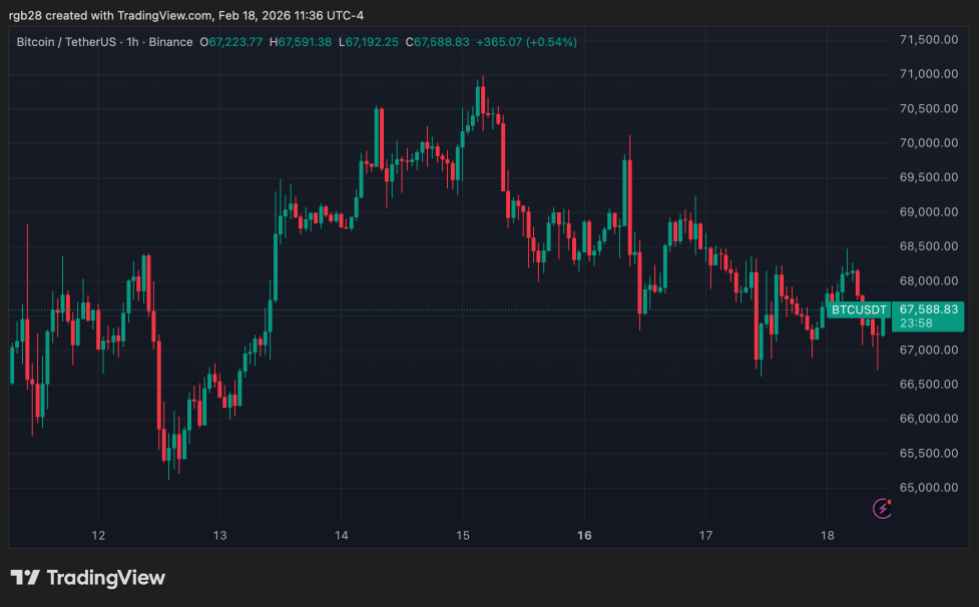
Bitcoin (BTC) trades at $67,588 in the one-week chart. Source: BTCUSDT on TradingView


Perguntas relacionadas

QWhat is Russia planning to do with global crypto exchanges according to the report?

ARussia is preparing to restrict access to global crypto exchanges, likely by blocking their websites, to shift trading activity to domestic platforms under a new regulatory framework expected by summer 2026.

QWhich Russian agency is expected to carry out the mass blocking of foreign crypto exchange websites?

ARoskomnadzor, Russia's federal executive body responsible for monitoring and controlling media and communications, is expected to begin mass blocking of these websites.

QWhat potential negative consequence did Nikita Zuborev warn about if global exchanges are not allowed to operate in Russia?

ANikita Zuborev warned that if global exchanges are not allowed to obtain licenses or operate as agents, a part of the market will move underground, leading to increased fraud, more difficult regulation, and higher commission fees.

QWhat alternative scenario, similar to another country's model, was suggested as a possibility for Russia's crypto regulation?

ADmitry Machikhin suggested a 'Belarusian scenario' is highly possible, where only companies operating under a special regime can conduct crypto transactions, while individuals are prohibited from using foreign platforms.

QWhat broader action is the European Union exploring regarding crypto transactions and Russia?

AThe European Union is exploring implementing strict sanctions to ban all crypto transactions linked to Russia to limit sanctions evasion, including a broader prohibition and a ban on any digital ruble-related transactions.

Leituras Relacionadas

Fu Peng's First Public Speech in 2026: What Exactly Are Crypto Assets? Why Did I Join the Crypto Asset Industry?

Fu Peng, a renowned macroeconomist and now Chief Economist at New火 Group, delivered his first public speech of 2026 at the Hong Kong Web3 Festival. He explained his perspective on crypto assets and why he joined the industry, framing it within the context of macroeconomic trends and financial evolution. Fu emphasized that crypto assets are transitioning from an early, belief-driven phase to a mature, institutionally integrated asset class. He drew parallels to the 1970s-80s, when technological advances (like computing) revolutionized traditional finance, leading to the rise of FICC (Fixed Income, Currencies, and Commodities). Similarly, current advancements in AI, data, and blockchain are reshaping finance, with crypto assets becoming part of a new "FICC + C" (C for Crypto) framework. He noted that institutional capital, including traditional hedge funds, avoided early crypto due to its speculative nature but are now engaging as regulatory clarity emerges (e.g., stablecoin laws, CFTC classifying crypto as a commodity). Fu predicted that 2025-2026 marks a turning point where crypto becomes a standardized, financially viable asset for diversified portfolios, akin to commodities or derivatives in traditional finance. Fu defined Bitcoin not as "digital gold" in a simplistic sense but as a value-preserving, financially tradable asset. He highlighted that crypto's future lies in regulated, institutional adoption, moving away from retail-dominated trading. His entry into crypto signals this maturation, where traditional finance integrates crypto into mainstream asset management.

marsbitHá 32m

Fu Peng's First Public Speech in 2026: What Exactly Are Crypto Assets? Why Did I Join the Crypto Asset Industry?

marsbitHá 32m

Justin Sun Sues Trump Family: What $75 Million Bought Was Only a Blacklist

Justin Sun, founder of Tron, has filed a lawsuit in federal court against World Liberty Financial (WLF), alleging he was made the "primary target of a fraudulent scheme" after investing $75 million. Sun claims the investment secured him an advisor title and WLFI tokens, which were later frozen by WLF, causing "hundreds of millions in losses." The dispute began in late 2024 when Sun's investment helped revive WLF's struggling token sale, which ultimately raised $550 million. Shortly after, the SEC dropped its lawsuit against Sun following Donald Trump's inauguration. However, relations soured when Sun refused WLF's demands for additional funding. In August 2025, WLF added a "blacklist" function to its smart contract, allowing it to unilaterally freeze tokens. Sun's holdings, worth approximately $107 million, were frozen, and he was threatened with token destruction. The lawsuit highlights WLF's structure, which directs 75% of token sale profits to the Trump family, who had earned $1 billion by December 2025. WLF's CEO is Zach Witkoff, son of U.S. Middle East envoy Steve Witkoff. The project faces scrutiny for opaque operations, including a controversial loan arrangement on the Dolomite platform, co-founded by a WLF advisor. Despite Sun's history with the SEC, the case underscores centralization risks within DeFi, as WLF controls governance and holds powers to freeze assets arbitrarily. Sun's tokens remain frozen as legal proceedings begin.

marsbitHá 40m

Justin Sun Sues Trump Family: What $75 Million Bought Was Only a Blacklist

marsbitHá 40m

$500 to Buy OpenAI Stock: Silicon Valley's Most Respectable Liquidity Invitation

Silicon Valley's largest venture capital platform, AngelList, has launched a new fund called USVC, allowing U.S. retail investors to buy into high-profile AI companies like OpenAI, Anthropic, and xAI with a minimum investment of $500—no accredited investor status required. Promoted by AngelList co-founder Naval Ravikant, the fund is framed as an opportunity for ordinary people to access high-growth private tech investments traditionally reserved for VCs. However, critics argue it functions more like an exit vehicle for early insiders. USVC acquires shares not through primary rounds but largely via secondary transactions—purchasing stakes from early investors, VC funds, and employees looking to cash out at peak valuations. With companies like xAI heavily weighted in the portfolio, the fund effectively channels retail money into providing liquidity for insiders who entered at much lower valuations. The fund’s structure raises concerns: shares are illiquid, with no secondary market, and buybacks are limited and discretionary. The actual annual fee reaches 3.61%, far above the advertised 1% management fee. This model parallels the "low float, high fully diluted valuation" strategy seen in crypto, where early investors profit by selling to latecomers at inflated prices. The timing—alongside similar moves by platforms like Robinhood—suggests that Silicon Valley’s sudden interest in retail inclusion may be less about democratizing access and more about securing exits for insiders.

marsbitHá 1h

$500 to Buy OpenAI Stock: Silicon Valley's Most Respectable Liquidity Invitation

marsbitHá 1h

Trading

Spot
Futuros
活动图片