RootData Launches Industry's First Cryptocurrency Exchange Transparency Ranking, Boosting Compliance and Growth

marsbitPublicado em 2026-01-20Última atualização em 2026-01-20

Resumo

RootData has launched the industry's first transparency-focused exchange ranking, "Top Cryptocurrency Exchanges Ranked by Transparency," moving beyond traditional volume-based metrics. The ranking, introduced during the December Binance Blockchain Week in Dubai, is now open for global exchange applications. It evaluates exchanges across six key dimensions: token economics and unlock transparency, project progress and key event disclosure, team background and capital endorsement, announcement accuracy, asset reserve transparency, token listing mechanisms, and regulatory compliance with audit data. This initiative aims to transform transparency from an abstract concept into a quantifiable standard, encouraging exchanges to disclose critical information as a mandatory practice rather than an option. Enhanced transparency helps build differentiated brand trust, attract institutional investors, and secure a competitive edge in an increasingly regulated market. RootData, a Web3 asset data platform processing over 4.2 million monthly search requests, is backed by investors such as NLVC, Boyaa Interactive, and Mask Network. Its data and research have been cited by leading institutions including The Wall Street Journal and Binance Research.

RootData has introduced the industry's first exchange ranking focused on transparency, titled "Top Cryptocurrency Exchanges Ranked by Transparency," breaking through the limitations of the traditional "volume-only" approach. It establishes a multi-dimensional evaluation system covering liquidity, asset value, compliance security, and information transparency.

The ranking was launched during the December Binance Blockchain Week in Dubai and is now open for applications from global exchanges. RootData transforms the abstract concept of transparency into quantifiable metrics, promoting the establishment of unified information disclosure standards in the industry.

RootData's Exchange Transparency Ranking Breaks the Limitations of the Traditional "Volume-Only" Approach

As the crypto market increasingly integrates with mainstream finance, RootData's transparency scoring system focuses on a core question: Are exchanges truly fulfilling their responsibility to disclose information?

Comprehensive information disclosure is not only a regulatory compliance requirement but also a necessary condition for protecting investor rights and promoting healthy market development. RootData aims to encourage exchanges to transform information disclosure from an "option" into a "mandatory task" through a standardized evaluation system.

Six Dimensions: Transforming Transparency into Quantifiable Standards

To convert the abstract concept of information transparency into quantifiable and comparable evaluation metrics, RootData has built a systematic information disclosure model, comprehensively assessing exchanges across the following six core dimensions: Token Economics and Unlock Transparency, Project Progress and Key Event Disclosure, Team Background and Capital Backing Transparency, Announcement Disclosure and Section Accuracy, Asset Reserve Transparency and Token Listing Mechanism, and Compliance Licenses and Audit Data.
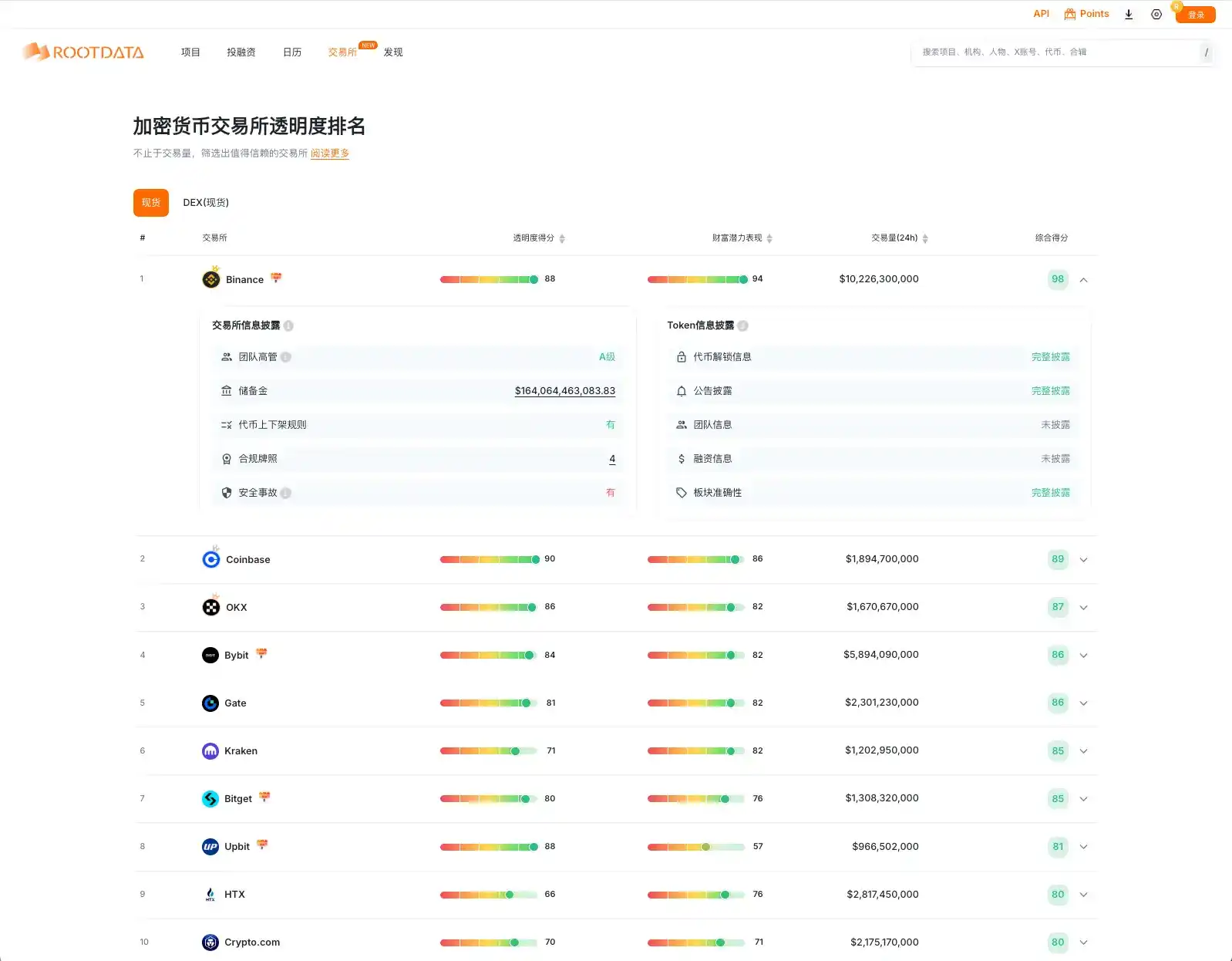
In a Highly Competitive Exchange Landscape, Comprehensive Information Disclosure Helps Build a Differentiated Brand Image

Transparency, as a quantifiable competitive metric, offers three major advantages for exchanges: First, it helps establish a differentiated brand image, becoming a hard-to-replicate trust identifier. Second, it attracts professional groups such as institutional investors, bringing high-quality users and stable trading volume. Third, it lays the foundation for long-term development, gaining a head start in an environment of increasing regulatory scrutiny.

The ranking is dynamically updated based on real-time data, allowing investors to track trends in exchange transparency changes. RootData believes that transparency should not remain a mere slogan for a few exchanges but should become a core arena that all mainstream participants must prioritize. Only in this way can the crypto market truly mature.

About RootData

RootData is a Web3 asset data platform that processes over 4.2 million search requests monthly. It has become an essential data platform for over 2 million Web3 users in their investment decision-making, committed to being a productivity-level tool for Web3 enthusiasts and investors.

RootData has received early investment support from top-tier institutions such as Asia's leading dollar fund NLVC Northern Light Venture Capital (Series B investor in Meituan-Dianping Group), Boyaa Interactive (00434.HK, the world's second-largest publicly traded company by Bitcoin holdings), and Mask Network. Additionally, RootData's data and research content have been repeatedly cited or reported by authoritative institutions both within and outside the industry, including The Wall Street Journal, Cointelegraph, Binance Research, and The Block.


Perguntas relacionadas

QWhat is the name of the new exchange ranking system launched by RootData and what is its main focus?

AThe new ranking system is called 'Top Cryptocurrency Exchanges Ranked by Transparency' and its main focus is on exchange transparency, moving beyond the limitations of traditional trading volume-based rankings.

QWhere and when was the RootData transparency ranking officially announced?

AThe ranking was announced during the December Binance Blockchain Week in Dubai.

QWhat are the six core dimensions used in RootData's transparency evaluation model for exchanges?

AThe six dimensions are: Token Economics & Unlock Transparency, Project Progress & Key Event Disclosure, Team Background & Capital Backing Transparency, Announcement Disclosure & Section Accuracy, Asset Reserve Transparency, and Token Listing Mechanism & Compliance Licenses/Audit Data.

QAccording to the article, what are the three main advantages that high transparency can bring to an exchange?

AThe three main advantages are: 1) Establishing a differentiated brand image as a trust identifier, 2) Attracting professional groups like institutional investors, and 3) Laying a foundation for long-term development and gaining a first-mover advantage in a tightening regulatory environment.

QWhat is RootData's role in the Web3 ecosystem and what scale does it operate at?

ARootData is a Web3 asset data platform that processes over 4.2 million search requests monthly and serves as an essential data platform for over 2 million Web3 users, aiming to be a productivity-level tool for Web3 enthusiasts and investors.

Leituras Relacionadas

The Value Distribution of Stablecoins

**Summary: The Value Distribution of Stablecoins** The article argues that stablecoins are evolving from mere trading tools into broader channels for dollar access. It divides the stablecoin ecosystem into four layers to analyze how value is distributed: 1. **Issuance Layer:** Mints stablecoins, holds reserve assets, and captures the spread between reserve yield and user costs (e.g., Tether, Circle). This layer currently earns the largest profit margin. 2. **Infrastructure Layer:** Connects stablecoins to the traditional financial system, handling fiat on/off-ramps, banking integration, compliance (KYC/AML), and asset management (e.g., Bridge, BVNK). This is the "unglamorous" but critical work, building the essential bridges between crypto and real-world finance. 3. **Acquiring/Distribution Layer:** Integrates stablecoins into merchant systems, manages payment flows, and provides enterprise financial software (e.g., Stripe, Coinbase). They act as the access point for businesses. 4. **Application Layer:** The end-users and businesses that ultimately use stablecoins for payments, settlements, or as a store of value. They benefit from convenience but have little pricing power. The core thesis is that while the issuance layer currently dominates profits, the often-overlooked **infrastructure layer holds significant long-term potential**. The real challenge and barrier to mass adoption is not the on-chain transfer of stablecoins (which is simple), but the complex "last mile" integration into existing business workflows, banking systems, and regulatory frameworks across different countries. Companies in this layer are currently in a "land grab" phase, investing heavily to build networks, secure bank partnerships, and establish compliance pathways. While their position is currently pressured by the profitable issuers above and distribution platforms below, the article suggests that if stablecoins become a default financial rail for businesses, the infrastructure providers who have done the hard work of integration will ultimately gain strong pricing power and become entrenched, essential players.

marsbitHá 6h

The Value Distribution of Stablecoins

marsbitHá 6h

The Value Distribution of Stablecoins

The Value Distribution of Stablecoins The article argues that stablecoins are evolving from a mere trading tool into a broad "dollar channel." It analyzes the industry's value chain through four layers: 1. **Issuance Layer (e.g., Tether, Circle):** The top layer that mints stablecoins, holds reserve assets, and captures the thickest interest rate spread. 2. **Infrastructure Layer (e.g., Bridge, BVNK):** Connects stablecoins to the traditional financial system, handling critical but complex "dirty work" like fiat on/off-ramps, banking integration, compliance (KYC/AML), and cross-border settlement. 3. **Acquiring/Distribution Layer (e.g., Stripe, Coinbase):** Embeds stablecoins into merchant systems, manages payment flows, and integrates with enterprise software. 4. **Application Layer:** End-users and businesses that ultimately use stablecoins for payments, settlement, or storing value. The author posits that while the issuance layer currently captures the most profit, the most overlooked and potentially critical layer is infrastructure. The core challenge for stablecoin adoption isn't the on-chain transfer (which is simple), but bridging the gap between blockchain and the real-world financial system. This involves solving practical problems for businesses: fiat conversion, reconciliation, tax handling, and user onboarding. Infrastructure companies are currently in a difficult "land-grab" phase—building networks, securing banking relationships, and achieving compliance country-by-country. They face pressure from both the profitable issuance layer above and distribution platforms below. However, the author suggests this layer is building a crucial moat. Once stablecoins become a default business rail, the infrastructure players who have done the hard work of integration may gain significant, durable value and pricing power.

链捕手Há 6h

The Value Distribution of Stablecoins

链捕手Há 6h

Trading

Spot
Futuros
活动图片