Robinhood Chain's First Breakout Hit Is a Meme Cat: Retail Investors Dig Out CashCat's 'Original Name,' CEO Jumps on the Trend

marsbitPublicado em 2026-07-08Última atualização em 2026-07-08

Resumo

Robinhood Chain launched its mainnet on July 1st, promoting tokenized U.S. stocks as its core feature. However, the first asset to gain significant traction was a meme token called CASHCAT, which surged over 1700% in 24 hours, reaching a market cap of $120 million. The token's narrative stems from Robinhood's early history: CEO Vlad Tenev revealed the company's initial working name was "CashCat." CASHCAT has no official ties to Robinhood and declares itself as "pure cat" with zero utility. Tenev added fuel by tweeting on July 8th that the chain is "great for memes," which the community saw as implicit approval. The hype has attracted copycat tokens on other chains like Solana and impersonator accounts promoting scams. The article highlights the extreme volatility and risks associated with this new, illiquid meme token on a fledgling blockchain, cautioning investors to verify contracts and treat any investment as high-risk speculation.

Author: Claude, Shenchao TechFlow

Shenchao Introduction: One week after the Robinhood Chain mainnet launch, while the officially promoted stock token hasn't gone viral yet, a Meme cat called CASHCAT has taken off first, with its price surging over 1700% in 24 hours at one point and its market cap exceeding $120M. Its entire narrative boils down to one sentence: the working name for Robinhood during its startup phase was CashCat. CEO Tenev himself shared this history and even tweeted a meme on the day of the surge. Meanwhile, copycat tokens and fake 'Roaring Kitty' shilling accounts are already in position.
Attracting traffic and retail investor attention still depends on Memes.

Robinhood spent a year paving the way for its own blockchain, pitching tokenized stocks as the core story. However, the first truly viral asset on the chain turned out to be a cartoon cat holding cash.

According to GMGN monitoring, on July 8th, the market capitalization of the Meme token CASHCAT on Robinhood Chain exceeded $120 million, with a 24-hour increase of over 1700%. In the following hours, readings from different data platforms continued to rise. According to CoinGecko data, CASHCAT primarily trades on the Uniswap V3 deployed on Robinhood Chain, with the CASHCAT/WETH pair seeing a 24-hour trading volume of approximately $28 million. For a new chain that has only been live for a week and has very few ecosystem applications, this cat is the current traffic itself.

Seventh Day Post-Mainnet Launch, The First Viral Asset Is a Meme

First, some background.

On July 1st, Robinhood officially launched the public mainnet for Robinhood Chain at an event in London. This is an Ethereum Layer 2 based on Arbitrum technology, unveiled by CEO Vlad Tenev and crypto business head Johann Kerbrat. The official positioning of this chain is quite 'serious'. Its core product, Stock Tokens, tracks the price performance of over 200 US stocks and ETFs and is open to users in over 120 jurisdictions (excluding US users). DeFi protocols like Uniswap and 1inch were deployed on day one, and Robinhood pledged to cover all Gas fees for the first 90 days.

According to the official script, the protagonists of this chain should have been tokenized stocks and RWA (Real World Assets). However, the script didn't follow the plan. In the first week after the mainnet launch, the most actively traded pair on the chain wasn't any stock token, but CASHCAT. Retail investors set the tone for this 'retail broker's chain' first.

A clear warning for holders: CASHCAT's current trading depth is concentrated on a single trading pair within a single DEX. Liquidity is thin on a new chain, price readings vary significantly across platforms, and both slippage and wick risk upon entry/exit are far higher than for Memes on mature chains.

Archaeology of the 'Original Name', Tenev Himself Told the CashCat Story

CASHCAT's success relies on a real piece of company history.

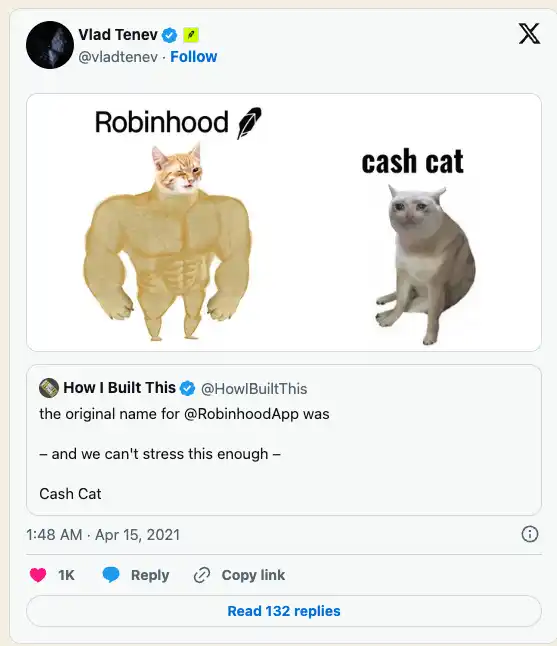
In early interviews, Tenev recalled the company naming process: "The original working name was actually CashCat, but everyone felt it wasn't powerful enough. My wife would introduce me to her friends by saying, 'They're the Robin Hoods of finance, doing things for the little guy.' That's how the name Robinhood stuck." This account has been cited in numerous company retrospectives after the GameStop saga, making it verifiable 'archaeological material.' This is the biggest difference between CASHCAT and other cat/dog coins built on fabricated stories.

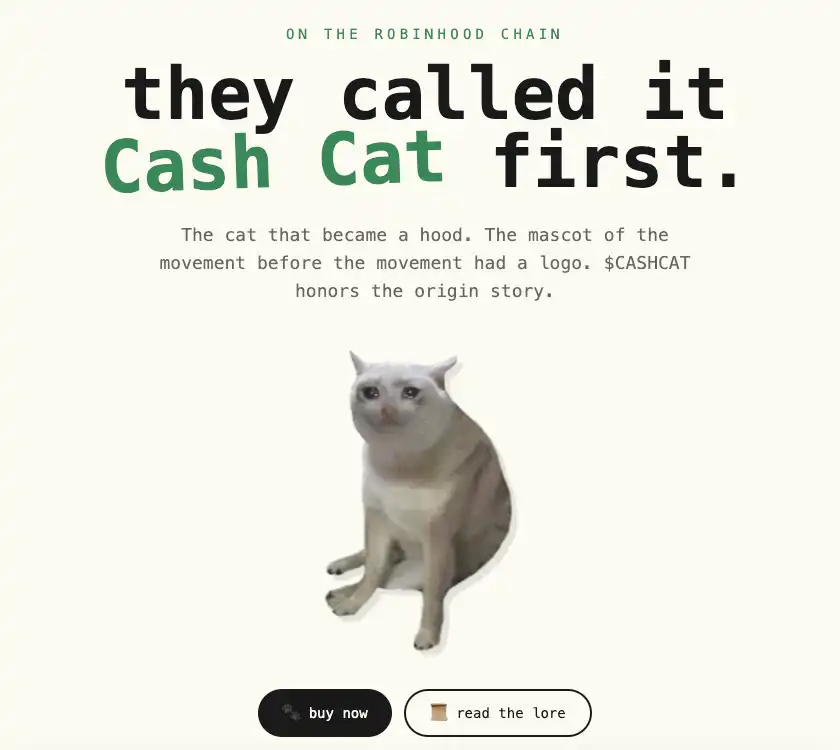
The token's structure is as simple as it gets. According to the project's website, the total supply is 1 billion tokens, with zero buy/sell taxes. The liquidity pool tokens have been fully burned, and it self-identifies as "zero utility, one hundred percent cat." The website also explicitly states that the project has no affiliation with Robinhood, calling it "fan fiction with a ticker."

The narrative is real, the product is unrelated. Readers need to distinguish these two facts: Robinhood's history provides this cat with viral material, but the company does not endorse it. The token's value is built entirely on attention, with no safety net when that attention fades.
Tenev Tweets Meme, Market Interprets It as Semi-Endorsement

What truly pushed the frenzy to its peak was Tenev himself.

On July 8th, Tenev posted on X (formerly Twitter): "We're making Robinhood Chain the best RWA public chain... but it runs Memes really well too." The post garnered over 500,000 views within hours. While he didn't mention CASHCAT by name, the timing coincided with the day of the massive surge. The community interpreted it as implicit approval, if not an assist, for the Meme frenzy on the chain.

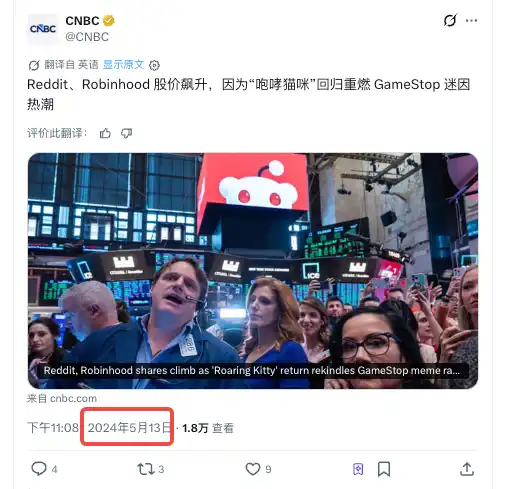
There's a layer of historical irony here. During the 2021 GameStop short squeeze, Robinhood was thrust into Congressional hearings for restricting retail buys of GME, becoming the 'villain' in the retail narrative. Five years later, this company's blockchain completes its cold start, precisely relying on the Meme culture that retail investors excel at, with the object of speculation being the name the company itself discarded. The CASHCAT website even specifically plays on this irony: "Cash Cat doesn't do options, and it doesn't do PFOF (Payment for Order Flow)."
For traders, it's necessary to heavily discount the actual value of this tweet. A playful tweet from Tenev and an official Robinhood endorsement are separated by an entire compliance department. The company has no commitments regarding custody, listing, or providing liquidity for the Meme token. The effectiveness of such sentiment catalysts typically lasts only hours.

Copycat Tokens and Fake 'Roaring Kitty' Accounts Are Already in Position

Once the heat arrived, the tools to hunt retail investors followed.

First, cross-chain copycat tokens. According to aggregated monitoring information from CoinGecko, an identically named CASHCAT has already been deployed on the Solana chain. The original contract is deployed on Robinhood Chain with an address starting with 0x020b and ending with 18b4; identically named tokens on other chains are unrelated to the original.

Second, impersonator accounts shilling. For example, an X account with the handle "RK" and a username highly similar to GameStop saga protagonist 'Roaring Kitty' Keith Gill tweeted, "CASHCAT is the first major Meme on Robinhood chain," and included a Solana contract address in the post.

New chain, new Meme, fake accounts, cross-chain copycats—this combination has claimed victims in every past Meme cycle. If you still decide to participate now, at least do these three things: verify the contract address, use only official or reputable cross-chain bridges, and keep your position size to lottery-ticket levels.

CASHCAT's current total value is just a good story plus a wave of attention, neither of which has a retention mechanism.


Criptomoedas em alta

Perguntas relacionadas

QWhat is CASHCAT, and why did it become the first viral asset on Robinhood Chain after its mainnet launch?

ACASHCAT is a meme token featuring a cartoon cat holding cash. It became the first viral asset on Robinhood Chain, launched on July 1, due to its connection to Robinhood's early history. The name 'CashCat' was Robinhood's original working name before it adopted 'Robinhood,' a fact shared by CEO Vlad Tenev. The token's price surged over 1700% in 24 hours, capturing significant market attention and liquidity on the new chain.

QWhat historical anecdote about Robinhood gives CASHCAT its narrative foundation?

AThe narrative foundation for CASHCAT comes from an anecdote shared by Robinhood CEO Vlad Tenev. He revealed that the company's original working name during its early days was 'CashCat,' but it was changed to 'Robinhood' because the latter was perceived as more powerful and aligned with the idea of 'stealing from the rich to give to the poor.' This true piece of company history differentiates CASHCAT from other meme tokens with fabricated backstories.

QHow did Robinhood CEO Vlad Tenev's actions on social media contribute to the hype around CASHCAT?

AOn July 8, Vlad Tenev posted on X, stating, 'We're building Robinhood Chain to be the best RWA public chain... but it runs Memes pretty well too.' Although he didn't mention CASHCAT by name, the timing coincided with the token's massive price surge. The community interpreted the post as a tacit endorsement or acknowledgment of the meme token activity on the chain, significantly fueling the hype and market speculation.

QWhat are the key risks associated with trading CASHCAT as highlighted in the article?

AThe article highlights several key risks: 1) The token's trading is concentrated on a single DEX (Uniswap V3) and a single trading pair (CASHCAT/WETH) on the new Robinhood Chain, leading to thin liquidity. 2) This results in high slippage, price volatility, and significant differences in price readings across data platforms. 3) The token's value is based solely on a historical narrative and market attention, with no underlying utility or backing from Robinhood, making it highly susceptible to rapid value loss when hype fades.

QWhat fraudulent activities emerged following CASHCAT's price surge, and what precautions should investors take?

AFollowing the surge, fraudulent activities included: 1) The deployment of fake 'CASHCAT' tokens on other blockchains like Solana, which are unrelated to the original Robinhood Chain token. 2) Impersonator accounts on social media, such as one mimicking 'Roaring Kitty' (Keith Gill), promoting these fake tokens. Investors are advised to: verify the correct contract address (the original starts with 0x020b and ends with 18b4), use only official or reputable cross-chain bridges, and limit their investment to an amount they are prepared to lose ('lottery ticket' sized positions).

Leituras Relacionadas

Bridging Traditional Funds and DeFi: Who Will Capture the Next Decade's RWA Dividends?

Bridging Traditional Funds and DeFi: Who Will Capture the RWA Decade's Value? Tokenization of real-world assets (RWA) is merging the 24/7, permissionless world of DeFi with the time-bound, regulated world of traditional finance. While the complexity is immense, the infrastructure layer enabling this fusion holds significant value. The total value of on-chain tokenized real-world assets now exceeds $33 billion. While tokenized U.S. Treasuries dominate, their share has fallen from 55% to under 45% in a year as other assets like institutional and private credit grow. The key differentiator for on-chain assets is *composability*, allowing capital to be recycled across multiple yield-generating strategies simultaneously. However, tokenized funds remain regulated products with daily NAV updates, KYC requirements, and redemption windows. Bridging these to DeFi requires solving core conflicts: pricing assets between NAV updates, enforcing compliance without stifling DeFi activity, and maintaining accurate accounting during cross-chain transfers. Solutions like the Centrifuge V3 architecture, in collaboration with LayerZero, propose a hub-and-spoke model. A single authoritative hub chain manages NAV, compliance, and accounting, while LayerZero's messaging layer syncs this data to spokechains where tokens can be freely composed in DeFi. This creates a high-barrier, essential middleware layer. The major incentive for institutions is the potential for recursive yield strategies—for example, depositing into a tokenized Treasury fund, borrowing stablecoins against it, and redeploying those funds into another yield-bearing asset, amplifying returns. Yet, risks remain: mismatches between on-chain instant redemptions and off-chain fund limits (as seen in recent private credit fund runs), pricing arbitrage due to NAV lags, and cross-chain settlement failures. Infrastructure must solve these while maintaining regulatory compliance. Just as SWIFT and Visa captured immense value as financial plumbing, the entities that build the robust middleware connecting traditional finance and DeFi are positioned to capture the next decade's value in the RWA space.

Foresight NewsHá 16m

Bridging Traditional Funds and DeFi: Who Will Capture the Next Decade's RWA Dividends?

Foresight NewsHá 16m

Trading

Spot

Artigos em Destaque

Como comprar CAT

Bem-vindo à HTX.com!Tornámos a compra de Simon's Cat (CAT) simples e conveniente.Segue o nosso guia passo a passo para iniciar a tua jornada no mundo das criptos.Passo 1: cria a tua conta HTXUtiliza o teu e-mail ou número de telefone para te inscreveres numa conta gratuita na HTX.Desfruta de um processo de inscrição sem complicações e desbloqueia todas as funcionalidades.Obter a minha contaPasso 2: vai para Comprar Cripto e escolhe o teu método de pagamentoCartão de crédito/débito: usa o teu visa ou mastercard para comprar Simon's Cat (CAT) instantaneamente.Saldo: usa os fundos da tua conta HTX para transacionar sem problemas.Terceiros: adicionamos métodos de pagamento populares, como Google Pay e Apple Pay, para aumentar a conveniência.P2P: transaciona diretamente com outros utilizadores na HTX.Mercado de balcão (OTC): oferecemos serviços personalizados e taxas de câmbio competitivas para os traders.Passo 3: armazena teu Simon's Cat (CAT)Depois de comprar o teu Simon's Cat (CAT), armazena-o na tua conta HTX.Alternativamente, podes enviá-lo para outro lugar através de transferência blockchain ou usá-lo para transacionar outras criptomoedas.Passo 4: transaciona Simon's Cat (CAT)Transaciona facilmente Simon's Cat (CAT) no mercado à vista da HTX.Acede simplesmente à tua conta, seleciona o teu par de trading, executa as tuas transações e monitoriza em tempo real.Oferecemos uma experiência de fácil utilização tanto para principiantes como para traders experientes.

120 Visualizações TotaisPublicado em {updateTime}Atualizado em 2026.06.02

Como comprar CAT

O que é TRUMP CAT

Família Trump Cat, $Trump Cat: Um Mistério Desvendado Introdução No panorama em constante evolução dos projetos de criptomoedas e inovações web3, surgiu um fenómeno curioso—um que parece estar na linha entre a criptomoeda e a cultura dos memes da internet. Este é o enigmático “Família Trump Cat”, também referido como “$Trump Cat”. Embora possa despertar curiosidade entre os entusiastas de criptomoedas, a realidade parece estar longe da definição padrão de um projeto de criptomoeda. Este artigo tem como objetivo explorar o conceito da Família Trump Cat, trazendo à luz o contexto que a rodeia e esclarecendo o seu status no reino das criptomoedas. O que é a Família Trump Cat, $Trump Cat? À primeira vista, pode-se pensar que “Família Trump Cat” se refere a uma criptomoeda legítima ou a um projeto web3. No entanto, após uma investigação mais profunda, torna-se evidente que o termo carece dos atributos de um empreendimento tradicional de criptomoeda. Em vez disso, “Trump Cat” parece estar predominantemente associado à cultura viral dos memes que surgiu após declarações controversas feitas pelo ex-Presidente dos EUA, Donald Trump, sobre imigrantes haitianos. A cobertura mediática gerou uma infinidade de memes, interpretações humorísticas e uma onda de comentários sociais. Estes memes retratam várias formas de sátira centradas no diálogo de Trump, muitas vezes utilizando gatos em cenários cómicos e, por vezes, absurdos. Em vez de um projeto estruturado destinado a abordar avanços tecnológicos ou transações financeiras, o conceito da “Família Trump Cat” existe predominantemente no domínio do humor da internet. Quem é o Criador da Família Trump Cat, $Trump Cat? Na investigação sobre quem está por trás da “Família Trump Cat”, torna-se aparente que não existe um criador identificável ou figura fundadora. O fenómeno parece ter origem na expressão coletiva da internet, em vez de um visionário singular com um objetivo de projeto definido. Esta anonimidade enfatiza ainda mais o seu status como um meme, em vez de uma iniciativa estruturada semelhante à maioria dos projetos de criptomoedas conhecidos. Quem são os Investidores da Família Trump Cat, $Trump Cat? Dado que a “Família Trump Cat” não se conforma às características de um projeto de criptomoeda respeitável, a questão do investimento torna-se irrelevante. Não existem fundações ou organizações estabelecidas que expressem apoio a um projeto com este nome. Em vez disso, o que existe são contribuintes individuais para a cultura dos memes—amadores, artistas e utilizadores de redes sociais que, coletivamente, povoam a internet com as suas interpretações e humor em torno do termo “Trump Cat”. Este crescimento orgânico dentro da comunicação humana digital reflete mais um comentário social do que um panorama de investimento financeiro. Como Funciona a Família Trump Cat, $Trump Cat? Se alguém procura estabelecer como a “Família Trump Cat” opera, a resposta é vastamente diferente do que se poderia esperar de projetos de criptomoedas padrão. Não existem mecanismos operacionais, inovações tecnológicas ou características únicas inerentes a este fenómeno. Em vez disso, ele existe através da propagação viral online, dependendo das plataformas de redes sociais para a sua proliferação. O “como” reside no domínio da cultura e comunicação—sua essência derivada das dinâmicas da interação social, em vez de protocolos de criptomoeda estabelecidos ou funcionalidades de blockchain. O que torna “Trump Cat” único, se é que algo o é, é a forma como dramatiza um diálogo político através do humor. As pessoas utilizam visuais envolventes, piadas internas e narrativas inventivas para transmitir sentimentos sobre figuras políticas e questões sociais. O poder dos memes transcende a comunicação tradicional, encapsulando pensamentos complexos numa forma que ressoa amplamente, mas permanece elusiva em termos de sucesso quantificável ou objetivos estruturados. Cronologia da Família Trump Cat, $Trump Cat Setembro de 2024: O discurso em torno dos comentários de Donald Trump sobre imigrantes haitianos alegadamente consumindo animais de estimação ganha força online, levando a um florescimento de memes e interpretações paródicas em várias plataformas. Impacto Continuado: Após este período, o fenómeno “Trump Cat” continua a viver enquanto os utilizadores das redes sociais aproveitam o humor para abordar, criticar ou simplesmente celebrar a absurdidade das conversas e eventos políticos. É essencial notar que, uma vez que a “Família Trump Cat” carece da estrutura formal de um projeto tradicional, a cronologia consiste principalmente em observações anedóticas, em vez de marcos notáveis comumente encontrados em empreendimentos de criptomoedas reconhecidos. Pontos Chave Cultura dos Memes: Em vez de uma iniciativa de criptomoeda estruturada, “Trump Cat” alinha-se mais com o panorama em evolução dos memes da internet. Origem do Termo: A gênese de “Trump Cat” relaciona-se diretamente com comentários sobre as declarações do Presidente Trump sobre imigrantes haitianos, provocando uma representação humorística generalizada. Ausência de um Quadro de Projeto: O termo não se alinha com quaisquer objetivos de projeto definidos, criadores ou investidores, marcando-o como uma experiência cultural nova, em vez de um projeto de criptomoeda. Conclusão Em resumo, a investigação sobre “Família Trump Cat, $Trump Cat” revela um fenómeno enraizado na cultura dos memes da internet, em vez de um projeto reconhecido nos setores de criptomoeda ou web3. A viralidade em torno do termo nasce do envolvimento coletivo dos utilizadores, refletindo o discurso digital moderno, em vez de uma iniciativa formalizada com estrutura ou visão estratégica. Para toda a curiosidade que possa invocar entre aqueles que buscam o próximo grande projeto de criptomoeda, a “Família Trump Cat” serve como um testemunho da criatividade, humor e frequentemente absurda relação da humanidade com a política na era digital.

291 Visualizações TotaisPublicado em {updateTime}Atualizado em 2025.01.22

O que é TRUMP CAT

Discussões

Bem-vindo à Comunidade HTX. Aqui, pode manter-se informado sobre os mais recentes desenvolvimentos da plataforma e obter acesso a análises profissionais de mercado. As opiniões dos utilizadores sobre o preço de CAT (CAT) são apresentadas abaixo.

活动图片