Ripple's RLUSD Market Cap Exceeds $2 Billion, With Nearly $1 Billion on XRP Ledger

cryptonews.ruPublicado em 2026-08-26Última atualização em 2026-08-26

Resumo

Ripple USD's ($RLUSD) market capitalization has surpassed $2 billion, with nearly $1 billion issued on the XRP Ledger. Launched in December 2024, the stablecoin is backed by reserves of cash and cash equivalents, attested monthly by Deloitte. Data shows $RLUSD's market cap at approximately $2.02 billion, split almost evenly between the XRP Ledger ($962.8M) and Ethereum ($1.05B). This represents an eight-fold increase since April 2025. The stablecoin has provided significant dollar liquidity to the XRP Ledger, with over $2.5B processed through RLUSD trading pairs. Ripple is expanding RLUSD's utility through payments integrations (including Mastercard), exchange listings, regional distribution deals, and support for institutional lending initiatives on the XRP Ledger. A new platform, Ripple Mint, also allows qualified institutions to manage RLUSD issuance and redemptions.

Last week, the market capitalization of Ripple USD ($RLUSD) exceeded $2 billion. On August 25, Ripple announced this achievement in a post on X:

"Last week, the market cap of $RLUSD surpassed $2 billion, with nearly $1 billion issued on the $XRP Ledger. The system has been operational since December 2024, built for real-world utility and designed for enterprise use cases."

Each $RLUSD token is designed to maintain a value of $1 through reserves consisting of cash and permitted cash equivalents. Ripple's documentation for $RLUSD states that reserves are held in segregated accounts and include short-term U.S. Treasury bills, government money market funds, overnight reverse repurchase agreements, and bank deposits. According to Ripple, Deloitte performs monthly reserve attestations.

According to RWA.xyz, the market capitalization of $RLUSD was approximately $2.02 billion, having increased by 31.45% over 30 days, with about $962.8 million issued on the $XRP Ledger and $1.05 billion on the Ethereum network. According to the same data, over the previous 30 days, the transfer volume in $RLUSD amounted to $11.81 billion, distributed across 1.39 million transactions.
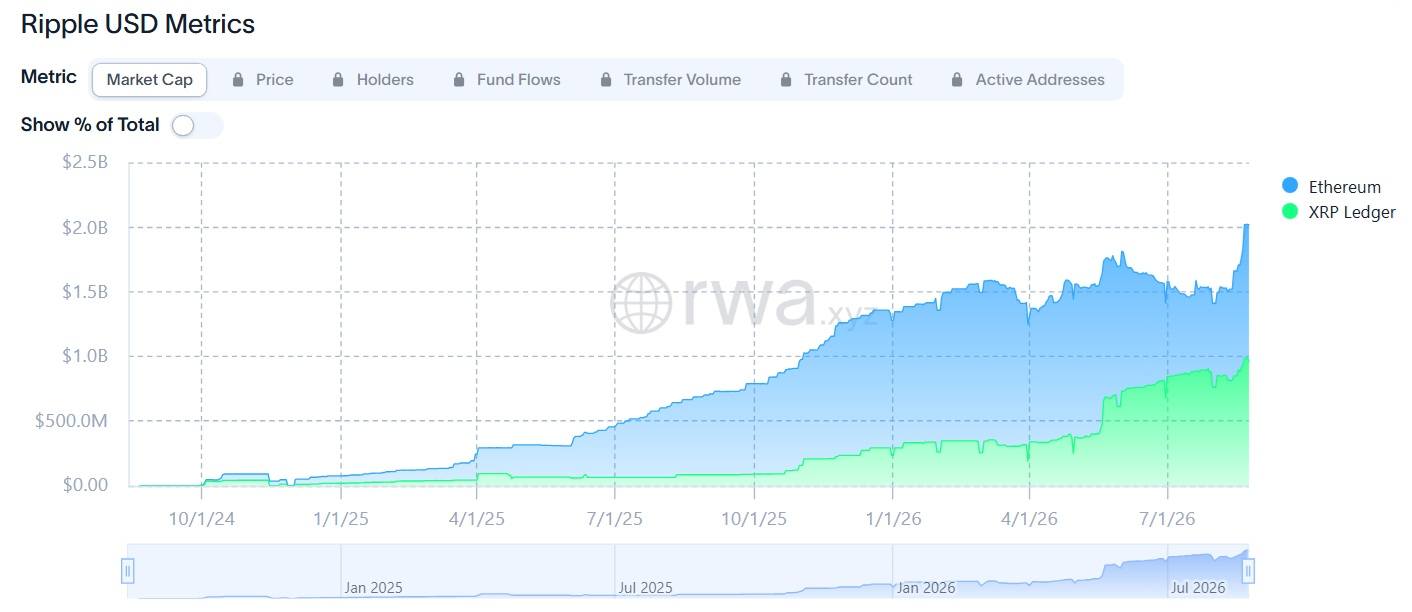
By August 25, the market capitalization of $RLUSD reached approximately $2.02 billion, with about $1.05 billion issued on Ethereum and $962.8 million on the $XRP Ledger. Source: RWA.xyz

Currently, these two networks account for nearly equal portions of the $RLUSD supply, with a difference of less than $90 million between them. Ripple mints the stablecoin directly on each chain rather than bridging them into a single pool, so these two balances comprise almost the entire $2.02 billion sum.

The stablecoin's current market cap is eight times the figure from its first four months post-launch. In April 2025, Ripple reported that the market capitalization of $RLUSD was approaching $250 million. At the time, the company had integrated the stablecoin into the Ripple Payments platform for cross-border transactions, treasury operations, and settlements with institutional investors.

Activity on $XRP Ledger Grows with $RLUSD Supply

The growing issuance of $RLUSD has provided additional dollar liquidity for the trading and payment infrastructure of the $XRP Ledger. According to an analysis by Evernorth, from the stablecoin's launch through the end of June, over $2.5 billion was processed through trading pairs with $RLUSD. The $RLUSD-$XRP pair accounted for approximately $900 million over the previous six months and constituted nearly 90% of $RLUSD trading volume on the network.

$RLUSD could also support institutional lending if two proposed amendments to the $XRP Ledger gain validator approval. Ripple supports an institutional lending initiative for $RLUSD involving Clearpool and Cicada Partners. The system remains in development on the Devnet and depends on the approval of amendments XLS-65 "Discreet Asset Vaults" and XLS-66 "Lending Protocol" before launching on the mainnet.

Institutional users gained another method of accessing the stablecoin when Ripple introduced a unified issuance and redemption platform in July. Ripple Mint allows eligible institutions to manage $RLUSD via a web interface or API. Its features include minting, redeeming, cross-chain bridging, balance monitoring, transaction tracking, and automated notifications, covering every step of the settlement process.

Payments and Multi-Chain Access Expand $RLUSD Utility

Ripple has expanded $RLUSD's utility through integrations with payment systems, exchange listings, regional distribution agreements, and support for additional blockchain networks. Among eight new $RLUSD introductions announced in July were: settlement support via Mastercard, availability in Japan and Turkey, integration with Bitso, and Flutterwave investments related to African payment corridors. Ripple also expanded the stablecoin's reach beyond its initial deployments on the $XRP Ledger and Ethereum.

Stablecoins are cryptocurrencies designed to be pegged to underlying assets, most commonly the U.S. dollar, through reserves, collateral, redemption mechanisms, or other structures. A stablecoin's collateral and redemption models determine how each token aims to maintain its peg to the underlying asset, as well as the risks faced by holders. The transfer volume metric measures on-chain movement, not payments, revenue, or net inflows, while market capitalization reflects the value of tokens in circulation.

end-content

Criptomoedas em alta

Perguntas relacionadas

QWhat milestone did Ripple's RLUSD stablecoin achieve recently according to the article?

AThe market capitalization of Ripple USD (RLUSD) recently surpassed $2 billion, with nearly $1 billion of that amount issued on the XRP Ledger.

QHow is the value of each RLUSD token maintained, and how are the reserves audited?

AEach RLUSD token is designed to maintain a value of $1 through reserves consisting of cash and permitted cash equivalents. According to Ripple's documentation, the reserves are held in segregated accounts and include short-term U.S. Treasury bills, government money market funds, overnight reverse repurchase agreements, and bank deposits. The auditing firm Deloitte performs monthly attestations of these reserves.

QWhat is the current distribution of the $2.02 billion RLUSD market cap between the XRP Ledger and Ethereum networks?

AAccording to RWA.xyz, approximately $962.8 million of RLUSD was issued on the XRP Ledger, and $1.05 billion was issued on the Ethereum network. The difference between the two networks is less than $90 million.

QHow has RLUSD contributed to activity within the XRP Ledger ecosystem?

AThe growing issuance of RLUSD has provided additional dollar liquidity for the XRP Ledger's trading and payment infrastructure. Analysis from Evernorth shows that over $2.5 billion was processed through RLUSD trading pairs from its launch until the end of June. The RLUSD-XRP pair alone accounted for approximately $900 million in volume over the previous six months, representing nearly 90% of RLUSD's trading volume on the ledger.

QWhat were some of the key use case expansions for RLUSD announced by Ripple in July?

AIn July, Ripple announced eight expansions for RLUSD, including: enabling settlements via Mastercard, availability in Japan and Turkey, integration with Bitso, and Flutterwave's investment related to African payment corridors. Ripple also expanded the stablecoin's reach beyond its initial deployments on the XRP Ledger and Ethereum.

Leituras Relacionadas

a16z Deep Dive: Stop Chasing the 'AI Smell', Here's a Practical Guide to Writing with AI

"Don't Obsess Over AI Detection: A Practical Guide to Writing Alongside AI" by Steph Zinn (a16z Crypto) This guide moves beyond the flawed premise that AI-generated text can be easily spotted by a set of "tells" and that these features automatically mean poor quality. Instead, it focuses on how writers and founders can use LLMs effectively by understanding, controlling, and editing the common stylistic tendencies of AI-assisted prose. The article breaks down AI writing "tells" into four key dimensions: **1. Rhetorical Features (Insight-Shaped Writing):** AI often produces semantically empty, "corporate-sounding" filler language—vague profundities, hedging phrases, excessive parallelism, and summary statements. The advice is to ruthlessly edit these out, using prompts to make language more specific and direct. **2. Voice Features (The Alexa Voice):** Default AI writing relies on a narrow, fungible vocabulary of low-friction, abstract words and cliché phrases that lack personality. While this generic voice is acceptable for support docs or mass communications, founders should preserve their unique voice for impactful writing. Use LLMs to identify and replace jargon, aiming for concrete, distinctive word choices. **3. Structural Features (Form Without Function):** AI tends towards over-structured text with excessive subheadings, lists, roadmaps, and the rigid "three-point" framework. While clear structure is good for readability and SEO, it shouldn't force ideas into unnatural containers. Choose a structure that serves the format and purpose, borrowing from effective examples. **4. Punctuation Features (Dash Panic):** The overuse of em dashes and colons has become a hallmark, but writers shouldn't avoid useful punctuation just to seem "human." The key is avoiding repetitive, distracting patterns. Use punctuation that is grammatically correct and supports the flow of your argument. The core argument is that many so-called AI flaws are just amplified versions of existing bad writing habits. The goal isn't to eliminate AI's role but to use it as a tool while maintaining editorial control. The final question shouldn't be "Can this be detected as AI?" but "Does this writing effectively do its job?"

marsbitHá 36m

a16z Deep Dive: Stop Chasing the 'AI Smell', Here's a Practical Guide to Writing with AI

marsbitHá 36m

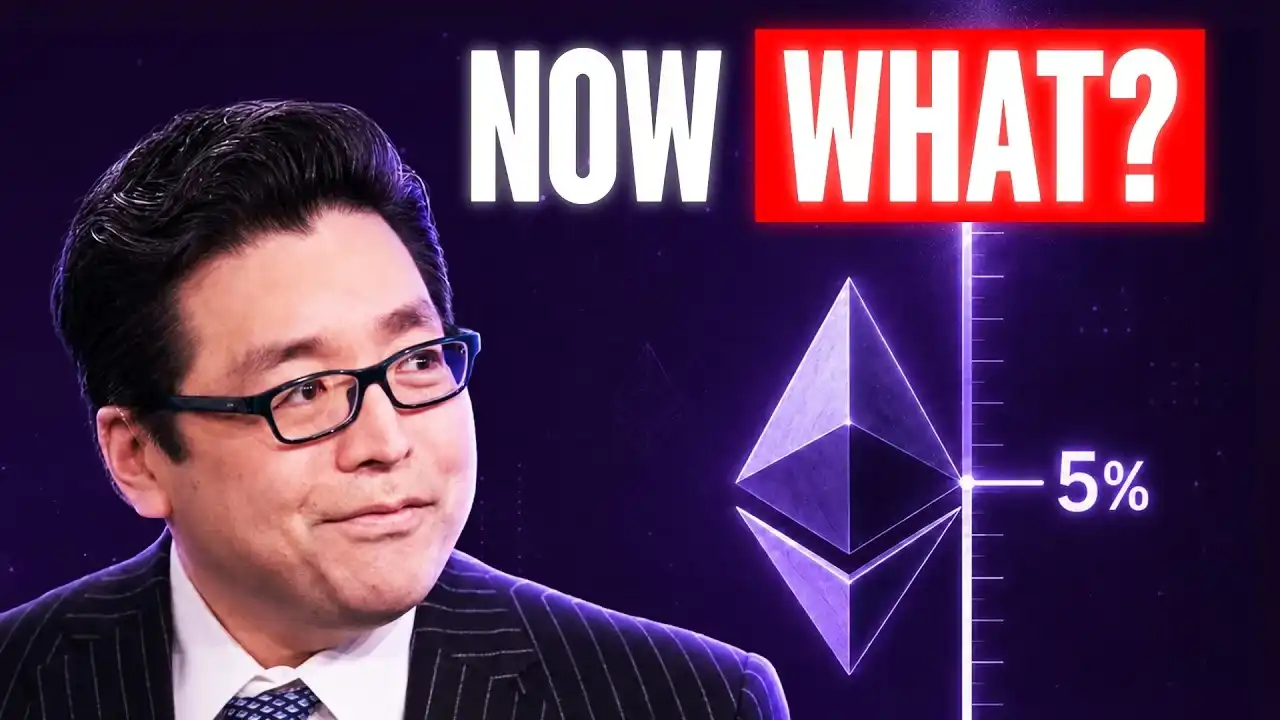
Podcast Notes | Conversation with Tom Lee: Bitmine Acquiring Nearly 5% of Total ETH Supply Is Not the End Goal, ETH Price Target Set at $10,000

In a podcast interview, Tom Lee, Chairman of BitMine Immersion Technologies, discusses the company's strategy to accumulate nearly 5% of the total Ethereum supply within 14 months, using equity financing and avoiding debt. BitMine has consistently purchased ETH for over 60 consecutive weeks, with recent weeks combining buybacks with purchases. The company's substantial ETH holdings generate approximately $300 million in annual staking rewards, covering operational costs like the dividends for its 9.5% perpetual preferred stock (BMNP). Lee positions ETH as a store-of-value asset, likening it to stocks or land, rather than a pure cash-flow instrument. Looking ahead, Lee suggests BitMine may continue buying beyond the 5% target if institutional adoption grows. He outlines a bullish price target for ETH: surpassing $5,000 in a new crypto bull cycle and potentially exceeding $10,000 within 1-2 years, driven by Wall Street tokenization and AI-related demand. The discussion also covers BitMine's evolution into an ecosystem player, funding Ethereum Foundation spin-offs and developing its Maven staking platform. Lee acknowledges his significant financial interests are tied to ETH's price and BitMine's performance. The interview provides a framework for evaluating ETH as a long-term asset, emphasizing staking yield sustainability and future institutional demand, while noting the uncertainties surrounding macro cycles and real-world adoption.

marsbitHá 36m

Podcast Notes | Conversation with Tom Lee: Bitmine Acquiring Nearly 5% of Total ETH Supply Is Not the End Goal, ETH Price Target Set at $10,000

marsbitHá 36m

Pricing Risk Assets in 8 Hours: Tonight's PCE to Set the Discount Rate, Nvidia to Test Earnings Tomorrow Morning

"Pricing Risk Assets in 8 Hours: PCE to Set the Discount Rate Tonight, NVIDIA to Test Profits Tomorrow Morning" Risk asset prices hinge on two variables: the numerator (earnings expectations) and the denominator (the discount rate). Both will be recalibrated within eight hours. First, at 20:30 Beijing time, the US Bureau of Economic Analysis releases July PCE inflation data and the second estimate of Q2 GDP. Consensus expects mild core PCE growth, but a surge in key PPI components poses an upside risk. A hotter-than-expected print could push Treasury yields and the dollar higher, threatening the recent rally in Bitcoin (BTC) above $80K, which was fueled by falling yields. A benign reading would support risk assets. Market sentiment is already "greedy" (Fear & Greed Index at 74), making it vulnerable to disappointment. Second, around 04:20, NVIDIA reports its Q2 FY27 earnings. While consensus revenue of ~$91.85B slightly exceeds company guidance, the market has priced in a beat. The key will be the magnitude of the beat and, crucially, the Q3 guidance. As a bellwether for tech and AI narratives, NVIDIA's results will significantly impact overall risk appetite and AI-related crypto tokens. The combination creates four scenarios: 1) Benign PCE & strong NVIDIA guidance confirms the bullish trend. 2) Hot PCE & strong NVIDIA leads to conflicted signals and likely volatility for BTC. 3) Benign PCE & weak NVIDIA guidance pressures tech but offers some macro support for BTC. 4) Hot PCE & weak NVIDIA guidance presents a "double whammy," risking a sharp pullback in BTC toward the $75K-$76K support zone. The outcomes will set the tone for markets ahead of the upcoming Jackson Hole symposium.

marsbitHá 1h

Pricing Risk Assets in 8 Hours: Tonight's PCE to Set the Discount Rate, Nvidia to Test Earnings Tomorrow Morning

marsbitHá 1h

Trading

Spot

Artigos em Destaque

O que é XRP 2.0

XRP 2.0: Uma Nova Fronteira no Landscape das Criptomoedas Introdução ao XRP 2.0 No reino em constante evolução das criptomoedas, novos projetos surgem continuamente, lutando por atenção e adoção. Uma dessas iniciativas promissoras é o XRP 2.0, um novo projeto de criptomoeda concebido para aproveitar a tecnologia de blockchain avançada e as metodologias de criptografia robustas. Embora o nome tenha paralelos com o XRP da Ripple, é crucial notar que o XRP 2.0 opera de forma independente, focando em melhorar a segurança das transações, a privacidade e a escalabilidade. À medida que o panorama financeiro digital abraça cada vez mais soluções descentralizadas, o XRP 2.0 visa contribuir de forma significativa para a web3 e a expansão global dos projetos de criptomoedas. O que é o XRP 2.0? No seu núcleo, o XRP 2.0 é um projeto de criptomoeda que visa criar um ecossistema de moeda digital seguro e descentralizado. Sua tecnologia fundamental integra princípios de blockchain sofisticados com técnicas de criptografia de ponta. O objetivo abrangente do XRP 2.0 é estabelecer-se como uma plataforma confiável e eficiente que possibilita a execução rápida de transações, priorizando a proteção de privacidade aprimorada para os seus usuários. O projeto é promovido como uma solução para muitas limitações enfrentadas pelas criptomoedas existentes, propondo um sistema que pode lidar com um volume maior de transações com velocidade e privacidade melhoradas. Esta versatilidade posiciona o XRP 2.0 como um concorrente significativo em um mercado repleto de várias moedas digitais. Quem é o Criador do XRP 2.0? A identidade do criador por trás do XRP 2.0 foi identificada como 'Wilbur.' No entanto, detalhes abrangentes sobre Wilbur ou a sua entidade associada permanecem elusivos. O anonimato de muitos criadores de criptomoedas não é um fenômeno incomum na indústria, muitas vezes concebido para manter um grau de privacidade e segurança. Quem são os Investidores do XRP 2.0? Até agora, informações específicas relacionadas às fundações ou organizações de investimento que apoiam o XRP 2.0 não estão disponíveis publicamente. No setor das criptomoedas, o apoio de investidores reputados pode influenciar significativamente a credibilidade e o sucesso de um projeto, no entanto, a transparência em relação aos apoiantes financeiros do XRP 2.0 não foi estabelecida. Como Funciona o XRP 2.0? O XRP 2.0 destaca-se por empregar uma combinação de tecnologia blockchain e algoritmos de criptografia avançados que asseguram transações seguras e descentralizadas. Sua estrutura inovadora inclui características únicas projetadas para fomentar o envolvimento dos usuários e ampliar as funcionalidades além das transações convencionais de criptomoedas. Entre essas características, o XRP 2.0 incorpora capacidades potenciadas por IA, como funcionalidades de texto-para-imagem e texto-para-fala. Estas adições são projetadas para melhorar a experiência interativa dos usuários, promovendo uma maior aplicabilidade em vários setores. Ao unir avanços tecnológicos com um design centrado no utilizador, o XRP 2.0 pretende captar a atenção de uma diversa gama de indivíduos e empresas que procuram integrar soluções de criptomoedas em suas estruturas operacionais. Cronologia do XRP 2.0 Compreender o XRP 2.0 requer examinar os marcos que definiram sua jornada até agora: 23 de Julho de 2023: O XRP 2.0 é apresentado como um novo projeto de criptomoeda, visando revolucionar as capacidades de transação seguras e descentralizadas no domínio do blockchain. 8 de Setembro de 2023: O lançamento de outro projeto, XRP20, ocorre, marcando o surgimento de um token ERC-20 na blockchain Ethereum que permanece não relacionado ao XRP 2.0. 13 de Novembro de 2023: O XRP Ledger passa por uma atualização significativa com o lançamento da versão 2.0.0 do software do servidor rippled. É importante notar que este desenvolvimento está desconectado do projeto de criptomoeda XRP 2.0. Pontos-chave sobre o XRP 2.0 Para destilar a essência do XRP 2.0, vários fatores críticos emergem: Características Únicas: A inclusão de características como texto-para-imagem e texto-para-fala potenciadas por IA diversifica ainda mais as aplicações potenciais do XRP 2.0. Tecnologia Blockchain: A estrutura utiliza mecanismos de blockchain avançados e protocolos de criptografia, assegurando um ambiente seguro e descentralizado para transações. Escalabilidade e Privacidade: O XRP 2.0 prioriza proteção de privacidade aprimorada nos processos de transação e a escalabilidade necessária para acomodar uma base de utilizadores crescente. Sem Afiliação com a Ripple: Importante, apesar do seu nome, o XRP 2.0 não tem qualquer lealdade ou colaboração com o XRP da Ripple, distinguindo sua estrutura operacional e objetivos dentro do ecossistema das criptomoedas. Conclusão O XRP 2.0 representa uma empreitada ambiciosa no domínio das criptomoedas, visando oferecer uma combinação de segurança, privacidade e eficiência em transações digitais. Ao integrar tecnologias sofisticadas e características amigáveis ao utilizador, o projeto propõe-se a ampliar os horizontes do que as criptomoedas podem alcançar na economia digital atual. Embora o anonimato do seu criador e a falta de investidores divulgados possam levantar questões para alguns, o foco do XRP 2.0 em funcionalidades avançadas e descentralização aumenta seu apelo num mercado de criptomoedas cada vez mais congestionado. À medida que o panorama das criptomoedas continua a evoluir, o XRP 2.0 pode ainda emergir como um jogador crucial na expansão de soluções de blockchain seguras e escaláveis.

256 Visualizações TotaisPublicado em {updateTime}Atualizado em 2024.12.03

O que é XRP 2.0

Como comprar XRP

Bem-vindo à HTX.com!Tornámos a compra de XRP (XRP) simples e conveniente.Segue o nosso guia passo a passo para iniciar a tua jornada no mundo das criptos.Passo 1: cria a tua conta HTXUtiliza o teu e-mail ou número de telefone para te inscreveres numa conta gratuita na HTX.Desfruta de um processo de inscrição sem complicações e desbloqueia todas as funcionalidades.Obter a minha contaPasso 2: vai para Comprar Cripto e escolhe o teu método de pagamentoCartão de crédito/débito: usa o teu visa ou mastercard para comprar XRP (XRP) instantaneamente.Saldo: usa os fundos da tua conta HTX para transacionar sem problemas.Terceiros: adicionamos métodos de pagamento populares, como Google Pay e Apple Pay, para aumentar a conveniência.P2P: transaciona diretamente com outros utilizadores na HTX.Mercado de balcão (OTC): oferecemos serviços personalizados e taxas de câmbio competitivas para os traders.Passo 3: armazena teu XRP (XRP)Depois de comprar o teu XRP (XRP), armazena-o na tua conta HTX.Alternativamente, podes enviá-lo para outro lugar através de transferência blockchain ou usá-lo para transacionar outras criptomoedas.Passo 4: transaciona XRP (XRP)Transaciona facilmente XRP (XRP) no mercado à vista da HTX.Acede simplesmente à tua conta, seleciona o teu par de trading, executa as tuas transações e monitoriza em tempo real.Oferecemos uma experiência de fácil utilização tanto para principiantes como para traders experientes.

1.9k Visualizações TotaisPublicado em {updateTime}Atualizado em 2026.06.02

Como comprar XRP

Discussões

Bem-vindo à Comunidade HTX. Aqui, pode manter-se informado sobre os mais recentes desenvolvimentos da plataforma e obter acesso a análises profissionais de mercado. As opiniões dos utilizadores sobre o preço de XRP (XRP) são apresentadas abaixo.

活动图片