Ripple Sends New Letter To The SEC: What It Could Mean For XRP

bitcoinistPublicado em 2026-01-13Última atualização em 2026-01-13

Resumo

Ripple has submitted a new letter to the SEC’s Crypto Task Force, urging a clear distinction between securities offerings and the underlying tokens traded in secondary markets. Dated January 9, 2026, the letter argues that regulatory focus should shift from "decentralization" to legal rights and obligations, emphasizing that the SEC’s jurisdiction should be time-bound to the lifespan of the obligation—not perpetual. Ripple contends that without this clarity, regulatory overreach could stifle secondary markets and create compliance burdens for issuers. The submission aligns with ongoing legislative efforts and could influence how XRP and similar tokens are regulated post-lawsuit. At the time of writing, XRP traded at $2.05.

Ripple has sent a new market-structure letter to the SEC’s Crypto Task Force, urging the agency to draw a hard line between a securities offering and the underlying token that may later trade in secondary markets, a framing that could matter for how XRP (post SEC lawsuit) and other tokens are treated in disclosure and jurisdiction debates.

In the January 9, 2026 submission, signed by Chief Legal Officer Stuart Alderoty, General Counsel Sameer Dhond, and Deputy General Counsel Deborah McCrimmon, Ripple positions its comments as input to ongoing Commission rulemaking or guidance, explicitly tying its argument to parallel legislative efforts on Capitol Hill.

The company references earlier letters from March 21, 2025 and May 27, 2025, and points to the House’s CLARITY Act of 2025 and Senate discussion drafts as evidence that classification choices will cascade into “jurisdiction, disclosures, and secondary-market treatment.”

Ripple Presses SEC To Cement XRP’s Post-Lawsuit Status

Ripple’s core thesis is that regulators should move away from “decentralization” as a legal metric because it is “not a binary state” and creates “intolerable uncertainty,” including both “false negative” and “false positive” outcomes.

One of Ripple’s key concerns is that an asset could be treated as stuck in a securities regime simply because an entity still holds inventory or continues contributing to development, a point with obvious parallels to Ripple. The company still holds a large chunk of all XRP in their escrow while developer arm RippleX contributes heavily to the development of the XRP Ledger.

Instead, Ripple pushes the SEC to ground jurisdiction in “legal rights and obligations,” emphasizing enforceable promises rather than market narratives about ongoing efforts. The letter argues that regulatory theories focusing on “efforts of others” risk collapsing the multi-part Howey analysis into a single factor and, in Ripple’s view, sweeping too broadly.

The most consequential section is Ripple’s argument that the SEC’s jurisdiction should be time-bound to the “lifespan of the obligation,” rather than treating the asset as permanently labeled. In a passage that goes directly to secondary-market implications, Ripple writes:

“The Commission’s jurisdiction should track the lifespan of the obligation; regulating the ‘promise’ while it exists, but liberating the ‘asset’ once that promise is fulfilled or otherwise ends. The dispositive factor is the holder’s legal rights, not their economic hopes. Without that bright line, the definition of a security, and the SEC’s jurisdictional limits, become amorphous and unbounded.”

That framing matters for XRP and draws parallels to the SEC lawsuit: whether secondary-market trading of a token can remain subject to securities-law oversight long after any initial distribution, marketing, or development-era statements. Ripple explicitly rejects the idea that active secondary trading is itself a jurisdictional hook, comparing high-velocity crypto markets to spot commodities like gold and silver and even secondary markets for consumer devices.

Ripple also spends meaningful time on the “capital raising” boundary, arguing for privity as a bright line that distinguishes primary distributions from exchange trading where counterparties are unknown and the issuer is “merely as another market actor.”

In that context, the letter warns that treating every issuer sale as a perpetual capital raise creates “perverse outcomes,” including what it calls a “Zombie Promise” and “Operational Paralysis”: language that, while generalized, clearly speaks to concerns around issuer-held token inventories and the compliance burdens that could attach to treasury management and sales practices.

Separately, Ripple endorses “fit-for purpose” disclosures in cases where securities regulation is actually warranted, rather than forcing “full corporate registration designed for traditional equity.” For XRP holders and market participants, that is a directional signal: Ripple is arguing for a regime where disclosure triggers attach to specific promises or specific forms of ongoing control, not to the token as an object indefinitely.

The timing is also notable. Ripple dated the letter January 9, 2026, less than a week before a January 15 markup on comprehensive digital-asset market structure legislation in the US Senate Banking Committee, an approaching deadline that could shape how classification language, jurisdictional lines, and disclosure concepts harden into legislative text.

At press time, XRP traded at $2.05.
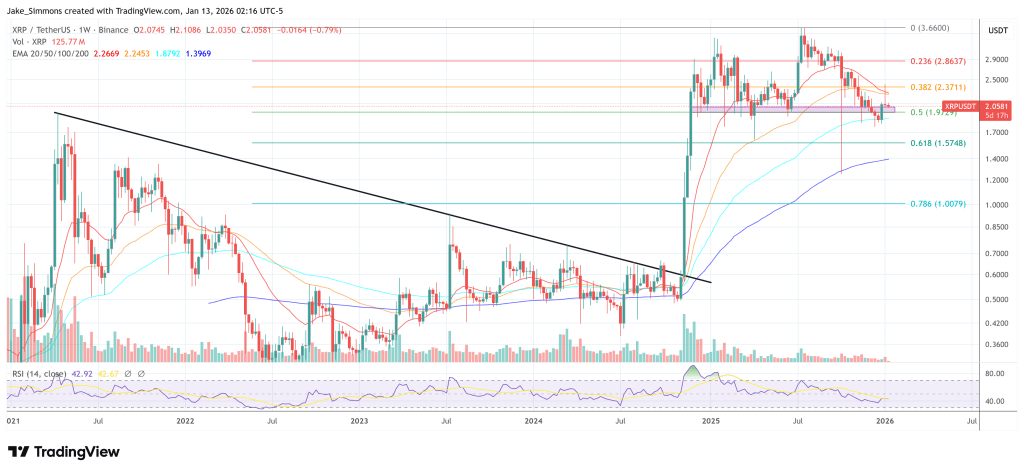
XRP rejected at the 0.382 Fib, 1-week chart | Source: XRPUSDT on TradingView.com

Criptomoedas em alta

Perguntas relacionadas

QWhat is the core argument Ripple makes to the SEC regarding the classification of tokens?

ARipple's core argument is that regulators should move away from using 'decentralization' as a legal metric because it creates uncertainty. Instead, jurisdiction should be grounded in 'legal rights and obligations,' focusing on enforceable promises, and it should be time-bound to the 'lifespan of the obligation' rather than treating an asset as permanently labeled as a security.

QWhy does Ripple argue that the SEC's jurisdiction should be time-bound?

ARipple argues that the SEC's jurisdiction should be time-bound to the 'lifespan of the obligation' to create a clear regulatory bright line. This means the SEC regulates the 'promise' while it exists but should liberate the 'asset' once that promise is fulfilled or ends, preventing the asset from being perpetually subject to securities laws based on its initial offering.

QWhat specific concern does Ripple raise about an entity holding inventory or contributing to development?

ARipple is concerned that an asset could be incorrectly classified as a security indefinitely simply because an entity (like Ripple itself) still holds a large inventory in escrow or continues to contribute to the asset's development through its developer arm (RippleX), creating what it calls 'false positive' outcomes and 'intolerable uncertainty.'

QHow does Ripple's argument relate to secondary-market trading of tokens like XRP?

ARipple argues that active secondary-market trading of a token should not itself be a jurisdictional hook for the SEC. It compares crypto markets to spot commodities like gold, asserting that once the initial obligation is fulfilled, the token should be free from securities-law oversight in secondary markets, where trades occur between unknown counterparties and the original issuer is merely another market actor.

QWhat legislative context does Ripple's letter reference, and why is the timing significant?

ARipple's letter references the House’s CLARITY Act of 2025 and Senate discussion drafts. The timing is significant because it was submitted on January 9, 2026, just days before a January 15 markup on comprehensive digital-asset market structure legislation in the US Senate Banking Committee, aiming to influence how classification and jurisdictional language is written into law.

Leituras Relacionadas

In Conversation with Ray Dalio: We Are Currently in an AI Bubble, with 1% of My Portfolio in Bitcoin

Ray Dalio, founder of Bridgewater Associates, warns in an interview that the current AI boom shows classic bubble characteristics, which could lead to significant economic downturns as seen in past cycles like 1929 or 2000. He explains that speculative enthusiasm, fueled by debt and overvaluation, often precedes a crash when rising rates or taxation force asset sales, causing widespread losses and recession. Dalio also outlines his "Big Cycle" theory, describing an approximate 80-year pattern where widening wealth gaps, massive government deficits, and shifting geopolitical power (like China's rise) create internal conflict and global instability. He emphasizes that we are in a late-cycle, transitional phase where traditional powers like the US and UK face decline. For personal wealth protection, Dalio advises diversification beyond cash into assets like stocks, bonds, real estate, and particularly gold, which he prefers over Bitcoin. While he holds about 1% of his portfolio in Bitcoin as a non-printable hard asset, he views gold as more secure from technological or governmental threats. Regarding AI's impact, Dalio believes it will disproportionately benefit capital owners, worsening inequality by replacing both physical and cognitive labor. He suggests that human intuition and emotional intelligence, combined with AI, will be key for future workers. On taxation, Dalio argues that wealth taxes are impractical and risk triggering asset sell-offs, reducing productive investment. He points to the UK as a cautionary example of debt, low productivity, and political strife. Geopolitically, Dalio foresees a more regionalized world, with the US showing weakness in prolonged conflicts like with Iran, akin to past imperial declines. The ideal outcome, he suggests, is coexisting powerful blocs (e.g., Americas, China-Asia Pacific) without major war.

marsbitHá 2h

In Conversation with Ray Dalio: We Are Currently in an AI Bubble, with 1% of My Portfolio in Bitcoin

marsbitHá 2h

Daily 7.2 Trillion KRW: Foreign Capital's Record Net Buying on Friday! Wall Street Says Headwinds for Korean Stock Fund Flows Have Subsided

South Korean stock market sees a dramatic shift in fund flows. On July 31, foreign investors made a record net purchase of approximately KRW 7.2 trillion in KOSPI stocks, marking a fundamental reversal from the persistent large-scale net outflows seen in previous months. This contributed to a significant narrowing of foreign net selling in July to KRW 9.8 trillion, down sharply from KRW 48.4 trillion in June and KRW 44.5 trillion in May. Simultaneously, domestic institutional pressure eased. South Korean pension funds and asset managers turned to a net buying position in July, purchasing KRW 1.0 trillion worth of KOSPI shares, contrasting with net sales in May and June. Market volatility is expected to be dampened by new financial regulations. Effective July 31, the Financial Services Commission tightened access for retail investors to single-stock leveraged ETFs by raising the minimum cash deposit requirement. Trading volumes for these products subsequently dropped to about 50% of their monthly average. Citigroup Research maintains its year-end KOSPI target of 10,000 points. The firm cites several supportive factors: the substantial easing of headwinds from capital outflows, a robust fundamental outlook for the semiconductor sector, historically low market valuations, strong economic fundamentals, and the potential for policy support from financial authorities if needed.

marsbitHá 2h

Daily 7.2 Trillion KRW: Foreign Capital's Record Net Buying on Friday! Wall Street Says Headwinds for Korean Stock Fund Flows Have Subsided

marsbitHá 2h

Thanks to Dice Rolls, Bitcoin Keys Are Stored Offline, But Not Everyone Will Do It

The article discusses using dice rolls to generate secure Bitcoin wallet seeds, providing entropy independent of potentially flawed hardware random number generators. It explains that each fair dice roll offers about 2.585 bits of entropy, with around 50 rolls needed for a standard 12-word seed phrase and 99+ recommended for higher security. This method gained attention after a vulnerability was revealed in some Coldcard hardware wallets, where a faulty firmware RNG (dating back to 2021) compromised generated keys. The analysis notes that while a dice-generated main seed was safe from this specific flaw, other Coldcard functions (like creating paper wallets, backup keys, or passwords) could still be vulnerable if they used the defective RNG. The piece argues that while dice-based entropy is technically robust, the manual process is error-prone, tedious, and unrealistic for most new users, who might make mistakes in recording or inputting rolls. It concludes that while manual entropy generation should remain an option for advanced users, the long-term goal is to develop reliable, user-friendly hardware and software that securely generates randomness without requiring specialized knowledge. Coldcard users are advised to check their firmware version and replace any secondary secrets (like paper wallet keys) created with vulnerable devices, while also considering multi-signature setups with devices from different manufacturers for added security.

cryptonews.ruHá 7h

Thanks to Dice Rolls, Bitcoin Keys Are Stored Offline, But Not Everyone Will Do It

cryptonews.ruHá 7h

Trading

Spot

Artigos em Destaque

O que é XRP 2.0

XRP 2.0: Uma Nova Fronteira no Landscape das Criptomoedas Introdução ao XRP 2.0 No reino em constante evolução das criptomoedas, novos projetos surgem continuamente, lutando por atenção e adoção. Uma dessas iniciativas promissoras é o XRP 2.0, um novo projeto de criptomoeda concebido para aproveitar a tecnologia de blockchain avançada e as metodologias de criptografia robustas. Embora o nome tenha paralelos com o XRP da Ripple, é crucial notar que o XRP 2.0 opera de forma independente, focando em melhorar a segurança das transações, a privacidade e a escalabilidade. À medida que o panorama financeiro digital abraça cada vez mais soluções descentralizadas, o XRP 2.0 visa contribuir de forma significativa para a web3 e a expansão global dos projetos de criptomoedas. O que é o XRP 2.0? No seu núcleo, o XRP 2.0 é um projeto de criptomoeda que visa criar um ecossistema de moeda digital seguro e descentralizado. Sua tecnologia fundamental integra princípios de blockchain sofisticados com técnicas de criptografia de ponta. O objetivo abrangente do XRP 2.0 é estabelecer-se como uma plataforma confiável e eficiente que possibilita a execução rápida de transações, priorizando a proteção de privacidade aprimorada para os seus usuários. O projeto é promovido como uma solução para muitas limitações enfrentadas pelas criptomoedas existentes, propondo um sistema que pode lidar com um volume maior de transações com velocidade e privacidade melhoradas. Esta versatilidade posiciona o XRP 2.0 como um concorrente significativo em um mercado repleto de várias moedas digitais. Quem é o Criador do XRP 2.0? A identidade do criador por trás do XRP 2.0 foi identificada como 'Wilbur.' No entanto, detalhes abrangentes sobre Wilbur ou a sua entidade associada permanecem elusivos. O anonimato de muitos criadores de criptomoedas não é um fenômeno incomum na indústria, muitas vezes concebido para manter um grau de privacidade e segurança. Quem são os Investidores do XRP 2.0? Até agora, informações específicas relacionadas às fundações ou organizações de investimento que apoiam o XRP 2.0 não estão disponíveis publicamente. No setor das criptomoedas, o apoio de investidores reputados pode influenciar significativamente a credibilidade e o sucesso de um projeto, no entanto, a transparência em relação aos apoiantes financeiros do XRP 2.0 não foi estabelecida. Como Funciona o XRP 2.0? O XRP 2.0 destaca-se por empregar uma combinação de tecnologia blockchain e algoritmos de criptografia avançados que asseguram transações seguras e descentralizadas. Sua estrutura inovadora inclui características únicas projetadas para fomentar o envolvimento dos usuários e ampliar as funcionalidades além das transações convencionais de criptomoedas. Entre essas características, o XRP 2.0 incorpora capacidades potenciadas por IA, como funcionalidades de texto-para-imagem e texto-para-fala. Estas adições são projetadas para melhorar a experiência interativa dos usuários, promovendo uma maior aplicabilidade em vários setores. Ao unir avanços tecnológicos com um design centrado no utilizador, o XRP 2.0 pretende captar a atenção de uma diversa gama de indivíduos e empresas que procuram integrar soluções de criptomoedas em suas estruturas operacionais. Cronologia do XRP 2.0 Compreender o XRP 2.0 requer examinar os marcos que definiram sua jornada até agora: 23 de Julho de 2023: O XRP 2.0 é apresentado como um novo projeto de criptomoeda, visando revolucionar as capacidades de transação seguras e descentralizadas no domínio do blockchain. 8 de Setembro de 2023: O lançamento de outro projeto, XRP20, ocorre, marcando o surgimento de um token ERC-20 na blockchain Ethereum que permanece não relacionado ao XRP 2.0. 13 de Novembro de 2023: O XRP Ledger passa por uma atualização significativa com o lançamento da versão 2.0.0 do software do servidor rippled. É importante notar que este desenvolvimento está desconectado do projeto de criptomoeda XRP 2.0. Pontos-chave sobre o XRP 2.0 Para destilar a essência do XRP 2.0, vários fatores críticos emergem: Características Únicas: A inclusão de características como texto-para-imagem e texto-para-fala potenciadas por IA diversifica ainda mais as aplicações potenciais do XRP 2.0. Tecnologia Blockchain: A estrutura utiliza mecanismos de blockchain avançados e protocolos de criptografia, assegurando um ambiente seguro e descentralizado para transações. Escalabilidade e Privacidade: O XRP 2.0 prioriza proteção de privacidade aprimorada nos processos de transação e a escalabilidade necessária para acomodar uma base de utilizadores crescente. Sem Afiliação com a Ripple: Importante, apesar do seu nome, o XRP 2.0 não tem qualquer lealdade ou colaboração com o XRP da Ripple, distinguindo sua estrutura operacional e objetivos dentro do ecossistema das criptomoedas. Conclusão O XRP 2.0 representa uma empreitada ambiciosa no domínio das criptomoedas, visando oferecer uma combinação de segurança, privacidade e eficiência em transações digitais. Ao integrar tecnologias sofisticadas e características amigáveis ao utilizador, o projeto propõe-se a ampliar os horizontes do que as criptomoedas podem alcançar na economia digital atual. Embora o anonimato do seu criador e a falta de investidores divulgados possam levantar questões para alguns, o foco do XRP 2.0 em funcionalidades avançadas e descentralização aumenta seu apelo num mercado de criptomoedas cada vez mais congestionado. À medida que o panorama das criptomoedas continua a evoluir, o XRP 2.0 pode ainda emergir como um jogador crucial na expansão de soluções de blockchain seguras e escaláveis.

174 Visualizações TotaisPublicado em {updateTime}Atualizado em 2024.12.03

O que é XRP 2.0

Como comprar XRP

Bem-vindo à HTX.com!Tornámos a compra de XRP (XRP) simples e conveniente.Segue o nosso guia passo a passo para iniciar a tua jornada no mundo das criptos.Passo 1: cria a tua conta HTXUtiliza o teu e-mail ou número de telefone para te inscreveres numa conta gratuita na HTX.Desfruta de um processo de inscrição sem complicações e desbloqueia todas as funcionalidades.Obter a minha contaPasso 2: vai para Comprar Cripto e escolhe o teu método de pagamentoCartão de crédito/débito: usa o teu visa ou mastercard para comprar XRP (XRP) instantaneamente.Saldo: usa os fundos da tua conta HTX para transacionar sem problemas.Terceiros: adicionamos métodos de pagamento populares, como Google Pay e Apple Pay, para aumentar a conveniência.P2P: transaciona diretamente com outros utilizadores na HTX.Mercado de balcão (OTC): oferecemos serviços personalizados e taxas de câmbio competitivas para os traders.Passo 3: armazena teu XRP (XRP)Depois de comprar o teu XRP (XRP), armazena-o na tua conta HTX.Alternativamente, podes enviá-lo para outro lugar através de transferência blockchain ou usá-lo para transacionar outras criptomoedas.Passo 4: transaciona XRP (XRP)Transaciona facilmente XRP (XRP) no mercado à vista da HTX.Acede simplesmente à tua conta, seleciona o teu par de trading, executa as tuas transações e monitoriza em tempo real.Oferecemos uma experiência de fácil utilização tanto para principiantes como para traders experientes.

1.8k Visualizações TotaisPublicado em {updateTime}Atualizado em 2026.06.02

Como comprar XRP

Discussões

Bem-vindo à Comunidade HTX. Aqui, pode manter-se informado sobre os mais recentes desenvolvimentos da plataforma e obter acesso a análises profissionais de mercado. As opiniões dos utilizadores sobre o preço de XRP (XRP) são apresentadas abaixo.

活动图片














