Ripple Joins Top 10 Global Private Companies With A $50B Valuation

bitcoinistPublicado em 2026-02-10Última atualização em 2026-02-10

Resumo

Ripple has been ranked among the top 10 most valuable private companies globally, with an estimated valuation of $50 billion, according to a widely shared "unicorn companies" list on X. This positions Ripple alongside major AI and fintech firms like OpenAI, ByteDance, and SpaceX. The valuation marks a significant increase from its $40 billion late-2025 financing, suggesting a sharp upward revaluation. Unlike public companies, Ripple's value is shaped by private transactions, including share buybacks at lower valuations in 2022 and 2024. The ranking reframes Ripple as a large-scale payments infrastructure business rather than a crypto-focused narrative. However, with no imminent IPO plans, its valuation remains subject to periodic private market activity. At the time of reporting, XRP was trading at $1.40.

Ripple has been slotted into the global top 10 of the most valuable private companies at an estimated $50 billion valuation, according to a widely shared “unicorn companies” table circulating on X.

The ranking matters because it reframes Ripple less as a single-token narrative and more as a scaled private-market franchise: a payments infrastructure firm that, at least in secondary valuation terms, is now being discussed in the same breath as the largest AI and fintech “super-unicorns.”

Ripple Ranks #9 Among World’s Largest Private Companies

The image that has been widely reposted on X presents a “List of unicorn companies” with Ripple highlighted at a $50 billion valuation. In that snapshot, Ripple appears alongside a cohort dominated by AI, fintech, and consumer platforms, including OpenAI ($500B), ByteDance ($480B), SpaceX ($400B), Anthropic ($350B), xAI ($230B), Databricks ($100B), Revolut ($75B), Stripe ($70B), and Shein ($66B).
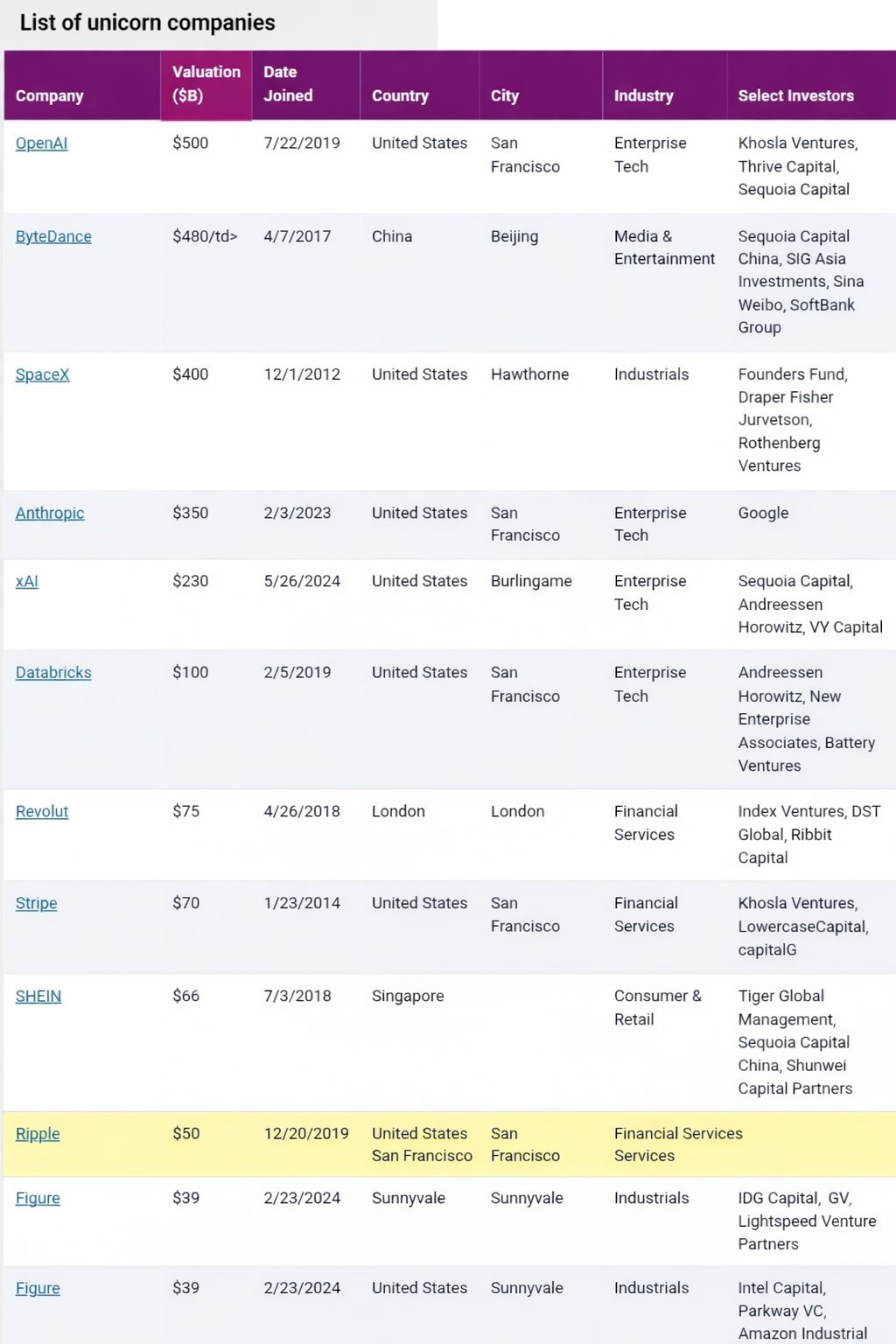
Ripple valuation enters top 10 | Source: X @Xaif_Crypto

A $50 billion tag implies a step-up from a $40 billion post-money valuation associated with a late-2025 equity financing. Taking those two marks at face value, the move to $50 billion represents roughly a 25% increase in implied enterprise value in a short window, an unusually sharp change for a late-stage private company unless secondary markets are repricing aggressively or a new transaction has reset expectations.

Ripple’s private valuation history has also been shaped by company-led liquidity events. The firm has previously conducted share repurchases that effectively created valuation reference points for employees and early investors, including buybacks at an implied $15 billion valuation in 2022 and $11.3 billion in early 2024. Against that backdrop, the late-2025 jump to $40 billion and the current $50 billion figure depict a company whose private-market value has been re-marked upward in distinct steps rather than through the continuous feedback loop of public markets.

That context also matters for how traders and allocators interpret the headline. Private valuations are not the same thing as liquid market prices, and they can reflect transaction structure, preferred terms, or limited float dynamics as much as broad investor consensus. Still, when a company starts appearing on top-10 private-company lists dominated by AI and mega-fintech, it signals that the market increasingly views it as an infrastructure-scale business rather than a niche crypto-adjacent story.

The valuation narrative is also colliding with IPO expectations and Ripple’s consistent stance that a listing is not imminent. With no near-term plan or timeline to go public, Ripple’s price discovery remains anchored to episodic financings and tender offers, meaning the next meaningful datapoint could come from another private round, a new buyback, or secondary transactions that leak into the market.

For crypto markets, the immediate implication isn’t a direct token catalyst so much as a reframing of Ripple’s corporate footprint. If the $50 billion valuation is true, it sets a higher bar for how investors model the company’s optionality: whether that’s future capital raising, M&A capacity, or leverage in institutional partnerships. If it doesn’t, the episode will still have demonstrated how quickly private-market narratives can harden into “consensus” once a single, shareable number hits the timeline.

At press time, XRP traded at $1.40.
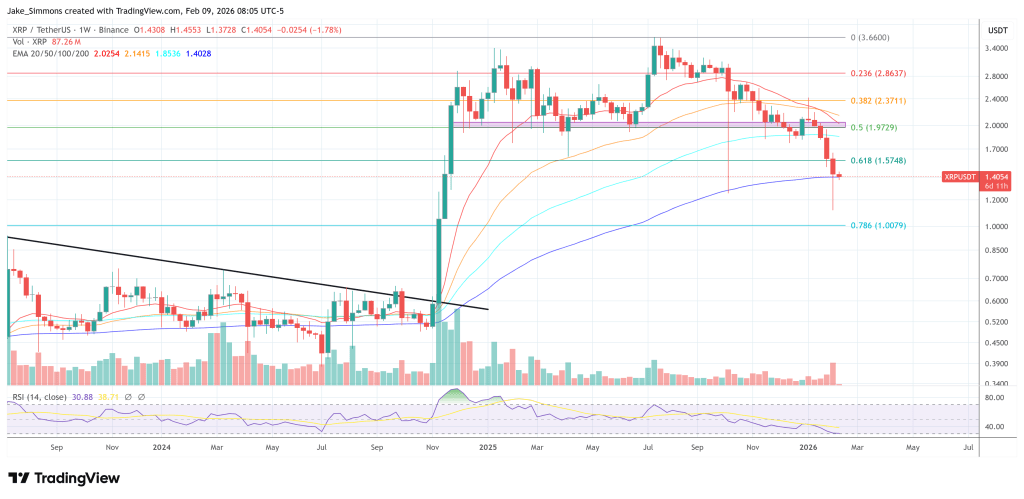
XRP holds above the 200-week EMA, 1-week chart | Source: XRPUSDT on TradingView.com

Perguntas relacionadas

QWhat is Ripple's estimated valuation according to the widely shared 'unicorn companies' table?

ARipple's estimated valuation is $50 billion.

QHow does the $50 billion valuation rank Ripple among global private companies?

AIt ranks Ripple as the #9 most valuable private company in the world.

QWhat type of companies dominate the top 10 list alongside Ripple?

AThe list is dominated by AI, fintech, and consumer platform companies.

QWhat does the article say about Ripple's plans for an IPO?

ARipple has a consistent stance that an IPO is not imminent, with no near-term plan or timeline to go public.

QWhat was the price of XRP at the time the article was published?

AXRP traded at $1.40 at press time.

Leituras Relacionadas

Borrowing Money from a Hundred Years Later, Building Incomprehensible AI

Tech giants like Alphabet, Amazon, Meta, and Microsoft are undergoing a radical financial transformation due to AI. Their traditional "light-asset, high-free-cash-flow" model is being dismantled by staggering capital expenditures on AI infrastructure—data centers, GPUs, and power. Combined 2026 guidance exceeds $700 billion, a 4.5x increase from 2022, causing free cash flow to plummet (e.g., Amazon's fell 95%). To fund this, they are borrowing unprecedented sums through long-dated, multi-currency bonds (e.g., Alphabet's 100-year bond). The world's most conservative capital—pensions, insurers—is now funding Silicon Valley's most speculative bet. This shift makes these companies resemble heavy-asset industrials (railroads, utilities) rather than software firms, threatening their premium valuations. Historically, such infrastructure booms (railroads, fiber optics) followed a pattern: genuine technology, overbuilding fueled by competitive frenzy, aggressive debt financing, and a crash triggered by financial conditions—not technology failure. The infrastructure remained, but many original builders and financiers did not survive. The core gamble is a "time arbitrage": using cheap debt today to build scale and lock in customers before AI capabilities commoditize. They are betting that AI revenue will materialize before debt comes due. Their positions vary: Amazon is under immediate cash pressure; Meta's path to monetization is unclear; Alphabet has a robust core business buffer; Microsoft has the shortest path from infrastructure to revenue. The contract is set: the most risk-averse global capital has lent its time to Silicon Valley, awaiting a future that is promised but uncertain.

marsbitHá 30m

Borrowing Money from a Hundred Years Later, Building Incomprehensible AI

marsbitHá 30m

The 'VVV' Concept Soars 9x in Half a Year, The New AI Narrative on Base Chain

"The article explores the 'VVV' concept as the new AI-focused narrative within the Base ecosystem, centered around the token $VVV of the privacy-focused, uncensored generative AI platform Venice, led by crypto veteran Erik Voorhees. Venice has seen significant growth in 2026, with its API users surging, partly attributed to exposure from OpenClaw. The platform now boasts over 2 million total users and 55,000 paid subscribers. Correspondingly, the $VVV token price has risen over 9x this year. Key to its performance are tokenomics designed for value accrual: reduced annual emissions, subscription revenue used for buyback-and-burn, and a unique staking mechanism. Staking $VVV yields $sVVV, which can be used to mint $DIEM tokens. Each staked $DIEM provides a daily $1 credit for using Venice's API services, creating tangible utility. The article also highlights other tokens associated with the 'VVV' narrative. $POD, the token of distributed AI network Dolphin (which co-developed Venice's default AI model), saw a massive price surge. $cyb3rwr3n, a project for a Venice credit auction market, gained attention due to perceived connections to Venice's team despite official denials. Finally, $SR of robotics platform STRIKEROBOT.AI rose after announcing a partnership with Venice for robot vision-language model development. Overall, the 'VVV' ecosystem combines AI platform growth, deflationary tokenomics, and innovative utility mechanisms, driving significant investor interest and price action in related tokens."

marsbitHá 39m

The 'VVV' Concept Soars 9x in Half a Year, The New AI Narrative on Base Chain

marsbitHá 39m

Anthropic and OpenAI Have Single-Handedly Severed the Logic of Pre-IPO Stock Tokenization

The pre-IPO stock token market is experiencing significant turmoil following strong statements from AI giants Anthropic and OpenAI. Both companies have updated their official policies, declaring that any transfer of their company shares—including sales, transfers, or assignments of share interests—without prior board approval is "invalid" and will not be recognized in their corporate records. This means buyers in such unauthorized transactions would not be recognized as shareholders and would have no shareholder rights. A major point of contention is the use of Special Purpose Vehicles (SPVs), which are legal entities commonly used by pre-IPO token platforms to pool investor funds and indirectly acquire shares from employees or early investors. The companies explicitly state they do not permit SPVs to acquire their shares, and any such transfer violates their restrictions. They warn that third parties selling shares through SPVs, direct sales, forward contracts, or stock tokens are likely engaged in fraud or are offering worthless investments due to these transfer limits. This stance directly threatens the core model of many pre-IPO token platforms, which rely on SPV structures. The announcement revealed additional risks within this model, such as complex "SPV-within-SPV" layering that obscures legal transparency, increases management fees, and creates a chain reaction risk of invalidation. Following the news, tokens like ANTHROPIC and OPENAI on platforms like PreStocks fell sharply (over 20%). The market reaction highlights a divergence: while asset-backed pre-IPO tokens plummeted, purely speculative pre-IPO futures contracts, which are bilateral bets on future IPO prices with no claim to actual shares, remained relatively stable as they are unaffected by the transfer restrictions. The industry is split on the implications. Some believe the fundamental logic of pre-IPO token trading is broken if leading companies reject SPV-held shares, potentially causing a domino effect. Others, like Rivet founder Nick Abouzeid, argue that buyers of such unofficial tokens always knowingly accepted the risk of non-recognition by the company. The statements serve as a stark risk warning and a corrective measure for a market where valuations for some AI-related pre-IPO tokens had soared to irrational levels, far exceeding recent funding round valuations.

marsbitHá 1h

Anthropic and OpenAI Have Single-Handedly Severed the Logic of Pre-IPO Stock Tokenization

marsbitHá 1h

Anthropic and OpenAI Personally Sever the Logic of Pre-IPO Crypto-Stocks

The pre-IPO token market has been rocked by strong statements from Anthropic and OpenAI. Both AI giants have updated official warnings, declaring that any sale or transfer of their company shares without explicit board approval is "invalid" and will not be recognized on their corporate records. This directly targets Special Purpose Vehicles (SPVs), the common legal structure used by pre-IPO token platforms. These platforms typically use an SPV to acquire shares from employees or early investors, then issue blockchain-based tokens representing a claim on the SPV's economic benefits. Anthropic and OpenAI's position means that if an SPV's share purchase lacked authorization, the underlying asset could be deemed worthless, nullifying the token's value. Anthropic explicitly warned that any third party selling its shares—via direct sales, forwards, or tokens—is likely fraudulent or offering a valueless investment. The crackdown highlights risks in the popular SPV model, including complex multi-layered "Russian doll" SPV structures that obscure legal ownership, add fees, and concentrate risk. If one layer is invalidated, the entire chain could collapse. Following the announcements, tokens like ANTHROPIC and OPENAI on platforms like PreStocks fell sharply (over 20%). In contrast, purely speculative pre-IPO prediction contracts remained stable, as they involve no actual share ownership. The move is seen as a corrective measure amid a market frenzy where some pre-IPO token valuations (e.g., Anthropic's token hitting a $1.4 trillion implied valuation) far exceeded recent official funding rounds. Opinions are split: some believe this undermines the core logic of pre-IPO token trading if top companies reject SPVs, while others argue buyers always assumed this legal risk when accessing unofficial channels. The statements serve as a stark warning and a potential catalyst for market de-leveraging and clearer boundaries.

Odaily星球日报Há 1h

Anthropic and OpenAI Personally Sever the Logic of Pre-IPO Crypto-Stocks

Odaily星球日报Há 1h

Trading

Spot
Futuros

Artigos em Destaque

Como comprar COMP

Bem-vindo à HTX.com!Tornámos a compra de Compound (COMP) simples e conveniente.Segue o nosso guia passo a passo para iniciar a tua jornada no mundo das criptos.Passo 1: cria a tua conta HTXUtiliza o teu e-mail ou número de telefone para te inscreveres numa conta gratuita na HTX.Desfruta de um processo de inscrição sem complicações e desbloqueia todas as funcionalidades.Obter a minha contaPasso 2: vai para Comprar Cripto e escolhe o teu método de pagamentoCartão de crédito/débito: usa o teu visa ou mastercard para comprar Compound (COMP) instantaneamente.Saldo: usa os fundos da tua conta HTX para transacionar sem problemas.Terceiros: adicionamos métodos de pagamento populares, como Google Pay e Apple Pay, para aumentar a conveniência.P2P: transaciona diretamente com outros utilizadores na HTX.Mercado de balcão (OTC): oferecemos serviços personalizados e taxas de câmbio competitivas para os traders.Passo 3: armazena teu Compound (COMP)Depois de comprar o teu Compound (COMP), armazena-o na tua conta HTX.Alternativamente, podes enviá-lo para outro lugar através de transferência blockchain ou usá-lo para transacionar outras criptomoedas.Passo 4: transaciona Compound (COMP)Transaciona facilmente Compound (COMP) no mercado à vista da HTX.Acede simplesmente à tua conta, seleciona o teu par de trading, executa as tuas transações e monitoriza em tempo real.Oferecemos uma experiência de fácil utilização tanto para principiantes como para traders experientes.

246 Visualizações TotaisPublicado em {updateTime}Atualizado em 2025.03.21

Como comprar COMP

Discussões

Bem-vindo à Comunidade HTX. Aqui, pode manter-se informado sobre os mais recentes desenvolvimentos da plataforma e obter acesso a análises profissionais de mercado. As opiniões dos utilizadores sobre o preço de COMP (COMP) são apresentadas abaixo.

活动图片