Ripple IPO Could Bring ‘Something Special’ For XRP Holders, CEO Suggests

bitcoinistPublicado em 2026-05-08Última atualização em 2026-05-08

Resumo

Ripple CEO Brad Garlinghouse suggested XRP holders could receive "something special" if the company goes public, though he stressed an IPO is not an immediate priority. He addressed community concerns about Ripple's corporate success not directly benefiting XRP holders, stating the company's main contribution is building products and partnerships to increase XRP's utility and value. While not endorsing a near-term mechanism like a token buyback, Garlinghouse left open the possibility of a future IPO-related benefit for holders. He explained Ripple is not rushing to go public, citing poor recent crypto IPO performance and the benefits of remaining private. Garlinghouse also rejected concerns that Ripple's expansion into areas like stablecoins dilutes XRP's role, arguing the company, as the largest XRP holder, remains deeply incentivized to see the asset succeed. He reaffirmed his commitment to the XRP community, calling it a driving mission for the company.

Ripple CEO Brad Garlinghouse suggested that XRP holders could potentially receive “something special” if Ripple eventually goes public, while stressing that any such move is not an immediate priority for the company.

Speaking with Eleanor Terrett on the Crypto In America podcast at XRP Las Vegas, Garlinghouse addressed one of the more sensitive questions inside the XRP community: whether holders of the token should benefit more directly from the firm’s corporate success as the company’s valuation, acquisitions and institutional footprint continue to expand.

Garlinghouse Addresses XRP Holder Benefits

The exchange came after Terrett noted criticism that Ripple has become a major private-company success story while XRP holders remain economically separate from Ripple’s equity. Ripple, Garlinghouse said, was last valued at $50 billion in a share buyback, a figure that has intensified debate over whether the company’s growth should translate into a more direct benefit for the XRP community.

Asked whether the company had explored an XRP token buyback or another structure that would allow holders to share in Ripple’s wealth, Garlinghouse did not endorse a near-term mechanism. Instead, he framed the firm’s contribution as indirect but central: building products, infrastructure and partnerships that increase XRP’s utility, liquidity and trust.

“I hope XRP holders feel like they are benefiting from Ripple’s existence by virtue of what we’re doing to try to catalyze things within the XRP community,” Garlinghouse said. “Is there a scenario if and when Ripple goes public, would we do something special for people who hold XRP or something? Maybe. But I mean, that’s not in the immediate term.”

That “maybe” is likely to draw attention because it leaves open a possibility the company has rarely discussed publicly: a future IPO-related benefit tied to XRP ownership. Garlinghouse was careful, however, not to describe it as a plan, commitment or pending corporate action.

Ripple Still Not Rushing Toward An IPO

Garlinghouse also made clear that Ripple is not currently prioritizing a public listing. He pointed to recent crypto IPO performance as one reason the company is not in a hurry, citing BitGo and Gemini as examples of deals that “haven’t done particularly well,” and noting that Kraken has reportedly delayed its own listing plans.

“The long-term dynamic, you know, we have not prioritized going public for a whole bunch of reasons,” he said. “There’s benefits to being private. Like, I could get up here and kind of say whatever the hell I want to say.”

His remarks suggest that any special structure for XRP holders would depend on a much broader corporate decision that remains unresolved. Ripple may have the valuation and market profile of a company that could eventually test public markets, but Garlinghouse framed the IPO question as distant rather than imminent.

The discussion also touched on a recurring concern among parts of the XRP community: whether Ripple’s expansion into stablecoins, prime brokerage, treasury products and institutional infrastructure could dilute XRP’s role in the company’s strategy.

Garlinghouse rejected that reading. He argued that Ripple remains deeply aligned with XRP because the company is still the largest holder of the asset and has the strongest economic incentive to see it succeed.

“Today, Ripple is still the largest holder of XRP on the planet,” he said. “We are the most interested party in seeing XRP be successful. We will continue to be the most interested party in seeing XRP be successful.”

He added that Ripple’s strategy is designed around making XRP “the most useful digital asset,” “the most liquid digital asset” and “the most trusted digital asset.” In his telling, even initiatives that do not appear immediately connected to XRP can still serve that broader objective through a longer route.

“I don’t feel the need to constantly update the whole world about our strategy because to some degree that just informs people who want to compete against us,” Garlinghouse said. “We’re going to do things that may not at first blush make crystal clear sense. But I swear to you, even if it doesn’t have a direct line from point A to point B, point B being good for XRP, it may be point A to point B to point B to point C.”

That explanation appeared aimed at criticism around Ripple’s RLUSD stablecoin and broader institutional push. Garlinghouse’s argument is that Ripple’s corporate expansion is not a pivot away from XRP, but part of a larger effort to deepen institutional rails around the XRP Ledger and related liquidity.

Garlinghouse repeatedly emphasized his loyalty to the community, calling it the “XRP family” and saying he wants Ripple to make decisions that are good for that ecosystem. He pointed to acquisitions, external investments and support for digital asset treasury company Evernorth as examples of initiatives Ripple views through that lens.

“I freaking love the XRP family,” he said. “I want to do things that are good for the XRP community. It is a driving mission.”

At press time, XRP traded at $1.379.
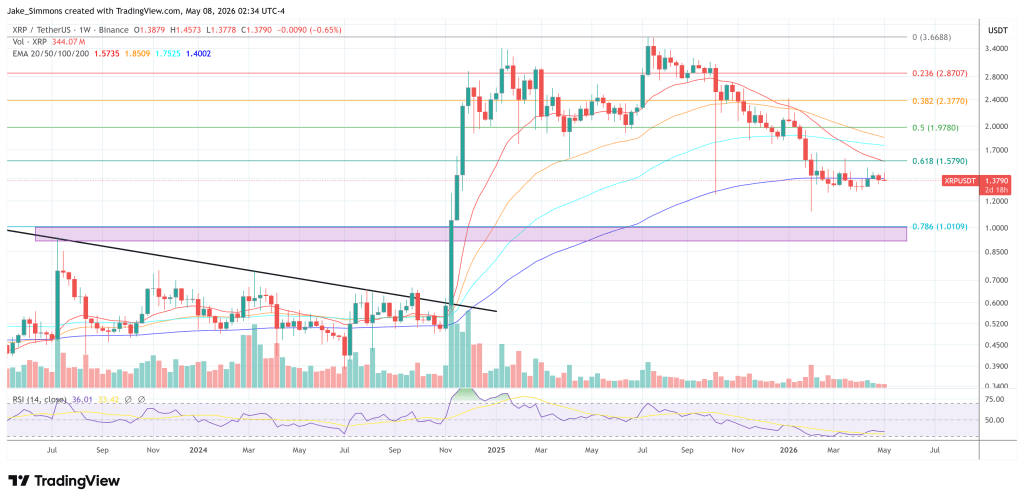
XRP trades around the 200-week EMA again, 1-week chart | Source: XRPUSDT on TradingView.com

Criptomoedas em alta

Perguntas relacionadas

QWhat potential benefit did Ripple CEO Brad Garlinghouse suggest XRP holders might receive if the company goes public?

ABrad Garlinghouse suggested that XRP holders could potentially receive 'something special' if Ripple eventually conducts an IPO, though he emphasized this is not a current plan or commitment.

QAccording to Garlinghouse, what is Ripple's primary contribution to the XRP community currently?

AGarlinghouse stated that Ripple's primary contribution is indirect, focusing on building products, infrastructure, and partnerships that increase XRP's utility, liquidity, and trust.

QWhy is Ripple not currently prioritizing a public listing (IPO), as stated by its CEO?

ARipple is not prioritizing an IPO due to the poor performance of recent crypto IPOs (citing BitGo and Gemini as examples) and the benefits of remaining a private company, such as greater freedom in public statements.

QHow did Garlinghouse address concerns that Ripple's expansion into other areas could dilute XRP's role in its strategy?

AGarlinghouse rejected this concern, arguing that Ripple remains the largest holder of XRP and has the strongest economic incentive for its success. He stated that all corporate initiatives, even those not directly linked, are part of a broader strategy to make XRP the most useful, liquid, and trusted digital asset.

QWhat was the trading price of XRP mentioned at the end of the article?

AAt press time, XRP was trading at $1.379.

Leituras Relacionadas

The Verdict in Choi Tae-won's Divorce Case: Revealing the Inheritance Undercurrent Behind SK Hynix's Trillion-Won Empire

SK Group Chairman Chey Tae-won's high-profile divorce case, involving a record 1.38 trillion won settlement, has drawn attention to the succession plans for Korea's second-largest conglomerate, especially its crown jewel, SK hynix. Unlike traditional chaebol scripts centered on the eldest son, Chey's three children from his marriage to former President Roh Tae-woo's daughter, Roh Soh-yeong, are carving distinct, non-traditional paths. Eldest daughter Chey Yun-jung (b. 1989) is seen as the most evident successor. With a scientific and consulting background, she holds executive roles at SK bioscience and SK Inc.'s growth support department, focusing on future strategy and biopharma. Her marriage is to an AI infrastructure entrepreneur, not a traditional business alliance. Second daughter Chey Min-jung (b. 1991) took a unique route, voluntarily serving as a South Korean naval officer, including an anti-piracy deployment. She later worked on policy and strategy for SK hynix in Washington D.C. before co-founding an AI-driven healthcare startup. She married a former U.S. Marine Corps officer, connecting her to U.S. defense and policy circles—networks crucial for a global semiconductor giant. The only son, Chey In-geun (b. 1995), who studied physics like his father, worked briefly at SK E&S before joining McKinsey. Despite fitting the traditional "heir" profile as the eldest son, he remains silent and holds no public position or shares in SK, suggesting the old succession playbook is obsolete. As SK hynix's valuation soars, becoming a geopolitical asset in the AI era, the heirs' legitimacy is no longer automatic. They must prove themselves in fields like AI biotech, global policy, and strategic consulting. Their marriages also reflect new elite networks in tech and defense, not old political alliances. Their inheritance is the complex challenge of navigating a globalized, tech-driven world, not just a corporate throne.

marsbitHá 11h

The Verdict in Choi Tae-won's Divorce Case: Revealing the Inheritance Undercurrent Behind SK Hynix's Trillion-Won Empire

marsbitHá 11h

From OpenSea to OpenRouter: Is Alex Atallah Repeating His 'Exit at the Peak' Playbook?

From OpenSea to OpenRouter: Is Alex Atallah Repeating His "Exit at the Peak" Playbook? According to the Wall Street Journal, payments giant Stripe is in talks to acquire the AI model aggregation platform OpenRouter in a potential deal valuing the company near $100 billion. This would mark founder Alex Atallah's second creation of a company reaching a $100 billion valuation, following his co-founding of NFT marketplace OpenSea. OpenRouter, founded just over three years ago, has grown rapidly by acting as a unified gateway for developers to access over 400 AI models. It currently has about 10 million users and processes over 200 trillion tokens monthly. While the platform's annualized revenue is around $50 million, its valuation has skyrocketed from $1.3 billion in March 2026. The potential acquisition by Stripe, a company OpenRouter's founder once likened it to, represents a major expansion into AI infrastructure for the payments leader. This move echoes Atallah's previous timing with OpenSea, where he departed before the NFT market's significant downturn. For OpenRouter, selling now may be strategic. Despite its scale, its business model—charging a 5-5.5% fee on AI inference calls—faces pressure from competition, open-source models, and potential price wars among model providers, limiting its profitability narrative for an IPO. A key asset for potential acquirers like Stripe is OpenRouter's vast repository of real-world AI usage data, which offers unique insights into model performance and developer preferences that are difficult to replicate. Whether this potential deal signifies a new valuation benchmark for AI infrastructure or another market peak signal remains to be seen.

链捕手Há 11h

From OpenSea to OpenRouter: Is Alex Atallah Repeating His 'Exit at the Peak' Playbook?

链捕手Há 11h

Trading

Spot

Artigos em Destaque

O que é XRP 2.0

XRP 2.0: Uma Nova Fronteira no Landscape das Criptomoedas Introdução ao XRP 2.0 No reino em constante evolução das criptomoedas, novos projetos surgem continuamente, lutando por atenção e adoção. Uma dessas iniciativas promissoras é o XRP 2.0, um novo projeto de criptomoeda concebido para aproveitar a tecnologia de blockchain avançada e as metodologias de criptografia robustas. Embora o nome tenha paralelos com o XRP da Ripple, é crucial notar que o XRP 2.0 opera de forma independente, focando em melhorar a segurança das transações, a privacidade e a escalabilidade. À medida que o panorama financeiro digital abraça cada vez mais soluções descentralizadas, o XRP 2.0 visa contribuir de forma significativa para a web3 e a expansão global dos projetos de criptomoedas. O que é o XRP 2.0? No seu núcleo, o XRP 2.0 é um projeto de criptomoeda que visa criar um ecossistema de moeda digital seguro e descentralizado. Sua tecnologia fundamental integra princípios de blockchain sofisticados com técnicas de criptografia de ponta. O objetivo abrangente do XRP 2.0 é estabelecer-se como uma plataforma confiável e eficiente que possibilita a execução rápida de transações, priorizando a proteção de privacidade aprimorada para os seus usuários. O projeto é promovido como uma solução para muitas limitações enfrentadas pelas criptomoedas existentes, propondo um sistema que pode lidar com um volume maior de transações com velocidade e privacidade melhoradas. Esta versatilidade posiciona o XRP 2.0 como um concorrente significativo em um mercado repleto de várias moedas digitais. Quem é o Criador do XRP 2.0? A identidade do criador por trás do XRP 2.0 foi identificada como 'Wilbur.' No entanto, detalhes abrangentes sobre Wilbur ou a sua entidade associada permanecem elusivos. O anonimato de muitos criadores de criptomoedas não é um fenômeno incomum na indústria, muitas vezes concebido para manter um grau de privacidade e segurança. Quem são os Investidores do XRP 2.0? Até agora, informações específicas relacionadas às fundações ou organizações de investimento que apoiam o XRP 2.0 não estão disponíveis publicamente. No setor das criptomoedas, o apoio de investidores reputados pode influenciar significativamente a credibilidade e o sucesso de um projeto, no entanto, a transparência em relação aos apoiantes financeiros do XRP 2.0 não foi estabelecida. Como Funciona o XRP 2.0? O XRP 2.0 destaca-se por empregar uma combinação de tecnologia blockchain e algoritmos de criptografia avançados que asseguram transações seguras e descentralizadas. Sua estrutura inovadora inclui características únicas projetadas para fomentar o envolvimento dos usuários e ampliar as funcionalidades além das transações convencionais de criptomoedas. Entre essas características, o XRP 2.0 incorpora capacidades potenciadas por IA, como funcionalidades de texto-para-imagem e texto-para-fala. Estas adições são projetadas para melhorar a experiência interativa dos usuários, promovendo uma maior aplicabilidade em vários setores. Ao unir avanços tecnológicos com um design centrado no utilizador, o XRP 2.0 pretende captar a atenção de uma diversa gama de indivíduos e empresas que procuram integrar soluções de criptomoedas em suas estruturas operacionais. Cronologia do XRP 2.0 Compreender o XRP 2.0 requer examinar os marcos que definiram sua jornada até agora: 23 de Julho de 2023: O XRP 2.0 é apresentado como um novo projeto de criptomoeda, visando revolucionar as capacidades de transação seguras e descentralizadas no domínio do blockchain. 8 de Setembro de 2023: O lançamento de outro projeto, XRP20, ocorre, marcando o surgimento de um token ERC-20 na blockchain Ethereum que permanece não relacionado ao XRP 2.0. 13 de Novembro de 2023: O XRP Ledger passa por uma atualização significativa com o lançamento da versão 2.0.0 do software do servidor rippled. É importante notar que este desenvolvimento está desconectado do projeto de criptomoeda XRP 2.0. Pontos-chave sobre o XRP 2.0 Para destilar a essência do XRP 2.0, vários fatores críticos emergem: Características Únicas: A inclusão de características como texto-para-imagem e texto-para-fala potenciadas por IA diversifica ainda mais as aplicações potenciais do XRP 2.0. Tecnologia Blockchain: A estrutura utiliza mecanismos de blockchain avançados e protocolos de criptografia, assegurando um ambiente seguro e descentralizado para transações. Escalabilidade e Privacidade: O XRP 2.0 prioriza proteção de privacidade aprimorada nos processos de transação e a escalabilidade necessária para acomodar uma base de utilizadores crescente. Sem Afiliação com a Ripple: Importante, apesar do seu nome, o XRP 2.0 não tem qualquer lealdade ou colaboração com o XRP da Ripple, distinguindo sua estrutura operacional e objetivos dentro do ecossistema das criptomoedas. Conclusão O XRP 2.0 representa uma empreitada ambiciosa no domínio das criptomoedas, visando oferecer uma combinação de segurança, privacidade e eficiência em transações digitais. Ao integrar tecnologias sofisticadas e características amigáveis ao utilizador, o projeto propõe-se a ampliar os horizontes do que as criptomoedas podem alcançar na economia digital atual. Embora o anonimato do seu criador e a falta de investidores divulgados possam levantar questões para alguns, o foco do XRP 2.0 em funcionalidades avançadas e descentralização aumenta seu apelo num mercado de criptomoedas cada vez mais congestionado. À medida que o panorama das criptomoedas continua a evoluir, o XRP 2.0 pode ainda emergir como um jogador crucial na expansão de soluções de blockchain seguras e escaláveis.

140 Visualizações TotaisPublicado em {updateTime}Atualizado em 2024.12.03

O que é XRP 2.0

Como comprar XRP

Bem-vindo à HTX.com!Tornámos a compra de XRP (XRP) simples e conveniente.Segue o nosso guia passo a passo para iniciar a tua jornada no mundo das criptos.Passo 1: cria a tua conta HTXUtiliza o teu e-mail ou número de telefone para te inscreveres numa conta gratuita na HTX.Desfruta de um processo de inscrição sem complicações e desbloqueia todas as funcionalidades.Obter a minha contaPasso 2: vai para Comprar Cripto e escolhe o teu método de pagamentoCartão de crédito/débito: usa o teu visa ou mastercard para comprar XRP (XRP) instantaneamente.Saldo: usa os fundos da tua conta HTX para transacionar sem problemas.Terceiros: adicionamos métodos de pagamento populares, como Google Pay e Apple Pay, para aumentar a conveniência.P2P: transaciona diretamente com outros utilizadores na HTX.Mercado de balcão (OTC): oferecemos serviços personalizados e taxas de câmbio competitivas para os traders.Passo 3: armazena teu XRP (XRP)Depois de comprar o teu XRP (XRP), armazena-o na tua conta HTX.Alternativamente, podes enviá-lo para outro lugar através de transferência blockchain ou usá-lo para transacionar outras criptomoedas.Passo 4: transaciona XRP (XRP)Transaciona facilmente XRP (XRP) no mercado à vista da HTX.Acede simplesmente à tua conta, seleciona o teu par de trading, executa as tuas transações e monitoriza em tempo real.Oferecemos uma experiência de fácil utilização tanto para principiantes como para traders experientes.

1.7k Visualizações TotaisPublicado em {updateTime}Atualizado em 2026.06.02

Como comprar XRP

Discussões

Bem-vindo à Comunidade HTX. Aqui, pode manter-se informado sobre os mais recentes desenvolvimentos da plataforma e obter acesso a análises profissionais de mercado. As opiniões dos utilizadores sobre o preço de XRP (XRP) são apresentadas abaixo.

活动图片