Ripple Enters the Financing Business of Leveraged US Stock Funds. Should XRP Holders Be Excited?

marsbitPublished on 2026-10-08Last updated on 2026-10-08

Abstract

Ripple, through its institutional brokerage arm Ripple Prime, has entered the traditional finance business of providing funding for leveraged stock ETFs. By charging retail-focused funds an estimated 8% annual financing cost, Ripple generates a new fiat revenue stream. However, XRP's price has shown no positive reaction to this news. This capability stems from Ripple's $1.25 billion acquisition of Hidden Road (renamed Ripple Prime), which holds the necessary licenses and relationships. The business involves funds using total return swaps to gain leveraged exposure, with Ripple Prime acting as the financing counterparty. A core issue for XRP holders is that the profits from this Wall Street-style business flow directly to Ripple the company, not to XRP token holders. There is no mechanism for distributing the financing income or using it to buy back XRP. The primary potential benefit for XRP lies in increased institutional adoption if new clients use Ripple Prime's services for XRP spot trading or collateral management. Usage of the XRP Ledger for settlement would generate minimal token demand due to its low, fixed transaction fees. While expanding Ripple's traditional finance footprint, this move highlights the disconnect between the company's profitable ventures and direct value accrual to its native XRP token.

Author: Claude, Deep Tide TechFlow

Deep Tide TechFlow Introduction: Ripple is extending its business tentacles into a hidden profit zone of traditional Wall Street: providing financing for leveraged equity ETFs. By charging retail investors pursuing amplified returns an annualized financing cost of approximately 8%, Ripple has successfully opened up a new fiat revenue stream. However, the XRP price has reacted coolly. For token holders, the core contradiction lies in this: the Wall Street spreads earned by Ripple at the company level are not, by mechanism, converted into genuine buy-side demand for XRP.

In the US stock market, if investors want to magnify their daily returns through a 2x long ETF, the fund issuer must borrow capital from financial institutions to maintain the leveraged exposure, paying ongoing financing fees for it. This business, long monopolized by traditional banks and prime brokers, is now seeing the entry of crypto players.

Citing a report from *The Wall Street Journal*, CoinDesk notes that Ripple's institutional brokerage business, Ripple Prime, has officially entered the financing service for leveraged equity ETFs. Taking the Tradr 2x long SanDisk fund mentioned in the report as an example, this fund pays the overnight bank funding rate plus a 4-percentage-point premium. Calculated at current market levels, this financing cost equates to approximately 8% annualized.

This means that while retail investors on the front end pay for and bear the decay of stock volatility, Ripple is at the back end, as the capital provider, steadily extracting this liquidity premium.

But the price of XRP has not responded accordingly yet. As of the time of writing on October 8th, XRP is approximately $1.41, down about 3.8% over the past 24 hours and down about 6.5% over the past seven days. It closed around $1.49 on September 30th and was around $1.42 on October 7th. There was also no significant pre-announcement price surge.

A $1.25 Billion Wall Street Business

Ripple's ability to charge stock funds relies on an acquired brokerage business.

In 2025, it spent $1.25 billion to acquire Hidden Road, rebranding it as Ripple Prime after completing the transaction in October. Funds can trade, clear, and obtain financing through this company without needing to find separate counterparties for each asset type.

The contracts purchased by the funds are called total return swaps. The broker agrees to pay the fund the returns corresponding to the stock's gains and losses, while the fund pays a financing fee; the broker then manages its risk by holding the actual stock, etc. The leveraged ETFs that retail investors buy on exchanges are backed by these institutional contracts.

Traders hold the fund, the broker sells the leverage. The more capital drawn in by stock market trends, the more financing the funds require, creating more fee opportunities for Ripple.

On August 27th of this year, Ripple formally launched swap services for US stocks, indices, and digital assets. On October 6th, hedge fund management firm Brevan Howard expanded its cooperation with Ripple, adopting its cross-asset brokerage, clearing, and financing services.

Today's report adds specific client and fee details. The licenses, teams, and institutional relationships Ripple bought are now starting to receive business.
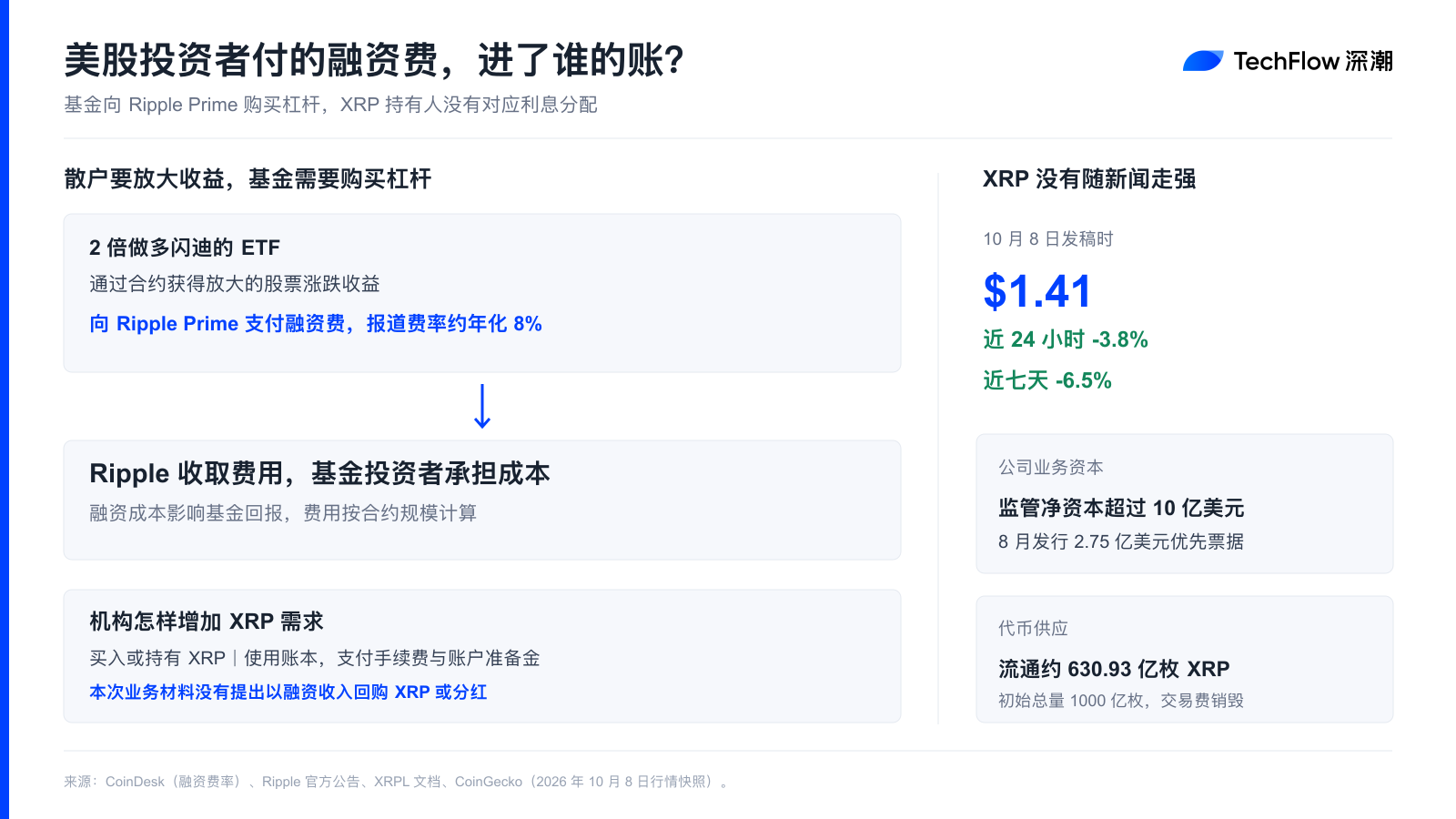
Chart: ETF investors bear the cost of obtaining leverage, the fund pays financing fees to Ripple Prime. XRP gains usage demand through institutional holdings, on-chain fees, and account reserve requirements.

But financing companies also need to borrow money.

Official disclosures state Ripple Prime's regulatory net capital exceeds $1 billion. In August, it issued $275 million in senior unsecured notes and had previously secured $200 million in debt financing. The roughly 8% financing fee paid by clients needs to cover funding, hedging, and operational costs; what remains is profit. Therefore, it remains to be seen whether this business shift will ultimately be profitable.

What XRP Holders Actually Get

Under the currently disclosed arrangement, this financing revenue is collected by Ripple Prime. Holding XRP does not entitle one to a corresponding interest distribution, and the business announcement did not propose using this money to buy back XRP. The addition of new clients first expands the company's business.

Ripple had already outlined how to connect the brokerage to its products during the acquisition. The plans at the time included using the USD stablecoin RLUSD as collateral and migrating some post-trade processing to the XRP Ledger. Funds could manage collateral with the stablecoin, and brokers could use the ledger to reduce settlement and operational costs.

For XRP, the relationship is more direct with actual institutional token holdings and trading.

Ripple Prime already offers OTC spot trading for XRP, and institutions can also manage margin by combining XRP spot holdings with other digital asset positions. If new clients increase their XRP allocations through these services, capital would flow into the token market.

Merely using the ledger generates far less demand. The standard base fee for a regular transaction is 0.00001 XRP, which is directly burned after payment; new accounts currently require reserving 1 XRP. Calculating with the standard base fee, one million regular transactions burn 10 XRP. Low costs facilitate institutional adoption but also indicate that large-scale US stock financing cannot be directly translated into large-scale XRP consumption.

The new revenue also doesn't change the XRP supply arrangement.

Approximately 63.093 billion XRP are currently in circulation. A snapshot from June 30th shown on Ripple's website indicates about 32.6 billion more were still in escrow lock-up. The escrow releases monthly, with unused portions re-locked for subsequent months. This stock financing business announcement did not disclose conditions requiring additional XRP lock-ups.

If you buy XRP because of this news, you are betting that Ripple's new clients will ultimately also become users of XRP. But holding XRP will not entitle you to receive, for instance, the interest paid by the SanDisk leveraged equity fund, nor is this a direct model where business revenue is used for token buybacks.

Or, one might say, many old crypto projects aligning with traditional finance is a current trend, but their original tokens have not been updated to be part of that new calculus.


Related Questions

QWhat is the core contradiction for XRP holders regarding Ripple's new leverage ETF financing business, according to the article?

AThe core contradiction is that while Ripple the company is generating new fiat revenue streams from this traditional finance business, the earnings are not directly converted into real buying demand for the XRP token itself. The revenue goes to Ripple Prime, and there is no mechanism for distributing profits to token holders or using the money for XRP buybacks.

QHow did Ripple acquire the capability to offer financing services to leverage stock ETFs?

ARipple acquired this capability by spending $1.25 billion to purchase the brokerage firm Hidden Road in 2025. After the acquisition was completed in October, it was renamed Ripple Prime, which provides the trading, clearing, and financing services that allow Ripple to enter this business.

QAccording to the article, what are the two main ways for Ripple's new business to potentially generate demand for the XRP token?

AThe two main ways are: 1. If Ripple Prime's institutional clients increase their XRP spot holdings and manage them alongside other digital assets using the platform. 2. By migrating parts of the post-trade settlement processes onto the XRP Ledger, which would generate minimal standard transaction fees (paid in XRP and burned) and potentially require XRP for account reserves.

QWhy is the direct positive impact of this business on the XRP token considered limited, as explained in the article?

AThe impact is considered limited because the transaction fees on the XRP Ledger are very low (e.g., 0.00001 XRP per standard transaction, which is burned), and only a small amount of XRP is needed for new account reserves. Therefore, the large-scale financing business for stock ETFs cannot be directly translated into a significant consumption or demand for XRP tokens.

QWhat did the price of XRP do around the time of the report on this new business development, and what does the article suggest this indicates?

AThe price of XRP did not show a positive response. At the time of writing (October 8), it was around $1.41, down approximately 3.8% in 24 hours and 6.5% over the previous week. There was no noticeable price increase preceding the report either. This suggests the market did not view the news as a direct catalyst for XRP token value.

Related Reads

Bernstein Research Report Interpretation: Fiscal 2028 Revenue to Top $740 Billion, Yet Only a Neutral Rating for Nvidia

Nvidia reported Q3 FY2027 revenue of $115.844 billion, beating consensus of $109.330 billion, with adjusted EPS of $2.68 versus $2.47 expected. Data Center revenue reached $107.610 billion, up 21% QoQ and 110% YoY, driven by the Vera Rubin architecture, which contributed about $20 billion in its first quarter, alongside continued Blackwell Ultra shipments. Hyperscale cloud revenue was $60.136 billion, while AI cloud and enterprise customers reached $47.474 billion, up 195% YoY. Networking contributed about $21 billion, and adjusted gross margin came in at 74.9%. Q4 FY2027 guidance stands at $130 billion, above the $125.1 billion consensus, but Bernstein notes this includes an extra accounting week worth roughly $5-10 billion; excluding it, the normalized outlook is slightly below consensus. Q3 also benefited from about $2.4 billion in Hopper sales to China, which are excluded from Q4 guidance. Q4 gross margin is guided at 71.5%, expected to be the cycle trough before price increases lift margins to 72-73% in FY2028. Management raised FY2028 revenue growth guidance to about 75% from 70%, implying revenue above $740 billion, saying strong global demand offsets new export controls. Supply commitments rose to $390 billion, or $518 billion including cloud, leasing, and equity commitments. Inventory climbed to $39.7 billion. Free cash flow was $43.8 billion, with $22.1 billion in buybacks and a new $150 billion authorization. Bernstein raised its FY2028 revenue forecast to $742.4 billion and EPS to $17.18. Despite strong fundamentals, Bernstein maintains a Market-Perform rating and $200 target price, citing governance and long-term execution risks following management changes. The board has said it does not intend to bring back Jensen Huang and is searching for a new leader, raising questions about supplier negotiations, product roadmap, decision speed, and talent retention, plus potential investigation risks. At around $155.46, the stock trades at just 9.0x FY2028 EPS, or about 10x the $200 target based on average FY2028-29 EPS of $20.59. Bernstein remains on the sidelines pending clarity.

marsbit25m ago

Bernstein Research Report Interpretation: Fiscal 2028 Revenue to Top $740 Billion, Yet Only a Neutral Rating for Nvidia

marsbit25m ago

Bitcoin Volatility Falls to 43%, Below Nearly One-Fifth of S&P 500 Constituents: Is the Crypto Asset Risk Narrative Being Rewritten?

Grayscale Research argues that Bitcoin's risk profile has structurally changed and that investors' framework for assessing crypto risk needs a fundamental reset. Bitcoin's one-year realized volatility has fallen from roughly 64% a decade ago and 81% five years ago to about 43% today, placing it within the normal range of S&P 500 large-cap stocks and below roughly 19% of S&P 500 constituents. This decline reflects deeper institutional market-making, spot ETP launches, and established regulatory boundaries. The report cautions against judging Bitcoin by volatility alone. Its returns exhibit fat tails and momentum clustering, with the bulk of long-term compound gains concentrated in a handful of best trading days; missing the top 10 days would erase most cumulative returns. Downside-only measures such as the Sortino ratio therefore flatter Bitcoin more than the Sharpe ratio does. Although drawdowns exceeding 50% have occurred, risk-parity-adjusted drawdowns look less exceptional versus traditional assets. Crucially, Bitcoin's returns are poorly explained by traditional macro factors, giving it low correlation with equities, bonds, and commodities. Backtests show that adding a 1–5% Bitcoin allocation to a classic 60/40 portfolio improves risk-adjusted returns without proportionally worsening maximum drawdown. Beyond Bitcoin, crypto sub-sectors are structurally decoupling: Bitcoin now explains only about 50% of overall crypto return variance. Smart contract platforms show roughly 58% volatility driven by on-chain fundamentals, while consumer and AI sectors show 76% and 85% respectively, driven by distinct narratives. This rotation creates room for bottom-up alpha. Institutions should adopt a two-layer approach: Bitcoin as a macro diversifier, plus selective exposure to vertical-sector infrastructure, managed through volatility budgeting and disciplined rebalancing.

marsbit1h ago

Bitcoin Volatility Falls to 43%, Below Nearly One-Fifth of S&P 500 Constituents: Is the Crypto Asset Risk Narrative Being Rewritten?

marsbit1h ago

Strategy Removed from MSCI: Will BlackRock's 123,000 Shares Really Hit the Market?

After Nov 30, MSCI will remove Strategy (Michael Saylor's bitcoin-holding company) from several indices, effective Dec 1, under new eligibility rules for "non-operating" companies. Investors expect selling pressure, since index-tracking funds that bought Strategy solely to mirror the index no longer have a reason to hold it. But two BlackRock funds tracking the same MSCI USA Index illustrate why holdings can't simply be summed into one sell order: iShares MSCI USA ETF (MLRG) holds Strategy shares directly (5,227 shares as of Nov 13), while iShares MSCI USA Swap UCITS ETF (MUSD) gets index exposure via total return swaps, so its counterparties may adjust their own positions without disclosure. BlackRock's URTH (29,300 shares) and ACWI (88,500 shares) also hold Strategy, bringing the three identified funds to 123,000 shares worth about $13.74 million — a specific snapshot, not the full universe of affected funds. USXF holds 16,100 shares but its specialized index adjustment is pending. Strategy says index funds collectively hold about 13 million shares, or 3.1% of free float. Crucially, shrinking holdings don't prove selling: ETFs grow and shrink with creations and redemptions, and shares can leave a fund via in-kind redemptions without exchange sales. Index removal may weaken demand for Strategy's stock and complicate its bitcoin-funding model, but it does not require Strategy to sell any bitcoin.

marsbit1h ago

Strategy Removed from MSCI: Will BlackRock's 123,000 Shares Really Hit the Market?

marsbit1h ago

US Chip Controls Extend from Overseas Compute to Lithography Machines: Why ASML May Be Hurt More Than Nvidia?

The article discusses how U.S. chip export controls are expanding from overseas computing power to lithography machines, arguing that ASML may be more vulnerable than Nvidia. It notes that after Jensen Huang's sudden resignation as Nvidia CEO, the U.S. Commerce Department's BIS issued an interim final rule on November 16 extending semiconductor export controls to third-country offshore AI data centers, requiring licenses for advanced chip and high-bandwidth network equipment exports to overseas data centers that may serve restricted entities. The rule closes loopholes by aggregating distributed cluster computing power, covering indirect training arrangements, mandating KYC checks, and giving existing data centers a 90-day transition period. For Nvidia, the direct exposure is mainly in Southeast Asia, where Singapore alone accounts for about 10% of revenue, but strong capex from North American hyperscalers like Microsoft, Meta, and Amazon should absorb any diverted GPU capacity, making the new rule more a compliance cost than a revenue cliff. The bigger risk is the bipartisan MATCH Act, which would turn administrative discretion into hard federal law, permanently locking in restrictions on DUV lithography and advanced etching and deposition equipment. The article argues this would hit upstream equipment makers—ASML, Lam Research, and Applied Materials—harder than downstream chip designers, since cutting off their largest cash-flow market without sufficient domestic fab subsidies would pressure both profits and valuations. It also warns that markets are underestimating retaliation risks in rare earths and critical minerals, and notes ASML's China shipment share once jumped from 11% to 39% during the last semiconductor downturn.

marsbit1h ago

US Chip Controls Extend from Overseas Compute to Lithography Machines: Why ASML May Be Hurt More Than Nvidia?

marsbit1h ago

Trading

Spot
活动图片