Ripple CTO Emeritus Fires Back at XRP Ledger Centralization Claims

bitcoinistPublicado em 2026-02-26Última atualização em 2026-02-26

Resumo

David Schwartz, Ripple's CTO Emeritus, refuted claims by Justin Bons, founder of Cyber Capital, that the XRP Ledger (XRPL) is centralized due to its Unique Node List (UNL) structure. Bons argued that the UNL grants Ripple "absolute power and control," making validators permissioned. Schwartz countered that the UNL does not enable censorship or double-spending, as validators cannot force dishonest actions on individual nodes. He explained that a malicious validator would simply be ignored by honest nodes, comparing a potential attack to a chain halt rather than a security breach. Schwartz emphasized that XRPL was intentionally designed to limit Ripple's control, even under legal pressure, and that abusing power would destroy trust in the network. He also contrasted XRPL's record with Bitcoin and Ethereum, claiming no history of transaction censorship or malicious re-ordering on XRPL.

Ripple CTO Emeritus David “JoelKatz” Schwartz pushed back against claims that the XRP Ledger (XRPL) is effectively centralized, after founder and CIO of Cyber Capital Justin Bons argued that XRPL’s Unique Node List (UNL) structure makes validators “permissioned” and gives Ripple-aligned entities “absolute power & control over the chain.”

The exchange, sparked by Bons’ broader thread calling for the industry to “reject all centralized ‘blockchains’,” quickly narrowed into a technical dispute over what XRPL validators can and cannot do in practice and what “control” means in a system that relies on curated validator lists rather than Proof-of-Work or Proof-of-Stake.

The XRP Ledger Centralization Allegation

In his thread, Bons lumped Ripple alongside Canton, Stellar, Hedera, and Algorand as networks with permissioned or semi-permissioned elements. His XRPL-specific charge was straightforward: because XRPL nodes typically rely on a published UNL, “any divergence from this centrally published list would cause a fork,” which in his view concentrates power in the hands of whoever publishes that list.

Bons framed it as a binary question: “either fully permissionless or it is not” and argued that even partial permissioning is a deal breaker. He also extended the critique into a broader institutional-adoption thesis: banks and incumbents may prefer controlled environments, but “those institutions will be left behind,” while “crypto natives” win by building and using fully permissionless systems.

Schwartz’s opening rebuttal attacked the logic of Bons’ “absolute power” framing. “‘...effectively giving the Ripple Foundation & company absolute power & control over the chain...’” Schwartz wrote, calling it “as objectively nonsensical as claiming someone with a majority of mining power can create a billion bitcoins.”

Bons responded that he wasn’t alleging supply manipulation or fund theft, but insisted majority influence can still matter. “They can not steal funds, either, but they could potentially double-spend & censor,” Bons said. “Which, again, is exactly the same if someone controlled the majority of mining power in BTC.” He then suggested they debate live on a podcast.

Schwartz rejected the equivalence on mechanics, emphasizing that XRPL nodes do not accept censorship or double-spend behavior simply because a validator says so. “That’s not true. XRPL and BTC don’t work the same,” Schwartz wrote. “You count the number of validators that agree with your node and your node will not agree to double spend or censor unless you, for some reason, want it to.”

He continued the point across multiple posts, leaning on a simple intuition: a dishonest validator is not an oracle; it’s just one vote. “If a validator tried to double spend or censor, an honest node would just count it as one validator that it did not agree with.”

What Schwartz Says The Real Attack Looks Like

Schwartz acknowledged there is still a failure mode, but described it as a liveness problem rather than a theft or double-spend scenario. “Validators could conspire to halt the chain from the point of view of honest nodes,” he said. “But that’s the XRPL equivalent of a dishonest majority attack except they never get to double spend. The cure is to pick a new UNL just as with BTC you’d need to pick a new mining algorithm.”

He also argued the empirical record matters, contrasting XRPL with other major networks. “The practical evidence tells this story,” Schwartz wrote. “Transactions are discriminated against all the time in BTC. Transactions are maliciously re-ordered or censored all the time on ETH. Nothing like this has ever happened to an XRPL transaction and it’s hard to imagine how it could.”

Schwartz later laid out a more detailed explanation of XRPL’s consensus model, emphasizing fast “live consensus” rounds—“every five seconds”—where validators vote on whether a transaction is included now or deferred to the next round. In that framing, the system’s key requirement is not blind trust in validators, but agreement on whether a transaction was seen before a cutoff.

He argued XRPL needs a UNL for two reasons: to prevent an attacker from spawning unlimited validators that force excessive work, and to prevent validators from simply not participating in a way that makes consensus impossible to measure. “That’s it. There’s no control or governance here other than coordinating activation of new features,” Schwartz wrote, adding that validators cannot force a node to enforce rules it does not have code for.

Schwartz closed with a longer, unusually candid rationale: that XRPL’s architecture was intentionally built to reduce Ripple’s ability to comply with demands to censor, even if Ripple itself wanted to be trusted.

“We carefully and intentionally designed XRPL so that we could not control it,” he wrote. “Ripple, for example, has to honor US court orders. It cannot say no... We absolutely and clearly decided that we DID NOT WANT control and that it would be to our own benefit to not have that control.”

He added a blunt incentive argument: even if Ripple could censor or double-spend, using that power would destroy trust in XRPL and therefore destroy the network’s utility. “And the best way to be able to say ‘no’ is to have to say ‘no’ because you cannot do the thing asked,” Schwartz wrote.

At press time, XRP traded at $1.3766.
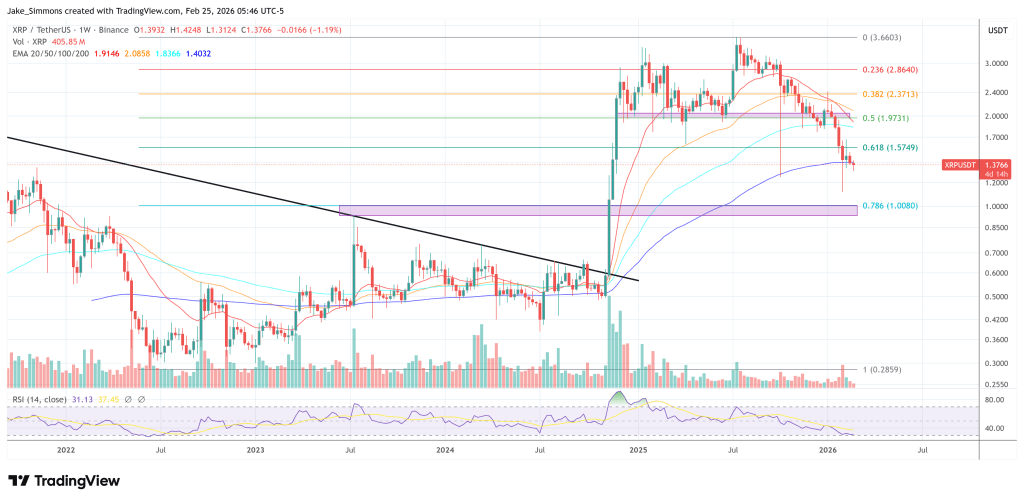
XRP trades below the 200-week EMA, 1-week chart | Source: XRPUSDT on TradingView.com

Perguntas relacionadas

QWhat was the main argument made by Justin Bons regarding the XRP Ledger's centralization?

AJustin Bons argued that the XRP Ledger's Unique Node List (UNL) structure makes validators 'permissioned' and gives Ripple-aligned entities 'absolute power & control over the chain'.

QHow did David Schwartz counter the claim that Ripple has 'absolute power' over the XRP Ledger?

ASchwartz called the claim 'objectively nonsensical,' explaining that validators cannot force a node to double-spend or censor transactions, and that dishonest validators are merely counted as one disagreeing vote by honest nodes.

QAccording to Schwartz, what is the real failure mode for the XRP Ledger, and how is it resolved?

ASchwartz described the failure mode as a liveness problem where validators could conspire to halt the chain, which is resolved by picking a new UNL, similar to how Bitcoin would require a new mining algorithm.

QWhat two reasons did Schwartz give for why the XRP Ledger needs a Unique Node List (UNL)?

ASchwartz stated the UNL is needed to prevent an attacker from spawning unlimited validators that force excessive work, and to prevent validators from not participating in a way that makes consensus impossible to measure.

QWhat was the key design intention behind the XRP Ledger's architecture, as explained by Schwartz?

ASchwartz stated that the XRP Ledger was 'carefully and intentionally designed' so that Ripple could not control it, even if they wanted to, to avoid being forced to comply with demands to censor and to protect the network's utility.

Leituras Relacionadas

Silicon Valley 'Startup Guru' Steve Hoffman: Web3 + AI Could Be a Trap

Silicon Valley investor and "Godfather of Startups" Steve Hoffman warns that combining Web3 with AI is likely a trap, not a promising venture. In an interview, Hoffman argues that while AI is a foundational technology touching all industries, Web3 adds complexity, friction, and regulatory risk without solving mainstream consumer or business needs. He advises founders to focus on deep, specialized applications where startups can out-iterate giants, rather than on generic features easily replicated by large tech companies. Hoffman observes that Silicon Valley will lead foundational AI research, while China excels at rapid, large-scale application and commercialization, particularly in robotics. He stresses that AI-driven autonomous agents capable of collaborative, multi-step tasks are 2-4 years away, which will cause significant job displacement. The solution is not to slow AI but to redesign business models around human-AI collaboration and reform social systems like education and retraining. For startups, Hoffman recommends focusing on vertical, expertise-heavy domains to build defensibility. He sees major opportunities in AI fraud detection and cybersecurity. Key founder mindsets include systemic thinking over feature-focus, relentless customer centricity, building adaptive teams, and deeply understanding AI's capabilities and limits. Hoffman is also leading a non-profit initiative to establish university centers aimed at training future leaders in responsible, human-value-aligned AI innovation.

marsbitHá 1h

Silicon Valley 'Startup Guru' Steve Hoffman: Web3 + AI Could Be a Trap

marsbitHá 1h

Token Inefficient, Economy Tokenless

The article "Tokens Aren't Economical, Economics Aren't Tokenized" analyzes a pivotal shift in the AI industry from a technology-driven narrative to one dominated by capital efficiency. It highlights two concurrent trends: a severe capital shortage due to the exorbitant and recurring costs of compute (e.g., OpenAI's high burn rate) and a wave of corporate spin-offs where major tech companies are separating their AI units (like Kuaishou's Kling and Baidu's Kunlunxin). The core argument is that AI's "anti-internet" business model, where user growth increases costs rather than profits, has created a disconnect between high valuations and actual cash flow. Spin-offs address this by allowing AI assets to be valued independently. Within a parent company, they are seen as cost centers, but as standalone entities, they are priced based on their growth potential and scarcity in the primary market, leading to massive valuation premiums (e.g., Kling's estimated value tripling post-spin-off). The industry is at an inflection point, moving from "model worship" to "value realization." The competition is evolving from a pure compute (GPU) race to a broader focus on systemic efficiency and full-stack engineering (involving CPUs and orchestration) to achieve viable commercialization. The year 2026 is framed as a critical moment where the industry must definitively answer how to economically translate AI capability into tangible business value, reshaping the sector's future power structure.

marsbitHá 1h

Token Inefficient, Economy Tokenless

marsbitHá 1h

Crossing the 'Memory Wall': The Wafer-Level Revolution and Computing Power Routes in the AI Inference Era

In 2026, a historic shift occurred in AI as major cloud providers' inference spending surpassed training spending for the first time, signaling a move from "building large models" to "using large models." This shifts the core challenge from computing power to the "memory wall"—the bottleneck of data movement (model weights, activations, KV Cache) between external DRAM and processors, where energy and latency from data transfer far exceed computation itself. Companies like Nvidia face GPU idle time due to bandwidth limits. In contrast, Cerebras Systems adopts a radical "wafer-scale" approach with its Wafer-Scale Engine (WSE). Instead of cutting a silicon wafer into many chips, Cerebras uses almost the entire wafer as one massive chip (WSE-3). This design provides 44GB of on-chip SRAM, delivering memory bandwidth thousands of times higher than traditional HBM (e.g., 21 PB/s vs. Nvidia B200). For LLM inference, weights are streamed layer-by-layer from external MemoryX storage to the chip, avoiding HBM bottlenecks. This results in token generation speeds 1.5–5 times faster than Nvidia's B200 in some models and significant advantages in first-token latency and long-context tasks. Additionally, Cerebras's architecture offers much lower interconnect power consumption (0.15 pJ/bit vs. GPU's ~10 pJ/bit). However, Cerebras faces challenges: SRAM scaling has slowed with advanced nodes, limiting future capacity gains; the chip requires specialized liquid cooling and custom software stacks; and its external I/O bandwidth (150 GB/s) is low compared to NVLink, hindering multi-system scaling for very large models. Competition is intensifying. Major players are pursuing three paths: 1) Developing proprietary inference ASICs (e.g., Google TPU, Microsoft Maia), 2) Leveraging advanced packaging (e.g., TSMC's SoW) to democratize wafer-scale-like integration, potentially eroding Cerebras's process advantage within a few years, and 3) Exploring optical interconnects for ultimate bandwidth. Commercially, Cerebras is transitioning from a hardware vendor to a service provider, facing the immense challenge of building high-power, specialized data centers to meet large contracts (e.g., 250MW/year from 2026–2028). In conclusion, the AI inference era presents a fundamental architectural trade-off. Cerebras opts for extreme physical optimization for low-latency, single-task performance, while Nvidia prioritizes versatility and massive cluster throughput. The path forward remains uncertain, with technology and business models still evolving in the race toward advanced AI.

marsbitHá 1h

Crossing the 'Memory Wall': The Wafer-Level Revolution and Computing Power Routes in the AI Inference Era

marsbitHá 1h

Has Bitcoin's 'Rebound Ended', Officially Entering the Late Bear Market Phase?

**Title: Has Bitcoin's Rebound Ended, Entering the Late Bear Market Phase?** **Summary:** Bitcoin's price has declined by 13% this week, signaling a potential return to late-stage bear market conditions. The price fell to around $67k, positioned between the Realized Price and Realized Cap Weighted Average. For the first time since early 2022, the Short-Term Holder cost basis has dropped below this key average, confirming a hallmark of late-cycle bear markets. Profitability metrics have collapsed sharply. The 7-day average of the Realized Profit/Loss ratio plummeted from a local high of 3.16 to 0.29, mirroring the February panic sell-off. Critically, the 90-day average never breached the threshold of 2, indicating the recent rally to $82k was a bear market bounce, not a structural shift. Realized losses surged to $1.35 billion daily, with $770 million coming from Long-Term Holders selling at a loss. This accelerating redistribution of supply from weak to strong hands is a necessary but ongoing process for a market bottom. The rally stalled almost precisely at the aggregate cost basis (~$83k) of US spot Bitcoin ETF investors, turning that level into strong resistance and leaving the average ETF holder underwater again. Spot market flows have turned decisively negative, showing sellers are dominating order books despite the price drop. While a significant futures long liquidation event cleared over $400 million in leverage, providing a potential reset, sustained spot demand is yet to materialize. Options markets continue to price in higher future volatility (Implied Volatility) than recent price action (Realized Volatility) has shown, with a persistent skew towards put options, indicating ongoing demand for downside protection. In conclusion, multiple metrics point to a fragile market structure. Resistance at the ETF cost basis, accelerating realized losses, dominant spot selling, and cautious options pricing all suggest the bear market trend persists. A sustainable recovery likely requires a resurgence of spot demand, ETF holders returning to profit, and a clear reduction in selling pressure.

marsbitHá 1h

Has Bitcoin's 'Rebound Ended', Officially Entering the Late Bear Market Phase?

marsbitHá 1h

Trading

Spot
Futuros

Artigos em Destaque

O que é XRP 2.0

XRP 2.0: Uma Nova Fronteira no Landscape das Criptomoedas Introdução ao XRP 2.0 No reino em constante evolução das criptomoedas, novos projetos surgem continuamente, lutando por atenção e adoção. Uma dessas iniciativas promissoras é o XRP 2.0, um novo projeto de criptomoeda concebido para aproveitar a tecnologia de blockchain avançada e as metodologias de criptografia robustas. Embora o nome tenha paralelos com o XRP da Ripple, é crucial notar que o XRP 2.0 opera de forma independente, focando em melhorar a segurança das transações, a privacidade e a escalabilidade. À medida que o panorama financeiro digital abraça cada vez mais soluções descentralizadas, o XRP 2.0 visa contribuir de forma significativa para a web3 e a expansão global dos projetos de criptomoedas. O que é o XRP 2.0? No seu núcleo, o XRP 2.0 é um projeto de criptomoeda que visa criar um ecossistema de moeda digital seguro e descentralizado. Sua tecnologia fundamental integra princípios de blockchain sofisticados com técnicas de criptografia de ponta. O objetivo abrangente do XRP 2.0 é estabelecer-se como uma plataforma confiável e eficiente que possibilita a execução rápida de transações, priorizando a proteção de privacidade aprimorada para os seus usuários. O projeto é promovido como uma solução para muitas limitações enfrentadas pelas criptomoedas existentes, propondo um sistema que pode lidar com um volume maior de transações com velocidade e privacidade melhoradas. Esta versatilidade posiciona o XRP 2.0 como um concorrente significativo em um mercado repleto de várias moedas digitais. Quem é o Criador do XRP 2.0? A identidade do criador por trás do XRP 2.0 foi identificada como 'Wilbur.' No entanto, detalhes abrangentes sobre Wilbur ou a sua entidade associada permanecem elusivos. O anonimato de muitos criadores de criptomoedas não é um fenômeno incomum na indústria, muitas vezes concebido para manter um grau de privacidade e segurança. Quem são os Investidores do XRP 2.0? Até agora, informações específicas relacionadas às fundações ou organizações de investimento que apoiam o XRP 2.0 não estão disponíveis publicamente. No setor das criptomoedas, o apoio de investidores reputados pode influenciar significativamente a credibilidade e o sucesso de um projeto, no entanto, a transparência em relação aos apoiantes financeiros do XRP 2.0 não foi estabelecida. Como Funciona o XRP 2.0? O XRP 2.0 destaca-se por empregar uma combinação de tecnologia blockchain e algoritmos de criptografia avançados que asseguram transações seguras e descentralizadas. Sua estrutura inovadora inclui características únicas projetadas para fomentar o envolvimento dos usuários e ampliar as funcionalidades além das transações convencionais de criptomoedas. Entre essas características, o XRP 2.0 incorpora capacidades potenciadas por IA, como funcionalidades de texto-para-imagem e texto-para-fala. Estas adições são projetadas para melhorar a experiência interativa dos usuários, promovendo uma maior aplicabilidade em vários setores. Ao unir avanços tecnológicos com um design centrado no utilizador, o XRP 2.0 pretende captar a atenção de uma diversa gama de indivíduos e empresas que procuram integrar soluções de criptomoedas em suas estruturas operacionais. Cronologia do XRP 2.0 Compreender o XRP 2.0 requer examinar os marcos que definiram sua jornada até agora: 23 de Julho de 2023: O XRP 2.0 é apresentado como um novo projeto de criptomoeda, visando revolucionar as capacidades de transação seguras e descentralizadas no domínio do blockchain. 8 de Setembro de 2023: O lançamento de outro projeto, XRP20, ocorre, marcando o surgimento de um token ERC-20 na blockchain Ethereum que permanece não relacionado ao XRP 2.0. 13 de Novembro de 2023: O XRP Ledger passa por uma atualização significativa com o lançamento da versão 2.0.0 do software do servidor rippled. É importante notar que este desenvolvimento está desconectado do projeto de criptomoeda XRP 2.0. Pontos-chave sobre o XRP 2.0 Para destilar a essência do XRP 2.0, vários fatores críticos emergem: Características Únicas: A inclusão de características como texto-para-imagem e texto-para-fala potenciadas por IA diversifica ainda mais as aplicações potenciais do XRP 2.0. Tecnologia Blockchain: A estrutura utiliza mecanismos de blockchain avançados e protocolos de criptografia, assegurando um ambiente seguro e descentralizado para transações. Escalabilidade e Privacidade: O XRP 2.0 prioriza proteção de privacidade aprimorada nos processos de transação e a escalabilidade necessária para acomodar uma base de utilizadores crescente. Sem Afiliação com a Ripple: Importante, apesar do seu nome, o XRP 2.0 não tem qualquer lealdade ou colaboração com o XRP da Ripple, distinguindo sua estrutura operacional e objetivos dentro do ecossistema das criptomoedas. Conclusão O XRP 2.0 representa uma empreitada ambiciosa no domínio das criptomoedas, visando oferecer uma combinação de segurança, privacidade e eficiência em transações digitais. Ao integrar tecnologias sofisticadas e características amigáveis ao utilizador, o projeto propõe-se a ampliar os horizontes do que as criptomoedas podem alcançar na economia digital atual. Embora o anonimato do seu criador e a falta de investidores divulgados possam levantar questões para alguns, o foco do XRP 2.0 em funcionalidades avançadas e descentralização aumenta seu apelo num mercado de criptomoedas cada vez mais congestionado. À medida que o panorama das criptomoedas continua a evoluir, o XRP 2.0 pode ainda emergir como um jogador crucial na expansão de soluções de blockchain seguras e escaláveis.

99 Visualizações TotaisPublicado em {updateTime}Atualizado em 2024.12.03

O que é XRP 2.0

Como comprar XRP

Bem-vindo à HTX.com!Tornámos a compra de XRP (XRP) simples e conveniente.Segue o nosso guia passo a passo para iniciar a tua jornada no mundo das criptos.Passo 1: cria a tua conta HTXUtiliza o teu e-mail ou número de telefone para te inscreveres numa conta gratuita na HTX.Desfruta de um processo de inscrição sem complicações e desbloqueia todas as funcionalidades.Obter a minha contaPasso 2: vai para Comprar Cripto e escolhe o teu método de pagamentoCartão de crédito/débito: usa o teu visa ou mastercard para comprar XRP (XRP) instantaneamente.Saldo: usa os fundos da tua conta HTX para transacionar sem problemas.Terceiros: adicionamos métodos de pagamento populares, como Google Pay e Apple Pay, para aumentar a conveniência.P2P: transaciona diretamente com outros utilizadores na HTX.Mercado de balcão (OTC): oferecemos serviços personalizados e taxas de câmbio competitivas para os traders.Passo 3: armazena teu XRP (XRP)Depois de comprar o teu XRP (XRP), armazena-o na tua conta HTX.Alternativamente, podes enviá-lo para outro lugar através de transferência blockchain ou usá-lo para transacionar outras criptomoedas.Passo 4: transaciona XRP (XRP)Transaciona facilmente XRP (XRP) no mercado à vista da HTX.Acede simplesmente à tua conta, seleciona o teu par de trading, executa as tuas transações e monitoriza em tempo real.Oferecemos uma experiência de fácil utilização tanto para principiantes como para traders experientes.

1.6k Visualizações TotaisPublicado em {updateTime}Atualizado em 2026.06.02

Como comprar XRP

Discussões

Bem-vindo à Comunidade HTX. Aqui, pode manter-se informado sobre os mais recentes desenvolvimentos da plataforma e obter acesso a análises profissionais de mercado. As opiniões dos utilizadores sobre o preço de XRP (XRP) são apresentadas abaixo.

活动图片