Ripple Chiseled a Crack in the Wall, but Swift Tore Down the Entire Wall

marsbitPublicado em 2025-12-23Última atualização em 2025-12-23

Resumo

At the Sibos 2025 conference, Swift announced the integration of a blockchain-based shared ledger into its infrastructure, built on Consensys' Ethereum Layer-2 network Linea, to enable secure, real-time, and interoperable digital finance. This move, supported by major banks like JPMorgan and Citibank, aims to bridge traditional finance with tokenized assets using zk-EVM technology for faster, cheaper, and more transparent settlements. While Ripple pioneered blockchain-based cross-border payments with XRP Ledger and achieved significant legal and operational milestones—including court victories against the SEC and expansion into 40+ markets—its reach remains limited compared to Swift’s global network of over 11,000 institutions. Ripple’s model relies heavily on XRP as a bridge currency, whereas Swift’s asset-agnostic approach supports multiple currencies, stablecoins, and CBDCs, reducing dependency on any single asset. Swift’s adoption of blockchain signals a major shift in global finance, potentially freeing trillions in trapped capital and enabling 24/7 real-time settlement. This transition from legacy systems to mathematically verified transactions represents a convergence of TradFi and DeFi, positioning Swift to dominate the next era of value transfer.

Author: Sanqing, Foresight News

During the Sibos 2025 conference in Frankfurt, Swift's Chief Business Officer Thierry Chilosi and Standard Chartered Bank's Global Head of Transaction Banking, Michael Spiegel, discussed the major transformation of global finance. As tokenization moves from pilot programs to reality, Swift officially announced the addition of a blockchain-based shared ledger to its infrastructure, aiming to achieve trusted and interoperable digital finance on a global scale. This ledger will serve as a secure, real-time transaction record between financial institutions, using smart contracts to validate transaction sequences and execute agreed-upon rules. It is designed to complement existing systems and seamlessly bridge traditional finance with tokenized assets.
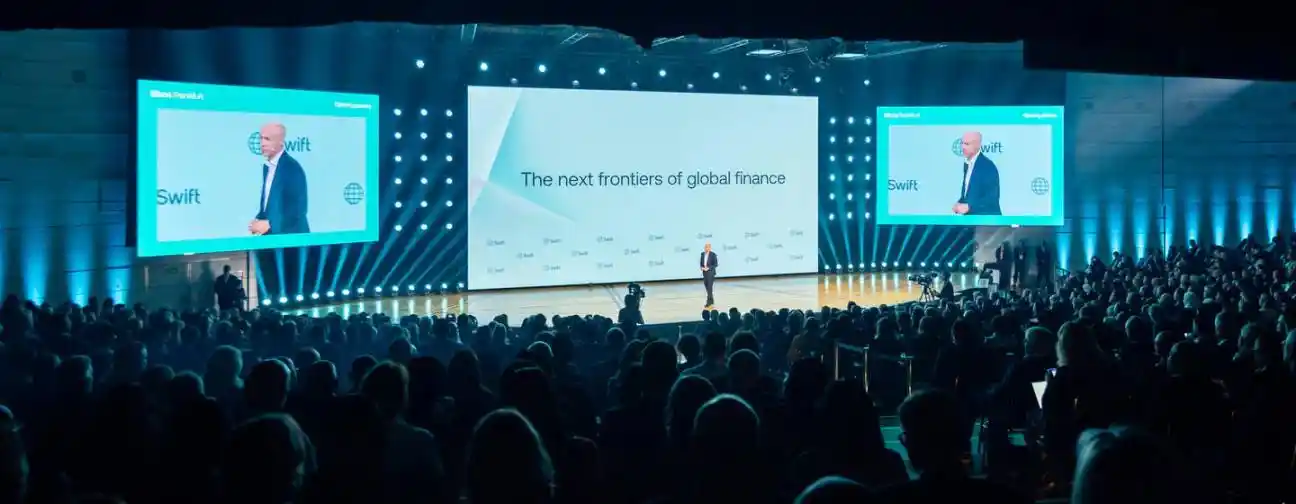
Image Source: Swift Official Website

Although Swift did not explicitly mention the technical platform when initially announcing this major news to the banking industry, Consensys CEO Joe Lubin revealed at the Token2049 conference in Singapore that Swift is leveraging the Ethereum Layer 2 network Linea to build its new payment settlement platform. By adopting Linea's zk-EVM rollup technology, Swift can significantly reduce costs and latency while meeting the financial industry's stringent requirements for 24/7 real-time settlement and security. Currently, over 30 top global financial institutions, including JPMorgan Chase, Bank of America, and Citibank, are preparing to participate in the pilot of this new blockchain-based payment rail built on Linea.

Ripple's Deep Cultivation and Current Status

Before discussing Swift, we must revisit the pioneer that challenged the old system for over a decade: Ripple.

In 2012, Ripple emerged with the XRP Ledger (XRPL), with the core goal of replacing the inefficient Swift correspondent banking model. During this period, Ripple successfully built the global payment network RippleNet, connecting over 300 financial institutions. In fragmented markets like Southeast Asia, its On-Demand Liquidity (ODL) service demonstrated that XRP, as a bridge currency, could reduce cross-border settlement times from days to just 3 to 5 seconds.

By 2020, affected by the U.S. SEC lawsuit, Ripple faced a blockade and stagnation in the U.S. market due to securities allegations, but its global scale continued to expand. By 2022, its business had reached over 40 payment markets, with total payment volume doubling to approximately $30 billion.

In 2023, Ripple saw a turning point when the court ruled that XRP itself is not a security, marking a milestone victory for Ripple and the industry.

In August 2025, with the SEC completely abandoning its appeal, the five-year legal battle came to an end. The full clarification of its legal status led to the approval of an XRP spot ETF, marking its official entry into mainstream institutional asset allocation portfolios.

Today, Ripple is conducting cross-border payment and receipt businesses in multiple real-world scenarios, ranging from retail remittances (To C) to enterprise-level payments (To B).

In the retail sector, Japan's SBI Remit uses XRP to bridge real-time remittance channels to the Philippines, Vietnam, and Indonesia, significantly reducing the pre-funding costs for overseas workers; Santander Bank offers transparent real-time transfers to its customers through the One Pay FX app. Meanwhile, the Southeast Asian payment platform Tranglo has significantly improved the efficiency of peso and baht settlements with the support of Ripple ODL.

At the enterprise level, American Express and PNC Bank utilize RippleNet to optimize B2B trade settlements and international payment experiences, respectively.

Additionally, in national infrastructure, Ripple is collaborating with over 20 countries, including Palau, Montenegro, and Bhutan, to develop CBDC platforms, applying blockchain technology to the issuance and清算体系 of sovereign currencies.

Why Did Swift Choose Linea?

When giants布局 the Ethereum ecosystem, they have shown a high degree of consistency in their preference for Layer 2 technology: Coinbase's Base chain is built on OP Stack, and Robinhood announced this year the launch of Robinhood Chain based on Arbitrum technology to support the tokenization and 24/7 trading of RWA.

This preference stems from L2's ability to leverage Ethereum's security while meeting high-performance needs through a modular architecture. The core difference between Swift's choice of Linea over OP or Arbitrum lies in the underlying validation logic.

OP and Arbitrum use Optimistic Rollup, which operates on the logic of assuming transactions are valid by default and only verifying them if challenged. Asset withdrawals typically require a multi-day challenge period, which is a significant time cost for financial清算追求流动性.

Linea, on the other hand, uses zk-EVM, which provides instant validity proofs mathematically. For Swift and its partner banks handling massive value settlements, zk-EVM not only offers faster finality but also ensures compliance verification while protecting transaction privacy.

Swift's choice of Linea embodies the first principle of capital operation: maximizing flow velocity.

Capital will flow like a fluid from the low-velocity (requiring large amounts of idle准备金预存 in Nostro/Vostro accounts), high-friction (layered fees from correspondent banks), slow-settlement (days-long settlement) telegraphic instruction traditional system to a high-velocity, low-friction, fast-settlement blockchain digital system.

Swift handles approximately $150 trillion in global payments annually. If it can achieve atomic-level reconciliation and 24/7 real-time settlement through Linea's technology stack, it means that trillions of dollars in准备金积压 in the global financial system, originally held to hedge against清算延迟, will be released and reinjected into the real economy.

As Consensys CEO Joe Lubin stated at the Token 2049 conference in Singapore, this is not merely a technological upgrade but the true convergence of TradFi and DeFi, marking the global value transfer protocol's official transition from the "telegraphic instruction era" to the "mathematical verification era."

The Significance of Swift Embracing Blockchain

As the global financial backbone network handling approximately $150 trillion in transaction volume annually, Swift's decision to build its ledger on Linea, an Ethereum Layer 2, signifies that blockchain technology will become the heart of mainstream finance.

Swift will eliminate fragmentation between different tokenized networks through unified technical standards, breaking down the long-standing barrier between TradFi and DeFi, and implanting the efficiency genes of decentralized finance into the traditional清算体系.

Through a 24/7 operational real-time ledger, global financial institutions will no longer be constrained by the cumbersome manual reconciliation and time-zone delays of the correspondent banking model. The massive amounts of capital积压 in correspondent bank accounts, originally held to hedge against清算风险, will be effectively released. This will allow the speed of capital flow to truly match the demands of the modern economy, ushering in a new era of global value transfer that is more transparent, lower cost, and更具互操作性.

Ripple struggled for a decade to build a new city based on the XRP Ledger outside the old system, but the scale of financial institutions it currently connects appears势单力薄 compared to Swift's存量 network covering over 11,000 institutions across more than 200 countries.

The core threat from Swift lies in its "asset neutrality." Unlike Ripple's ODL model, which heavily relies on XRP as a bridge currency, Swift's blockchain ledger is designed to support multiple assets, including fiat currencies, stablecoins, and CBDCs.

Banks within the Swift system can achieve instant settlement by upgrading their existing rails without bearing the volatility risk of a single asset. This combination of "存量优势 + technical compliance" is giving Ripple its most透骨的寒意 since its inception.


Criptomoedas em alta

Perguntas relacionadas

QWhat is the core innovation announced by Swift at Sibos 2025, and what technology is it built on?

ASwift announced the addition of a new blockchain-based shared ledger to its infrastructure, built on the Ethereum Layer 2 network Linea, utilizing its zk-EVM rollup technology.

QHow does Ripple's ODL (On-Demand Liquidity) service using XRP improve cross-border payments?

ARipple's ODL service uses XRP as a bridge currency to reduce cross-border settlement times from several days to just 3 to 5 seconds, significantly lowering the cost of pre-funding for overseas payments.

QWhat key advantage does a zk-EVM rollup (like Linea) have over an Optimistic Rollup for a financial settlement network?

AA zk-EVM rollup provides instant validity proofs for transactions, enabling faster finality and near-instant withdrawals. This is superior to Optimistic Rollups, which have a multi-day challenge period for withdrawals, creating undesirable delays for high-value financial settlements.

QWhat major legal victory did Ripple achieve in 2023, and what was a significant consequence of its final resolution in 2025?

AIn 2023, a court ruled that XRP itself is not a security. In 2025, the SEC abandoned its appeal, which led to the approval of XRP spot ETFs, marking its entry into mainstream institutional asset allocation.

QWhy does the article suggest Swift's new platform poses a fundamental threat to Ripple's business model?

ASwift's threat stems from its 'asset neutrality' and massive existing network. Unlike Ripple's model which relies heavily on the XRP asset, Swift's ledger is designed to support multiple assets (fiat, stablecoins, CBDCs), allowing its vast network of over 11,000 banks to upgrade for instant settlement without exposure to a single asset's volatility.

Leituras Relacionadas

Qualcomm: AI Hype Subsides, When Will Smartphones Emerge from the Gloom?

Qualcomm reported its Q3 FY2026 results (ending June 2026), with revenue of $9.95B, down 4% YoY but above expectations. Gross margin declined to 53.1%, pressured by rising costs across manufacturing and memory. Key business segments showed mixed performance: Handset revenue fell 19.6% YoY to $5.09B, dragged by an 11% decline in non-Apple Android shipments and weaker high-end mix. Conversely, Automotive revenue surged 61% to $1.59B, and IoT grew 9% to $1.83B. Core operating profit dropped 41% YoY due to margin compression and higher expenses. Management's Q4 FY2026 guidance projects revenue of $9.7B-$10.5B, in line with consensus, but Non-GAAP EPS guidance of $2.05-$2.25 fell short of expectations. Amidst persistent weakness in its core handset market, Qualcomm is pursuing growth in AI, focusing on Edge AI (smartphones, PCs, automotive) and Data Center AI. Its data center strategy includes four pillars: AI accelerators (e.g., AI200), commercial CPUs (Dragonfly C1000), custom silicon, and connectivity solutions. While these initiatives initially boosted its stock, concerns over AI capital expenditure sustainability have since erased those gains. The company targets $5B in data center revenue for FY2027 and $15B for FY2029. The report concludes that with the traditional handset business still under pressure, the data center opportunity is currently viewed as a longer-term option, and a more conservative valuation based on core operations may be warranted until AI contributions materialize.

marsbitHá 3m

Qualcomm: AI Hype Subsides, When Will Smartphones Emerge from the Gloom?

marsbitHá 3m

From TPU to Self-Evolving Agents: How Jeff Dean Predicts the Next Step in AI

At the 2026 YC Startup School, Jeff Dean outlined his vision for AI's next phase, shifting focus from simply scaling models to building intelligent, autonomous systems. He believes AI's progress is no longer just about creating smarter models, but about integrating them into systems capable of long-term, iterative work, automated experimentation, and continuous learning. This evolution moves the competition from "who has the bigger model" to "who can best organize intelligence." Dean suggests AI capabilities are now comparable to a junior engineer, enabling the automation of complex workflows. However, the true challenge and opportunity lie in managing these AI "workers" at scale. He emphasizes the importance of **context engineering**—structuring tools, memory, and feedback loops—over raw model power. For startups, this means building deep expertise in niche domains where general models currently fail (near 0-1% success rates), leveraging proprietary data, specialized tools, and domain-specific evaluators. A recurring theme is re-examining fundamental constraints. Dean's past work, like moving Google's search index to memory or creating the TPU, stemmed from questioning outdated assumptions about hardware and cost. He sees similar inflection points today, particularly in **specialized inference hardware** to drastically reduce latency and energy consumption for real-time Agent operation. Notably, he points out that in modern AI systems, the dominant cost is often not computation but **data movement**. Reliable, long-running Agents require robust system design, borrowing concepts from distributed computing like checkpointing, state management, and parallel exploration to handle failures and maintain progress over days or weeks. As AI automates execution, the scarcest human skills will shift to **defining clear specifications**, **judging what problems are worth solving** (taste), and designing effective feedback loops. Ultimately, Dean's framework prioritizes understanding the problem deeply, identifying the true bottlenecks, and systematically building closed-loop systems where AI can not only perform tasks but also improve AI itself.

marsbitHá 4m

From TPU to Self-Evolving Agents: How Jeff Dean Predicts the Next Step in AI

marsbitHá 4m

Trading

Spot

Artigos em Destaque

Como comprar O

Bem-vindo à HTX.com!Tornámos a compra de O1 exchange (O) simples e conveniente.Segue o nosso guia passo a passo para iniciar a tua jornada no mundo das criptos.Passo 1: cria a tua conta HTXUtiliza o teu e-mail ou número de telefone para te inscreveres numa conta gratuita na HTX.Desfruta de um processo de inscrição sem complicações e desbloqueia todas as funcionalidades.Obter a minha contaPasso 2: vai para Comprar Cripto e escolhe o teu método de pagamentoCartão de crédito/débito: usa o teu visa ou mastercard para comprar O1 exchange (O) instantaneamente.Saldo: usa os fundos da tua conta HTX para transacionar sem problemas.Terceiros: adicionamos métodos de pagamento populares, como Google Pay e Apple Pay, para aumentar a conveniência.P2P: transaciona diretamente com outros utilizadores na HTX.Mercado de balcão (OTC): oferecemos serviços personalizados e taxas de câmbio competitivas para os traders.Passo 3: armazena teu O1 exchange (O)Depois de comprar o teu O1 exchange (O), armazena-o na tua conta HTX.Alternativamente, podes enviá-lo para outro lugar através de transferência blockchain ou usá-lo para transacionar outras criptomoedas.Passo 4: transaciona O1 exchange (O)Transaciona facilmente O1 exchange (O) no mercado à vista da HTX.Acede simplesmente à tua conta, seleciona o teu par de trading, executa as tuas transações e monitoriza em tempo real.Oferecemos uma experiência de fácil utilização tanto para principiantes como para traders experientes.

464 Visualizações TotaisPublicado em {updateTime}Atualizado em 2026.06.29

Como comprar O

Como comprar PROS

Bem-vindo à HTX.com!Tornámos a compra de Pharos (PROS) simples e conveniente.Segue o nosso guia passo a passo para iniciar a tua jornada no mundo das criptos.Passo 1: cria a tua conta HTXUtiliza o teu e-mail ou número de telefone para te inscreveres numa conta gratuita na HTX.Desfruta de um processo de inscrição sem complicações e desbloqueia todas as funcionalidades.Obter a minha contaPasso 2: vai para Comprar Cripto e escolhe o teu método de pagamentoCartão de crédito/débito: usa o teu visa ou mastercard para comprar Pharos (PROS) instantaneamente.Saldo: usa os fundos da tua conta HTX para transacionar sem problemas.Terceiros: adicionamos métodos de pagamento populares, como Google Pay e Apple Pay, para aumentar a conveniência.P2P: transaciona diretamente com outros utilizadores na HTX.Mercado de balcão (OTC): oferecemos serviços personalizados e taxas de câmbio competitivas para os traders.Passo 3: armazena teu Pharos (PROS)Depois de comprar o teu Pharos (PROS), armazena-o na tua conta HTX.Alternativamente, podes enviá-lo para outro lugar através de transferência blockchain ou usá-lo para transacionar outras criptomoedas.Passo 4: transaciona Pharos (PROS)Transaciona facilmente Pharos (PROS) no mercado à vista da HTX.Acede simplesmente à tua conta, seleciona o teu par de trading, executa as tuas transações e monitoriza em tempo real.Oferecemos uma experiência de fácil utilização tanto para principiantes como para traders experientes.

490 Visualizações TotaisPublicado em {updateTime}Atualizado em 2026.06.29

Como comprar PROS

O que é VERONA

I. Introdução ao Projeto VERONA é uma blockchain construída para todos, em todo o lado, através da abstração da cadeia. Utilizando a sua camada de Abstração Generalizada, a VERONA distingue-se por integrar funcionalidades complexas de blockchain, como contas, assinaturas e interoperabilidade, diretamente ao nível do protocolo. Esta abordagem permite a interação com aplicações de blockchain sem a necessidade de compreender as tecnologias subjacentes.1) Informação Básica Nome: VERONA (VERONA)III. Links Relacionados Link do site oficial: https://xion.burnt.com/ Whitepaper: https://xion.burnt.com/whitepaper.pdf Exploradores: https://explorer.burnt.com/ Mídias Sociais: https://x.com/burnt_xion Nota: A introdução ao projeto provém dos materiais publicados ou fornecidos pela equipa oficial do projeto, que é apenas para referência e não constitui aconselhamento de investimento. A HTX não se responsabiliza por quaisquer perdas diretas ou indiretas resultantes.

1.2k Visualizações TotaisPublicado em {updateTime}Atualizado em 2026.06.22

O que é VERONA

Discussões

Bem-vindo à Comunidade HTX. Aqui, pode manter-se informado sobre os mais recentes desenvolvimentos da plataforma e obter acesso a análises profissionais de mercado. As opiniões dos utilizadores sobre o preço de A (A) são apresentadas abaixo.

活动图片